Session 26
The Price Of Knowing
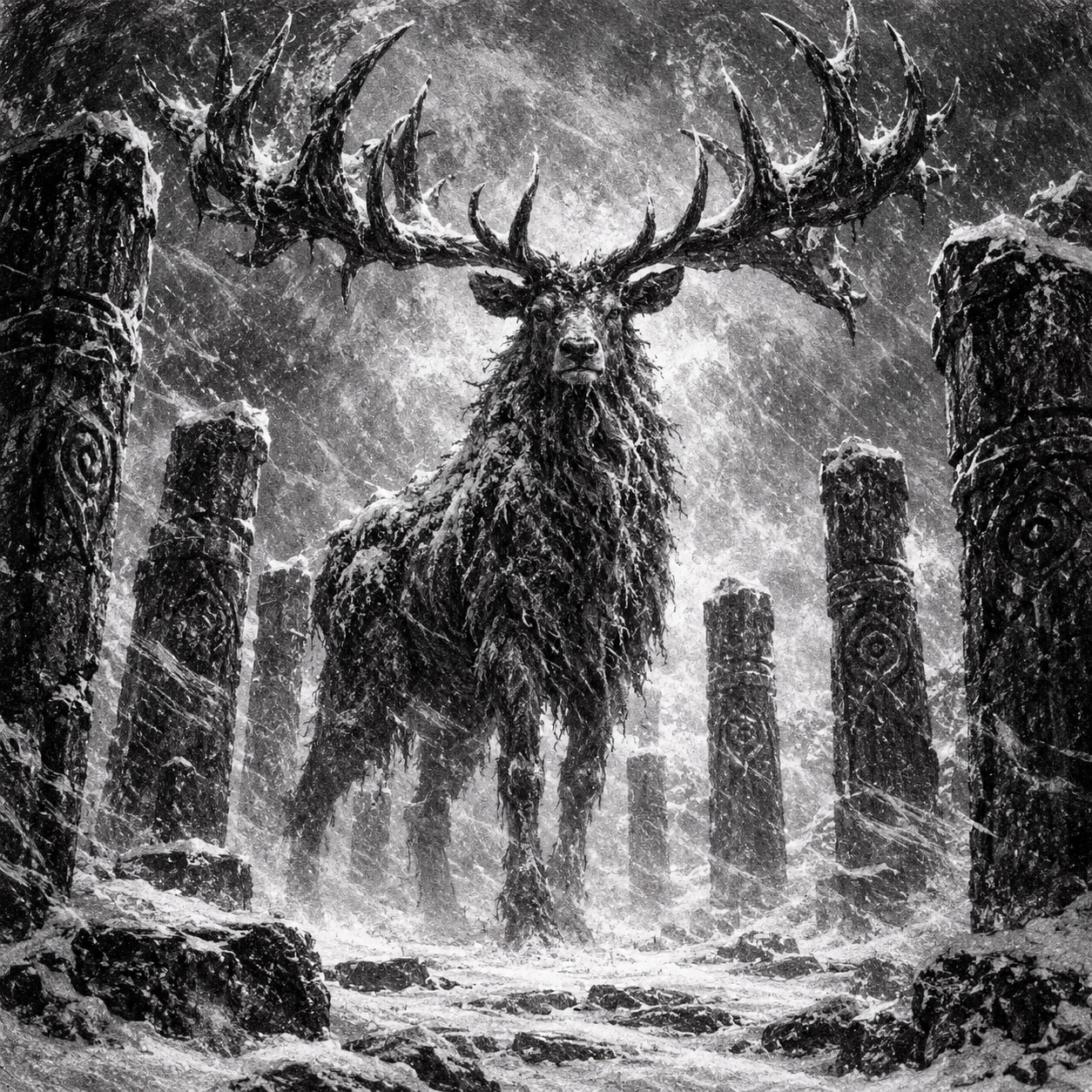
They pushed through the last of the trees and into pristine snow. No tracks. No scuff marks. Light flakes still fell, steady and quiet, softening edges and filling in whatever the wind had scratched across the surface. The forest felt sealed off here, as if the weather itself had been told to keep its distance.
Thelonius sent Owly up and out, a quick scout beneath the canopy but high enough to get the lay of the area.
From the air the shape of it was obvious. A large circular indentation cut into the snowy hillside. In the centre, a triangular gnomon of beautifully carved crystal, twenty feet tall, rising like a marker. Around it, the snow had melted away in a neat ring, exposing symbols carved into stone: phases of the moon. A moon dial, not a sundial.
On the eastern edge of the circle, a ten‑foot berm hugged the curve. Evergreens grew around and atop it, sheltering what looked like a granite sarcophagus buried under snow, enclosed by a half‑circle of pale blue crystal pillars. North of the berm sat a carved marble gazebo with an unlit stone brazier in the middle, its bowl full of snow and pine needles. South of the berm, six white marble statues stood on granite pillars in a line, all facing north. Slender robed figures. Faces worn away by the wind, but the pointed ears still gave them away. The plinths beneath them stood seven feet high, snow piled thick against the stone.
Below the circle, embedded in the hillside, a stone door sat sealed into the slope. No handles. No hinges. Just stone.
Owly came back down. He shook the snow from his feathers, an indignity the barn owl did not enjoy, then wormed his way back into the folds of Thelonius’ cloak. Not for the first time, Thelonius wondered why his familiar was a barn owl, built for quieter, temperate nights, not this endless winter and bone‑chilling snow. He didn’t dare say it out loud. Owly had a penchant for pecking when annoyed.
Miquitzil cast Light on Raine’s shield and they moved up for a closer look at the statues. Felwar drifted in to examine them properly. Raine stepped up to one and, before anyone could stop him, tried to push it over. The seven‑foot granite column beneath the statue was far too heavy, and the warrior’s boots did nothing but cut grooves through the snow as he strained against it.
Felwar snapped, “What are you doing? Let’s not destroy things until we know what we’re dealing with, eh?”
Raine stepped back, looking up at the robed statue again, already weighing whether it might shift if he pushed at the figure atop the pedestal instead.
Thelonius lingered a fraction behind. He said, loud enough for the others to hear, that coming here reminded him of the forbiddance they’d run into at the druid grove. His druid grove. The same kind of pressure in the air. The same sense of a place telling you to stay out.
They were still speculating, whether it was evil, whether it had been corrupted, when a voice spoke out of the cold.
“Don’t breathe so loud. It hurts the cold.”
Miquitzil sent his light toward it. The voice answered again, sharper now, more insistent.
“Heat. Warm ones. None are welcome here.”
Miquitzil and Thelonius, who were nearest the voice, peered into the low, snow‑laden branches of a nearby spruce.
A small shrub pushed out from beneath it and awkwardly stuttered toward Thelonius. It moved like something that had only recently worked out how legs were meant to function, roots uncoiling, twig‑thin limbs planting and slipping in the powder. Snow clung to it in little caps and cuffs. It was vaguely bipedal and about two feet tall, a thin trunk with a messy crown of branches that twitched and flexed like hands. Some of those branches bore hard red berries, bright against the white. It had no discernible head. No mouth. Yet the voice carried clearly, close and certain, as if the words were coming from the wood itself.
“Wrong sap,” it said, tapping at Thelonius’ boots. “But there is hope there.”
Near the statues, some twenty‑five feet away, Raine drew his blade.
“Not our wood to speak of hope,” said another shrub, emerging from beneath a neighbouring pine. “This is her wood. And that one”, it waved a branch at Thelonius, “is a liar.”
Thelonius looked to Miquitzil, who only shrugged.
Felwar stepped over, still ten feet away, not too close. Then he noticed a third shrub pushing through the drift from beneath another tree. “More trees,” he said, not alarmed but concerned. “Talking trees. They seem to like you, Thel,” he added.
Thelonius flashed Felwar a confused look. “I guess, yes, maybe. I don’t know.”
The first shrub tugged at Thelonius’ druid cloak, sharp and insistent. “You come, they go,” it commanded, then started walking toward the statues.
The shrubs didn’t like the others following. They kept insisting they leave.
Thelonius held his ground, unwilling to go anywhere just yet. Then he saw Miquitzil’s face, no fear, only curiosity.
Thelonius cast Message and whispered to Miquitzil, “I’ll play along for now. See what they want.”
Miquitzil whispered back, reminding him the chwinga had said this was meant to be a bad place. Thelonius understood the meaning: the shrubs weren’t to be trusted. He gave Miquitzil a quick wink as if to say, I’ve got this.
As Thelonius moved forward, putting a few paces between himself and the others, the world narrowed.
Not to darkness. Not to silence. To a voice.
It slid into his mind like it had always been there, waiting for him to step into the right patch of snow.
The wind carries strange stories… of a man who walks as wolf, who swims as the things of the deep. I see now they are true.
Thelonius froze mid‑step.
For a heartbeat he told himself it was his own thoughts. That the cold had finally cracked something loose again. That he’d gone mad. Again.
Then the voice returned, calm as a knife.
These gifts are not chance. They mark you for something greater. Do you even know why you were chosen?
“Hello?” Thelonius said aloud, turning his head as if the sound had come from a direction. “Who’s there?”
Miquitzil’s eyes snapped to him. Felwar shifted closer, cautious. Raine moved without thinking, setting his feet and scanning the trees with that hard soldier focus, already past the shrubs. Talking bushes were nothing. Something speaking inside a man’s skull was something else.
I am Ravisin. We met once before. Do you remember me?
Thelonius swallowed, throat suddenly dry. “Someone is talking to me,” he said, loud enough for them to hear. “In my head. She called herself Ravisin.”
Felwar’s tone sharpened. “What is she saying?”
Thelonius didn’t answer. Not because he wouldn’t. Because the voice kept coming, cutting in over everything.
Hush now. They do not need to know. Send them on their way. You stand between the wild and the town, between skin and skin. That path is not easy… but it can be powerful.
The words dug under his ribs. Found the sore spots. The parts of him he didn’t talk about.
Thelonius clenched his jaw. “I am happy with the path I am on,” he said out loud, forcing the words through his teeth. “Stop talking in my head.”
I can show you how to embrace what you are, instead of letting it gnaw at you. But the others, they don’t belong here.
“No,” Thelonius said, immediate. “They are my friends.”
They are not welcome here. If you are with them, you too must go.
Thelonius turned back to them, anger and uncertainty warring across his face. “She says you have to go,” he said. “And if I’m with you, then I do too.”
Raine’s voice came hard. “Tell her to come out. I want to see who’s talking to you.”
Thelonius looked from Raine to Miquitzil. Miquitzil had taken his left hand out of his pocket, that small, familiar tell‑tale sign that magic was ready to spill.
And then the shrubs reacted.
Two of them slipped back into the foliage so fast it was like the forest swallowed them. The one that had been tugging at Thelonius went dead still, branches drooping, suddenly nothing more than an ordinary shrub half‑buried in snow.
Thelonius took a chance. “How do you know me? Know so much of me? When did we meet?”
You were a coward then, Ravisin murmured inside his skull, almost fond. A frightened boy with new power in his hands and no idea what to do with it. You were testing your bear form with that ice hunter, breathing fire.
Thelonius swallowed. “I… I remember you. Outside Targos. In the shadows. You beckoned me.”
Yes. I wanted to take you under my wing. To teach you the ways of the Frost Druids. It is not too late.
Thelonius stammered, still trying to fit memory to meaning. “I thought you were the serial killer, that ice hunter.”
None of that matters now. You stand on the edge of becoming, Thelonius. Between skin and skin. Between the wild and the towns. That makes you dangerous — and it makes you rare.
There was a pause, long enough to feel deliberate.
Come with me. Become a Druid of Frost as I am. Leave the town‑dwellers. Walk from those who rail against the cold. Join me.
As an equal.
As something this land can trust.
We could be lovers, you and I. And together we will wake the wild again — more beasts, more teeth in the dark. Like the serpent of Maer Dualdon.
Realisation hit Thelonius like a thunderbolt. “It was you?” he said out loud. “You set that monster against Bremen!”
The other Brave Hearts couldn’t hear the voice in his head, only his words. They went taut at once, eyes sweeping the trees, weapons ready, expecting something to step out of the snow at any moment.
If Ravisin heard him, she ignored it.
Ten‑Towns is rot pressed into the snow. Always changing. Polluting. Destroying. Warm hands taking and taking and calling it survival. They spoil what should be clean. They don’t belong here.
Help me make them leave. It would please Her.
Thelonius’ voice came out hard. “Never. I will end this winter. With my friends here.”
The voice was gone. As suddenly as it had appeared.
Thelonius exhaled, only then realising he’d been holding his breath. “I think she’s gone. At least, I can’t sense her in there anymore.” He tapped a finger against his temple.
Raine nodded. Silence of any kind was often a precursor to violence, and he kept his eyes on the treeline. “Let’s explore,” he said. “But keep your wits about you. If this Ravisin is here, and I suspect she is, she will come at us fast.”
The others felt the hairs on their necks rise. Raine was more experienced in most things, and they’d learned to trust his instincts when he said a place felt wrong.
Felwar and Thelonius turned back to the statues. Up close, the workmanship was still there beneath the weathering: elegant lines, robed figures, the kind of carving that didn’t come from Ten‑Towns’ hands. Felwar brushed snow away and found wind‑worn Elvish runes, names in Elvish script that meant nothing to him. He tried to drag up anything useful about elves in the north, but it came in scraps — someone, somewhere, long ago, telling him they used to be here. Not now. Not openly. Icewind Dale had dwarves, Reghed tribes, goliaths. Elves weren’t spoken of. Once in a long while you might see one with a caravan, or working as a ranger or a guide, but there was no community to point to.
These statues were old though. Very old.
Raine turned to ask Miquitzil something and stopped. Whatever he was going to say died on his lips.
The awakened shrubs were moving again. And there were more of them.
Not the hesitant totter from before. This time they came in hard. Branches lifted like clubs or poised like spears, little wooden bodies hunching forward as they began to swarm.
Raine called out. The Brave Hearts sprang into action.
Thelonius uttered words of druidic magic, effortless now, and dropped a bonfire under the nearest shrub. It went up in a snap of heat and smoke, burning down to crisp black wood in seconds.
The shrubs came in fast, surprisingly quick given their awkwardness. Thelonius and Raine held the south, hacking and stamping through the snow while the little things darted for ankles and calves. Miquitzil and Felwar shifted north, Felwar angling toward the gazebo, Miquitzil moving to the base of the steps that led up the berm.
Something big crashed through the trees.
A massive moose exploded out of the treeline like it had been loosed from a bow, snow blasting up under its hooves, antlers down and driving straight at Miquitzil.
It was enormous, not just big but wrong for the world. Its coat was a dirty winter‑white, clumped with frost and old sleet, the hide stretched tight over heavy muscle. The antlers were a crown of violence, wide as a doorway, thick tines sharpened by impact and stained dark with dried blood. Looking at them, the smashed tree trunks they’d found in the forest hours ago suddenly made sense. The kind of force that could crack timber and leave a man dead up a tree.
Its breath came out in hard, steaming bursts. Its eyes held no animal fear, only blunt certainty, as if it had been set here to guard this place and break anything that dared step into it.
When it spoke, the words came out like frost on glass.
“You don’t belong here, warm blood.”
The charge should have folded him. Instead, Miquitzil snapped a word of magic and his Shield sprang into existence before him. The impact as the antlers crashed into the semi‑translucent barrier rang out across the clearing. The beast reared and its hooves came down hard, but they too bounced off Miquitzil’s magic. The shield flashed like cracked ice under the strain.
Nearby, another shrub lunged at Felwar and landed a hit. Another darted in behind Miquitzil, stabbing for the space behind the Ice Hunter’s knees, but Miquitzil sensed the attack and lifted a leg just in time. The little creature missed, overbalanced, and scrabbled in the snow.
Felwar disengaged and pushed further north, eyes on the gazebo, trying to see if anything was waiting there. He saw nothing. No movement. No figure. Just the marble floor and the snow and the pine‑needle‑filled brazier. He turned back then, attention snapping to the moose threatening Miquitzil.
Raine swung on the closest shrub and missed, blade hissing through empty air. He swore. “Hang in there, Miq, I’m coming!” he bellowed. Miquitzil didn’t dare look around. He just hoped Raine would hurry.
Thelonius dropped another bonfire onto the second shrub and caught it clean. It tried to stagger out of the flames and lash back at him, but its strike went wide.
The shrub at Miquitzil’s heels jabbed at his leg, twig‑spears scraping uselessly against his boot. It was clumsy and weak, barely registering. Miquitzil’s attention was locked on the huge moose trying to flatten him, impale him, or both.
The beast shifted its weight for another swipe, antlers dipping, hooves digging furrows into the snow.
Miquitzil cast again, a deep chant from the back of his throat, and this time he cast Web.
The air in front of him filled with pale, sticky strands that snapped into place in an instant, spreading across the snow and up into the low branches like a net. The moose was caught in the mass near the edge, scant feet from where Miquitzil stood. It tried to bull through on sheer strength, shaking violently, throwing its head, wrenching its legs, but every movement only dragged more of the webbing around it. Strands wrapped the antlers, bound the forelegs, and cinched tight across its chest. It thrashed and strained, but only trapped itself deeper.
For a moment, Miquitzil felt the pressure ease. Just a fraction. Just enough to breathe. He risked a glance to see where Raine was, then turned to deal with the nuisance at his feet — and saw the shrub explode into splinters as Felwar’s Eldritch Blast hit it clean. Bits of twig and berry sprayed across the snow.
Miquitzil flashed Felwar a quick nod of thanks, then turned back to the moose, watching it thrash against the webbing, antlers jerking and hooves tearing at the snow. The creature’s eyes were wide and it bellowed, angry and frustrated.
Then the weather turned violent.
Unseen by the Brave Hearts, a snow owl drifted down through the branches and circled once over the clearing. It dropped onto the rise without a sound, white feathers folding in tight — and then the shape changed. Feathers became hair. Wings became arms. A woman stood where the owl had been, wrapped in heavy furs, face pale in the stormlight, eyes hard and bright as ice.
Ravisin.
She didn’t shout. She didn’t threaten. She simply lifted a hand and spoke a few words in a cold, clipped tongue that didn’t sound like it belonged in a human mouth.
The sky answered.
Ice Storm crashed down into the clearing like a hammer. Hailstones the size of fists slammed into snow, stone, shield, and flesh. Shards of ice tore sideways on the wind, biting through cloaks and finding gaps in armour. The sound was relentless, a brutal pummelling, as if the whole clearing were being beaten into the ground.
Miquitzil and Thelonius felt the cold less than the others, but the hail still hit like thrown rocks. The pain came through the impact, blunt and concussive, hard enough to rattle teeth and bruise bone. Raine and Felwar took the full brunt of it, cold and trauma together, staggering under it as the storm battered them in place.
Miquitzil rode it out, forcing himself steady on his feet, while the rest of the Brave Hearts blinked through the white roar, trying to keep eyes on Ravisin up on the rise.
One of the remaining shrubs died in the blast, torn apart and flattened into the snow.
Then Ravisin was gone. A tight spiral of snow and frost snapped up around her — and when it fell away there was nothing but drifting ice and the pale rise beyond.
Raine saw it and snapped, “Gods damn it. Where did she go?” He needed to get in close to end the threat.
He tried to scramble onto the berm from the side, but his gloved hands found no purchase on iced stone. He slipped, swore, tried again, and finally a nearby companion boosted him up.
Then Thelonius leapt after him and landed as a large brown bear. A slab of fur and muscle, easily eight hundred pounds, paws scratching for purchase on the slick, snow‑covered rise. His breath steamed in thick bursts. The eyes, though, were not those of a brown bear — there was intelligence in them, focused and human, taking in the ledge, the distance, the threat.
He sniffed around the space where Ravisin had disappeared, trying to pick up her scent, trying to use the bear’s senses to drag her out of the snow.
From his spot atop the berm, wiping snow and ice from his eyes and swiping his long, wet hair back off his face, Felwar caught movement again on the rise.
“There!” he yelled, pointing her out to the others.
Ravisin’s mouth curled. She looked straight at Felwar and answered with Hold Person.
Felwar locked up, rigid and helpless, breath steaming in his throat. Ravisin moved in close and slashed him viciously with a sickle, then shifted into an owl and launched away, wings beating hard through the cold air.
Raine and Thelonius, bear‑form heavy on the rise, tracked the owl as it dipped out of sight beneath the level of the berm. Raine knew the danger of letting a spellcaster keep distance.
“Find her, Thel,” he said. “I’m going to help Miq.”
Raine charged across the rise, past the still‑frozen Felwar, and down to where Miquitzil had the moose trapped in the web.
The moose was still fighting the sticky strands, which were thinning at the edges now. Miquitzil held his ground and fired an arrow through the webbing. It punched into the creature’s shoulder and it lurched, shaking its head hard enough to snap frost from its coat.
Thelonius couldn’t catch Ravisin’s scent and he couldn’t see her, but he’d seen the direction the owl went. He ran to the western edge and looked down. He caught a last glimpse of pale wings slipping through a broken section of wall, into the dark space beyond.
He didn’t hesitate. Not for the moose. Not for the shrubs. Not for his paralysed companion. Trusting the others to hold the line, he launched himself down to follow. He thundered around the crystal gnomon and shoved his bulk through the opening.
He smelled them before he saw them: a trio of juvenile black bear cubs wedged in one corner, frozen stiff as the great head of a brown bear swung in. Across the chamber a pair of foxes backed away, ears flat, eyes wide. To the south, rabbits scattered in sudden panic, a half dozen at least, darting and skidding over stone.
No Ravisin.
Thelonius’ bear nose worked anyway, sweeping, searching. Nothing but animal fear and damp fur and cold stone. Three exits gaped out of the chamber, each one dark.
Do I follow, or go back?
The question hit him hard and fast. If he chased alone and she turned on him, he’d be cut off. If he went back, she might slip away to strike again.
He backed out.
Then he charged back toward the fight.
Raine was at Miquitzil’s side now, stabbing at the moose, trying his best not to sever the strands of web that were still holding the beast at bay.
Thelonius bounded back up onto the rise and saw Felwar was still trapped in Ravisin’s hold magic. He looked safe enough, the druid reasoned — helpless, but not about to be torn apart while the others were close.
So Thelonius did what he did best now. He called on one of his most powerful spells and dropped Moonbeam onto the moose. Radiant light poured down and scorched the beast, the air hissing as it burned. The webs held through it, no fire or flame to take them away.
Until they didn’t.
With one brutal surge the moose tore free and launched itself at Miquitzil. Miquitzil snapped his Shield up again and the antlers skidded aside on the invisible barrier, but the beast was too close now, too heavy. A hoof smashed into his shoulder and drove pain through him.
Atop the rise, Felwar finally shook off the hold.
With his arms freed now, able to slash instead of stab, Raine landed a magnificently aimed strike that carved a deep gash into the moose’s tree‑trunk neck muscle. Miquitzil followed with true strike and drove his spear in solidly.
But still the moose fought on, wild with rage.
Thelonius turned his bear bulk on another awakened shrub that seemed to appear out of nowhere, smashing it apart with bite and claw.
The moose turned on Raine, drove into him with a solid blow, and knocked the warrior off his feet. Raine hit the ground hard and the hooves came down after him, but he rolled, twisting through the snow, and the strikes found only cold earth.
Miquitzil backed away, leaving the warrior to tackle the moose alone. One hit from those antlers and he knew he would die. He moved around the side of the stairs, pushing into the darker edge of the clearing.
Thelonius heard Ravisin again in his head, faint, trying to get back into the cracks.
He shut her out, invoking his family — his mother, his father, his brother — using their names like stakes hammered into the earth. At the same time he adjusted his Moonbeam, dragging the blistering light back over the moose’s rear as it shifted away from the beam while it fought Raine.
Then he shouted his final reply out loud, hoping she could hear him wherever she’d gone. “But most of all I’m a Brave Heart, and betraying each other or the people of the Ten‑Towns is not how we roll.”
Her presence left him immediately.
The anger stayed behind, in the sudden silence.
For a handful of heartbeats there was no Ravisin at all. Just the moose, wounded and furious, and the churn of combat in the snow.
It came at Raine again and again, antlers sweeping like a battering ram, hooves hammering down with bone‑jarring force. Blows that would have folded a lesser man. Raine turned the worst aside with his shield, shoulders braced, boots sliding, taking inches when the beast tried to take yards. And every time the moose’s head swung wide, every time it reared or showed throat, Raine drove his sword in behind that wall of antler — quick cuts, short thrusts, ugly work. The moose was bleeding from a dozen wounds now, dark streaks running through its frost‑clumped coat.
Felwar hauled himself clear of the worst of it, misty stepped, fired — and missed.
Miquitzil stayed sharp, watching the edges for the druid, not trusting the quiet for a second.
Unseen, the owl swept out of the broken wall under the hill, low and fast, white wings beating hard through the cold air. It skimmed the clearing and rose onto the berm, and as it landed, the shape folded in on itself. Feathers became hair. Wings became arms. Ravisin stood there again, as if she’d simply stepped out of a doorway.
Thelonius pointed a paw and bellowed, “There!”
She didn’t posture. She didn’t talk.
Spike Growth rolled out across the ground, cruel druidic magic that turned snow‑covered stone into hidden teeth. It wasn’t obvious until you stepped wrong and felt it bite. The sleet vanished as the spell took hold, replaced by that awful certainty underfoot. Felwar and Thelonius stood caught in it, and they both knew the pain that moving would bring.
And then she misty stepped away again, always slipping, always refusing the fight on anyone else’s terms.
Thelonius cried out in fury as she vanished from sight. He started to move, then felt it underfoot. Thorns and snares hidden beneath the snow, waiting. One step in the wrong place and the ground would punish him for it.
So he held where he was, breathing hard, eyes sweeping the clearing, refusing to blunder into her trap.
Raine kept cutting the moose down. Thelonius dragged Moonbeam across it again, forcing it to stumble and bleed, great swathes of fur burning away in the radiant light. Miquitzil sang a deep note, knocked an arrow, and fired. He put it into the moose and ended it with a clean, brutal shot, the arrow entering one of its large brown eyes.
Panting, Raine looked over his shoulder and gave a wordless nod of thanks.
Somewhere in the white, Ravisin caught Raine with Hold Person. He locked mid‑stride, blade still in hand, fury on his face and his body refusing to obey.
The Brave Hearts scanned the area, desperate now. Felwar yelled, “Where the hell is she?” though the question was already on all of their minds.
Miquitzil slid around and stood beside the dead moose, scanning. And he saw her — a shape tucked behind a tree, almost lost in snow and bark. “There!” He pointed. “She’s behind that tree.”
Miquitzil drove magic missiles into her, forcing her back, stumbling in the snow.
Thelonius shifted the Moonbeam over her position, burning her where she stood.
Her scream hit Thelonius inside the skull, raw and furious.
We could have been lovers.
Felwar misty stepped again, flanked, and dropped his killing spell onto her — a churning cloud like hornets, all buzz and teeth. He moved it with her, kept it on her, cut off the angles and the exits.
Another volley of magic missiles thudded into her.
Ravisin threw back her head and howled, a wolf‑like bellow that carried across the clearing and chilled the Brave Hearts to the bone. She tried to answer with more cold‑laced magic, tried to buy the time she needed to change shape and slip away again, but she didn’t get it.
Felwar dragged that buzzing cloud straight over her and held it there.
Ravisin tried to shift again — tried to slip away — but Felwar dragged the cloud of hornets straight over her and held it there. The swarm hit her face and throat, and she clawed at herself like she could tear it off. Her scream turned into a choke as the buzzing filled her mouth. Blood sprayed into the snow in hot bursts, then steamed in the air. She staggered one step, blind and flailing, and then her knees went. She collapsed hard, still clutching at her face, the spell chewing until there was nothing left in her but shuddering breath — and then that stopped too.
But the forest had answered her call.
Wolves came in from the trees, fast and silent. They hit Miquitzil first. He snapped Shield up again, turning one bite aside, but another wolf caught him hard and knocked him prone. Jaws went for his throat. He jammed his staff up between them and held it there, straining, keeping teeth off flesh by inches.
Raine was free of the paralysing magic now, and he charged them down. Miquitzil scrambled to his feet, took a defensive stance, and held his ground. He didn’t need to kill the wolves — just keep them occupied while the others did what had to be done.
Thelonius ran in and cracked starry wisp into the first wolf, striking it clean. Felwar fired his eldritch seeds, but he lost his footing as he cast and the burst flew high, slamming into a tree and sending a shower of snow down over the fight.
Raine didn’t hold back. He dropped the first wolf with a solid hit, then turned and finished the second moments later, head all but severed at the shoulder.
When the last body hit the snow, the clearing went quiet again — not peaceful, not yet — but quieter than it had been.
Thelonius and Raine were wounded too, but they weren’t prepared to rest. Despite calls to come rejoin at the gazebo, they moved off the rise, around the gnomon, and into the space beyond.
The black bear cubs tumbled over themselves as Thelonius ambled in, his brown bear head lolling as he tried to look harmless. He rumbled and tried to calm them, but they were too terrified to listen. The rabbits had bolted. The foxes were nowhere to be seen.
Raine ignored the cubs. They were no threat to him. He raised his shield and lit the chamber fully.
Three ways out.
Two corridors ended at stone doors — no hinges, no handles, nothing obvious to grip or force. The third passage ended at a mirror, nine feet high and half as wide, set into the wall with a stone border etched in what Raine took for Elven runes.
“Hmm,” he muttered, sheathing his sword. “We’ll need Miq for this.”
He headed back the way he’d come and called for Thel to follow. “Come on. We’ll rest with the others, then search more thoroughly.”
In the middle of the gazebo sat an unlit stone brazier, its bowl only twenty inches across, full of snow and pine needles swept in by the wind. Miquitzil leaned in close and felt it, not heat, not exactly, but a low hum in his core that made the hair rise on the back of his neck. The weave was tangled through it, quiet but present, like a wire under tension.
Miquitzil and Felwar traded theories about what the brazier was for a while, back at the engraved moon dial, the others examined the gnomon. They pushed, pulled, and strained, testing it from different angles. It didn’t move. But they noticed an odd detail: the stone around it felt warmer than it had any right to be.
Deciding they might need Felwar and Miquitzil’s help, they rejoined the others and spent a good hour bandaging wounds and recovering strength.
An hour or two later, with wounds bound and heads clearer, they went back over the ground properly.
Felwar and Miquitzil moved through the chamber beyond the moon dial and began picking at the Elvish work that had been half‑hidden by drift and shadow. Between them they found enough of the inscriptions to turn the place from mystery into instruction.
In the middle tunnel, the frame around the mirror read: “Gaze upon your own face and have your questions answered.”
Back at the dial itself, at the three o’clock and nine o’clock positions, another line was carved into the stone: “Unlock the tombs of the half-moon.”
It finally made a kind of sense. Felwar voiced what they were all thinking: moonlight. If the dial wanted moonlight to function, then a Moonbeam spell might stand in for the real thing.
They worked around the clearing again, careful now, checking what they’d ignored while fighting for their lives. Thelonius picked up Ravisin’s sickle at one point, felt the weight of it and the memory of what it had done, then tossed it aside like it was filth.
Miquitzil returned to the gazebo and did a proper arcana read on the brazier. That low hum wasn’t random. The weave was threaded through it with purpose, and when he followed the thread in his mind, he realised it wasn’t a single piece. The brazier and the sarcophagus up on the rise were linked — parts of the same working, built to be used together.
So they climbed up to the sarcophagus and the crystal pillars around it, clearing snow as they went. Near the top of each pale blue pillar was a carving: a twig, a pinecone, a flame, a feather, and a humanoid hand. A sequence. A lock with five teeth.
The first four were simple enough. They gathered what they could — a twig, a pinecone, a feather — and lit a flame in the brazier. The last symbol demanded what it demanded. Raine did it without ceremony. Ravisin’s hand went into the bowl.
They lit the brazier.
Then they went back to the sarcophagus.
At first it looked unchanged. Then Raine tried the lid again and this time it shifted. The seal broke with a dry grind of stone. A stale, ancient smell rolled out: dust, old cloth, and the sour breath of something shut away for centuries.
The lid opened like a box.
Inside, an ancient figure sat up, wrapped like a mummy, eyes opening on a world that no longer belonged to him.
Felwar spoke in Elvish. “Who are you? What is this place?”
“The seal has been broken,” the figure rasped. “Then you have paid the price.”
“The price for what?” Felwar asked.
“My service,” it said. “My name is Sahnar, and I have been brought back here to serve you, to aid the righteous with whatever noble task is needed.”
Sahnar asked the Brave Hearts what year he had been laid to rest. When they told him the current year, the answer hit like a hammer. Sahnar informed them he had been dead for over six hundred years.
They spoke then of Auril’s curse — the endless winter, and the plight of the people of the Ten‑Towns. Of the towns Sahnar knew nothing, but he swore to help them in their quest as long as his bones allowed.
Sahnar looked past them, past the snow and the stone, as if he could still see the place the way it had been.
“When I lived,” he said in Elvish, Felwar and Miquitzil translating, voice dry as old cloth, “the elves of the moon came here to worship Sehanine Moonbow. This was not built as a trap. It was a holy place, a sanctuary. A place to mark the turning of the sky and lay honoured dead to rest beneath her light. Pilgrims came in secret when the world was kinder. They prayed. They watched the moon. They left offerings. Then they went back into the forest and kept their lives hidden.”
Raine didn’t bite. He wasn’t here for history.
“How do we use the mirror,” he said, “and how do we get those doors open?”
Sahnar nodded, as if that was the only sensible question. He spoke then of the dial, of moonlight, of the tombs — and gave them two names tied to the place, names that still meant something to him even if the world had forgotten them. The half‑moon doors would not open without the right light cast on the right symbol. The place had rules. It had always had rules.
Felwar and Miquitzil said at once, “Thel, cast your moonbeam.” But the druid was already casting. Thelonius summoned Moonbeam and moved it across the dial until the shadow fell where it needed to fall.
One of the half‑moon doors yielded.
Inside the first was another sarcophagus. Felwar slid the heavy stone and the lid grated aside, stale air rolling out. Nestled within, at the foot of a desiccated elven body, wrapped and laid with care, were three items that had no business surviving this long without rot or rust: an unstrung pale‑wood bow, a simple wooden cup engraved with a winged fish, and six silvered arrowheads laid in a neat line, each one catching what little light there was.
Sahnar watched them take it in, his patience absolute. Then he spoke in Elvish and Felwar and Miquitzil translated as he went.
“The bow belonged to one who hunted by moonlight,” Sahnar said. “He carried it unstrung when he travelled, so the forest did not hear him coming.”
He nodded toward the cup. “That one was a pilgrim’s cup. A small thing but made with care. A reminder that water should be respected, not taken for granted.”
His eyes moved to the arrowheads. “And those… those were gravebright points. For the dead that don’t stay dead. For the things that wear another skin.”
Felwar’s expression tightened. He remembered the dwarven cairn. The axe. The way a simple theft could turn into a curse that followed you home.
“We shouldn’t take anything,” he warned. “Not from tombs.”
Sahnar turned his head slowly to Felwar, eyes old and steady.
“If your intent is righteous,” he said, “no ill will will befall you here. These were laid for the living to use, if the living came in need. This place was built for the moon’s mercy, not for spite.”
That settled it or settled it enough. They gathered the items carefully and moved on.
They shifted the Moonbeam to the other mark. The second door opened — and two awakened shrubs burst out in the same breath, trying to take advantage of the moment.
They didn’t get far.
Thelonius dropped bonfire onto one, Miquitzil put an arrow through the other, and Felwar finished the work with his deadly seeds. The shrubs were dispatched before Raine could even close the distance.
This tomb was different. Not undisturbed. Not honoured.
It was clear Ravisin had been using it. The broken branches of dead shrubs were decorated with curious baubles and trinkets, little scraps and trophies hung like ornaments. Companions, in her own twisted way. An herbalism kit was spread across the top of the sarcophagus as if it were a worktable, the tools laid out with casual familiarity.
Raine and Thelonius shifted the lid. It was heavy, a slab of stone that fought them, and when it finally moved the tomb filled with a horrible stench of decay.
Inside lay the rotting corpse of a human female.
Sahnar’s posture changed the moment he saw it — tight, offended. This was not the elf he had expected to find. To the others, the face within the stone box looked like Ravisin. A sister, or a twin.
The cold had slowed the rot but not stopped it. Months dead, left here like refuse in a place that had been built for reverence. Raine fished around quickly anyway, more out of habit than hope, but there was no treasure to be had here. He slammed the lid shut.
Sahnar spoke in Elvish, the words clipped with anger, and Felwar and Miquitzil translated as best they could.
“This tomb was consecrated,” Sahnar said. “It was meant for one of Sehanine’s faithful, for a moon‑keeper whose name should have been spoken with honour. To use it as a den, to leave the dead like this… it is desecration.” He stared down into the stone box a moment longer. “I wonder where the bones of my brethren are now.” His voice trailed off.
Then his eyes lifted, as if he could see through stone and snow to the one who’d done it.
“May the one who did this find the end they have earned,” he said.
Once Felwar translated, Raine slapped the lid and smiled broadly. “Rest assured. We killed her already. She paid a price for that — and I fear a great many other evils.”
Sahnar could not smile, not really. He lacked the flesh for it. But Raine sensed the undead elf was pleased, nevertheless.
They went back to the middle tunnel.
The mirror waited at the end of the tunnel, nine feet high and half as wide, set into the wall with a stone border etched in Elvish. Felwar and Miquitzil leaned in close, reading the inscription again. The words seemed to shine in the glow of Miquitzil’s magical light as they translated for the others.
“Gaze upon your own face and have your questions answered.”
For a moment nobody stepped forward. Not because they didn’t believe it. Because everyone understood what a thing like that could cost. An answer is never just information. Sometimes it changes what you do next.
Finally, Thelonius stepped out, raised a hand, and cast Moonbeam, targeting the gnomon. Pale light washed down the passage and touched the mirror’s surface.
The glass took it like water. The reflection sharpened. Deepened. The mirror stopped being a mirror and became something that looked back.
Raine stepped up first.
He didn’t dress the question up. He didn’t waste words. His voice came out rough anyway.
“My youngest daughter. Where is she?”
The mirror held his face for a heartbeat, then answered with certainty, each line landing like a nail.
“SHE IS NOT WHERE YOU LEFT HER.
SHE IS NOT WHERE YOU WOULD LOOK.
SHE IS NOT IN THE HANDS THAT TOOK HER.
SHE WAS TAKEN — TRADED.
THE BARGAIN WAS MADE IN HUNGER.
THE ONE WHO PAID DID NOT PAY WITH COIN.
YOU WILL FIND HER IN BALDUR’S GATE.”
Raine stood there a moment longer than he needed to, like he was trying to force himself to accept the shape of the answer. Then he stepped back, breathing hard through his nose, and gave the others room.
Miquitzil moved in next. He didn’t hurry. He just stepped into the moonlight and looked at himself in the glass, as if he half‑expected to see something else staring back.
“The shard,” he said. “The ice in me. Is it linked to Auril’s never‑ending winter?”
The mirror answered cleanly.
“THE SHARD IS FROM YTHRYN, THE ANCIENT NETHERESE CITY, AND IS ALTOGETHER UNRELATED TO AURIL’S NEVER‑ENDING RIME.”
Miquitzil stood there a moment longer, staring at his own face in the glass as the words settled.
He hadn’t realised how much of that guilt he’d been carrying until the mirror cut it free. The shard in his ribs wasn’t Auril. It wasn’t the endless winter. It wasn’t the curse that had strangled the sea, kept the whales from returning, and left his people hungry. All those years of wondering, of half‑believing the shaman’s poison, fell away in one breath.
He exhaled slowly. His shoulders dropped. He felt lighter, as if something he’d been bracing against had finally let go.
Then the second part of the answer caught up with him.
“Ythryn,” he said, quiet. The word felt old in his mouth. “Netherese.”
His eyes sharpened. He could speak Loross. The language of the Netherese. It wasn’t a coincidence — not anymore. It made a brutal kind of sense now, the way his shard had always felt wrong, alien, too old for the world.
Miquitzil stepped back from the mirror and gave the others space, but his mind was already moving — away from guilt, toward the name he’d just been handed.
Thelonius stepped forward after that. He looked tired in a way that wasn’t just wounds. He asked anyway.
“My brother. Brince. How can I save him? How do I free him from Levistus?”
The mirror didn’t soften the truth.
“LEVISTUS OWNS THE CONTRACT THAT BINDS YOUR BROTHER. THAT SIDE OF THE TRADE IS COMPLETE. THE PACT WILL NOT BREAK — BUT IT CAN BE TRADED. ALL THAT REMAINS NOW IS THE PAYMENT.”
The answer sat between them in the cold air. Not a refusal. Not hope either. A path, but an ugly one. Thelonius rocked back, then turned away, hiding his face from the others. He didn’t know what to make of the words — only that his brother seemed truly lost.
Felwar was last.
He hovered for a moment, then stepped into the light and faced his own reflection like he was daring it to speak. He smoothed his hair, suddenly and foolishly conscious of how dirty his face was.
“Who is my true father?”
For a second the mirror seemed to catch, the surface wavering as if the answer was there, just out of reach.
Then the silver of the mirror frosted over, the reflection dulling and whitening as if ice were forming from the inside. A gold hue spread out from the centre, pushing the frost back in a slow, deliberate wave.
Miquitzil tensed. It wasn’t what had happened before. Not the same calm certainty. Not the same cold answers.
When the surface turned fully gold it flared — bright, brilliant, sudden. The Brave Hearts covered their eyes or turned away on instinct. Even Sahnar averted his dead gaze.
When they looked back, the light was gone.
And so was Felwar.