Session 25
Not The Same Thing
Moments after Nildar vanished, Thelonius lifted his voice and hurled it down the stone throat of the outpost, hoping the duergar could still hear him somewhere in the dark.
“Deep Duerra is under Asmodeus’ control! Xardarok is being fooled—lied to. Your kind don’t belong up here in the cold—answer me!”
He hoped Nildar would pause. Come back. Surrender, even. But there was no reply. He called out again and again, each time more desperate. Nildar didn’t return.
Still in giant spider form, Thelonius skittered low and quick, a black speck against grey stone, hunting for anything the duergar might have disturbed in his rush. Felwar watched him for a beat, then looked past him.
Felwar guessed Nildar wouldn’t show his face again, no matter what Thelonius shouted. The Brave Hearts had just killed his brother and shattered whatever Nildar had been running in this place. More likely he would slip away and make for Xardarok’s side—wherever the hell that was.
Nildar would have to report the truth of it: the outpost lost, the operation compromised, the chardalyn and plans exposed. That alone would be bad enough. But Felwar doubted Nildar would ever repeat Thelonius’ claim that Xardarok was being fooled, even if there were the faintest chance it was true. More likely, Nildar would decide the humans were lying and bury the accusation as one more insult rather than carry it back as a warning. Duergar didn’t seem an overly forgiving, empathetic, or understanding race.
Thelonius called for Nildar a few more minutes before Felwar cut in, a sudden, alarming thought arriving unbidden.
“The dogs,” he yelled, loud enough for the others. “If Nildar fled through the frozen well and made to leave the valley—they could be in danger. If Nildar kills our dogs…” He let the thought hang.
They moved.
Outside, the cold had a sharpness to it, a brittle edge that made breath feel like broken glass in the lungs. Felwar checked the culvert and the drifted approaches, searching for the simple honesty of tracks—and found none. But on the wind he heard the dogs barking. Faint, but unmistakable.
“Come on! The dogs are barking.”
The others heard it too now, and they set off the way they’d come—along the northern edge of the valley, behind the bunker—any pretence of stealth abandoned.
Thelonius moved in without thinking. Quieting the sled dogs had become his job—not by effort, but by instinct. Since taking up the druid’s path he’d slipped into their pack like he belonged there, a bond formed in days that felt older than that. They read him the way animals read weather—something steady, something natural, something safe.
He stepped into their space, ready for the usual greeting—wagging tails, wet noses, that eager push for attention.
And forgot, in his hurry, that he was a giant spider.
Instead of affection he got pure alarm. The lead dog recoiled so hard the harness bit, then the whole team went off together—barking, snapping at the air, teeth flashing, bodies straining as if they could back themselves out of their own skins. Not aggression, not really—fear made loud.
Raine shook his head, grabbed Thelonius by the scruff—as much as you can grab a spider the size of a pony—and pushed him aside.
Then Raine crouched in, hands calm, voice low, and did the simple work of settling them—palm to shoulder, fingers under a chin, steady contact until the barking broke into uneasy huffs and the pack remembered itself.
Only once they were down from the ledge did Felwar pull out his stinking tin and offer the lead dog half a fish. It vanished in one gulp, and the spell rode the meat the way it always did. Felwar’s brow furrowed as the dog’s meaning came through in blunt, practical shapes.
Something had been at the sled. Rummaging. Nosing through straps and packs. And the dogs had driven it off.
Invisible.
Nildar.
Felwar checked the lashings. One corner had been worked loose, but nothing obvious was missing. He squinted into the dark through the snow and felt the futility of it—a few minutes’ head start, a storm to cover tracks, and a duergar who knew how to vanish.
“Nildar was here. I’m fairly sure of it,” he said. “He’s got a few minutes on us, but I doubt we’ll find him in this bloody storm. Come on. Let’s get the dogs inside and plan our next steps.”
They moved down the middle of the valley beside the frozen stream, the dogs hauling the sled without strain, until they were all inside the outpost and the great stone doors were closed.
Thelonius checked the frozen well—clinging to the stone, peering into the hard‑white throat—and found no sign of passage. No scraped rim. No snapped ice. No disturbed frost. No blood.
“Maybe there’s another way out,” he said finally, legs skittering on the stone.
The giant spider moved north, down a passage they hadn’t explored. “A door,” he called back to the others. He pawed at the latch, legs scrabbling on iron, but it might as well have been a puzzle made for hands.
“God damn it,” he snapped. “Raine—get over here. Open this bloody thing.”
The door opened easily. Unlocked. Good.
They entered a long lookout room, but the arrow slits made it feel exposed. On a clear day you could watch the whole valley from here. Tonight there was nothing to see—just pitch black beyond the stone, the storm swallowing what little light the sky could spare. Snow hissed through the slits in thin flurries, dusting the stone floor in pale streaks. The room was chill enough that breath showed immediately, and every surface had that faint, greasy sheen cold stone gets when it never properly dries.
They were still battered and bruised from the earlier fight, but they had to keep searching. Maybe there were more duergar hiding somewhere. Maybe Nildar had circled back. Maybe he was still here, listening.
Thelonius scampered up the wall, then across the ceiling to the far side, where a stair led down. Raine moved in next, Miquitzil’s light still clinging to his shield like a stubborn ember. Felwar stayed in the doorway, eyes on angles, listening for the scrape of boots on stone. Miquitzil hung further back, still wary of the duergar’s ranged fire.
Then they heard it.
Footsteps—from the stairwell beyond.
Not running. Not panicked. Measured. Coming up.
Raine froze, then backed out fast. He set himself in the doorway they’d just entered—shield up, Felwar tight at his side, Miquitzil behind them. Across the room, tucked hard against the stone near the stairs, the giant spider that was Thelonius went still, eight eyes locked on the dark, waiting for the first shape to show itself.
A bolt snapped through the opening a heartbeat later, meant for Raine’s face. It chipped stone instead.
A duergar emerged in the stairwell and fired again, then drew back into cover, using the narrow space like it had been built for him. Thelonius tried words again, as if truth could do what steel couldn’t.
“Asmodeus is pretending to be Deep Duerra,” he called. “He’s lying to Xardarok.”
The words died in the cold air. No pause. No answer. Just the sharp, infuriating sense that none of the bastards wanted to listen. Then, finally, an answer—not the one he’d hoped for—a second crossbow bolt, thankfully wide. He skittered back into the top‑right corner, his hairy bulk filling and overflowing the space.
Miquitzil kept the light on Raine’s shield, making sure the duergar couldn’t hide in darkness and pretend they were ghosts. But he kept glancing over his shoulder at the ink‑black space behind them—just the soft shifting of the goats—and inched forward, desperate not to be left alone in it. He had only a few spells left, and he needed them to count.
Raine was sick of it. He wasn’t going to stand there while the bastard dwarves took pot‑shots from cover. He charged across the room for the stairs, Thelonius and Felwar close behind.
At the bottom was an armoury—racks and steel and dwarf‑made order—but none of that mattered. In the southern doorway his light caught them cleanly: two armoured duergar with crossbows, set and waiting. It’s what he would’ve done.
Raine went anyway, shield thrust out as far as he dared, cutting down their angles as he closed. He prayed they wouldn’t shoot low—his legs were the only part he couldn’t hide behind the shield—and, for once, luck held. One bolt slammed into his shield and buried itself, the shaft quivering. The other glanced off, spun end‑over‑end, and clacked harmlessly into Thelonius’ chitin.
The giant spider squealed and recoiled on instinct, but the shot hadn’t bitten.
Felwar ran in Raine’s wake and fired. His Eldritch Blast—a tiny, charged seed—streaked out and burst against stone, flaring force and light as it went wide.
Miquitzil followed behind and readied True Strike, jaw clenched, as if he could will the next hit into existence.
The fight turned ugly fast.
One of the duergar enlarged, swelling into the room until it seemed to bully the air aside, towering over Raine and hemming him in between two foes. Behind the giant, the open trapdoor gaped in the floor—a black square of nothingness with a ladder dropping into it, the shaft below swallowing light and sound.
Thelonius—still a giant spider—hugged the wall and slipped around, angling for the smaller duergar’s neck. He struck, fangs snapping down hard—and hit iron. The points skated off the duergar’s helmet with a jolt that ran up through his skull. Pain, sharp and stupid, and the sudden realisation he’d misjudged the angle.
The duergar didn’t waste the opening. He dropped the crossbow and, in one fluid motion, brought his heavy‑headed war pick around in a sideways arc, shoulders and forearms locked as the point slammed into the spider’s head. Not panic. Not luck. Experience.
Thelonius slid from the wall and hit the stone, eight legs curling in as the world went thin and distant. His body shifted, the spider form sloughing away, and Thelonius lay there—unconscious or worse—blood running freely from a deep wound at his hairline.
Felwar didn’t hesitate. A clipped word—Healing Word—and the room filled with the faint scent of a spring glade, pollen and crushed flowers. Thelonius dragged breath back in. His eyes flickered open.
A duergar loomed over him.
Panic surged—a raw, animal urge to scream—but all he managed was a harsh exhale as the dark dwarf turned away, already refocusing on Raine.
Raine wasn’t paying attention to the bouquet in the air. He was toe‑to‑toe with two seasoned warriors—one nine feet tall, the other well‑armoured and hard‑eyed with experience. He answered in the only way he knew how: with violence sharp enough to make their confidence flicker. Two critical hits in a row—not lucky swings, not showy, just clean work done with a grim kind of focus.
Thelonius hauled himself upright against the wall, not entirely sure what had happened. One moment he’d been a spider—the next he was on two unsteady legs, the room pitching and rolling around him. He saw the duergar closing on Raine and, on reflex, snapped a Starry Wisp onto the smaller one—a faint, stinging light that clung to its armour and skin.
At least this one couldn’t vanish into invisibility the way Nildar had.
Felwar adjusted, sighted, and sent magic‑laden seeds into the smaller duergar’s back. It was already bleeding from several savage slashes of Raine’s sword. The dark dwarf crumpled like a cut marionette.
Miquitzil, despite True Strike, kept missing. One twist of fate after another, each one souring in the air. He was running desperately low on what arcane power he had left, and falling back on the bow felt like defeat. The bow punished him for it—shots loosed too quickly, breath not settled, the string biting his fingers as the arrows went wide.
And then the enlarged duergar made a choice that wasn’t brave, just clever.
He grabbed Raine, took a long step, and bodily threw him down the open shaft.
It was sudden. Raine tumbled down, head over heels, bouncing off the ladder rungs on the way—each impact a sharp, punishing jolt—before the hard final hit as he struck the cold stone floor many feet below.
He forced his head clear. The duergar would follow—he knew it. Grim relief, then, to find sword and shield still in hand—and, blessedly, Miquitzil’s light still clinging to the shield.
He looked up.
The enlarged duergar was already climbing into the shaft, shoulders scraping stone. As it descended it hauled the trapdoor down after it and the hatch slammed shut, cutting off the room above.
Then came the sound that made it real.
Metal on metal—the bolt driven home.
In the harsh spill of Raine’s shield‑light, the duergar’s twisted face appeared for a heartbeat through the narrowing gap, promising death without a word—and then it started down the ladder, one rung at a time.
Raine had already scrambled back into the ten‑foot tunnel. He let the duergar come. He let it bring its size into a space that didn’t want it.
Above, Thelonius and Miquitzil threw themselves at the hatch, trying to force it, then stopped when they heard the bolt slide into place. Felwar took off, sprinting, boots hammering, taking the long way round, lungs burning as he chased the idea that there had to be another way into the bunker.
“Stand back, Miq,” Thelonius commanded, and cast Create Bonfire. Flame flared into existence atop the hatch and the wood caught at once in the unnatural heat.
Miquitzil fed it with Control Flames, forcing the heat into the seams. Smoke billowed up in dirty clouds as the cold wood began to burn, the chamber filling with the bitter sting of scorched resin.
Below, the enlarged duergar stepped into the tunnel and discovered the problem immediately. He couldn’t swing properly. He couldn’t turn. The stone stole his reach and made his bulk a mistake.
Raine kept his shield high, blade tight, and worked him like a man who’d done this before. Not heroics. Not speeches. Pressure. Angles. The dull grind of survival.
The duergar tried to muscle him back. It shoved, it crowded, it snarled in Duergan curses. Raine gave ground a half‑step, then slid sideways, keeping the shield between them, forcing the war pick to scrape stone instead of finding flesh.
It wasn’t pretty. It was heavy work.
Then the duergar overcommitted—a shove, a swing, trying to end it with weight alone.
Raine dropped low and surged forward, sliding in under the duergar’s centre of mass, using the creature’s own bulk against it. The tunnel stole the duergar’s ability to twist or shift. It couldn’t turn. It couldn’t get the weapon down in time.
Raine drove his blade up and in, hard, through the groin where armour failed and pride didn’t matter.
Blood came out hot and sudden. Worse than blood. It poured over Raine’s sweat‑matted hair and down his face as the duergar staggered, then folded, collapsing with a wet, final heaviness into the tunnel.
Raine shoved and wriggled free, breathing hard, the shield‑light shaking with each ragged breath.
Above, the hatch finally gave.
With a crack and a roar, burning timber dropped down the shaft. Planks hit stone and broke apart in a shower of embers, smoke pouring after them.
Raine coughed, shield up, and crawled clear of the falling debris as it clattered and hissed ahead of him, the air tasting of fire, smoke, and relief.
Thelonius and Miquitzil called down, and Raine signalled back that he was alive—the battle was over. Miquitzil killed the fire with a sharp word and a flick of his fingers.
They climbed down to him, boots scraping on rungs, and once they were together, they followed the tunnel for eighty feet or so until it opened into another ladder shaft. Looking up, they saw an open hatch.
They climbed without ceremony, all pretence at stealth abandoned. If anything above hadn’t heard the fight, it would see the glow soon enough.
They emerged into the bunker, Raine’s shield—still sporting a crossbow bolt—entering first.
Empty.
Snow and wind knifed through the arrow slits in sharp flurries, and the place smelled of cold stone and old smoke. A small heating oven gave off heat but no light—a sullen little pocket of warmth that could never win against the weather. Beside it lay bundled wood and a scattering of food and drink supplies, a curious mix of human and duergar fare.
Felwar—now outside the bunker—saw the light appear behind the slits and called out. They answered, voices hoarse, and agreed to meet back inside at the front doors.
They were tired. Battered. Running on what was left.
For now, Nildar’s outpost was theirs—whatever threats remained had been killed or slipped away into the storm. All that was left was the search, the rest they’d earned the hard way, and the question of what came next.
The next three hours were spent resting and turning the place over—room by room, shelf by shelf, prising open chests and checking the fallen for anything of value.
Hidden in the hollowed‑out bedpost of Nildar’s bed, they found a map to what could only be Xardarok’s fortress. Deep in the Spine of the World, an X marked the location as clear as day, along with the safest place to cross the vast Redwaters River. The writing was in Duergan—any real use of it would require translation.
They also found manifests and reports—ordered paperwork that suggested someone methodical, likely the mushroom‑specialist they’d killed. Progress updates, charts, tables, diagrams, pages of tight script. Without the language, it was all locked behind ink.
Felwar reminded them that the dwarf who ran Frozenfar Expeditions out of Caer‑Konig could speak and read Duergan. If they wanted answers, heading there was an option.
In storage they found more stolen items—mostly the sort of things that looked like they’d come from Caer‑Konig, but there were pieces that could have been from elsewhere too. Easthaven. Caer‑Dineval, even. It would take far too long to catalogue it all, and they didn’t have the time. They’d tell someone when they could, and hope it was still there when help arrived.
There were foodstuffs as well. Some of it was clearly duergar fare from the Underdark, sealed and pungent, and they left that alone. But there was also salted fish, hardtack, dried legumes, and sacks of grain—non‑perishables that kept bodies moving in bad weather.
They decided to take what they could to the Black Cabin. If Copper Knobberknocker was right, Macreadus would be desperate for it.
Miquitzil frowned as they sorted the supplies, fingers stiff with cold. “Remind me—Macreadus. Who is he again?”
Felwar didn’t look up from the straps he was tightening. “Copper’s friend,” he said. “The gnome.”
Miquitzil waited.
Felwar exhaled—not annoyed, just worn thin—and finally gave it properly. “Copper Knobberknocker. The rock gnome tinkerer who lives up in the attic of the House of the Morninglord in Bryn Shander—where my dad was hassling Priestess Mishann, remember? Copper was the one in the teddy onesie.”
He jerked his chin toward the sled. “He told us about Macreadus. Another gnome—a sage, a tinkerer—and a devout follower of Lathander, the god of dawn and rebirth.”
“Right,” Miquitzil said, like the name was only now finding its place.
“This Macreadus thinks he can end Auril’s winter,” Felwar went on. “He’s holed up alone in the Black Cabin, spending every waking hour on a device he calls the Summer Star. Something meant to bend the weather back toward summer. He found the blueprints in some ancient book.”
“Ancient book?” Miquitzil asked, more interested now.
Felwar gave the strap he was toying with an annoyed tug and turned to give Miquitzil his full attention. “Yes. Copper said the design for the Summer Star came out of a strange book Macreadus found. You can ask him all about it, soon enough.”
He returned to the sled and pulled the last knot hard. “They fell out, those two. Pride. Stupidity. Whatever it was. But Copper still cares—that was plain enough. He practically begged us to check in on him. And to bring supplies, because whatever pride Macreadus has left, it won’t keep his pantry full.”
Just as they were finishing their search, the front doors of the outpost swung open. Cold air knifed in—and the sled dogs erupted into sustained barking.
They rushed for the entry chamber, weapons drawn.
Four duergar had come in, dragging a sled behind them. It was being hauled by creatures that looked like wolves at first glance—until the light caught them and the lie fell apart. Undead. Wrong in the joints. Wrong in the eyes. Snow blew in over the duergar’s shoulders as they stepped inside, stamping ice from their boots.
When the Brave Hearts appeared, the glow on Raine’s shield lit the chamber and the newcomers snapped their heads up. Instantly alert. Instantly wary.
They shouted in their harsh, guttering language. The party didn’t need to understand the words to catch the meaning—they were calling for Nildar. For Durth. Demanding answers.
No one got them.
The duergar were still on the drawbridge when Raine charged, putting himself between them and his lightly armoured friends. All four outsiders snatched up javelins. Three flew wide and short, thrown too fast with numb hands. The fourth would have taken Raine high if he hadn’t turned his shield at the last second—it struck hard, then skittered away into the dark.
Felwar raised a hand and sent Titania’s hornets.
Cloud of Daggers took shape like a tight, furious swarm. One duergar was enveloped immediately and the spell cut him down so quickly he barely made a sound.
Miquitzil’s throat‑song rose, sharp and raw, and he loosed Shatter. The shockwave hit the drawbridge like a hammer. Timber buckled and groaned under their feet—damaged, but holding—and the remaining duergar reeled as if the world had punched them in the ribs.
Thelonius became a brown bear and hit the bridge at a run.
One duergar tried to enlarge, swelling into the narrow space like brute strength could solve anything. Miquitzil lashed him with Witch Bolt, lightning snapping out and holding, a bright leash in the storm air. The bear tore into the big one. Raine stayed tight in front, blade working, keeping pressure on so nobody could slip past him to the back line.
Felwar shifted the hornet‑swarm and let it chew through the undead dogs as they lunged, shredding rotten hide and snapping bone until they finally stopped moving.
Raine finished the enlarged duergar.
The last one tried to retreat across the bridge—tried to put distance and darkness between himself and death—but Miquitzil surged the lightning and ended it. Flesh blackened and bubbled where the spell held. Then it went still.
It was fast. Brutal. And then there was only the wind again, blowing snow through the open doors and over the bodies on the bridge.
With the drawbridge slick with blood and snow, they dragged the duergar’s sled fully inside and shut the doors again. The dogs wouldn’t settle—not with undead stink still in the air—but at least the outpost was quiet.
They searched the fallen and the sled.
The sled carried more stolen goods—bundles and crates taken from Ten‑Towns, rough‑sorted and strapped down for hauling. A few small sacks of chardalyn, too, mixed in with dirt as if mined. And beneath it all, half‑covered in canvas and frost, was a body.
A female tiefling.
Dead weight. Rigid with cold. The skin greyed and hard at the edges where the wind had worried it.
Thelonius—still in bear form—lowered his head and drew in a long breath.
Then he went still.
Beneath the tiefling’s own stink—rot held tight by cold—beneath the tang of human sweat, duergar iron, and spilled blood, there was a thread he knew. Faint. Buried. Unmistakeable.
Brince.
The smell hit Thelonius in the gut, cutting straight through fur and rage. The tiefling wore a chardalyn amulet against her chest, and he knew what that meant—one of Levistus’ Black Swords, the cultists who’d taken Caer‑Dineval.
He told himself to stop there. Label it, file it away, move on. He’d been doing that since he’d left Brince behind—refusing the thought every time it tried to rise, pretending distance was enough to make it not matter.
But the bear’s senses didn’t care what he wanted.
It was unmistakable, a note he recognised too well. Small, intimate, impossible. The kind of scent that lives in old rooms and shared clothes and the corners of a life you don’t admit you miss.
Brince.
The name came unbidden, dragged up from wherever he’d buried it. His eyes snapped back to the tiefling’s face and the memory he’d been dodging for weeks surged in, sharp as a slap, dinner in Caer‑Dineval, this devil‑woman sitting near Brince and the other human fellow, laughing softly, talking to his brother like they were lifelong friends. Like Thelonius didn’t exist. Like the past was something Brince had shrugged off and replaced.
Looking at her now, dead weight on a duergar sled, the feeling wasn’t clean enough to call grief. It was jealousy, maybe. Loss. The ugly pinch of being left behind while someone you loved found it easy to belong somewhere else, even somewhere vile.
A gulf had opened between them, and Thelonius hadn’t crossed it. Brince had—without hesitation, without looking back.
Thelonius stared down at the body and thought, with cold certainty, that if their paths crossed now Brince might not recognise him at all. And if he did—if he saw what Thelonius had become, a warden of nature instead of its butcher—Brince would laugh. He’d laugh until he choked.
Finally, Thelonius stammered, “I remember her. In Caer‑Dineval. She was sitting next to Brince and the other one. She’s a Black Sword, alright.”
Raine spoke first and spoke hard. “So, she’s evil, just like your brother. No loss then.” If she was with the Black Swords, and Brince was with the Black Swords, then that was that. Devil worshipper. Case closed.
Thelonius snapped back, fury flaring so fast it surprised even him. Not just grief, the insult of certainty. The way Raine took a living, complicated mess and flattened it into a neat judgement he could carry without feeling the weight.
“You don’t get to do that,” Thelonius said, voice shaking. “You don’t get to look at a body and decide you know everything she ever was. Like good and evil are signs hanging around the neck of everyone you meet.”
He jabbed a finger at the corpse on the sled, then at the chardalyn amulet.
“It wasn’t that long ago you were in league with Levistus yourself. Yeah, I haven’t forgotten. None of us have. Did that mistake of yours make you evil? No. Of course not. Because people aren’t one choice. They’re all the choices, all the reasons, and all the fear in the middle.”
His eyes were wet. His jaw clenched hard enough to ache.
“Think, man. Just once. You broke the spell. Were you evil when you wore that black amulet? Should we have killed you for it? No. We held, we watched, we waited. And you finally did the right thing. A simple caravan guard broke free of it, so don’t stand there telling me it’s impossible for a starving farmer, or a frightened bastard, to do the same.”
He saw the disdain on Raine’s face, and it lit him up.
“And you do this every time. Goblins. Giants. Duergar. You see the tusks, the size, the grey skin, and your mind slams shut. Evil. Kill it. Burn it. Like there can’t be exceptions. Like if you met one who wasn’t a monster, you’d still put it to the sword. Not because you had to, but because you’d rather be right than be fair.”
He swallowed, forcing the next words out.
“You’re not judge and priest both, Raine. You’re not holier‑than‑thou. You’re just a bloody caravan guard with a sword, and you’re acting like that makes you right about everything.”
A bitter, broken laugh.
“And you know what’s worst? You’re so damn sure of yourself. But I’m beginning to see—you’re a simple fool, Raine. And that’s coming from me, an alcoholic potato farmer from Dougan’s Hole.”
Miquitzil tried to break the tension with a grim little joke about taking an arm back for the dogs, but Thelonius waved him off, eyes still boring into Raine.
He looked like he had more to say, something sharper, something that he couldn’t take back once spoken. He held it in, jaw working, then turned on his heel and stormed away toward the storage room.
Raine didn’t react. If any of it landed, neither Felwar nor Miquitzil could tell. He just turned back to the sled and started unlashing it, methodical as ever, eyes on valuables instead of faces.
Miquitzil and Felwar exchanged a glance, then went back to searching too, because standing still meant thinking, and thinking hurt.
Among the loot was a strange magical rod: a tube of translucent blue ice that sat at room temperature, wrong in the hand and wrong to look at for too long. Felwar took it, tested its balance, and later, when they finally allowed themselves a long rest, attuned to it in silence, letting whatever cold purpose lived inside it settle into his awareness.
They set their plans after that. A long rest here, with the dogs as alarms, then north around Kelvin’s Cairn and on to the Black Cabin.
While the others settled, Miquitzil took out one of the books he’d recovered from the Netherese Spire. A black leather tome threaded with fine silver filaments, titled On Resonant Anchors and Living Matrices. It was written in Lorus, the ancient language of the Netherese Empire, which he could read somehow, without knowing why.
He began to work through the dense script, hunting for something useful in the words. Not just answers about the duergar, but a sense of why Icewind Dale felt pinned in place, held fast by something you couldn’t see.
The tome wasn’t poetry, or prophecy. It was a report. Clinical. Certain. Written by someone who thought suffering was a rounding error.
In fractured enclaves, it said, the Netherese needed stable points of resonance, so-called “resonant shards”, but early designs bled power into the open Weave until they went dark. The solution was simple, and ugly: embed the shard in a living host. Blood, breath, and thought—the constant, irregular current of life—kept the lattice from unravelling. The shard endured. The host gained protections appropriate to the shard’s attunement.
Then came the list—cold, fire, lightning, poison, necrotic, radiant—boons paired with costs. A cryonic shard could drink lethal chill and keep a host alive in cold that should kill them but left the host brittle to heat. Early trials were “promising.” Subjects survived blizzard exposure. Flesh blackened more slowly. The shard stored excess chill as usable arcane potential. The cost was noted without pity: heat hurt. Heat became dangerous.
For field use, the shard had to seat itself. No surgeon. No magus. The final design was keyed to the instant between life and death. When it sensed a mind on that knife‑edge, it triggered a binding sequence—phasing through armour and skin, seeking the nearest vital nexus of nerve and bone, then rooting itself there, knitting to blood and spirit with pre‑inscribed sigils.
One doomed subject. One falling shard. One impossible survival.
Changed after.
Unsettled dreams. Cold endurance beyond natural limits. Fire scalding deeper than before, as if the shard itself screamed at every rise in temperature.
And then—a secondary effect, noted almost casually. Hosts developed a subtle directional pull. Left unrestrained, they drifted, step by step, toward the shard’s original locus of attunement.
The last passage was worse because it was so calm about it.
They expanded the trials beyond condemned criminals. They requisitioned “lower-level beings” because they tolerated cold‑tuned shards better. Survivorship improved. One specimen, TH‑19, was abandoned in a controlled blizzard and recovered alive three days later, core temperature far below baseline, extremities ruined yet heart strong.
On retrieval, the shard had burrowed deeper between the ribs, fusing with bone. Extraction was impossible without killing the host.
The conclusion was a single, cold line of intent.
Acceptable.
Miquitzil lowered the book and stared at the cold stone of the outpost. The passages weren’t theory anymore. They described a shard that found a body at the edge of death, seated itself, and kept the host alive—at a cost.
It sounded like the thing in his ribs.
As an infant, on the ice, he should have died. Instead, the shard had found his warmth and rooted itself into him. Not mercy. Not chance. A mechanism. A symbiosis—his blood and breath keeping the lattice alive, the shard drinking the killing cold and leaving him breathing where he shouldn’t have been.
The realisation left him unsettled. Not fear exactly—something colder. Like learning his survival hadn’t been his alone. Like learning he’d been carrying an anchor in his bones since the beginning.
The only tug he could name was south—the amulet, and the supposed automaton it was attuned to. But was there another pull underneath that, quieter and older?
He didn’t want to think about it.
Ten or so hours later the Brave Hearts left Nildar’s outpost and headed once again into the frigid tundra. The first few hours were straight into the teeth of glacier winds, the kind that stole warmth through furs and made speech pointless. They pushed on regardless, skirting north of Kelvin’s Cairn where the land rose and fell in hard drifts and half‑buried rock, every step a small argument with the cold.
Many hours of it. Forest giving way to open stretches, then back again—black spruce like spears, snow piled thick at their bases. The dogs hauled without complaint, breath steaming, paws crunching in rhythm. Nobody talked much. The storm didn’t leave room for conversation.
Later in the afternoon, Thelonius heard something heavy moving in the dark—not the crisp steps of a deer, not the slither of wind through branches. Something big. Close. He had the sled stop and they peered into the tree line where he pointed.
A brown bear.
The bear didn’t charge, but it didn’t retreat either. It stood half in the tree line, breath steaming in thick bursts, dark eyes locked on Thelonius—and, behind him, the line of sled dogs and the three others. Thelonius felt the danger even as the others called for him to be careful.
One back leg dragged, the paw not quite taking weight. Hunger had hollowed it out—not skin‑and‑bone, not yet, but lean in a way that said it had missed meals for days.
Thelonius kept his hands low and his voice softer than the wind. He let the magic settle in his throat and spoke so the bear could hear him as more than noise.
The bear’s reply wasn’t words so much as need. Pain. Hunger. A stubborn, exhausted anger at a world that kept taking.
It kept looking up.
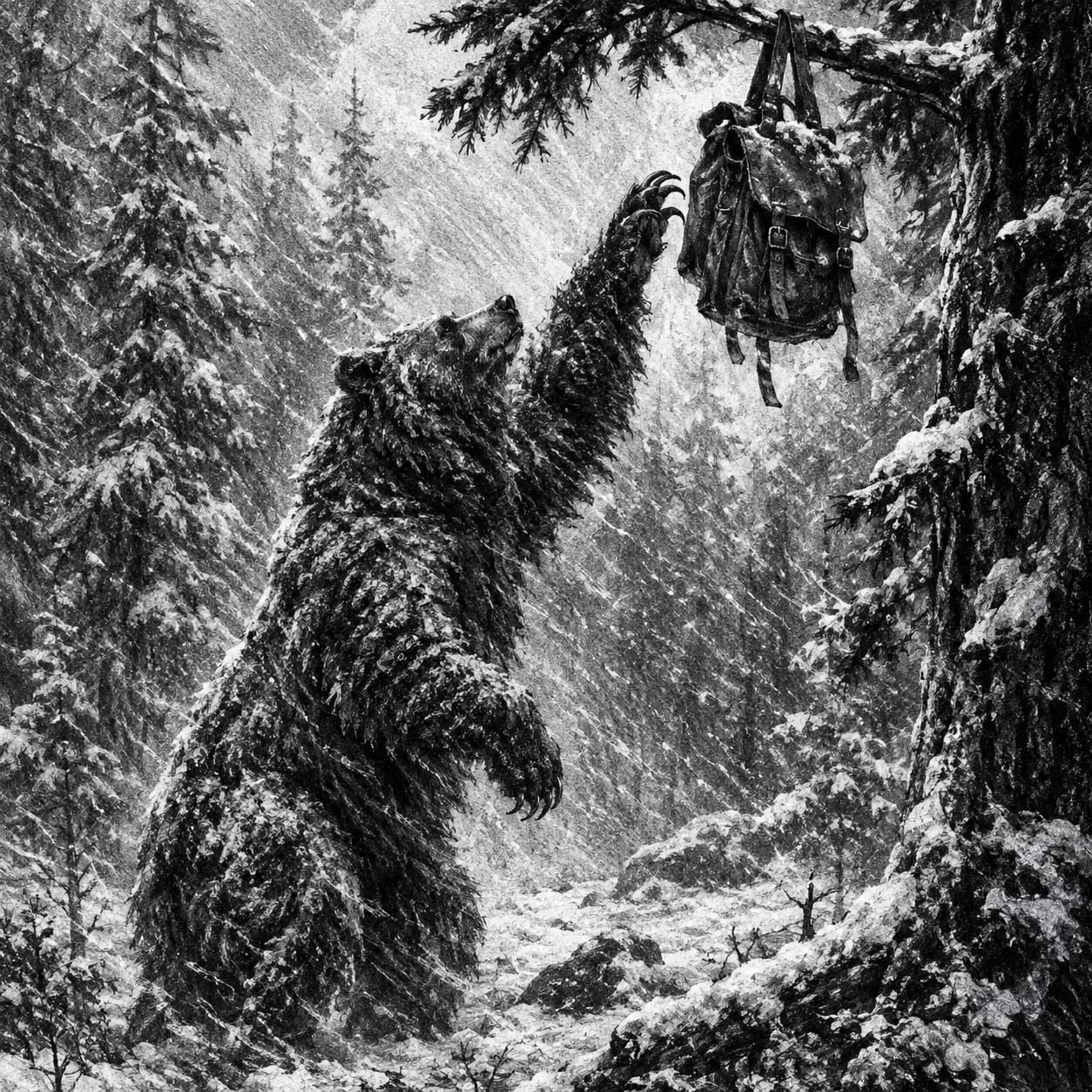
That’s when Thelonius saw it—a dead man jammed high in the branches, frozen stiff, wedged where trunk met limb. The bear had been circling the tree, trying again and again to climb, but the injured leg wouldn’t let it. It could smell food inches from salvation and couldn’t reach.
The bear huffed and shifted its weight and the wounded paw slipped. It snarled—not at them, at the tree, at itself.
Thelonius moved closer, slow enough that the bear had time to decide. He spoke again, steady and low, and the bear held, muscles trembling with restraint. Close up he could see how the leg had swollen, the skin torn, the cold working into it.
He laid a hand on the fur above the injury and pushed the healing through.
Warmth spread under his palm. The swelling eased. The bear flinched once, then stilled, confused by the sudden absence of pain. It tested the leg carefully, like it didn’t trust good luck. Once. Twice. Then it put weight on it properly and a low sound came out of its chest. Not gratitude, not quite, but something that wasn’t threat.
It looked up again. Then at Thelonius.
And climbed.
Not graceful. Powerful. It hauled itself up the trunk with brute confidence now that the leg would hold, claws biting bark, shoulders flexing. It reached the corpse and tore at it, again and again, putting all its weight into the pull.
Something gave with a wet crack.
The body came down hard but not clean. One leg stayed wedged tight in the V of branch and trunk, and what tore free at the knee hit the snow with a heavy, dead thud.
The bear climbed down after it, breathing hard, and paused over what it had won. Then it looked to Thelonius and nosed the corpse once, as if offering terms.
Half.
Thelonius shook his head and stepped back. He kept his voice calm as he declined, and the bear accepted that too, not pleased, not offended. Just hungry.
It tore at the man’s clothes first, impatient, stripping stiff fabric away to get to meat. Then it set to work with the brutal focus of starvation.
Thelonius raised a flat hand to the others. Stay put. Let it feed.
He moved around the base of the tree and kicked through the snow.
A broken bow. Spilled arrows. A backpack.
He pulled it free and flipped open the stiff flap, fingers working through frozen straps and damp leather. Trapper, hunter, woodsman—something like that. A long way from anywhere. He tried to place it, mind turning over distance and direction. Lonelywood, maybe. Someone cutting across the wrong stretch of forest at the wrong time.
Behind him, the bear wasted no time. A great pool of red spread beneath what was left of the man, already darkening at the edges in the cold. Thelonius didn’t watch for long. This was nature, not theatre.
He turned his attention to the trees.
Now that he was looking properly, the signs were everywhere. Shield‑sized chunks of bark torn away between five and seven feet off the ground. Not claw marks—the cuts were too clean, and some of the impacts had the hard, punched look of something heavy thrown into wood.
He moved in a widening circle, scanning, touching, crouching to sight along the grain.
Then he found it.
A sliver of bone, antler, most likely, embedded deep in a trunk, driven in with force.
The damage looked fresh enough to fit the scene. Days, not weeks. Whatever had chased the man up that tree had been strong enough to hit the trunks hard and keep hitting them, strong enough to shake him loose. Thelonius stared up at the V where the foot was still trapped and pictured the slip, the panic, the body wedged wrong, the slow dying that followed.
Hell of a way to go.
When the bear finished, it wandered off into the trees without so much as a look back, the man’s head held in its jaws like a prize.
A snack for later, Thelonius thought, and shuddered. All that remained was an empty cavity in the snow, torn cloth, and blood‑dark ice, one foot still wedged up in the branches above, and beneath it the other leg, still booted, along with half an arm and a gloved hand turned palm‑up, clenched, as if the man had died still trying to hold onto the tree.
With the bear gone, they tried to follow the signs, the damaged trees, the torn bark, but the trail petered out not far from where the man had died.
Later, they spotted a small shape in the snow. A chwinga, bundled in leaves and twigs like a child’s doll left out in winter. It had an awakened hare lifted by the ears, the creature kicking like a demon and swinging its hind legs in furious, useless bicycle strikes.
They pulled the sled to a halt. The dogs stood breathing hard, steam rolling from their muzzles, heads cocked toward the strange sight as if they couldn’t decide whether to bark, chase, or bolt.
The chwinga simply turned the hare around with a quick, practised twist, presenting its back like a naughty child to be carried off. The hare kept kicking anyway, feet thumping air, accomplishing nothing except noise.
“Unhand me, you smooth‑brained faerie fucker!” the hare shrieked. “You! humans! Put an arrow in this wretched thing so I can be on my way!”
The chwinga blinked at the outburst, unbothered, then looked up at them with a tiny, solemn frown.
“Chirp—chip—tweek—chirp,” it said, like a cross between a bird and a cicada.
Thelonius lifted a hand and, with a quiet pulse of Druidcraft, coaxed a bud on a nearby bush into bloom. A single stubborn flower opened against the cold like it had no business existing.
The chwinga’s whole face changed. It gave a delighted little chirp and leaned in close to inspect the bloom, utterly charmed. The hare seized the moment to kick harder.
“Stop bribing it with gardening! That’s not… that’s not justice! Kill it, the stupid little shit! Has no business snatching me up. I’ve got a lot of sex planned for today, and this is NOT helping my mood one little bit!”
Felwar dropped low, slow and careful, and produced a stinking fish from his tin. He tore it in half, ate one piece himself, and offered the other to the chwinga with both hands like an offering. The spirit accepted it with deep seriousness, chewed, and swallowed.
The hare became apoplectic. “Don’t feed it, you dolt! Kill it! Stabby stab stab!”
Then the chirping little language seemed to click into place, not fully, not cleanly, but enough that meaning came through the sounds.
The hare, still held by the ears, thrashed and shouted over everything. “Help! Help! I’m being abducted by a walking shrub!”
The chwinga ignored the tantrum. It hopped closer, patted the flower once like it was thanking Thelonius, then stamped its tiny foot, shaking the hare.
It made a longer chirp then, drawn out like a warning. To Felwar, with fish still on his tongue and the spirit’s language suddenly clearer, the meaning landed clean.
Bad.
Felwar blinked. “The hare is bad?”
The chwinga nodded furiously.
“Bad?” the hare scoffed. “Me? Never. I have fathered over twenty children. This year alone. I’m a local hero, is what I am.”
The chwinga shook the hare once, sharp and final, and the hare fell silent for the first time, eyes wide, chest heaving, ears still stretched in the spirit’s grip.
Then the chwinga thrust its hands out in a hard, impatient demand.
Hold hands.
No explanation. Just insistence.
Felwar hesitated only a heartbeat. He offered his hand. The chwinga took it with both of its tiny twig‑fingers, grip surprisingly firm.
It looked back at the hare, chirped once, a decision, and let go.
The hare hit the snow, spun, and bolted toward the trees, away from the humans, chwinga, and the dogs, leaving a string of profanity behind it as it vanished.
“Fine! Fine! Enjoy your haunted walk you absolute mugs! And tell that leaf‑creep I’ll not forget this day. He will pay. The fucker will most assuredly pay!”
Miquitzil was chewing on something and leaned into Raine. “Awakened animal, that. Like the wolves. And the creature in the lake.”
Raine’s eyes widened a fraction as it clicked into place. “Right,” he said finally.
The chwinga didn’t watch the hare go. It only tugged on Felwar’s hand, impatient now, and stamped its foot, urging him to follow.
Felwar took a few awkward steps and realised the issue immediately. The chwinga was knee‑height, quick as a fox, and it wanted to move faster than a full‑grown man could follow without wrenching its arm off.
He loosened his grip to let it run ahead.
The chwinga snapped its head back and chirped, sharp, urgent. It scurried back and grabbed Felwar’s fingers again, then made a chattering sequence of cheeps and clicks, gesticulating with its free hand at the others, then back at Felwar, then out again.
Felwar translated as best he could, brow furrowing. “It says—you must hold onto each other and me. A chain. You must be touching me, for some reason. If you don’t… you’ll get lost.”
Raine’s jaw tightened. “Do we have time for this?”
Miquitzil glanced between the chwinga and the treeline. “My curiosity is piqued, I must say.”
Thelonius didn’t hesitate. “Of course we help it. Something’s making animals go mad.”
Raine exhaled through his nose, then nodded once. “Not going to argue the point.” He secured the sled and the dogs, then gave Felwar a curt gesture to lead.
They did as it asked. Hands linked. A line made.
Not long after, as they crunched through pristine snow, Felwar felt the world change. The wind didn’t just ease—it fell away, as if someone had shut a door. The pressure shifted. The cold seemed to thicken. It was subtle but immediate, like walking through an invisible skin stretched between the trees.
For the others it hit harder—not discomfort so much as force. Like being pushed back by something you couldn’t see. Like trying to press two magnets together the wrong way, same polarity, repulsion absolute. Each step took effort. And when someone loosened their grip, the pressure caught them and slid them sideways, trying to peel them off the line and steer them away from wherever the chwinga was leading.
So they held on and drove through it, boots grinding in snow, shoulders tight, teeth clenched.
Then, as abruptly as it had begun, the pressure eased. The air thinned. The forest felt normal again, if “normal” could be used for anything in Icewind Dale these days.
A few minutes later the chwinga stopped dead. Its movements turned careful, almost delicate. It motioned for Felwar to squat, then scrambled up onto his knees and clapped a tiny hand over Felwar’s ear as if to claim his full attention. With the other hand it pointed into the darkness, toward a low ridge half‑seen through blowing snow.
“Bad,” it chirped, the meaning clear enough now.
Then it hopped down, plunged headfirst into the drift, and vanished. A small hole remained for a heartbeat before the snow slumped in and filled it, as if it had never been there at all.
Ahead, beneath the drifts, something waited.
Disclaimer
This is a work of fan fiction. All relevant characters, locations, and settings remain the property of Wizards of The Coast (WOTC) and the story contained here is not intended for commercial purposes.
I do not own Dungeons and Dragons (D&D) or any of the related characters. D&D is owned by WOTC (and its parent companies) and all rights of D&D belong to them. This story is meant for entertainment purposes only.