Session 27
Summer Star
Thelonius was the first to speak.
He stepped forward and tapped the mirror with a cautious finger. The golden hue was already draining away, the surface settling back into ordinary silver as though nothing at all had happened.
“What the actual…?” He turned to the others. “He just disappeared?”
“Looks like it,” Raine said.
The warrior pushed past him and checked the frame, the floor, the wall. No catches. No seams. No hidden mechanism. “Teleported, maybe. Or something.”
Thelonius cupped his hands around his mouth. “Felwar! If you can hear us, make a noise!”
Nothing answered.
His voice faded into the tomb, leaving only silence, and the faint click and scatter of bone on stone.
Miquitzil had settled cross‑legged on the floor where Felwar had been standing moments earlier. While Thelonius called and Raine searched, he tipped a handful of bones from a pouch and cast them across the stone, studying their landing positions as though they might offer the sort of answer neither panic nor shouting ever could.
That was the theory, anyway.
The bones were saying nothing useful.
Not that they ever really did, Miquitzil admitted. Still, there was always the chance today might be the day they finally earned their keep.
“Always a first time,” he murmured.
“What was that?” Thelonius rounded on him immediately. “First time for what? You think he’ll vanish again? You think we’re next?”
Miquitzil ignored him and cast the bones again. They clicked and skittered across the floor, landing in another pattern that meant just as little as the first. He stared, frowned, then gave a low grunt through his nose.
Total mystery.
Then his expression shifted.
“Ah,” he said softly, as though something had finally become clear, and gave a slow, thoughtful nod.
Thelonius turned to Raine at once, his voice dropping with sudden urgency.
“Miquitzil’s onto something. Look. See?”
Raine looked.
Miquitzil leaned back from the spread of bones, and Felwar stepped out of the mirror as suddenly as he had vanished, appearing right in the middle of them.
The bones scattered beneath him.
For half a heartbeat nobody moved. Then the silence shattered.
Voices rose at once, questions coming from every direction. Where had he gone, what had happened, was he hurt, what in the hells had the mirror done to him?
Miquitzil abandoned the bones immediately. He got to his feet, stepped in close, and without a word seized Felwar by the face, pinching both cheeks hard enough to bring colour into them.
“Ow,” Felwar snapped, batting his hands away. “Is that totally necessary?”
“Yes,” Miquitzil said.
He released him, gave a single satisfied grunt, and stepped back as though that settled everything.
Raine was next. He caught Felwar by the shoulders and turned him bodily to face him, holding him eye to eye.
“Where did you go?”
Felwar blinked, still gathering himself, and answered with a question of his own.
“You’re still here.”
Thelonius slid into view beside Raine, all nervous energy and offended concern.
“Of course we’re still here. We were worried. The mirror—”
“Yes, the mirror,” Felwar said.
He glanced back at it and took a small step away, as though he wanted a little more distance between himself and whatever had just happened.
“How long was I gone?”
Raine and Thelonius exchanged a look.
“Five minutes,” they said together.
Felwar nodded once. Relief flickered across his face, brief but unmistakable.
A little way down the corridor, Miquitzil had lit his pipe. The smoke curling from it smelled foul enough to strip paint, but his eyes never left Felwar. He watched him carefully, still not wholly convinced that whatever had stepped out of the mirror was exactly what had gone in.
“I was gone two days,” Felwar said. “At least, two days in Feywild time.”
Raine frowned. “I understand time. What the hell is Feywild time.”
Felwar opened his mouth, thought better of the first answer, and tried again.
“It’s another realm. Another place. The Feywild.”
Raine’s expression did not change.
Felwar sighed. “Full of fae creatures. Fairies, satyrs, talking animals. That sort of thing.”
Thelonius’s eyes sharpened. “That’s where Owly comes from.”
Felwar gave him a quick glance and a nod. “Yes. There.”
That seemed enough for Thelonius, not because it answered everything, but because it placed the thing. Gave it shape.
Raine, meanwhile, had begun to realise there was no immediate danger here. No spell taking hold. No enemy wearing Felwar’s face. He eased back a step and, after a moment, settled against the wall to wait the rest out with patient reserve.
Felwar rubbed his arms and shivered. He was still in his underclothes, he realised, and the cold had wasted no time getting to work. One moment he had been standing in the thick warmth of a summer day, the next he was back in a frozen stone corridor, half‑dressed, with the chill nipping at his fingers, ears, and any other bit of him foolish enough to be exposed.
He bent, retrieved his winter coat, and slung it over one shoulder.
“The short version is that the mirror didn’t answer me like it did for you lot. No, it sent me into the Feywild.”
Thelonius leaned in, intent now, and Felwar, seeing there was no clean way around it, gave them the shape of the thing. He told them of the fae court he had stumbled into, of arriving in the middle of a dance and being judged for it before he had properly found his feet. He told them of Princess Dandelion’s stolen cup, and how no one there had any interest in answering his question until he had earned it. So, they had sent him into the Hedgerow. He had followed the trail, been challenged, bargained, tested, and pushed from one strange turn to the next until at last he found the thief and the truth of it.
Thelonius asked questions as Felwar went, not foolish ones, just the sort that came from real interest. What kind of court? What sort of tests? Was the Hedgerow a place or a thing? Felwar answered some, brushed off others, and kept going. Raine listened at first, then less and less as the danger drained out of the tale and the details piled up, his attention slipping into the background while Felwar spoke on. Miquitzil said nothing at all. But he had stopped hanging back. By the time Felwar spoke of the thief, of finding him at Silver Lake with the cup in hand, trying to flee through to the Shadowfell to save his wife, the pipe had lowered a little in Miquitzil’s hand, and some of the hard suspicion had gone out of his face.
Felwar did not dwell on that part. He only said, with a brief tightening around the mouth, that for a moment he had nearly let the man go. Then he moved on. He brought the cup back. He was sent onward to a place called Nectarfall Winery. And there, at last, he found them.
“My mother,” he said. “And my real father.”
That brought Raine’s eyes back to him. Thelonius frowned slightly, following the thread but not quite trusting where it was leading. Felwar saw that much and spelled it out.
“The man I thought was my father isn’t my father at all. That arsehole back in Bryn Shander, the one leading the Children of Auril. The one bullying Mishann.”
Thelonius nodded at once, remembering.
Felwar’s mouth tightened.
“Well, that wife‑beating prick isn’t my father. In fact, he’s nothing to do with me other than father by name.”
As if that were not revelation enough, the Feywild had one more surprise for him.
“Even as we were getting to know each other in the kitchen, Queen Titania arrived. Titania, Queen of the Summer Court.”
That landed hard enough to quiet them again.
“She confirmed that the spark within me is hers,” Felwar said. “That the power I wield flows from her. She called me a seed of summer, planted in a field winter has held too long.”
He glanced away from them then, back toward the mirror.
“She said the note I sang in the chapel, the one that shattered the glass, wasn’t a mistake. Said it was a counter‑melody. That winter heard it, and winter broke.”
The corridor was still for a moment.
“Then she told me to find the Codicil of White. And those of good heart who would seek it with me.”
“And after that,” Felwar said, “she sent me home.”
“What the hell is a codicil?” Thelonius asked.
Miquitzil was not entirely sure, but the word stirred something faint in his memory. “Legal papers, I think. Writing. A book, maybe.”
“Ah. It seems your group is reunited. A foursome once more.”
Sahnar’s hollow, whispery, paper‑thin voice cut across the corridor.
Miquitzil spun, startled. He had not heard the ancient undead elf approach.
Raine moved at once, striding past him. For a moment it looked as though he meant to strike Sahnar down where he stood. Instead, he turned back to the others and jabbed a thumb at the elf.
“What about this one, then? Are we just going to wander across the countryside with the walking dead at our heels? Trust that this elf won’t butcher us in our sleep? How in the nine hells are we meant to trust the undead?”
Sahnar gave a dry wheeze that might once have been a sigh.
“I am no threat to you or your companions. I have been returned to aid the righteous in their good deeds, and so I am indebted to you, to battle to the last and to help return the seasons to this place you call Icewind Dale.”
Raine looked wholly unconvinced.
Still addressing the others rather than the mummy, he said, “Well? Do we trust zombies now? What’s next, tango with goblins? Maybe we should’ve invited Maud along. She could’ve been our cook.”
That earned a quiet chuckle from Miquitzil.
Sahnar drew breath to object, but Raine cut across him.
“Whatever you are, you are not alive. That makes you dead, or near enough to it. And in my experience, dead things like you are evil.”
So, the Brave Hearts argued it out there in the cold corridor, speaking plainly and without much ceremony. In the end they agreed Sahnar could travel with them, though not one of them was ready to offer him full trust. Much of what Raine said made sense. Good undead were all but unheard of. Still, there was a quiet honesty about Sahnar, a lack of guile perhaps, or simply the weariness of someone long past pretending, that won Felwar, Thelonius, and Miquitzil over.
Raine relented in the end, though only reluctantly. A mummified elf might prove useful if things turned ugly again. Auril had servants besides Ravisin. Stronger ones, perhaps. Coldlight walkers. Ice creatures. Worse. In a land like this, under a goddess like that, there was no telling how far her reach might extend. And if Sahnar was what he claimed to be, then keeping him close, and keeping an eye on him, might be worth the risk.
By the time they made it back to the sled, the dogs were curled together in a great breathing mound of fur and steam, tucked against the cold as only creatures born to it could be. At the sound of familiar boots on snow, heads lifted at once. Tails thumped. Then the whole lot of them were up in a scrambling, whining rush, delighted beyond dignity. They were happiest to see Thelonius and Raine, crowding close for pats and attention, though Felwar and Miquitzil received their share once the first excitement had burned through. Their joy redoubled when food appeared. There was still a fair amount of plunder lashed to the sled from the duergar outpost: provisions, gear, and, more importantly to some minds than others, several barrels of decent wine.
It was Miquitzil who pointed out the problem. Sahnar moved with all the speed of old stone. If they kept him on foot, he would slow them to a crawl and become a liability the moment anything went wrong. The answer was obvious, though nobody liked it. One of the barrels would have to come off the sled to make room. There was a brief and mournful silence at that. Thelonius looked pained. He knew a good vintage when he saw one, and this was not swill fit only for cooking. Still, there was no helping it. The barrel was left behind with far more reluctance than the mummy had ever inspired, and Sahnar was perched atop the sled in its place like some grim and shrivelled lord of winter freight. With that settled, the Brave Hearts turned their faces toward the Black Cabin and Macreadus, if the man yet remained out in the wilderness.
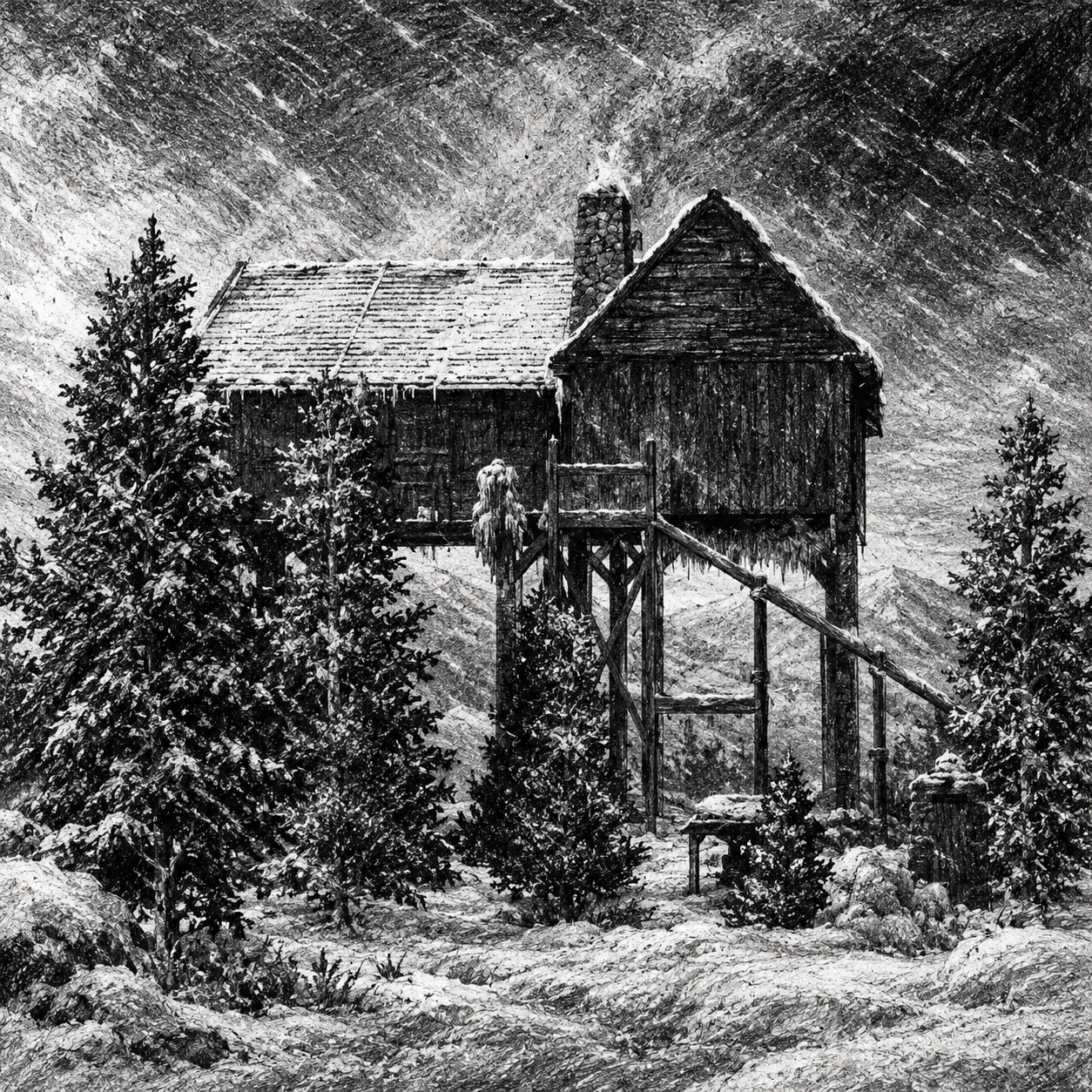
They found the place perched on the edge of a snowy ridge above a gorge, a black lodge raised on wooden stilts and clinging to the cliff like something too stubborn to fall. In daylight, in clear weather, the view from there might have been magnificent. One could imagine it, perhaps: the sweep of the gorge, the hard beauty of the wilderness, the sort of lonely grandeur that drives men to build homes in impossible places. But there was no grandeur in it now. In the dimness, with the weather closing in and sight cut short by drifting snow and failing light, the gorge was only a yawning black maw beside the cabin, an inky emptiness swallowing whatever little light the world still offered. It made the whole structure look more precarious, more foolish, as though one good shove from the wind might send it down into the dark.
A set of icy steps climbed toward a snow-covered walkway fixed to the southern side of the lodge. The roof sagged under its white burden. Broken windows stared out like blind eyes. Loose shutters knocked and flapped in the wind with the dull, irregular sound of something trying and failing to speak. Snowdrifts pressed in around the stilts, half-burying a nearby woodshed and an outhouse that looked one hard winter away from collapse. No path remained. Whatever track had once led here was long since swallowed by snow. The whole place had the air of utter abandonment, not the peace of an empty house but the thin, uneasy silence of somewhere left behind for a reason. Only the wind moved there, prowling around the cabin and along the lip of the gorge, and even that seemed too restless to stay.
Thelonius sent Owly ahead to scout, first directing the fae owl beneath the cabin to look at the supports. It seemed sensible enough. If the whole place was ready to collapse into the gorge, better to learn that before they set foot inside. But neither owl nor druid knew much about architecture, and even looking through Owly’s eyes, Thelonius was forced to settle for rough impressions rather than certainty. The struts looked broad enough. There was no obvious sign of rot. Beyond that, he could say little.
He sent Owly up and around the cabin instead, peering through the broken windows as the little familiar circled in the wind. A workroom. A large central chamber in disarray, with a big table and rubbish strewn across the floor. One bedroom. Then another, this one with its windows still intact.
No sign of Macreadus.
Owly returned at once, hating every moment of the wind, and burrowed straight back into Thelonius’s jacket with the air of a creature who had seen quite enough scouting for one day.
They passed the outhouse and paused, eyeing the door half-buried in drifted snow. For a moment Felwar thought they might try to dig it free, but the wind surged up and over the gorge like a living thing, needling through seams and buckles, and the idea died unspoken.
Up here the cold had teeth.
“That wind is a killer,” Raine muttered, hunching his shoulders as he cupped his hands and breathed into them. His breath smoked thick and fast. “Honestly, Felwar, how are you not feeling that?”
Felwar frowned. He waited for the sting, the deep ache that usually crept into his fingers by now. It didn’t come. The air brushed past him, sharp but strangely muted, like pain held at arm’s length. Since his return from the Feywild, the cold had loosened its grip on him, but he hadn’t truly noticed until this moment, until Raine gave voice to the difference.
“I don’t know,” Felwar said, drawing a slow breath that did not burn his lungs as it once would have. “Perhaps a piece of Titania’s warmth remains within me.” A faint, thoughtful smile touched his mouth. “If so, I am grateful for it. Out here, such gifts are not wasted.”
Raine let out a short, humourless huff and stamped his feet against the frozen ground. “Of course it does,” he said. “Leave it to me to be the only one still paying full price for the weather.” He pulled his cloak tighter and squared his shoulders. “Next time we’re bargaining with higher powers, remind me to ask for better circulation.”
There were no tracks near the building. No scuffs, no half-frozen footprints. Miquitzil tilted his head toward the chimney, where soot lay cold and undisturbed. No woodsmoke. No warmth. Nothing living had lingered here for some time.
Felwar lowered his voice. “Stay alert. Whatever happened to Macreadus, it wasn’t quick—and it wasn’t gentle.” His gaze drifted to the empty doorway, then back to his companions. “Let us be certain it does not find us as unprepared.”
With that, the journey became an investigation. The Brave Hearts slowed and took more care. One after another they climbed the rickety steps, Raine going first, kicking snow from each tread as he went, part to make the footing safer, part to test the state of the wood beneath his boots.
They checked the workroom first. It was a smith’s space, or near enough, a cramped metal workshop built for making and mending rather than grand craft. A small forge sat against one wall, blackened but seemingly serviceable. Nearby stood a broad workbench, a quenching vat, lengths of metal stock, bent rods, flat plates, wire, scrap, and fittings in little sorted piles that now looked less organised than abandoned. Tools hung where they had been left: some heavy and blunt, fit for force, others fine and delicate, meant for patient hands and careful work. There were tongs, hammers, punches, files, chisels, clamps, little screw-tools and callipers, all the clutter of a man who worked with heat and precision. But for all that, the room had no way through into the rest of the cabin.
They moved back onto the outer walkway and made for the second door. Several of the slats there had long since rotted through, leaving a gap none of them fancied leaping with a gorge yawning beside them. Instead, they wrestled the heavy workbench out of the workshop and, with no small amount of grunting and awkward shoving, dragged it across the breach. It was not elegant, but it was solid enough. A rough repair. Good enough for the moment.
The second door opened into the main room, and the cabin’s story turned ugly at once.
The smell hit them first: burnt wood, burnt flesh, and beneath it all the faint sour-sweet scent of spilled wine. Snow had blown in through holes in the roof and broken windows and gathered in dirty heaps against the corners. The walls were blackened. So was the furniture. A table stood scorched near the middle of the room, and on it lay the charred remains of a book. Nearby, among broken wine bottles and ash, sprawled the mostly incinerated skeleton of a man. Macreadus, they guessed. Beside him sat a spherical object about six inches across, crusted with frost as though the fire that had killed him had left that one thing untouched.
“Careful,” Raine said. “Let’s go room by room before we start moving things around.”
Being careful to avoid the worst of the fire-damaged floor and stepping over Macreadus’s blackened remains with more caution than comfort, they worked their way through the rest of the cabin.
One room proved to be a storeroom. The scent of wine was stronger there. Four frost-covered barrels stood against the wall, and nearby were meagre rations for one person, though even those had been divided and divided again, as if Macreadus had been trying to stretch the last of them past all reason. Raine flicked through the crates with the tip of his knife and shook his head.
“This Macreadus was a man possessed,” he said. “Should’ve left for Lonelywood days ago.”
At the far end of the cabin, they found two bedrooms. One had long since surrendered to the cold. A broken window in the east wall let the wind blow straight through, setting the tattered grey curtains flapping like angry ghosts. Snow lay across the bed and much of the floor besides. No one had slept there in a long while.
The other room had clearly been Macreadus’s. Broken glass had been boarded over to keep out the worst of the weather, and though the place was no warmer for it, at least it looked lived in. There was a sagging double bed, a small bookcase with folded clothes, blank parchment, and a set of calligrapher’s supplies. Beside it sat a soot-stained hearth, and in the ashes Raine found a scroll that had somehow escaped the fire.
It was a letter from Copper.
Raine unrolled it and read it aloud.
Macreadus,
I’ve had enough of this damned, relentless cold. I feel it creep into my bones, my head, my heart. I’m heading back to Ten-Towns for a decent meal and a warm bed. I fear this endless winter has numbed your mind, and any tinkerer worth their chains can see the Summer Star is a fool’s errand. Maybe without me here to incessantly complain to, you’ll finally snap out of your obsession.
If you truly insist on dedicating your remaining days to this doomed project, might I suggest that three is better than two. I considered telling you before, but you were particularly rude about the dinner I made last night.
May the light of the Morninglord protect you,
Copper
Felwar lowered his eyes a moment, then nodded. “This tracks with what Copper told us. A falling out, but the friendship remains beneath it all.”
Miquitzil grunted in agreement. “The Summer Star must be the project he was working on.”
They did not need to say what followed. It was obvious enough. The only thing in the main room untouched by flame was that little frost-covered device lying beside the body. Whatever answers the cabin still held, they would lead back to that.
The next room looked more like a laboratory than a living space. It held a fireplace, two empty bookcases, and walls covered in frost-rimed blueprints, with more strewn across the floor in careless drifts. Lying face-down beside one of them was a tiny clay figure shaped roughly like a man. Raine nudged it with his boot, but it was nothing more than that, a small humanoid made of clay, curious but lifeless.
Miquitzil, meanwhile, had already crouched over the papers. He studied them in silence, turning one after another with growing focus, until at last the pieces began to line up in his mind. Different designs, iterations, failed attempts, all centred on some magical device. When he returned to the main room and looked again at the object beside Macreadus’s body, the shape of it came clear.
“The Summer Star,” he said, “is a weather-controlling device.”
The thing resembled a gyroscope, and the blueprints matched it closely enough to leave little doubt. Miquitzil began gathering the papers into a careful pile, sorting sense from chaos one page at a time.
Thelonius was poking through the detritus on the floor when he found what was left of a burned book spine. Very little had survived, only a few blackened scraps and the letters E T H E R still clinging to the leather. He held it up for Miquitzil to see.
Miquitzil turned from the blueprints, took one look at the font, and felt something stir at the back of his mind.
He dropped his pack to the floor and opened it at once.
“The books,” he said. “The books from the Spire. You each took one. Put them here. All of them.”
The others did as they were told, producing the volumes they had hauled from the Lost Spire of Netheril. Miquitzil sorted through them quickly, his hands moving with growing certainty, until at last he found the match, the same book, but whole and unharmed.
Magical Wonders of Netheril.
Miquitzil held it up for a moment, then looked across the room toward Macreadus’s scorched remains.
“This, then, holds the secrets that consumed our dead friend over there. I will need a few hours.”
He righted a fallen chair, sat, and opened the book without bothering to see whether anyone objected. If the Summer Star could be understood, it would be through this.
Felwar went back outside for more wood while Thelonius, still determined to be useful, investigated the outhouse. He returned not long after with an armful of ripped paper squares.
“More blueprints,” he said proudly. “I bet Miquitzil can put these together.”
Miquitzil glanced up from the book. “Found them where?”
“The outhouse. In a pile beside the… you know. The hole.”
Miquitzil looked at him and waited.
Thelonius waited back, expecting some admiration.
None came.
At last, Miquitzil said, “I think what you have brought me is toilet paper.”
Thelonius blinked. “Oh. Right then.”
He coughed, gathered up the little scraps with what dignity he could salvage, and handed them off to Felwar, who was busy getting a fire going.
Hours passed.
The room was made as comfortable as it could be. Windows were boarded over where possible. Wood was brought in and stacked near the hearth. The fire gradually pushed back the worst of the cold. Raine searched Macreadus’s body more thoroughly and found an amulet that had somehow survived the blaze. He set it aside on the table for Miquitzil to examine later. Thelonius saw to the dogs, bringing the sled, Sahnar, and the team in beneath the cabin out of the wind.
Through it all Miquitzil read.
Now and then he would turn a page more slowly or go back and check a line against the blueprints, or glance toward the frost-covered device beside Macreadus’s remains. He was careful not to touch it. By the time he finally looked up, the others could see he had begun to piece it together.
“The Netherese,” he said, tapping the open book, “built marvels beyond anything most folk now remember. Flying cities. Engines of magic. Devices that could shape the world around them.”
That got their attention.
He went on, not reading word for word, but drawing out the meaning of it.
“This book is a collection of interviews with archmages, discussions of ancient elven magic, engineering, and the creation of devices called mythallars. Mythallars were among the greatest magical devices Netheril ever produced. Vast reservoirs and regulators of arcane power. They could channel raw magic into impossible acts, levitating cities, altering the elements, reshaping the rules us ordinary people live by.”
Raine folded his arms. “And Macreadus built one of those?”
Miquitzil shook his head. “Not one of those. Not truly. But something inspired by them. A lesser imitation, perhaps. A fragment of the idea.”
He gestured toward the frost-rimed sphere in the other room.
“The Summer Star.”
The words sat heavily in the cabin.
“It is a weather-working device,” Miquitzil said. “A gyroscopic focus for magical energy. The blueprints show different iterations, refinements, failures. Macreadus was trying to build a small mythallar, not for flight, not for empire, but for climate. For warmth. For summer.”
Felwar glanced toward the dead man’s bones. “And it killed him.”
“That would be my guess,” Miquitzil said. “The designs are complex. Delicate. Dangerous. And incomplete.”
He rested a hand on the open page of Magical Wonders of Netheril.
“The book makes one thing plain. Devices like this require exactness, patience, and more knowledge than Macreadus perhaps possessed on his own. But Copper knew enough to leave him one useful piece of advice.”
“Three is better than two,” Thelonius said.
Miquitzil nodded.
“Yes. I think Copper saw the flaw. Macreadus did not.”
Then the papers moved.
Not by much at first. Just a faint shiver across the tabletop, the sort of thing a man might blame on a draught if there were enough wind in the room to make the lie stick. One sheet slid a finger’s breadth out from the pile. Another turned slightly. Then, with a dry whisper of parchment on wood, several pages shuffled at once, some pushed forward across the table, others brushed clean off it and onto the floor.
Everyone was on their feet in an instant.
Raine’s hand went to his weapon. Thelonius recoiled hard enough to nearly upset his chair. Felwar froze where he stood, eyes narrowing on the papers. Only Miquitzil stayed seated, though he had gone very still indeed.
For a moment nothing more happened.
Then one of the pages on the table twitched again. Another slid toward Miquitzil’s elbow with slow, stubborn insistence.
“It’s him,” Felwar said quietly. “Macreadus.”
That did not improve Raine’s opinion of the situation.
The dead tinker, or whatever remained of him, had no voice, no body fit for pointing, no way to do anything except fuss with the world in small, irritating ways. But the intent became clearer the longer they watched. Certain pages were being nudged forward. Others were being rejected outright, flicked to the floor with unmistakable annoyance.
Somehow the ghost of Macreadus was here.
Miquitzil, seeing the shape of it first, reached for an empty bottle from the wreckage of the main room and set it upright on the table.
“All right,” he said into the air. “We will try this properly. Upright for yes. Tipped for no.”
The bottle wobbled, then steadied upright.
Thelonius blinked. “Well, that’s unsettling.”
He looked entertained as well, though, and settled in to help.
Miquitzil ignored him and began sorting through the plans one by one, holding up pages, tapping notes, asking short, exact questions. Was this design sound? The bottle stayed still. Was this component part of the final model? The bottle tipped over. Was Copper’s note important? Upright. Did Macreadus understand the flaw before he died? A pause there, then, slowly, the bottle rolled onto its side.
Piece by piece the exchange took shape.
The spirit was trying to help. Not always clearly, perhaps. Not elegantly. But honestly, and in the end, usefully enough. What might have taken Miquitzil hours, perhaps days, to sort through by booklight and guesswork was instead hurried along by the dead inventor’s stubborn little corrections.
Pages with no value were shoved from the table. Useful sketches were pushed back toward Miquitzil. At one point Thelonius, eager to assist, rescued a fallen sheet and set it proudly atop the pile, only for it to be swept straight back onto the floor by an unseen hand.
“That one’s no good, then,” Felwar said.
“Apparently not,” Thelonius replied, with wounded dignity.
By the end of it, Miquitzil had separated the blueprints with the most promise from the false starts and dead ends, and beside them he laid the one clue Copper had left behind: three is better than two.
That was the heart of it.
Macreadus had not been lashing himself to a fool’s errand after all. He had been close. Fatally close. And now, with a dead inventor rustling papers at his shoulder and Copper’s parting advice finally understood, Miquitzil had something he could actually work with.
“Right, then,” Miquitzil said at last.
The others had all but fallen asleep by then. Thelonius had dozed forward with his face on the table and came upright at once at the sound of Miquitzil’s voice, peeling a blueprint off his cheek where it had stuck to a line of drool.
Miquitzil ignored that.
“We have two choices. We take the Summer Star with us, or we try to fix it here. I believe the workshop has the tools and materials we need. The task is simple enough in theory: fashion a third ring identical to the other two, only half an inch greater in diameter. If you are willing, then with your strength on the bellows,” he said to Raine, “and your careful hand,” to Felwar, “and my instruction, we can do this.”
Thelonius sat up straighter. “What can I do?”
Miquitzil looked at him. Saw the hopeful expression there. The honest eagerness not to be left out.
“You have one of the most important jobs of all,” he said.
That pleased Thelonius at once.
“You are to watch the plans, watch the ring, and watch us. If anything does not match, size or spacing or curve or alignment, you speak at once. No guessing. No kindness. If it is wrong, you say it is wrong.”
Thelonius blinked, then nodded gravely, as though entrusted with the fate of kingdoms.
“I can do that.”
“Yes,” Miquitzil said. “I believe you can.”
And with that, the Brave Hearts set themselves to the dead man’s final work.
It was painstaking work. Ten hours of exacting labour at the forge, shaping the third ring to match the other two in every detail but size. Metal was heated until it glowed, then drawn out, hammered flat, bent true, reheated, and worked again. Under Miquitzil’s direction, and with the occasional silent correction from Macreadus’s ghost, they stretched the curve a fraction at a time, checking it constantly against the Summer Star’s existing rings, never trusting the eye alone where the hand could err. When the circle was finally true, they joined it cleanly and set about the finer work: filing the surface smooth, etching the same runic markings around its length, and fixing in place the two short pins by which it would attach to the Summer Star.
By the end they were exhausted, blackened with soot, and heartily sick of the ring of hammer on metal. But the finished piece lay on the bench looking as precise and perfect as the blueprints that had guided its making.
The Summer Star remained where Macreadus had died beside it on the floor. They did not dare simply snatch it up. Instead, Miquitzil used a cloak, easing the frost-rimed device onto it and lifting it carefully before laying it on the table beside the newly forged ring.
“Now,” Miquitzil said, “this is the tricky part.”
The others gathered round.
“Macreadus’s ghost has indicated I shall have only a few seconds to attach it. Get it wrong and…” He gestured toward the scorched walls, the burned floor, the holes blasted through the ceiling, the missing boards. “Well. You can see what might happen. It would be bad. Perhaps you should all wait outside.”
They did not.
Thelonius cast Guidance instead, laying what little extra luck and grace he could upon the work. Miquitzil drew a breath, steadied his hands, and began. The new ring had barely touched the device before the Summer Star reacted. Heat surged through it with frightening speed, violent and sudden, the metal waking like something alive and angry. For a few seconds it looked as though Macreadus’s fate might be about to repeat itself. Then the pins slid home, the rod clicked into place, and the danger ebbed as quickly as it had risen.
Miquitzil snatched his hands back and let out a long breath.
“It’s done.”
He looked to the bottle. It tipped upright again and again, knocking against the tabletop as if in eager approval.
“Yes, yes, yes,” Miquitzil said dryly, and despite themselves the others smiled. The ghost was pleased.
“I will need to attune to it,” he said, “but first, some spells.”
He cast Detect Magic, then Identify, and recoiled slightly at what flooded back through the spell.
“This mythallar,” he said at last, staring at the little device. “A tiny thing compared with what the Netherese archmages once made, but more powerful than anything I have yet seen. The energy in it dwarfs even the hag’s cauldron. This is…” He shook his head once. “Frightening.”
Then his eyes fell to the amulet Raine had found and left upon the table.
“That is an Amulet of Health.”
At once the bottle spun and tipped its neck toward Raine.
“I think he wants me to take it,” Raine said.
No one argued. He was the one who stood in front when steel came out. Any edge in endurance was worth having.
Miquitzil readied himself, running through the sequence one last time in his head. Inner left. Middle right. Outer up.
Then he set the rings in motion.
The moment he flicked the outer ring upward; tiny pinpricks of magical light spilled from the coal-dark heart of the mythallar. Most were blue and white, though silver and gold motes shimmered among them as well. There was no heat this time, thank every god still listening, only a rising hum in the air as the little device lifted and hung between Miquitzil’s hands.
He closed his eyes and spoke the Netherese words.
For a heartbeat, nothing happened.
Then light poured through the broken windows.
Not aurora. Not some pale winter imitation. Sunlight.
Real sunlight.
It struck the blackened walls, spilled across the warped floorboards, turned drifting dust to gold. For a second none of them moved, as though they did not quite trust it. Then Felwar and Thelonius were running, shoving past the doorway and out onto the snow to stare over the gorge.
Above them and for miles around, for the first time in more than two years, the sun shone bright and clear in a hard blue sky. It was almost too much to look at. Thelonius had to turn his face aside at first, blinking furiously, laughing under his breath like a man who had forgotten what daylight felt like. Felwar stood still and let it hit him full in the face. At once he was back at Nectarfall Winery, the blazing warmth, the heavy summer air, the bright cruel glory of that Feywild sun. It felt impossible to find even an echo of that here, in Icewind Dale, on the lip of a frozen gorge.
And the gorge itself had changed. What had been a black scar in the dark now opened into something vast and wild and beautiful, steep snow-laden walls dropping away into a chasm lined with frost-rimed trees and broken stone. Even as they watched, the world began to answer the warmth. Snow softened and slumped. Water dripped steadily from the cabin roof. Branches shed their burdens in wet clumps. From the eaves came the sharp, regular patter of meltwater. Here and there the hard white crust over the land darkened and gave way, as though the whole place were exhaling for the first time in years.
It was wondrous.
They watched it for ten minutes. Twenty. Thirty.
Then Felwar’s gaze lifted farther.
Beyond the edge of that impossible circle of sun and blue sky, the Frostmaiden’s curse still held. Winter crouched there unchanged, dark and oppressive and merciless. The warmth reached perhaps as far as Lonelywood, perhaps farther. Maybe Termalaine too. But beyond that, Targos and Bryn Shander and Bremen and all the rest still lay beneath her hand. They might see the sunlight in the distance, a miracle burning on the horizon, but they would feel none of it.
The curse remained.
Felwar felt his jaw tighten. Then let it.
He would end this. End her.
Nearby, Thelonius had stripped off his shirt and thrown his arms wide, drinking in the warmth with the fierce gratitude of a man reprieved from execution. Up on the walkway, Miquitzil and Raine stood side by side. Raine was grinning broadly now, all caution burnt away in the face of it. The warmth seemed to carry him somewhere else entirely, to southern summers, to fields and farms and the long heat of home.
But Miquitzil was not smiling.
He was staring at the mythallar in his hands.
Felwar saw it at once.
“What is it, Miquitzil?” he called. “Is there a problem?”
Miquitzil looked up and nodded.
“Yes. I think the magic is gone. Spent.” His voice was flat with disappointment. “The design was sound, but something is missing. Something ancient. Something not written in the texts or in Macreadus’s notes. Some Netherese secret.”
His shoulders sagged. For a moment he looked as though the weight of it might pull him bodily from the walkway. The mythallar slipped from his fingers, struck the slats once, bounced, then fell over the side of the cabin to vanish into the snow below with a soft, miserable plop.
Miquitzil looked down after it.
“This is it,” he said. “This is all we achieved. Perhaps ten miles of sun in a land of tens of thousands. We wasted our time.”
“No,” Felwar snapped at once.
He stepped closer to the cabin, voice rising.
“No. This is no waste. Look at it. Look what you have done, what we have all done. We pushed the curse back. We brought back the sun. Not everywhere, no. Not forever. But we did it. And that proves it can be done.”
He pointed out toward the dark beyond the bright edge of summer.
“We can beat that bitch.”
Thelonius came across the snow and threw an arm around Felwar’s shoulders.
“We’re going to do this,” he said. “Together. The four of us.”
Then Raine called out from the walkway, looking not at them but across the gorge into the distance.
“Look. Auril’s aurora. It’s back, and how.”
They followed his gaze.
Beyond the ring of sunlight, the green fire of the aurora had sharpened into something hard and vicious, bright as a wound across the dark sky.
“I’ve never seen it look so…” Raine shook his head, grinning now with open relish. “Angry.”
He laughed then, a big, raw, hearty laugh that rolled out across the gorge.
“We made the bitch angry,” he said.
Then, louder, to the winter beyond:
“We’re coming for you, bitch.”
Almost on cue, a light shone within the nearby forest.
Not warm light. Not sunlight. This was something else entirely, a hard, pitiless beam, impossibly bright and deathly white, lancing through the trunks as it moved. It flickered once, then again, like a lantern carried by a corpse through the woods. The shape behind it was slow and gaunt and wrong, its whole body seeming to glow with that same hateful radiance.
Everyone saw it at once.
Raine had his shield off his back before anyone spoke and was already moving, pushing past Miquitzil along the walkway toward the fray. Beside Felwar, Thelonius turned in a rush of snapping bone and shifting muscle, flesh swelling outward until a great brown bear stood where the druid had been. And then the rest of Auril’s answer came screaming in on fast-beating wings: three ice mephits, each no bigger than a small child, all needle-teeth and spite and jagged frost.
Auril had noticed.
The sun, here, in her land, was an insult she would not abide. So, she sent what servants were near enough to answer the outrage, things of cold and hunger and blind obedience, converging on the Black Cabin to snuff out the miracle and slaughter whoever had dared make it.
The battle hit like an avalanche.
Thelonius, all bear now, thundered through the snow and met the coldlight walker head‑on, taking the thing before it could reach the others. Miquitzil snapped out a spell and flung a net of conjured webbing across the sky. Two mephits were caught mid‑wheel, their wings snarled in sticky strands. Felwar cursed the third with hexed malice and fired upward, but the creature jerked aside and the blast went wide.
The trapped mephits tore themselves free and answered with freezing breath. Cold washed over Thelonius in a glittering burst that rimed his fur with frost.
Raine hit the ground in a leap from the walkway and went straight through one of them, smashing it back in a spray of cracked ice and shrieking outrage. The coldlight walker swung its beam toward him, that murderous white glare slamming across shield and armour, but Raine held his ground. Then the creature was on the bear, long limbs swinging with dead strength. One blow glanced off fur and muscle. The next landed hard enough to shake even Thelonius’s massive frame.
Sahnar started down toward the fight with all the speed his ancient limbs could muster, which was not much. His dry wrappings stirred in the wind as he fixed one of the mephits with a dead‑eyed stare. The thing quailed for a heartbeat, then shook it off. Miquitzil answered with song, a sharp, cutting note that cracked across the battlefield like breaking glass. Thunder burst over the walker and two of the mephits.
One of the little horrors blew apart outright, exploding into razor shards that stung both Raine and bear‑form Thelonius. Thelonius answered in kind, seizing the walker with tooth and claw. The moment his jaws closed, the cold was so savage it came out the other side of itself and felt like fire, a blistering, hateful burn that lit his muzzle with agony. But the great bear held on, tearing free a spray of frost and dead white matter from whatever unholy stuff the creature was made of.
Then Felwar saw the next problem.
Out from the tree line, crashing through the snow with brutal speed, came a were‑polar bear. A monstrous thing of white fur and rolling muscle, bigger by far than any natural bear had a right to be. It moved in a horrible shifting mix of two legs and four, dropping to all fours for speed, then rearing half‑upright again in a way that made the eye rebel. There was something sickeningly human in the shoulders, in the reach of its forelimbs, in the sense of a man twisted and swollen inside the beast. Its jaws hung open, slab‑like teeth slick with spit, and its little dark eyes were fixed on the fight with a predator’s certainty. Snow kicked up in sheets behind it. Even at a distance it looked strong enough to break a man in half.
Felwar shifted his curse and blasted one of the remaining mephits from the air, then ducked beneath the stairs where the larger beast would struggle to reach him. Raine killed another mephit in a spray of ice and kept moving, circling to pressure the last before it could join the walker in finishing Thelonius.
But the walker was relentless. It battered the bear down at last, and when Thelonius crashed into the snow, it did not stop. It struck him there with cold, methodical purpose, intent on killing him and moving on. Auril had sent it for slaughter, and the thing seemed to know no other task.
Sahnar turned his dreadful gaze on the werebear and at last found purchase, enough to make the creature falter. Miquitzil stepped out into the open and threw his will behind a quieter, stranger kind of magic.
“This place is too dangerous for you,” he said. “The sun hurts your eyes. Go home and stay there. Do not return.”
The suggestion took hold. Not forever, perhaps, but enough. The creature slowed, agitated, uncertain, then began to pull away from the fight.
That left the walker.
Thelonius lay bleeding in the snow, one failed grasp at life already behind him. Felwar hauled him back from the brink with a shouted word of healing, then slammed the walker with force. Raine came in from the side and landed a brutal, perfect blow that should have put most things in the ground for good. The walker scarcely seemed to notice. It turned straight back to Thelonius, cut him down again, and struck him once more where he lay. Then its beam snapped toward Owly in a flash of cold white brilliance, and the little familiar — who had been darting in and out to distract the thing — vanished in a puff of feathers and magic.
Miquitzil answered with three darts of pure force, each one hammering into the walker’s glowing corpse‑flesh. Thelonius clung to life by inches. Felwar cast Cloud of Daggers that, thanks to his connection to Titania, took the form of a furious swarm of tiny, conjured hornets, whirling and stinging in a maddened cloud around the walker’s head and shoulders. It staggered beneath the combined punishment, light flaring wildly from within it, until at last the coldlight walker came apart in a collapse of dead radiance and shattered frost.
But the last mephit was still there, and spite kept it alive longer than it deserved. It darted in low and struck at Thelonius again, forcing him one step nearer the grave. Raine dropped to a knee in the snow, tore out a healing potion, and poured it down the druid’s throat. As Thelonius struggled back to breath and movement, Miquitzil held a spell ready in his palm like a drawn blade. The moment the druid cleared the mephit’s death burst, the Ice Hunter released the missiles. They slammed into the creature and left it reeling. Then Felwar shifted the cloud across the snow and fed the mephit into it. The last of Auril’s little servants vanished in a mince of ice and bloodless ruin.
And just like that, it was over.
The snow around the cabin was churned and bloodied. The coldlight walker lay in shattered pieces, its wicked light gone at last. The mephits were gone too, each reduced to a scatter of elemental ice across the snow. The were-polar bear had fled back into the white. The Brave Hearts still stood, just. Thelonius had been down twice and had come close to being lost. Raine was cut and rimed with frost. Felwar’s breath came ragged in the cold air. Miquitzil looked drained to the bone. Only Sahnar seemed outwardly unchanged, his shrivelled face giving nothing away.
But the others were alive.
And the sun still shone.
Disclaimer
This is a work of fan fiction. All relevant characters, locations, and settings remain the property of Wizards of The Coast (WOTC) and the story contained here is not intended for commercial purposes.
I do not own Dungeons and Dragons (D&D) or any of the related characters. D&D is owned by WOTC (and its parent companies) and all rights of D&D belong to them. This story is meant for entertainment purposes only.