Session 24
Nothing Stays Clean
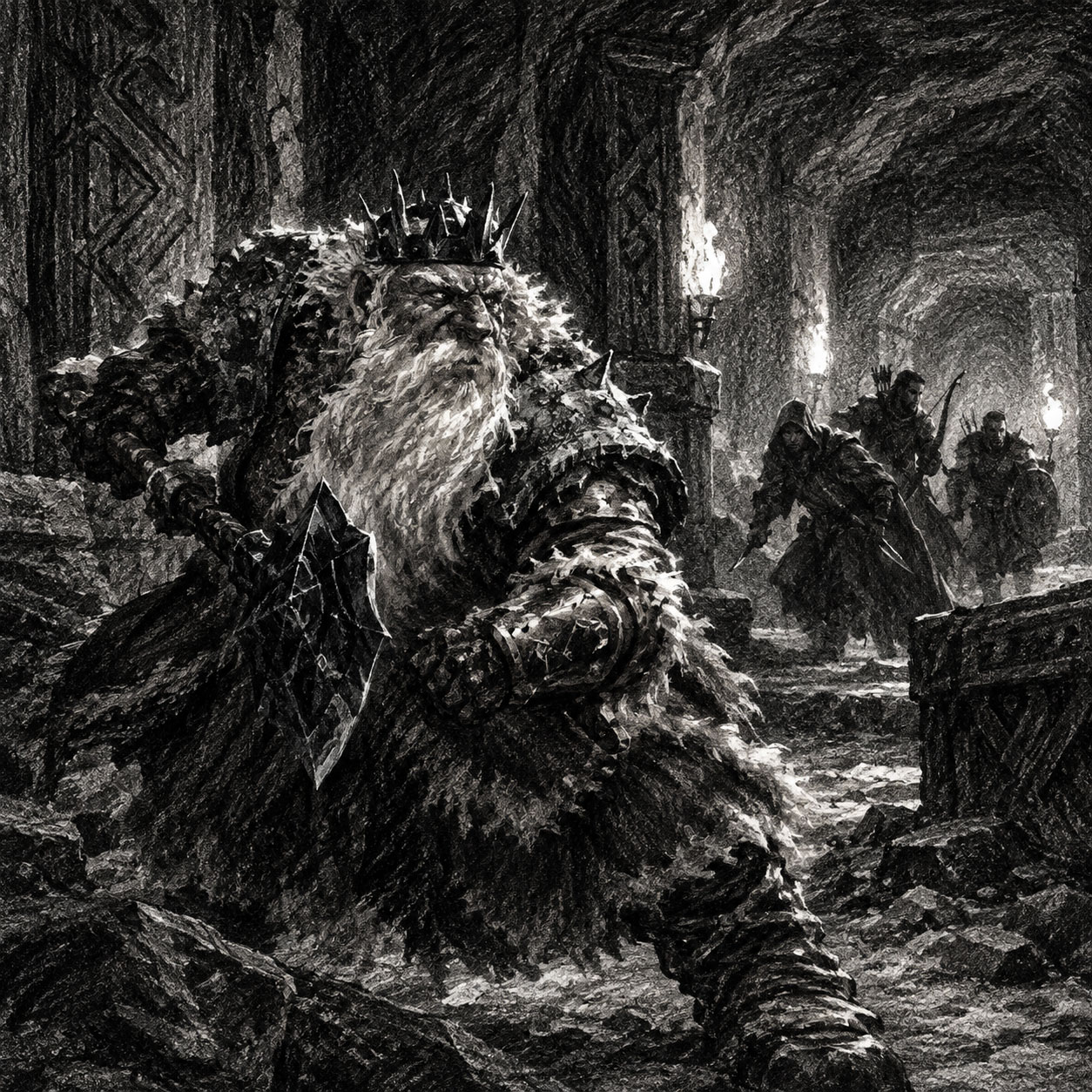
Night sat heavy in the valley, pressing the world into a tight, anxious circle.
For Raine, Thelonius, and Miquitzil, the oppressive dark and thick snow gave them perhaps ten feet of clarity—enough to see a man’s back, the next bootprint, the edge of a drift. Beyond that was suggestion. Shapes. The kind of nothing that makes you imagine teeth.
Felwar was different. In clean darkness his eyes could reach a hundred feet and more, but here he had sixty at best when the snow eased—shrinking again whenever the wind threw white grit across the ground. He kept watching the hillside, quietly grateful the duergar would likely see no better than he did in this hellscape.
Thelonius didn’t bother squinting.
He shut his eyes and left.
Owly lifted from his glove and vanished into the dark, and Thelonius rode with him—warged clean into his feathered familiar. In one breath the owl’s senses became his: the crisp cut of night air, the faint hush of moving snow, the valley’s hard angles laid out in pale relief. And in exchange his own body became a dead thing for a moment—deaf, blind, numb to cold, trusting.
As always, he reached out and found Raine’s shoulders.
Raine didn’t flinch. He simply widened his stance, the older man’s broad back steady as a post in the wind. Thelonius hooked in with one hand and let the other hang at his side—though it twitched now and then, as if guiding the owl’s flight by instinct.
Then he started talking—low, constant, as if speaking kept the map real.
“Alright. Valley’s a few hundred feet deep. Lowest in the middle—there’s a frozen stream bed running its length. Slopes up both sides to the walls. I’ve swept the mouth. Going in now.”
There was a pause, and Felwar realised he’d been holding his breath.
Finally, Thelonius continued. “The valley ends at a stone wall and… there. Yes—stronghold. Blocky. Rough crescent shape. Most of it’s buried into the hillside, like it’s trying to crawl back into the rock. I can only see the doors—”
A pause. Thelonius’ head tilted slightly, tracking Owly’s arc.
“No. Wait. There’s more.”
They listened, boots planted, breath held. Felwar kept his eyes up, but even he relied on Thelonius now—because Owly could see what the rest of them could only guess at.
“Main entrance is a big double door—stone,” Thelonius said. “Approach is a gentle slope, fresh snow over it. Northeast of the doors there’s a culvert. Barred. Looks like a stream used to run out of it—frozen now. And there’s more. Three barred openings along the north wall. Narrow. If someone’s behind those… they’ve got a clean view of the hillside.”
“Arrow slits,” Raine muttered.
Thelonius nodded, still half elsewhere. “I think so, aye. There’s something similar on the south wall too—only one set, though.” He swallowed. His fingers tightened on Raine’s shoulder without him noticing. “Closer to us—separate from the rest, nearer the valley wall—there’s a low bunker. Snow-covered. More arrow slits. On a clear day it could watch the whole valley.”
No one spoke. In the quiet, the outpost felt like a mouth with its lips sewn shut.
Raine finally murmured, close enough that the words wouldn’t travel. “Weather’s on our side for once. If Felwar can’t see them, they can’t see us. So we stay quiet. And even with that—we don’t go straight up the middle.”
Thelonius gave a small, absent nod—still half in the owl, half in the cold meat of his own body.
Raine continued, voice flat with intent. “We skirt it. North side. Keep high on the slope as long as we can. Behind the bunker first—then on to the culvert. Front doors only if we have to.”
Felwar’s gaze flicked out into the valley. Just a wall of snow at the edge of his fae‑vision. “No lights,” he said. Not surprised—just laying down the rule. “They don’t need them, and we won’t be using them either. Anything bright’ll bounce off these flakes and give us away. Follow the man in front of you. I’ll lead.”
Plans formed the way they always did with the Brave Hearts—not pretty, not noble. Practical. Mean. Get in quiet. Don’t give the duergar a chance to decide the shape of the fight.
Thelonius inhaled and let the magic fall over them like a cloak.
Pass Without Trace.
It didn’t make them invisible. It made them less true. Footsteps softened. Breath quieted. Snow that should have squealed under a boot simply accepted their weight. Even the little betrayals—the crunch, the scrape, the clink of gear—were smothered into nothing.
They moved.
Up the north edge of the valley, keeping distance from the gentle slope that led straight to the doors. The bunker sat off to their nearer side, arrow slits like black stitches in stone. The barred openings along the northern wall waited ahead, watching the hillside like narrow eyes.
Owly nuzzled into Thelonius’ cloak, keen to escape the biting wind. The familiar hated the cold—feathers ruffled, eyes narrowed, every instinct screaming for shelter. Thelonius felt the small shiver as he severed the link and let him burrow deeper, glad to get the owl back into what passed for warmth beneath his winter folds.
They moved as Felwar ordered—one man’s back to the next man’s eyes, a thin chain of shapes swallowed by snow.
The north edge of the valley rose slightly underfoot, and they kept to it, angling away from the gentle slope that ran straight up to the stronghold’s doors. The squat bunker sat nearer now—Felwar could see it at the edge of his sight—a separate lump of stone half‑drowned in drifts, perforated by arrow slits that looked like old wounds. He cautioned the others to be especially careful. No shortcuts. No careless clink of metal. Every step placed, every breath measured.
Felwar led, shoulders hunched into the wind, head turning in small increments. He checked the bunker, then the hillside, then back again. No light behind the slits—which was exactly what he expected. Duergar were dwarves of the Underdark. They were more comfortable in darkness than not.
The Pass Without Trace clung to them as they went, an impossible hush.
Miquitzil brought up the rear and couldn’t help but marvel at it—the way their boots seemed to skim the powder instead of biting into it, as if they were walking on the snow rather than through it. The drifts didn’t crunch. The surface didn’t break. When he glanced back, there was nothing. No trail. No line of betraying prints. Just wind‑scoured white, as if the valley had never held them at all.
A marvel—and a warning.
Because if the magic could make a party vanish from the snow, it could just as easily hide the approach of something else. Miquitzil remembered the yeti on Kelvin’s Cairn—the way it had come out of the white like it had been there all along—and for a heartbeat he imagined the same thing here, something huge and hungry bursting up through the powder. He swallowed and chased the thought away before it could take root.
They slipped past the bunker’s blind slits. No door they could see. Whether that was expert duergar craft, a hidden entrance, or simply an access point on the far side of the stone, it would have to remain a mystery. The stronghold’s crescent bulk loomed larger ahead—doors somewhere out in the dark, culvert and barred openings waiting like teeth in stone.
They edged along the north wall until the cliff rose into worked stone—sheer, cold, deliberate. Ten feet up the masonry began, a blank plane of dark blocks; three feet above that, narrow arrow slits cut the wall like thin, spiteful smiles.
Raine pressed in close, shoulder almost brushing stone. Too close for any watcher behind those slits to angle down and spot them—but they still moved like men expecting a bolt in the throat. Every boot set down gently. Every buckle held still. Thelonius’ strange hush wrapped it all, turning what should have been audible betrayal into nothing.
Further on, they found the culvert.
A small, round mouth in the hillside—seven feet across, choked with ice where a stream had once run out and across the valley. Frost coated the iron bars, each one set seven inches apart, running from the culvert’s crown down into shadow and ice—ribs vanishing into a frozen gut.
Raine tested one with his gloved hands first, then with brute stubbornness. When that did nothing, he dug out his crowbar and wedged it in, muscles locking, breath steaming hard as he strained.
The bar didn’t even twitch.
He tried again, swearing softly at inanimate objects—words enough to make a sailor blush. A shift of leverage. A grunt. A flash of irritation.
Nothing.
He shook his head and slammed the crowbar back into his pack.
Felwar crouched, peering into the culvert’s throat. He half‑expected to catch the glint of something beyond—a light, a shape, anything—some underhanded way into the outpost. All he found was darkness and the dull suggestion of ice as the frozen stream vanished around a bend. No movement. No sound. Nothing looking back.
No matter. Even if there was a way through, they couldn’t reach it.
“Front doors, then,” Thelonius muttered, and the words tasted like compromise. He wasn’t pleased with it—not with a main entrance, not with anything that sounded like walking into someone else’s teeth—but the valley didn’t offer other gifts.
They angled back toward the central slope, keeping low, keeping tight, Felwar leading them up the gentle rise. The stronghold’s crescent bulk loomed close now, stone half‑buried in the hillside as if it had tried to hide from the wind and failed.
The doors were there.
And amazingly—absurdly—they weren’t locked.
Felwar tested the seam. No resistance. He eased the stone door open just enough to slip Owly through to scout.
No torches. No sconces. Not even the courtesy of a bracket on the wall. Duergar were truly a race of darkness.
Owly glided into the hall beyond, wings whisper‑quiet, and Thelonius rode his senses for a quick, searching sweep.
Just inside the entrance was a large wooden drawbridge, mercifully down. Beneath it yawned a pit—thirty feet or more of hard drop and harder consequences.
Beyond, a bare hall. No carvings. No banners. No priestly icon to curse or spit at. Just function and cold. A frozen well stood near the centre like a wound sealed over. A hallway ran east. Along one wall, three iron cages had been shoved into place.
One held an ogre—or what had been an ogre.
It was malodorous even at a distance, a hulking thing with rotting, half‑frozen skin and an empty right eye socket that stared out like a black pit. Heavy leather and metal harness wrapped its shoulders and waist. Its great head swung at the whisper of movement, despair and hunger tangled together in a guttural sound. The ogre zombie sensed the owl—but it didn’t have the wit, or the freedom, to do more than snarl behind iron.
Another cage held a pair of nervous goats. They flinched and bleated every time the ogre shifted its bulk, hooves slipping on the frozen bars beneath them.
The third cage was empty.
Leaning against the wall near the cages was a wooden dogsled, the ice on its runners half‑frozen into a dull glaze where it had thawed and refrozen.
They slipped inside and let the door ease shut behind them, stone kissing stone without a sound—the fresh snow dusting the drawbridge the only sign the doors had been opened at all.
Inside, the darkness wasn’t just the absence of light—it was a thing the duergar had built their lives around. Felwar could still see, his vision cutting through the black, but the others were reduced to a line of hands and shoulders. Raine took point behind him, one palm resting on Felwar’s cloak. Thelonius behind Raine, then Miquitzil—each man touching the one in front, moving by trust and the faint scrape of breath.
Miquitzil kept a light spell poised in the back of his throat, ready to spit illumination into the dark the instant something went wrong. He didn’t want to use it. None of them did. Light was a flare—a confession that would rouse the outpost as surely as any bell. But he held it anyway, like a knife you pray you won’t need.
Felwar led them toward the southern door, feeling his way by sight and instinct, listening for anything beyond the stone—a shift of boots, a cough, the click of a latch.
Nothing.
He pressed his ear close. Still nothing.
He was getting used to the spell’s hush—the way Pass Without Trace made even his own movements feel unreal—but habit kept him cautious.
Felwar went to open the door when Thelonius whispered, “Maybe we go through that corridor there—further into the mountain?” He nodded toward the larger chamber Owly had glimpsed—the one with two doorways likely leading deeper into the stone. “I don’t know keeps or outposts, but wouldn’t the good stuff be deeper, not on the edges? Feels like we’re skirting the rim.”
Raine shook his head, though Thelonius couldn’t see it. “We clear the edge before we cut into its heart. I’m not having something sneak up behind us.”
It made sense. Thelonius gave the smallest nod for Felwar to continue.
Felwar opened the door a fraction, then another, letting the gap widen with patient slowness.
Beyond lay a cellblock.
Stone doors lined the chamber, each with a small barred window set at dwarf’s‑eye height. The air in here had a different bite—colder, sharper. Snow and wind pushed in through a barred window in the northeast corner, the same direction as the bunker outside, carrying that thin, relentless moan that made the room feel half‑exposed, like it was already losing the fight to the storm. Against the west wall, a wide stair climbed into darkness.
Felwar held the door and looked it over, counting doors, measuring angles.
Behind him, the line tightened—hands on shoulders, breath controlled—as the Brave Hearts stepped in.
“I’ll check the stairs,” Felwar murmured. “Wait here.” He eased the door shut behind them, stone kissing stone without complaint, and left the others in the same absolute black they’d been living in since the valley. Then he turned and started up the steps, quiet as the snow.
Thelonius didn’t wait.
He shifted Owly up into his hands and warged into the familiar’s night‑sight. The world snapped into colder clarity through the owl’s eyes—edges sharper, distances wrong, his own body suddenly a clumsy thing he couldn’t properly feel. He shook a hand off his shoulder—Raine’s, or Miquitzil’s, he couldn’t tell—and sidled to the first cell door on the west wall. Holding Owly up like a lantern made of feathers, he peered through the small barred window.
“Empty,” he whispered—more habit than message, the word falling into the dark where no one was close enough to catch it.
He moved on, cell by cell, one hand trailing along stone to keep himself honest. It was disorienting, his vision displaced from where his body insisted it should be—like walking with your head turned the wrong way—but there was no urgency. No alarms. No rushing boots. The wall stayed beside him, a steady guide in the dark.
He crossed the open span by the stair, and through Owly’s eyes he caught Felwar’s boots above—careful steps, soundless on stone as the warlock slipped higher into the outpost.
Across the stairwell, more empty cells.
Then the first occupied one, on the southern wall.
A woman stood inside, perhaps thirty‑five, perhaps younger once—hard to tell now. She wore the ragged remains of Ten‑Towns winter clothing, layers stiff with frost and neglect, but the fabric had stopped being the most important thing about her.
The mushrooms had taken her.
Pale stalks sprouted from her collarbones and ribs, thick as fingers, their caps bruised violet and sickly grey. Smaller growths clustered along her jaw and temple, like a cruel imitation of hair. The flesh still visible had gone waxy and mottled, the colour of old fat, threaded with greenish veins that pulsed faintly as if the fungus had learned the rhythm of a heart and decided to keep it for itself.
She wasn’t chained. She didn’t need to be.
She stood slack against the wall, head angled slightly, eyes open but not seeing—or seeing something else entirely. The stalks twitched lazily in the stale air. Every few breaths a faint puff of spores drifted from one cap or another, dusting the cell like dirty snow.
Thelonius swallowed.
“Creepy as hell,” he muttered—the words escaping before he knew he’d said them. The thing in the cell didn’t react. Either it hadn’t heard, or it didn’t care what men thought of what it had become.
Up above, Felwar climbed the stairs with the same careful patience, each step placed as if the stone might complain. At the top he found what looked, at first glance, like a mess hall—bare tables, benches scraped clean, the harsh practicality of duergar meals taken without ceremony. Four closed doors offered the only exits, two set into the north wall and two into the south.
Then he saw the work.
Jars. Tubes. Stoppered bottles. Glass boxes fogged from within. Shapes suspended in cloudy fluid. Vases packed with pale, fibrous growths and darker, more stubborn strains—fungi in every size and colour, some soft as mould, others thick as leather—arranged with the methodical neatness of a man who thought rot was a craft.
A mess hall—and an experimentation chamber sharing the same cold room.
Felwar padded back down, expecting to find the others exactly where he’d left them.
Instead, the cellblock had shifted.
Thelonius wasn’t in the dark beside the door with the others. He was halfway down the southern wall with Owly in hand, head cocked, body moving in that careful, absent way a man did when his eyes were somewhere else. The owl’s night‑sight had stolen him again.
“Thel,” Felwar whispered—quiet as he dared, loud as he could risk—then thought better of feeding his voice to the room. He moved to him instead, boots soundless under the druid’s hush.
Thelonius turned slightly, still not quite present. “These lot are full of… of mushroom people,” he whispered. “Look for yourself.”
Felwar leaned in at the first barred window.
A woman stood inside—the one Thelonius had seen—half Ten‑Towner still by the rags of her winter layers, more fungus than flesh in the wrong places. Next door: a tribesman, older, the kind of face carved by wind and ice. Then another—older again—and then an old man who was, at this point, almost entirely a garden of sickly growths, as if the human had long since been eaten and only the shape remained.
And then the brute.
A glacier tribesman built like a sled‑dog—thick shoulders, thick neck—except his head had been taken by the growth. Not replaced so much as overrun. A single broad cap had flowered out of his skull like a grotesque helm, heavy‑lipped and mottled, drooping low where his eyes should have been. Stalks sprouted from his jawline and throat, twitching faintly, puffing spores with each slow, wrong breath.
And in the last cell—a young girl.
Felwar put his head to the grille beside Owly, close to where Thelonius held the owl like a feathered lamp, and peered in.
Icewind Dale, by her clothes. Small. Too small. She looked different. More alive. While the others stood slack against their back walls, this one twitched and jerked, head snapping in sharp, hungry little movements. Long fungal tendrils sprouted from her eyes, pale strands that flexed and tasted the air. They all angled toward the door as Owly and Felwar peered in.
Thelonius felt the attention lock on like a hook.
Then the girl ran.
She hit the bars in a frantic rush, hands clawing for Owly as if the owl was the only living thing left in the world worth taking. Felwar jolted back so fast he nearly tripped over his own boots. Thelonius jerked his familiar out of reach—feathers brushing iron—but the cell door flung open with a sudden, ugly scrape.
Felwar gathered himself, shoved the flash of fear down where it belonged, and spun—instinct sharp as a blade. Steel slid free in a whisper, point finding the dark.
Along the southern wall, the four other doors burst open in a chain of stone‑on‑stone violence. Five figures spilled into the cellblock—the woman, two tribesmen, the old man, and the girl—hybrids of flesh and fungus, moving with a hungry, borrowed purpose. Caps trembled on shoulders. Pale stalks twitched along collarbones and jaws. Each motion shook loose small, involuntary puffs of spores that drifted in the dark like dirty snow.
In that moment, in the pitch black, Raine and Miquitzil could only hear it—the scrape of bare feet, the wet rustle of growth, a breathy, wrong kind of hunger moving fast and close. Raine brought his shield up and levelled his sword into the dark, body angling to make himself the wall. Miquitzil crowded behind him, tense, ready.
“What the hell is going on?” Raine hissed.
Felwar’s answer snapped out—sharper than he meant. “Light. Cast your light.”
Miquitzil released the spell, and the room flooded with magic—bright in the centre, dimming at the edges, shadows thrown hard against stone.
Now they could see them properly.
Five bodies, once people, now claimed. Skin waxy and mottled. A riot of colour—greens, reds, purples, white and black—eyes open but not present. The girl’s face slack with need, tendrils sprouting from her eyes and flexing toward the living as if scenting them.
They didn’t hesitate. They swarmed.
Raine met the first impact with his shield, steel groaning in his arm as the thing slammed in, claws scrabbling for purchase. Another tried to hook around the shield edge—quick, grasping hands still human enough to be cunning. Raine answered with a short thrust, brutal and economical, blade biting into softened flesh. The creature shuddered—not a scream, just a violent twitch as the growth inside it spasmed.
Thelonius didn’t waste words. He didn’t waste time.
He changed.
One blink he was a man in winter layers, the next he was a giant spider unfolding into the light—legs splaying wide, body low, chitin gleaming dark. For half a heartbeat the fungus‑things paused—not afraid, exactly, but forced to recalculate.
Felwar took that half‑beat and turned it into violence.
He circled around Thelonius, mindful of the noise the fight would raise, wary of what might be listening above the stairs, and snapped his hand forward. A tiny seed of force—his particular kind of magic, charged and bright—shot out and burst on impact with a sharp crack of light. It struck one thrall square in the chest and staggered it sideways, mushroom caps quivering, spores puffing in a thick little cloud.
Miquitzil barked, as quietly and fiercely as he dared, “Don’t breathe in the spores!”
Then he darted to flank—his wicked orcish blade flashing in short, committed cuts. Each strike tore through flesh that didn’t bleed right, and necrotic energy followed close behind his steel, making the fungi wither and blacken wherever the blade sliced and stabbed.
The thralls answered with poison and desperation.
They clawed and grabbed with hands that found straps and sleeves and the rim of Raine’s shield, trying to pull the living down into the muck of their reach. Spores burst with every impact, and the air turned sour and fungal, like breathing in damp rot.
One found Thelonius.
A rake of claws dug into the spider’s flank, and whatever foulness lived in those mushrooms bled straight into him. Thelonius lurched, legs skittering, poison burning cold through his new blood. Another hit landed. Then another. For a moment it looked like they might drag the spider down under sheer weight and mindless persistence.
Raine drove forward to relieve the pressure, shield‑bashing hard enough to send one creature staggering back across the chamber. Miquitzil stabbed in to peel another away. Felwar stayed back, seed after seed of force bursting in close quarters—cracking heads sideways, snapping bodies back, each flash throwing the cellblock into harsh pulses of light and shadow.
Then the spider’s instincts took over.
Thelonius snapped forward, mandibles parting, and bit down.
Not a warning. A kill.
Fangs punched into the nearest thrall and pumped venom into a body already half‑owned by fungus. The creature convulsed, limbs jerking, mushrooms shuddering violently as if trying to flee the flesh they’d claimed. Then it sagged—collapsing into a heap that was more plant than person.
The line broke.
Not in morale—they didn’t have morale—but in coordination, as if whatever mind now looked out through their eyes had to re‑thread its grip. They still twitched and jerked, still reached, but less certainly than before. Raine used that moment like a man who’d been waiting for it, finishing one with a clean thrust and turning his shield to catch the next. Miquitzil hacked another down, tendrils of black vapour clinging to his wicked orcish blade. Felwar’s bursting seeds hammered the last two until they finally folded, twitching, into stillness.
When it was over, five bodies lay scattered across the cellblock floor. Spores hung in the air like ash. The Brave Hearts covered their mouths and noses with sleeves and scarves, but it was too late—they could taste the stuff, bitter and fungal, sitting on the back of the tongue.
No one said it out loud, but the thought landed in all of them the same way: what if that’s how it starts? What if the spores didn’t just kill—what if they took you, slow and patient, until you were standing slack against a wall with mushrooms blooming from your skin?
Thelonius remained in spider, legs spread, pedipalps twitching, body rising and falling with slow, poisoned breaths—as if daring the dark to send more.
Nothing came.
Only the wind through the north‑east barred window, hissing softly into the room—and the clean dusting of snow, a brief, pristine white against the awful multicoloured spores.
They gathered themselves, sucked down steadier breaths, and moved quietly up the stairs as one—leaving the cellblock’s stink and drifting spores behind. Miquitzil re‑cast his light onto Raine’s shield so it would move with them. It was a comfort they were all quietly grateful for.
At the top, the room opened into the same harsh practicality Felwar had seen first—bare tables, cold stone, and an absence of anything resembling familiar human comfort. Miquitzil went straight to the experimentation benches, drawn as if by gravity. Glass boxes. Stoppered bottles. Tubes and vases packed with growths in every shape and colour. He didn’t touch anything yet—just leaned in close, eyes narrowing, trying to understand what kind of mind made a place like this.
Raine, meanwhile, checked the doors—one by one, methodical, shield ready, listening before each latch gave.
The two southern doors opened onto sleeping chambers. Four beds apiece. No hearth. No shelves of small belongings. No crude attempts at warmth. Just beds, open empty chests, and bedclothes that looked wrong in the light—not wool, not linen, not anything you’d find in Ten‑Towns. The fabric was slick and tough, pale and faintly iridescent, like it had been taken from something that lived in dark places and didn’t want to be touched.
“Underdark,” Raine said quietly, as if the word explained the coldness of it.
The first door to the north was not empty.
Raine eased it open, slow enough that the hinges never got a chance to complain. Light spilled across a cramped chamber and found a duergar male asleep in the nearest bunk. He wasn’t built like the ones they’d fought—no thick neck, no heavy shoulders. This one was slight for his kind, narrow‑chested, fine‑boned, all sharp angles and careful lines. Even at rest there was something pointed about him—the sort of body you got from a life hunched over ledgers and instruments instead of swinging a pick or hefting a warhammer.
A pair of spectacles sat on the bedside table, neatly placed. Beside them, a book. Beside that, a small jar of something brown that looked like it wanted to be medicine and failed.
The light didn’t wake him.
Raine slid his sword from its scabbard in one smooth, practised draw—no flourish, no noise, just steel appearing as if it had always been there. He looked to Thelonius—still in spider form, a dark, patient bulk in the doorway—as if daring him to object.
The spider said nothing. Thelonius simply shifted away, drifting back toward Miquitzil and the experiment tables, leaving Raine to make the choice without an audience.
Raine stepped in.
He lowered the blade with surgeon care, slipping it under the sleeping duergar’s chin until the edge kissed skin. For a heartbeat the room held its breath. Then Raine pushed—quick, controlled, decisive.
The duergar’s eyes snapped open too late. His body spasmed once, twice, a sound caught in his throat that never became a cry. Then he went still, head lolling on the pillow, spectacles staring at nothing from the table beside him.
Raine withdrew the blade, wiped it on the strange, slick bedclothes without a flicker of hesitation.
“A mercy evil doesn’t deserve,” he said at last, voice flat.
He took the book, tucked it into his pack, and moved past Felwar to the next door. The next chamber held four bunks, one occupied by a regular‑sized duergar male—asleep, slack‑jawed in the kind of deep, heavy sleep that comes from long work and longer marches. Thelonius’ spell did its work, smothering the little betrayals of armour and boot and breath until Raine was almost nothing.
Raine dispatched this one with the same ruthless efficiency as his neighbour—swift steel, no warning, no sound worth calling a scream.
Only the faintest shudder of a body going from living to not.
Raine and Felwar searched the duergar quarters with the same cold thoroughness they’d used on the sleeping dark dwarves.
In one small sack they found more valuables, likely stolen from Caer‑Konig—twenty‑five pearls carved into decorative beads. In another sack were the practical spoils: three daggers, a set of woodcarver’s tools, a set of navigator’s tools, fishing tackle, and a potion of healing tucked into a leather pouch alongside seventy‑three silver.
When they emerged, Felwar asked Miquitzil about the experiment benches.
Miquitzil stared at the glass and the fungus and the stoppered jars like they were a language he’d never learned. “No idea,” he admitted at last.
Thelonius—still in spider form—joked, “He doesn’t even want to take anything for snacks.”
Miquitzil didn’t answer.
Raine hefted the book he’d taken from the scholar‑duergar’s bedside table. “Maybe this will be useful,” he said. “Found it in the bookish one’s room.”
Miquitzil exhaled—half relief, half resignation. He already had too much reading to do, the books dragged from the Lost Spire of Netheril stacked in his mind like debt. What was one more added to the pile? Still, he was glad for it. He just wished—not for the first time—that they could stay in one place for a week or two and catch up with the knowledge chasing them.
They moved back through the entrance hall, then west into what looked, at first glance, like simple storage rooms. The first chamber was all shelves and stacked crates, boxes and barrels lining the walls in tight, orderly rows. Felwar slipped through one of the two narrow entrances toward the next chamber—
Twang.
A small, tell‑tale sound. A severed tripwire, thin and sharp—the same ugly little note they’d heard on the Easthaven ferry.
The air changed.
Nildar stepped out into the room like he’d been waiting for them to announce themselves. If he was surprised to see them—or frightened by the sudden appearance of humans in his outpost—he didn’t show it. He was duergar through and through: squat, dense, built like a stone block given lungs. But there was a commander’s weight to him. He wore heavier armour than the others, layered and studded, fur at the seams, a pale beard spilling down his chest like frost on iron.
His eyes were hard and watchful, taking stock in a heartbeat.
Then Durth entered—and if Nildar had the look of a captain, Durth had the look of a battering ram given a name. Same cruel set to the face. Same family stamp in the brow and beard. But where Nildar carried himself like a man who gave orders, Durth carried himself like the order was always violence. He gripped his weapon with casual certainty, shoulders hiked under thick furs and plates, already deciding who would break first.
Thelonius squeezed his bulk through the upper doorway north of Felwar. Felwar stayed in the threshold between rooms, half‑turned—not trapped, not pressured, just hedging his bets. From there he could advance with Thelonius or fall back to Raine and Miquitzil in a heartbeat, keeping both spaces in view.
Durth took one look at the room, yanked a nearby lever, and the outpost showed its teeth.
Between each doorway, spikes slammed down from above and drove up from below in the same instant—a brutal cage of iron meant to trap whatever stood in the wrong place. Felwar was almost caught. Almost.
He sprang clear by instinct, the spikes snapping shut where he’d been, and landed hard beside Thelonius—the two of them now in one chamber with the duergar brothers, while Raine and Miquitzil were cut off in the other room.
No pause. No breath.
Felwar realised instantly how dangerous it was to have Raine out there, cut off, while two duergar warriors stood in here with him and Thelonius. He moved nimbly across the floor, ducking a swing from Durth, and seized the lever again. Durth had made it look effortless. Felwar found the truth of it. He braced both hands, put his weight into it, felt the mechanism resist—then finally give.
The lever dropped. The spikes dividing the rooms retracted with a harsh scrape, the trap undone.
The way was open.
Raine and Miquitzil surged in behind them, light riding on Raine’s shield—and the fight that mattered finally began.
Nildar snapped something in Duergar to his brother—sharp, clipped—and raised his fire lance, tipping it toward Miquitzil.
Their focus shifted to the Ice Hunter—or so it seemed to the Brave Hearts.
The fire lance wasn’t a torch. It was a weaponised spell in a duergar’s hands. The metal tube coughed once, like a beast clearing its throat, then spat a cone of alchemical flame that roared out in a tight, brutal fan. Not campfire heat—forge heat. It filled the narrow space with orange glare and stinging sparks, the kind that bite through wool and find skin anyway.
It caught all of them in the wash, but Miquitzil took the heart of it.
Fire was already his enemy. The shard in his ribs had made cold his ally and flame his punishment. When the cone hit, the pain wasn’t just sharp—it was absolute, a white‑hot spear driven straight through muscle and bone. His breath vanished. His vision narrowed. For an instant there was nothing in the world but the sound of burning and the animal certainty that he was about to die.
He staggered, trying not to scream, trying not to give the duergar the satisfaction—and failing to keep the fear out of his eyes.
Durth saw it. Nildar saw it too.
They seemed pleased.
The hairs on Thelonius’ spider carapace lit like a thousand tiny candles before winking out, leaving only a thousand thin threads of smoke.
Miquitzil tried to answer with magic, tried to hold the centre with frost and will, but Nildar closed and hit him like a falling door. The blow drove Miquitzil down hard. The light on Raine’s shield wavered as Miquitzil fell, and for a half‑second the room threatened to go back to black.
Thelonius was there—fast in that unnerving, many‑legged way, a giant spider covering ground too quickly for something that size, grim and practical as ever.
His druid blessing dragged Miquitzil back from the edge and forced breath into him with healing magic that felt like cold water in the lungs. Miquitzil coughed, eyes wide, hands scrabbling for his focus. Back up. Back in it.
Not for long.
Nildar pressed the advantage with the kind of relish that came from practice. The brothers had fought too many battles against drow to make the same mistake twice—the spellcasters had to go down first, hard and fast. Too dangerous to let that sort flit about the battlefield on their own terms.
Miquitzil went down again under their attention—a second time, hard, brutal, personal. Durth didn’t even look at the others as he did it, as if the only point of the fight was to prove a lesson.
Thelonius hauled him back again. Twice in one battle. Twice refusing to let the wicked dark dwarves take him.
Somewhere in the chaos, Felwar landed an opportunist’s strike as Nildar shifted his weight. A seed of force burst against the duergar leader with a sharp crack of light, and Nildar’s head snapped sideways. For the first time, his composure slipped.
He glared at Felwar, eyes promising later.
Miquitzil threw ice in panic and precision, the spell snapping into place around Nildar’s boots with a hard, crystalline crack. Frost climbed fast, locking his feet, halting his movement mid‑step. Miquitzil didn’t wait to see how long it would hold—he retreated out of range, breath ragged, eyes still wide with fire‑fear.
Across the chamber, Raine had been battling Durth, steel ringing off armour, driving him back through the storage room and into the adjoining chamber where the great mechanical construct waited—a squat iron brute of plates and spikes. Durth retreated straight into it like a man climbing into a coffin he trusted. Metal clanged. Levers shifted. The machine woke with a grinding sigh.
Then it moved.
The iron thing slammed at Raine with a spike‑fist, heavy enough to fold a lesser man. Raine took it, staggered, and held his ground anyway. When the construct tried to claw into his mind—a cold pressure, a brutal command—Raine’s jaw tightened and he shoved it back with sheer stubborn refusal.
“Not today,” he growled. The once‑caravan guard dropped shield and sword and ripped the greatsword from his back. “You’re going to feel this,” he said, voice low and furious. “I swear to god.”
Behind him, Nildar kept hunting Miquitzil, shaking off ice and pain and restraint with the grim focus of a man made for this exact cruelty. Miquitzil answered with every scrap he had left. Thelonius threw down a moonbeam, and the pale column burned where it touched, forcing Nildar into frantic, ugly motion as he tried to stay out of it.
Nildar hissed through his teeth as the light seared him.
Through his chitinous mandibles, Thelonius snapped, “What are you doing? Xardarok has played you, fool!”
Nildar faltered—not because a giant spider was speaking. The Underdark had stranger things than that. It was the name. Xardarok. Too familiar, too close to the bone. He jerked his head toward Thelonius, eyes narrowing, and barked back in broken Common, “What did you say?”
Thelonius answered in the same calm tone he’d used to map the valley, as if this were another piece of terrain to be measured and dismissed. “Asmodeus has Xardarok fooled. A devil whispering—not your Deep Duerra.”
Nildar took another step, caught the edge of moonlight again, and snarled as it burned. The pain dragged him back into himself. For a heartbeat he’d listened—actually listened—and then he seemed to realise what it was: a distraction, a name thrown like a hook to steal his focus.
Steel and magic kept battering him while the words landed, and whatever doubt had sparked in him guttered out, smothered by pain and pride. He refocused, cold and furious, and spat in Duergar, “Xardarok will grind your bones to dust. You will wish you had died when he is through with you.”
In the other room, Felwar and Thelonius kept after him, intent on pinning Nildar in place and keeping him off Miquitzil. Nildar made Felwar pay for it—heavy blows, close and punishing, armour ringing, breath knocked half out of him. Felwar slipped away in a blink, misty‑stepping across the fight, and Titania’s magic chased the worst of the pain from his body before it could drag him under.
Miquitzil had retreated further into the great hall, dragging breath back into his lungs and trying to put distance between himself and Nildar’s fire.
That was when he saw it.
The ogre zombie lurched out of the dark, clearly loose from its cage now—a huge, stinking bulk with rotting, half‑frozen skin and that empty eye socket like a black pit. It moved with the slow certainty of something that didn’t fear pain, didn’t fear death, and didn’t need to.
Miquitzil didn’t have room to panic. Not properly. He reached for something stronger—one of his most potent spells—and spoke low and commanding in his best giant dialect.
“Go back to your cage. Close the door.”
The ogre zombie blinked its one good eye. Swayed. Turned its head slightly as if listening to a voice far away—then shook itself, a wet, heavy motion, and ambled forward anyway.
Whether it was too stupid to understand, whether the words meant nothing in its dead mind, or whether some unexpected resistance sat behind its empty eye, the result was the same.
It didn’t go back.
It kept coming—angling away from Miquitzil and back toward Felwar and Thelonius. Miquitzil had circled too far from the fight and the spill of Thelonius’ moonbeam. He was alone in the great hall now, with too much dark around him and that dead bulk still too close for comfort.
He cast Light reflexively.
Disaster.
Several rooms away—where Raine was locked base‑to‑base with Durth in the mechanical war suit—the glow on Raine’s shield blinked out as if someone had pinched it between fingers. Distance and stone swallowed the moonbeam’s spill, and Raine was left fighting in sudden, absolute black.
“Oh crap,” Raine muttered, even as Durth’s laughter rattled out through the small holes of the metal mask—ugly, smug, close.
Raine tightened his grip and tried to fight by other senses—the scrape of iron on stone, the shift of air before a blow, the stink of oil trapped inside the suit. It wasn’t enough. One hit landed—then another—heavy impacts that rang through bone and armour alike.
Then the darkness broke.
Felwar had seen what happened—had felt it, almost. He knew Raine was a dead man if he stayed in that room, alone with the war suit in the black. Felwar answered fast. He cast Faerie Fire onto the armour, bathing Durth and the whole chamber in a vivid, unnatural glow that restored the shape of the fight. Then he misty‑stepped back out, dragging himself clear and knitting the worst of his own wounds shut once again.
With the light restored, it was Raine’s turn to laugh.
For a moment the battlefield simplified. Just brothers. Just steel. Just breath.
The fight swayed and ground on. Raine couldn’t find purchase through the suit’s armour, but his blows were mighty all the same—each strike smashing Durth this way and that inside his metal shell. And then he saw it: blood seeping out between a hinge and a plate, dark in the unnatural light. That was enough. If it could bleed, it could break.
Durth’s voice came out through the mask in ragged bursts, half pain, half disbelief. “I remember you. What do you want? Why are you hunting me? I have caused you no harm.”
“You will die, evil one,” Raine replied, and there was something in his tone that made it sound less like a threat than a verdict.
Inside the suit Durth gritted his teeth. Whatever bravado he’d carried into the fight thinned under the pounding. Brain‑addled, hanging on by a whisper, he began to pray to his god.
Across the rooms, Thelonius moved the moonbeam with patient, elegant cruelty, sliding it a few feet at a time to catch Nildar and the ogre zombie in its radiant bite. The light burned. The heat forced motion. The spell turned the space into a shifting hazard that only Thelonius truly controlled.
With Felwar’s seeds of eldritch force bursting like hard, bright impacts, Miquitzil lashing out with cantrips whenever he could breathe, and the moonbeam hemming him in, Nildar made his choice.
He went invisible—and fled.
Not routed. Not panicked. Just cold calculation. The instant he decided the fight had turned, Nildar saved himself to fight another day. Durth’s fate was his alone to manage. His brother was resourceful—but whether he lived or died meant nothing measured against Nildar’s own survival.
Invisible, he moved slowly and carefully away from the burning light and the deadly intruders.
Raine stayed with the machine.
He found the gap—the one place the armour gave a fraction. He drove steel into it, again and again, ignoring the pain, ignoring the weight of each impact. The iron construct shuddered, lurched, then collapsed with a grinding shriek. Durth died inside it, not with a speech, not with a curse—just a gurgle cut short as metal failed around him.
The last threat was the ogre zombie. It knew only that the living were enemies. It slammed into Felwar with a dead thing’s strength.
And paid for it.
The blow drove Felwar to his knees, but if the warlock was concerned, he didn’t show it. He laughed as his Armor of Agathys flared, cold and cruel, and the creature died the instant it struck, ice blooming across its rotting flesh as if winter itself had reached up and claimed it.
Silence returned in ugly pieces.
Durth was dead. Nildar had escaped. Miquitzil was breathing only because Thelonius had refused to let him stop. Raine stood over the ruined machine, shoulders heaving, sword wet with oil and blood. Felwar’s eyes tracked the dark corridors where an invisible duergar leader had vanished, already imagining the next time those brothers’ cruelty would find them again.
And somewhere below, in the entrance hall, the goats kept bleating—terrified, stubbornly alive—as if nothing in Icewind Dale was allowed to be simple.
Disclaimer
This is a work of fan fiction. All relevant characters, locations, and settings remain the property of Wizards of The Coast (WOTC) and the story contained here is not intended for commercial purposes.
I do not own Dungeons and Dragons (D&D) or any of the related characters. D&D is owned by WOTC (and its parent companies) and all rights of D&D belong to them. This story is meant for entertainment purposes only.