Session 23
Nothing Stays Fixed
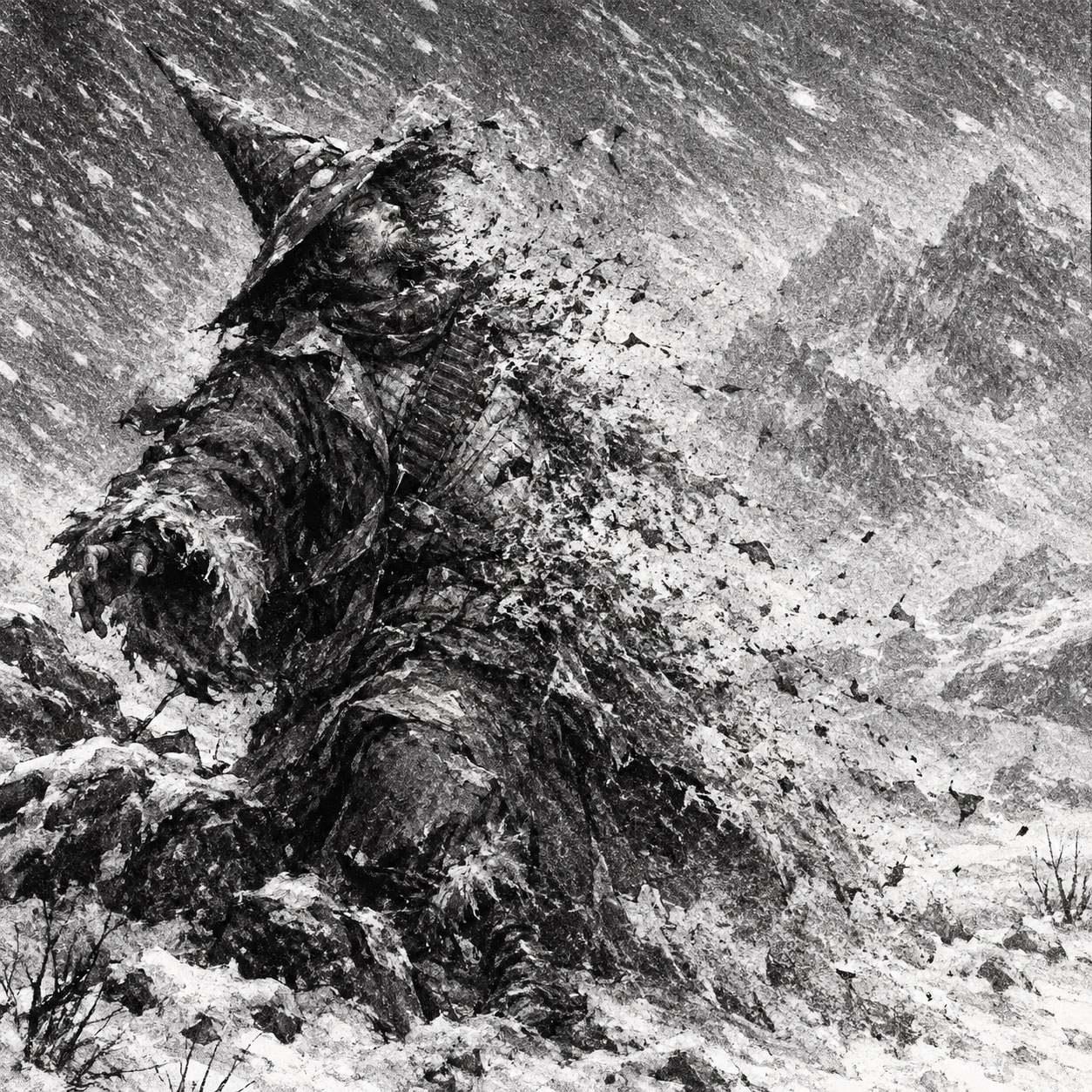
The fight began in a blur of cold breath and panic. Miquitzil threw up a fog cloud, and the world shrank to white noise and shifting silhouettes. It bought seconds, enough for Raine to squeeze free, enough for Felwar to drag Dzaan out like a half‑drowned man.
Bugbears pushed into the mist anyway. Two swung at Raine and found nothing but air.
The barking, frightened dogs, tightened something in Thelonius as he emerged from the tunnel. He stepped aside carefully, mindful of the black monster crawling upward beneath him. His voice stayed steady, hands already moving to cast cure wounds, a brief flash of desperately needed kindness in a place that had none.
Miquitzil circled the tower, dodging, measuring angles, keeping himself alive by inches. With his companions clear of the tunnel, he let the fog cloud dissolve.
Raine tried to shove and shift the line. Felwar answered with violence made precise—a cloud of hornets that chewed the space behind them, stinging one bugbear until it howled with rage.
Dzaan slipped away from the others, skirting the tower’s base. He lifted a hand and spoke a word that made the world heavy.
Slow.
Almost all of them were caught in it—muscles lagging, reactions dulled, aggression turned clumsy. Even their roars sounded wrong, almost humorous to Dzaan, if the situation weren’t so dire. It was the most powerful spell he had ever cast, and euphoria flooded him as the weave released.
“Yes, I could get used to this,” he muttered, his voice lost to the wind.
Thelonius snapped a thorn whip into existence and yanked a bugbear off balance. It stumbled, then toppled into the hole. A scream followed it down. Thelonius risked a glance at his companions, pleased his plan had worked, but they were too busy surviving to notice.
The scream didn’t last. Fifty feet below, the black pudding welcomed it like meat.
Miquitzil shifted again, eyes hard, and released a cone of binding cold—rime and killing ice. Two bugbears froze in place, armour and fur crusted white, their feet locked to the stone. Raine seized the moment and shoved another into the hole without ceremony. Thelonius laughed out loud.
“More—let’s feed all of them to the hole!”
Felwar drew his hornets back onto the bugbear that had staggered away, grinning as its pained howls filled the air. Thelonius stepped out of the crush and repositioned, risking a glance at the still‑tethered dogs. They were in no immediate danger, to his great relief. He cast another spell, and one of the slowed bugbears bellowed—a deep, resonant bass note. He didn’t know why they were moving so sluggishly, but he suspected the wizard’s hand and was grateful for it.
Miquitzil lashed out with witch bolt at the leader. The towering bugbear turned on him with unrestrained hatred, yellow eyes burning. Miq hastily conjured another fog cloud and slipped inside, hoping the grey curtain would keep it lumbering and blind long enough for the others to finish the rest and come to his aid.
But outside the fog, the fight had turned ugly. Some bugbears shook off Dzaan’s slowing magic; others cracked free of the ice Miq had locked around them.
One seized Felwar and squeezed—ribs grinding, breath stolen—shattering his concentration. The hornets vanished like they had never been.
Another swung at Raine and missed, the blow glancing off his armour. Thelonius hurled a starry wisp into the dark, a guiding spark that carried intent. More bugbears howled into the frigid air.
Raine broke away from the two he’d been fighting and drove toward Felwar—toward the fog where Miquitzil had vanished. He caught an opening as he moved and slipped his blade into a bugbear’s side.
Felwar misty stepped, the magic carrying him clear as it stitched his pain closed. He finished another bugbear that never saw him coming, the creature flinching as Felwar appeared behind it in the fog. A handful of Titania’s forceful seeds—then death.
The bugbear followed the witch bolt’s tether through the grey murk like a hunting dog, straight toward where Miquitzil crouched. It swung twice—wild, vicious—but the mist was thick and both blows went wide. Miquitzil clenched his jaw and sent another jarring surge down the tether, forcing the creature to bellow and stagger.
Outside the fog, the Brave Hearts had already begun to turn the tide. Raine broke away when the opening came, slipping a blade into a bugbear’s neck with cold efficiency. Felwar misty stepped into the mist, drawn along the witch bolt’s lightning thread like a breadcrumb trail through storm‑grey air. Beads clicked in his palm—then flashed—and something big stopped moving.
Dzaan emerged as often as he dared, lobbing glistening globes of acid over hunched shoulders and snarling faces before retreating again to his shelter at the base of the tower.
The last two bugbears, no longer seeing their leader in the press, faltered. Their nerve broke. They ran. One scooped up a stunned sled dog and bolted into the dark. Thelonius went after it without hesitation, starry wisps burning through the night like thrown sparks. The creature didn’t get far. When it fell, Thelonius gathered the dog into his arms and whispered soft, steady nonsense into its fur—a promise of warmth, of safety, of anything but teeth.
Up close with the bugbear leader, Miquitzil knew he stood no chance alone. He let the fog collapse, exposing himself on purpose, betting everything on speed and faith.
And his companions answered.
Raine charged as Miquitzil stepped deftly aside. Steel and frost moved together—Raine ducking a nasty blow by inches, Miquitzil’s ray of frost splashing across the bugbear’s shoulder and throat, leaving rime where blood should have been hot. Raine’s eyes narrowed. He lunged.
The sword slid in and out of the creature’s throat as cleanly as a lesson. Blood fanned across the snow, staining it dark. The bugbear dropped to its knees first, surprise frozen on its bestial features, then pitched forward and lay still, face‑down in the drift.
The snow settled slowly in the silence that followed. For a moment, no one moved. The only sound was the wet hiss of blood cooling on the ice and the distant, hungry churn of the pudding far below.
Raine stood over the leader’s body, breath steaming, blade still angled downward. He wiped it clean on the creature’s fur—a single, practiced motion—then sheathed it with quiet finality.
Felwar finished the last of the fleeing bugbears with an eldritch blast, then staggered, shoulders tight. His ribs ached where the creature had crushed him, but the pain felt far away—drowned beneath the fading echo of Titania’s magic and the sharp, metallic taste of adrenaline.
Miquitzil lowered his hand, the last crackle of witch bolt fading from his fingers. The fog had thinned around him, revealing the others through drifting grey. He looked small beside the fallen brute, but his eyes were steady. He looked up at Raine as the warrior tended to his gear.
“I am pleased you turned your back on that amulet. You are… a better man now.”
Raine stared at him for a moment, nodded once, then moved to where the other bugbears lay.
Thelonius knelt in the snow a short distance away, a trembling sled dog pressed against his chest. He whispered soft, meaningless comfort into its fur, his voice lost to the wind. The dog’s heartbeat fluttered against his arm like a trapped bird.
And it lived. That simple fact hit him like warmth. Joy—sharp, unfamiliar—flooded his throat and made him swallow hard. A month ago he would have shrugged at a dog’s suffering—might have laughed. A month ago he would have kept walking. Now he held on like the animal mattered, like it was a small piece of the world worth saving.
He shook his head at it—at himself—and kept whispering anyway.
Dzaan leaned against the tower stones, pale and shaking, the afterglow of slow still humming through him. He stared at his hands as if surprised they had obeyed him at all.
The spell was among the most powerful in his repertoire, and the casting of it—feeling the weave answer, intoxicating and absolute—filled him with fierce delight. And the knowledge that he could draw on that power again tomorrow, and the day after, made something greedy and grateful bloom in his chest. He tried to keep his face implacable, then decided it didn’t matter if the others saw his joy.
They had made him real.
He would be forever thankful to them.
No one spoke. The cold did the talking.
They gathered themselves slowly, as if waking from a shared dream.
Thelonius checked the other dogs, running gentle hands over fur and bone. None were dead. Some were bruised, shaken, terrified—but alive. He let out a breath he hadn’t realised he’d been holding.
One dog—the youngest bitch—favoured her foreleg, the muscle pulled tight and angry. Thelonius crouched beside her and drew the magic from his cloak, letting it settle into his voice.
He spoke to her in the language of dogs—scent and intent, warmth and promise. “You ride. No shame. Pack protects pack.”
Then he turned that same quiet certainty on the others, speaking so they understood: she would ride on the cart, and the rest would pull. The injury would heal cleaner with rest, and the team would hold together.
Raine and Felwar dragged the bugbear leader’s corpse away from the hole. The others they pushed in without ceremony, letting the darkness swallow them.
The leader they searched carefully—weapons, scraps of hide, a few crude tokens. Nothing that explained why it had come.
Perhaps it was bad luck. Perhaps the creature had caught the dogs’ scent on the wind and followed it like a promise of easy meat. Whatever the reason, it was terrible timing—and that small, ugly logic made the fight feel a fraction less senseless.
Miquitzil stood apart for a moment, fingers brushing the new medallion beneath his furs. It tugged faintly—southward, insistent. He said nothing, but the pull lingered in his expression.
“Somewhere in the Spine of the World, then,” he murmured. “My guardian golem awaits collection.” He paused, listening to the medallion’s stubborn insistence, then added, quieter, “But it will have to wait a little longer.”
Dzaan tried to steady himself as the Brave Hearts prepared to leave. He spoke of his master’s stolen spellbooks and swore he would head to Easthaven to reclaim what was his. He attempted a simple ritual—just to feel the weave again—but his frozen hands trembled, and the magic slipped through his grasp like water. Being human meant he felt the cold far more keenly than he ever had as a thing of ice and ruby dust. He cursed softly.
“Gloves. I have to buy some gloves.”
He shoved his hands deeper into his borrowed jacket.
They rested in the lee of the tower, sharing what warmth they could. The wind off the Reghed Glacier tore and gnawed at them, but the tower took the brunt of it, and soon enough the shaking passed. When they finally rose to leave, the sky had darkened to a bruised blue. The dogs were eager to run but had to be held back—there were too many humans to safely sled with only one dog down. So, with the wind at their backs, they huddled close and made their way toward Caer‑Konig, boots crunching through the hardening snow.
Several hours into the journey, Dzaan made a sound that stopped everything.
It wasn’t a shout or a curse or a cry for help—it was a pained, ragged howl dragged out of him like something being torn loose. The lead dog pulled up short, hackles rising, and the whole line went tight and trembling as if the sound had snapped a nerve.
Dzaan held up his hands. For a heartbeat they were just hands—pale, shaking, human—and then they began to go wrong. Skin slackened as if the bones beneath had decided to leave. Fingers softened, sagged, slid. The first drops fell in fat, coin‑sized black puddings that plopped into the snow and sat there, obscene and alive.
He tried to breathe. His breath hitched. His legs followed his hands, melting out from under him. He lurched, knees folding, and his mouth opened again, but whatever he meant to say drowned in the wet sound of him coming apart. His face blurred at the edges like wax held too near a flame, his torso breaking down in slow, awful layers—like a sculpted thing returning to sludge.
Within seconds he was gone—just a pile of borrowed winter clothes and a scatter of tiny black puddings across the snow. They curdled and crinkled in the frigid air, too small to survive, twitching their last before the Dale finished them.
Thelonius stepped forward and kicked at the pile of black things, scattering them. “Dzaan?” he asked, meekly, not quite believing what he’d seen.
Miquitzil knelt and pinched a dead pudding between gloved fingers. He remembered the cracks in the wall of the illusion chamber, and it all fell into place. The magic was broken. Maybe it had worked when the tower was whole, but now it was imperfect, and the life it gave Simulacrum Dzaan was sadly fleeting.
“He had hours as a real man,” Miquitzil said, looking up at the others as they gathered around, “and I think he would’ve taken that trade.”
Felwar added, “He used his magic, too. That seemed to light him up—for a time, anyway.” His voice trailed away.
Thelonius swallowed. “I… I don’t understand. Are you saying he’s gone? Dead?”
Miquitzil nodded, solemn.
Thelonius shook his head, as if he could dislodge the truth. “Imagine spending the last four or five hours of your life scrambling in terror from a murderous black pudding, only to be ambushed by a pack of bugbears, then trudging for hours in this cursed wind, frozen to the core. Then you just… well… cease to be.”
“It is sad,” Miquitzil said. “I was looking forward to talking to him at that tavern in Caer‑Konig.”
Raine was fumbling in his gear atop the sled. “The diamonds are still here.”
“For now,” Miquitzil said. “Keep an eye on them. If they start to turn, empty them onto the snow. We don’t want a black pudding forming on the sled.”
Sure enough, just as the dim lights of Caer‑Konig came into view, the diamonds began to pop and shift. Raine called the sled to a halt and tipped the bag into the snow.
A cascade of diamonds—enough for all of them and their families to live in luxury for generations—spilled out. Some turned to black puddings as they fell. Others changed when they landed. Raine scattered them with his boot, grinding them into the drift, making sure they all died.
“Well,” he said, staring at the ruined fortune, “that sucks.”
The others said nothing. There was nothing to add.
As they approached, it was clear Caer‑Konig was not the same small town they had left weeks ago. Boarded windows, nets strung between buildings, makeshift barricades of crates and broken furniture.
Fear had reshaped the place.
Thelonius used the last of his magic to summon his familiar and sent the fey beast out to scout. Owly circled overhead, then swooped low to report: tripwires, pots and pans, crude alarms strung across the three main entrances. Someone had been busy.
They circled the town and stabled the dogs in a shed at the abandoned farm a short walk away—the same place the duergar thieves had been discovered. With the dogs groomed, fed, and secured, they headed into Caer‑Konig.
Felwar kept his voice low. “Let’s be careful. Tripwires we know—but there could be bear traps under the snow, spikes, anything. We make for that tavern… what was it called?”
“The Northern Light,” Raine said.
Felwar nodded. “Then we find Trovus and find out what the hell is going on here.”
“If he’s sober,” Thelonius said.
Felwar smiled at that, but he knew—even as drunk as they’d seen Trovus—there was always a clarity of thought just below the surface. That man could be drowning in ale and keep one hand on the truth. He was confident the white dragonborn would have answers.
And then the thought tried to crawl in—his mother’s face, the stink of old drink, the way love can sour into something you step around on the floorboards. Felwar shut the door on it at once. Not now. Not here. He had learned young that drunkenness wasn’t always a joke, and he wasn’t about to hand that wound the knife again.
He drew a breath of ice‑cold air, let the ache settle back into its cage, and kept walking.
The magical lantern shone brightly as they approached the tavern, and they all felt a small surge of pride knowing their part in its return. They stepped into the Northern Light’s warm, smoky air.
The room erupted as the locals recognised the Brave Hearts. They swarmed the four adventurers even as they tried to shake the snow from their cloaks—claps on shoulders, embraces, even a kiss on the cheek. Mugs were raised in their honour, voices calling their names and demanding stories of what marvels they’d seen. Even Trovus, drunk and slumped in his usual corner, managed a proud, slurred greeting.
When they finally settled into his booth, he told them about the duergar he’d caught. About the traps. About how clever he’d been. He laughed too loudly, but there was fear behind it.
“Come, I’ll show you,” the dragonborn said. “I’m quite proud of ourselves for catching such a thing.”
Raine frowned. “What did you plan to do with it?”
Trovus scratched the back of his neck, thinking. “I… ah… well, I knew you four would be back eventually,” he said at last. “Reckon you might want to ask it a question, or ten.”
He led them through the darkened streets toward the barn, boots crunching on hard snow, lantern light catching on nets and boards and all the ugly little defences the town had stitched together.
“We caught him in a net to the south of town,” Trovus said, pride and drink wrestling in his voice. “Bells and all sorts of alarms—so we came running pretty quick. The fool tried to enlarge to snap the net, too.”
He paused to grin over his shoulder.
“But this was a knucklehead net,” he added, as if that settled the matter. “Not so easily torn.”
Raine glanced around at the clatter‑traps and tripwires. Thelonius said nothing, but listened the way he listened now—like every detail mattered.
“By the time we arrived,” Trovus went on, “it went invisible—but we were ready for that too.” He jabbed a clawed thumb toward a line of buckets stacked near a doorway, each covered with a tarp to keep the snow out. “Ash. Dry as a sermon. You throw a bucket on the invisible blighter and—with the moisture in the air—it sticks. And voilà—no more invisible duergar.”
He seemed pleased with himself for saying voilà. He took a swig to celebrate.
They reached the barn. Two locals stood guard inside, crossbows loaded and within easy reach. A brazier crackled between them, doing its best against the cold and making the barn merely tolerable.
Trovus ushered the Brave Hearts inside and closed the door behind them.
The smell rolled out: hay, cold iron, and the sour musk of fear.
Raine’s eyes went first to the table by the wall—the duergar’s gear laid out like evidence. Winter clothes, yes, but not the sort surface folk wore. Not patched furs and thick wool and honest stitching. This was darker work: cloth treated against damp, seams too neat, fastenings of blackened metal instead of bone or horn. The coat was tight and practical, built to move without snagging, to keep heat in and noise down. The sack beside it was the same—tough, compact, made for stone passages and hard travel. Even the hood, folded beside the coat, looked wrong—shaped to sit close, made for someone who expected cold but not open sky.
Then they saw the duergar.
It sat bound to a post in the straw, stripped of its travelling kit and left with only the basics—enough cloth to keep it alive, not enough to give comfort. It wasn’t slumped or defeated—not quite—but it held itself with that tight, cornered tension, like a rat deciding whether to bite or beg.
The thick iron collar around its neck was clamped shut and bolted straight into the post. An inch on either side of its throat meant the collar wasn’t worn, exactly—but there was no way to pull its head free. Iron manacles, riveted shut, bit at wrists and ankles, chains kept short so it couldn’t build leverage or speed. Raw marks showed where it had tested the iron and found it didn’t care.
Trovus stepped in just far enough to point, pride warming his slur without tipping into showmanship.
“See,” he said, tapping the collar with a claw. “Not fancy. Just solid. He tries to grow, he’ll jam himself hard—collar’s fixed to the post, bolt goes all the way through. But if he tries to go small, the irons shrink with him, and they’re bolted to the same damned post. See? He’d be small, sure—but still chained. Still mine.” He glanced at the duergar, baring his massive canines, then back at them with a smile. “And he knows any attempt at foolishness will make me very unhappy. I watched him the first two shifts to see if he’d try anything clever. He didn’t.”
The duergar’s eyes flicked from face to face—measuring, calculating—but its mouth stayed shut.
Trovus took another swig, some of it splashing down his scales. Thelonius smelled the cheap liquor immediately—sharp, familiar, ugly. Once, it would have made his body ache with want. Now it turned his stomach. He sidled away from the dragonborn, putting ten feet between them. He looked aside, surprised by his own reaction, and didn’t look back.
Trovus wiped his mouth with the back of his hand. “He’s your prisoner. Do what you want, Brave Hearts.” He waved the bottle toward the captive like he was presenting a prize fish.
“He doesn’t talk much,” he added, voice dropping. “Maybe you’ll have better luck.”
Miquitzil slipped into Dwarvish—the tongue came easily to him. “What are you doing here?”
The duergar’s eyes narrowed. In broken Dwarvish it replied with a sneer, “Let me out.”
Miquitzil translated, and the others funnelled their questions through him. The duergar refused to answer any of them plainly, instead demanding to be freed. It worked hard to sound confident despite its predicament, and that effort—that strained performance—was unsettling.
Felwar stepped closer, boots crunching in the straw. “You will die here,” he said softly. “Slow or quick. That part is up to you.”
The duergar’s jaw worked. The sneer stayed on its mouth and nowhere else. Under Felwar’s stare it tried to hold its shape—measuring them, searching for weakness.
“You’ll get nothing from me,” it spat in Common. “Let me out.”
It found no weakness.
Raine’s hand went to his sword.
Thelonius shifted on instinct, as if his body meant to put itself between the blade and what came next. “Wait—no. We can’t just—”
Raine moved before the sentence finished, and before the creature could speak again. One clean, decisive motion—steel whispering through cold air. The head hit the straw with a dull, almost anticlimactic thud. The body slumped a heartbeat later, twitching once before going still.
Raine spat. “Evil must die.”
Thelonius stood as if someone had struck him. Not because he hadn’t seen death—he’d seen plenty—but because it had come so quickly, so casually, like swatting a fly. He looked from Raine to Felwar, then to Trovus with his bottle and his breath and his quiet approval, and something in him recoiled. Not fear—something worse. Recognition.
Raine turned away as if the matter were closed, already moving toward the table to examine the duergar’s belongings.
Silence settled over the barn like frost. Thelonius stared at the corpse, his expression caught between shock and a bitter, embarrassed shame he didn’t have words for. Finally he raised an eyebrow and spoke, louder than he meant to.
“We didn’t commit torture,” he said, voice low and flat. “So I guess we’re the heroes, right?”
No one contradicted him. No one agreed.
Trovus nudged the severed head with his clawed foot and burped. “I could’ve done that,” he muttered to himself.
He gestured to the two guards, and they set to work with a wheelbarrow, shovelling what was left of the duergar into it like refuse. When they trundled it out toward the pig sty, the Brave Hearts heard the animals surge forward—snorting, squealing, the wet tearing sounds of hunger meeting meat.
Thelonius swallowed hard. For a moment he thought he would vomit. He didn’t. He forced it down because he had to, and because there was no room for weakness here—but the revulsion stayed. This wasn’t squeamishness. It sat in him like a splinter under the nail, deep and raw, because what he’d just seen felt wrong to his core.
“Nothing much here,” Raine said at last, sorting through the duergar’s things with the calm of a man inventorying tools. “Some food. Some strange cloth—slick stuff, treated, almost like oilskin, but darker and tougher.” He held up a folded piece and let it fall back to the table. “And this is interesting. A map of Icewind Dale.”
He spread it out. Not all of it—just the eastern towns. Good Mead. Easthaven. The two Caers. Kelvin’s Cairn marked with a rough symbol and words in the duergar tongue. And a marking on what was obviously Nildar’s outpost.
“It’s worse than the one we got from the Easthaven ferry,” Raine said, frowning. “Far less detail. Less everything. The scale is all wrong.”
Miquitzil leaned in. “What do you think that means?”
Raine shrugged. “No idea. It’s just curious. Why would they have different maps?”
Felwar looked up at Trovus. “Where did you catch him?”
“Entering town,” Trovus said, wiping his claws on straw like that counted as cleaning. “From the south.”
There was nothing more to do inside the barn. Outside, snow had begun to fall again—thin drifting flakes that caught in Felwar’s hair as he stepped away from the trough. He wiped his hands on his cloak though there was nothing on them. Habit, not need.
Thelonius lingered by the barn door, jaw tight, eyes fixed on the churned snow where the duergar’s blood had already begun to freeze. His breath came out in slow, controlled clouds. Somewhere close, the snorting from the pig sty had finally faded, but the memory of it still crawled under his skin.
Felwar broke the silence first. “It was a mercy,” he said, voice low but steady. “An execution. Clean. Quick. Better than what he would’ve done to any of us.”
Thelonius didn’t look at him. “You’re dressing it up.”
Felwar frowned. “I’m stating the truth.”
“No,” Thelonius said, turning now, eyes sharp. “The truth is we killed a bound creature that couldn’t fight back.”
“He chose that,” Felwar said. “He had a chance to speak. To bargain. To give us something.”
“He was terrified,” Thelonius snapped. “You saw it. He was cornered and alone and—”
“And dangerous,” Felwar cut in. “You think he wouldn’t have slit your throat the moment you loosened the iron? You think mercy means letting a threat walk free?”
Thelonius stepped closer, boots crunching in the frost. “Mercy means not becoming the thing we’re fighting.”
Felwar held his ground. “Mercy means ending suffering when there’s no other path.”
“That wasn’t mercy,” Thelonius said, voice dropping to a rough whisper. “That was convenience.” He wanted to say murder. The word sat behind his teeth like bile.
A muscle in Felwar’s cheek twitched. “You think I wanted this?”
“I think you’re getting comfortable with it,” Thelonius retorted, anger cracking through his control.
The words hung between them, sharp as ice.
“The polar bear and walrus exist in endless struggle,” Miquitzil said—and they both jumped, not hearing his approach. His words cut through the heavy silence. “If the walrus has a chance to take the polar bear out with a tusk, it does so without pause. The duergar made his choice. So did we.”
“Argh,” Raine said, pushing past them toward the tavern. “It’s too blood‑cold out here for this philosophical crap. The thing was evil and we kill evil. It’s pretty simple. I’m going somewhere warm. Maybe even take a bath.”
The Brave Hearts returned to the Northern Light for a long‑overdue break. Raine, true to his word, arranged a bath, and Thelonius was in no mood to socialise. He went to bed, leaving Miquitzil and Felwar in the common room.
Miquitzil poured two glasses of drink, then slid one to an empty chair.
Felwar raised an eyebrow. “Who’s that for?”
“Dzaan,” Miquitzil replied softly.
The tavern had settled into its late‑night rhythm—low voices, clinking mugs, the soft thud of boots on old floorboards.
Felwar sat near the hearth, letting the warmth soak into his bruised ribs. For the first time since the tower, the world felt still.
That was when he heard it.
A single line of melody, thin as a thread of ice. A woman’s voice, distant, almost tender. Just a bar—no more—but enough to freeze him in place.
Felwar’s head snapped up. His eyes swept the room. A pair of fishermen murmured over their drinks. A group of hunters argued about traps. Trovus snored into his mug.
None of them were singing.
But the sound persisted—faint, curling at the edge of his hearing like smoke. The same phrase, the same fragment, looping.
Felwar stood abruptly. The bench scraped. A few patrons glanced over, startled. He ignored them and was about to cross the room when Miquitzil placed a hand on his shoulder.
“What is it, Felwar?” Miquitzil asked. His cup steamed, carrying the odour of fish and something bitter.
Felwar frowned. “Do you hear it? That song?”
Miquitzil blinked, studying him with that quiet, analytical stillness of his.
“No.”
Felwar’s jaw tightened. “Someone was singing. Over there.” He gestured toward the hunters. “A woman’s voice. I heard—”
Miquitzil shook his head once, gently. “No one sang.”
Felwar swallowed. The melody was still there, faint but insistent, like a memory trying to claw its way out of his skull. “It’s happening again,” he murmured. “Same as before. When things go quiet.”
Miquitzil set his cup down and motioned for Felwar to sit. When he didn’t, Miq tugged lightly at his sleeve until he relented.
“Close your eyes,” Miquitzil said.
Felwar hesitated, then obeyed.
“Now breathe. Slow. In through the nose.”
Felwar inhaled. The song wavered.
“Hold it.”
The melody thinned, like frost melting.
“Let it out.”
Felwar exhaled shakily. The voice dimmed to a whisper.
Miquitzil watched him carefully. “It’s not coming from them,” he said. “It’s coming from you.”
Felwar opened his eyes. “That doesn’t make it better.”
“No,” Miquitzil agreed. “But it means you can influence it.”
Felwar frowned. “How?”
“By not chasing it,” Miquitzil said simply. “By not giving it shape. Let it be noise. Let it pass like wind through a crack.”
Felwar tried. He closed his eyes again, breathing as instructed. The melody fluttered, resisted, then slowly—reluctantly—faded into the background hum of the tavern.
When he opened his eyes, the room looked the same, but he felt different. Lighter. Or maybe just less hunted.
Miquitzil picked up his cup again. “It comes when you’re calm,” he said. “When your mind has space. That means it’s not a command. It’s an echo.”
Felwar rubbed his temples. “An echo of what?”
Miquitzil’s gaze softened. “Something old. Something that touched you once. But echoes can be quieted.”
Felwar let out a long breath. “Thank you.”
Miquitzil shrugged, but there was warmth in it. “We all have things in our heads we didn’t ask for.”
Felwar managed a thin smile. “Yours doesn’t sing, I hope.”
“Not yet,” Miquitzil said, and took another sip.
The tavern noise swelled around them again—laughter, clattering mugs, the crackle of the hearth. Ordinary sounds. Safe sounds.
And for the first time that night, the song stayed silent.
Morning—such as it was—came reluctantly to Caer‑Konig, a thin grey light pushing through the tavern shutters. The fire had burned low, leaving only a bed of sullen embers. Trovus was already awake—or at least upright—nursing a mug of something hot and bitter that steamed around his snout. He waved the Brave Hearts over with a heavy, frost‑cracked hand.
“Tell me about Caer‑Dineval,” he said, voice rough from drink and sleep. “What’s really happening there?”
Felwar didn’t soften it. “Devil worship,” he said simply. “The whole place is compromised.”
Trovus blinked, then let out a long, weary exhale. “Devil worship,” he repeated, as if tasting the words. “Gods. What a mess.”
He rubbed at his temples, the weight of leadership settling on him like fresh snow. “Bryn Shander needs to hear this. They won’t like it, but they need to.”
“They know,” Raine said. “And they’re determined to root it out.”
“Pointless waste of lives,” Felwar added. “I tried to talk them out of such foolishness but—”
“But Speaker Duvessa Shane wouldn’t be talked out of it,” Trovus finished, with the tired certainty of a man who’d seen too many proud people dig in. “We’ve got evil on one side and stupidity on the other. Hard to say which is worse.” He took a breath and looked at them properly. “I need to go there. Maybe she’ll listen to me.”
“I wouldn’t advise taking that road alone,” Felwar said. “It’s not safe out there anymore.”
Trovus nodded once. “I see. Then why don’t you take me?”
“We’re heading north,” Raine said. “To the duergar outpost. We’ll take you once we come back.”
“If we come back,” Thelonius muttered, still refusing to meet Felwar’s gaze.
Felwar paused. Something tugged at him—memory, instinct, or something stranger. He turned back to Trovus. “The duergar you caught. Which way did you say he entered town, again?”
Trovus pointed with his mug, sloshing a little hot liquid onto the floorboards. “South entrance. Tracks came straight up the road. Bold little bastard. Why do you ask?”
“One of the duergar in Easthaven escaped,” Felwar said.
Raine cut in. “No, I was up close with that one from the ferry. He wasn’t our headless fellow, that’s for damned sure.”
Thelonius shot Felwar a sharp, sour look. “Either way, bit late to ask him, eh?”
Felwar ignored it and turned back to the towering dragonborn. “We’re not sure how long before we come back. Promise you won’t try and make the trip without us.”
Trovus nodded. “Aye.”
The road north of Caer‑Konig wasn’t a road at all—just the suggestion of one, a faint depression in the snow where sleds and boots had passed weeks ago. The Brave Hearts followed it anyway, breath steaming in the brittle morning air. The wind came down, as it always did, off the Reghed Glacier in long, hollow sighs, carrying flecks of ice that stung the skin like thrown sand.
Raine took the lead, shoulders hunched against the cold, eyes narrowed to slits. He moved with the steady, stubborn rhythm of someone who had walked too many hard miles to be impressed by a few more. Behind him, Felwar kept one hand tucked inside his cloak, fingers brushing the bag of seeds at his belt as if counting them kept the cold at bay.
Miquitzil walked a little apart from the others, gaze drifting often to the south, where the medallion’s pull had first stirred. Now it was quiet, but he felt its memory like a bruise beneath the skin. Every so often he paused, scanning the horizon, listening for something only he could hear.
Thelonius trudged beside the dogs, murmuring encouragement whenever one faltered. Their paws punched through crusted snow with soft, pained whines. He stopped often to check their pads, brushing away ice, speaking warmth into their ears in the language they understood. The dogs leaned into him instinctively, trusting him more than the wind or the sky or the land itself.
The world grew emptier the farther they walked. Caer‑Konig’s scattered lanterns vanished behind them, swallowed by rising drifts. Ahead lay only white—white and the jagged silhouette of Kelvin’s Cairn, its peak lost in a crown of storm cloud.
Tracks appeared now and then: a hare’s frantic zigzag, the scattered pinpricks of ptarmigan feet, the heavy, deliberate prints of something large that had passed in the night. None of it was comforting.
At one point Raine raised a hand, halting the group. He didn’t point at anything obvious—just stood still, head slightly tilted, eyes narrowed as if the wind itself had said something.
Then he moved a few steps off their line and crouched. In the snow lay a small scatter of stones, half‑sunk and half‑frosted. Natural at a glance. But Raine’s gloved thumb brushed one aside and revealed the tell—a deliberate placement, a shallow wedge of rock angled the wrong way, set where it would only make sense to someone looking for it.
Not a cairn.
Not a flag.
Just a quiet nudge.
A direction.
Felwar crouched beside him. “Recently?”
Raine snorted, not unkindly. “Impossible to tell. The snow here makes everything a damned mystery.”
Thelonius glanced at the stones. “Is there any indication how many dark dwarves we will find?”
Raine shrugged. “Can’t say.”
“As long as we don’t need to head back up there,” Miquitzil said, eyeing Kelvin’s Cairn—the mountain that had almost claimed his life.
They pressed on. The land sloped upward, the snow deepening with every step. The wind sharpened, threading through their clothes, biting at exposed skin. The dogs began to lag, and Thelonius lifted one into his arms without complaint, cradling it against his chest as he walked.
By midday the sky had darkened to a bruised violet—the sun still stolen these days, the world never truly bright, only less oppressive than the night. The mountain loomed closer on their left now—a vast, frozen wall rising from the earth, its flanks carved by ancient avalanches and the slow, grinding patience of ice.
Somewhere near its base, hidden in folds of rock and shadow, the duergar had carved out a foothold. A place to gather. A place to plan. A place that needed to be found.
Raine tightened his grip on his sword hilt. Felwar adjusted his cloak. Miquitzil’s breath fogged in front of him, steady and controlled. Thelonius whispered to the dog in his arms, promising warmth, promising safety, promising things he wasn’t sure he could give.
The Reghed Glacier wind howled across the tundra where it bounced off Kelvin’s Cairn, swirling and kicking up snow. It was cold enough to burn.
They kept walking until a valley opened up before them.
Disclaimer
This is a work of fan fiction. All relevant characters, locations, and settings remain the property of Wizards of The Coast (WOTC) and the story contained here is not intended for commercial purposes.
I do not own Dungeons and Dragons (D&D) or any of the related characters. D&D is owned by WOTC (and its parent companies) and all rights of D&D belong to them. This story is meant for entertainment purposes only.