Session 4
Delicate Discussions
The walls of Targos rose out of the wind like a clenched fist. At the gates, guards in frost‑stiff leathers took names for the lottery with the bored efficiency of men who had done it too often.
At the gates, their names were taken with the same care some towns used for birth records. Raine noticed how the guards checked them twice, lips moving silently as they counted. The new moon was important. For some towns, that meant cold hearths. In others, empty storehouses. In Targos, it meant something worse.
“How long before the next New Moon?” Miquitzil asked, interrupting the man’s flow.
The sour‑faced guard sneered. “When do you reckon?” he spat. His fingers drummed once on the ledger. “You don’t forget the moon in this town.”
Luckily, not every guard was built from spite and gristle. A younger one, less bitter and more talkative, gave them a rough orientation and pointed them toward the Luskan Arms.
“Speaker Naerth drinks there most afternoons,” he said. “Says he’s keeping an eye on the docks. Looks more like he’s keeping an eye on the good whiskey to me. Follow the lake. You can’t miss it.”
On the road down toward the harbour, they passed Torrga’s travelling market set up near the frozen docks. Raine recognised the layout before he saw the faces, the sleds, the tarps, the way the guards stood.
“There,” he said. “Torrga Icevein. Torg’s.”
Torrga herself was a thin female dwarf with an I‑am‑always‑too‑busy scowl and a no‑nonsense manner. Even from across the street, they could feel her irritation at anyone who dared breathe near her stock without paying. The long‑ponytailed man in the open shirt was there too, still dressed like he had taken a wrong turn on the way to a summer fair. The cold did not seem to touch him until, as if catching himself being watched, he shrugged into a winter coat in one smooth, practised motion.
Just beyond, a wild‑eyed zealot held court on a crate, preaching to almost no one. Aside from the party, only two locals listened, both with the glazed look of people too tired to walk away.
“Many in Ten‑Towns huddle in hovels and beg for mercy,” he shouted, voice cracking the air. “But Auril does not heed mercy. She heeds obedience. The Forever Winter will end only when every town swears the rite. Lotteries and sacrifice. That is the path. The only path.”
He jabbed a finger toward the sky. “Let blood mark the snow, or watch your children freeze in their cradles! Petition your Speaker! Demand a vote for universal sacrifice at the Speakers’ Council. There is no other way!”
When someone asked if his own name went into the lottery, he looked genuinely offended that the question even needed asking.
“Of course,” he said. “My divine obligation is to offer my name. It is everyone’s joint responsibility. We should embrace, nay, celebrate being on the list. Every new moon, the Speaker draws a name at dawn. That night, the chosen burns upon the lake. Such is the Frostmaiden’s will.”
It was not comforting doctrine.
The Luskan Arms sat overlooking the lake like a half‑sunk ship. It was the oldest public house in Ten‑Towns, built when Bryn Shander had been nothing but “the camp on the hill” and Luskan still sent sleek, crowded ships up the coast.
Inside, the place was a museum of better days. Cracked wood panelling and faded carvings lined the walls. Nautical trinkets, ship wheels, rust‑flaked lanterns, old nets, hung yellowed with age. Behind the bar, a line of crude but oddly lovely paintings showed the pub in warmer times. In some, the building glowed from within, windows bright, the sign freshly painted. In others, sunlight glittered across blue water, white sails sharp against the sky.
It was a Targos that barely existed anymore.
The floorboards creaked under every step. A cold draft rose from the cellar. The air reeked faintly of mildew and pipe smoke. Somewhere in the walls, rats scurried constantly, and occasionally scuttled bold as you please across the floor. Even so, the Luskan Arms had a weary charm. A relic that refused to lie down.
The party waited.
Eventually, the door to the back opened, and Captain Skath emerged. He was a tall tiefling with ash‑grey skin, curling horns, and a soldier’s posture. Beside him walked a broad‑shouldered, red‑bearded man Skath called Shandar. Whatever conversation they had just finished had not been friendly. At the threshold, Skath jabbed a finger into Shandar’s chest to drive the point home.
“Do not mess this up,” he said.
Then Shandar was gone, and Skath turned his amber eyes on the party.
“Felwar. Raine,” he said. “Speaker will see you now.”
He led the group upstairs to the Speaker’s private quarters.
Naerth Maxildanarr’s chamber looked like it belonged in a wealthy southern manor, not a wind‑scoured fishing town.
Rich, dark wood panelled the walls, southern timber, oiled and polished to a mirror sheen. A long mahogany table dominated the room, ringed by high‑backed chairs upholstered in cracked leather and brass studs. There were no antlers, no hunting trophies, no knucklehead trout mounted on plaques. Instead, oil paintings showed rolling green hills, sunlit vineyards, a masked ball in some distant warm city.
Raine recognised a silver decanter from Luskan, and a ceremonial Waterdhavian blade resting in a glass case. Near the hearth stood an ivory‑inlaid vase from Neverwinter, flanked by books bound in suspiciously smooth leather. The fire burned clean and constant with no woodpile in sight. Above the stone hearth, in giant script, a single word: Everburn.
Near the window, a lacquered side table held a large, cloth‑draped shape, chest‑sized, crisp corners, edges tucked with care. Raine’s eyes snagged on it for a moment, wondering, then moved on. The liquor cabinet in the corner pulled his attention harder. Glass doors, crystal decanters, bottles older than many men and worth more than most houses in Bremen.
It was, undeniably, a Speaker’s chamber. Just not the sort any of them had expected this far north.
They handed over Dorbulgruf’s letter from Bremen and laid out the situation in plain terms: the murdered man, the impossible ice blade, the talking lake creature that seemed to target only Bremen’s boats, and the collapse of the town’s fishing.
Naerth read the letter once, lips pursed, then passed it to Skath. The captain’s eyes flicked across the page, expression unreadable, before he handed it back.
Felwar and Raine spoke while Skath sat slightly behind and to Naerth’s right, silent, attentive, focused. Brief glances passed between the two men, quick, practised, full of meaning that did not reach the strangers at the table. Raine clocked them but could not read them.
At last, Naerth gave a sympathetic nod.
“Of course we will help our neighbours,” he said. His voice was smooth, the sort that had practised speeches in expensive rooms. “We are a community here in Targos, and Targos is part of the wider Ten‑Towns. We are in this together, though some of my peers seem to forget that from time to time.”
He spread his hands. “Are the people of Bremen, our nearest neighbours, not entitled to the same basics every community relies on? Safety. Warmth. Shelter. The means to feed themselves. Yes, I think so. In times as dire as these, we must all pull together. While their need may exceed Targos’ ability to assist as fully as we would prefer… we will do what we can.”
He turned, almost lazily, to Skath. “Make the necessary arrangements. I think some boats from dock two can be made available. That newly rebuilt warehouse, convert it to short… no, medium‑term accommodation until we get a handle on this thing in the lake.”
Skath inclined his head, all sharp obedience.
Felwar and Raine thanked the Speaker. Naerth wished them well in whatever they were doing next. It was the sort of polite dismissal that sounded like kindness if you did not listen too hard.
Skath arranged rooms for the party without ceremony. There was no false warmth in it, but no insult either. He also said he would see that the murder victim’s body transported on to Bryn Shander alongside them, as per Dorbulgruf’s wishes.
Felwar kept the Bryn Shander scroll, promising to hand‑deliver it. One more promise to stack on top of the others.
The Luskan Arms had a bottomless bar and kitchen, and the innkeeper seemed eager to impress the Speaker’s guests. The Brave Hearts showed a measure of restraint. Miquitzil did not. He made short work of unattended scraps, stuffing leftovers into flasks and pouches like a man who had known genuine hunger and did not intend to shake its hand again.
“Waste not, want not,” he muttered, cheeks full.
Thelonius kept his distance from the hard stuff. He drank, but carefully, as if one extra cup might suddenly turn his skin to fur or his hands into tentacles. He did not joke about it. The others did not push.
Felwar grew restless in the taproom. His eyes kept drifting toward a table where three fishermen sat drinking. There was a furrow between his brows, the others had learned to recognise. The look he got when some old memory was whispering.
Then one of the fishermen hummed a fragment of a song.
Felwar stood so suddenly his chair skidded back. He crossed the room in three strides and planted himself at their table, eyes locked on the one who had been humming.
“What did you just sing?” he asked, voice too tight to be casual. “Say it again. That line you sang, what was it?”
The men exchanged glances. One decided this was nonsense and not worth his time.
“Jog on,” he said, lifting his cup. “Stick to goat’s milk.”
They laughed. Felwar did not move. For a moment it looked like he might push it, then he clenched his jaw, stepped back, and walked away.
He did not explain. Maybe he could not. For months he had been haunted by a song he could barely remember, fragments and echoes, a frostburn in the mind. For the first time, he had heard a snatch of melody that felt as though it belonged to that same impossible tune.
Then it was gone.
The next morning, as they were breaking their fast, Skath crooked a finger at Raine from across the room.
“Walk with me,” he said.
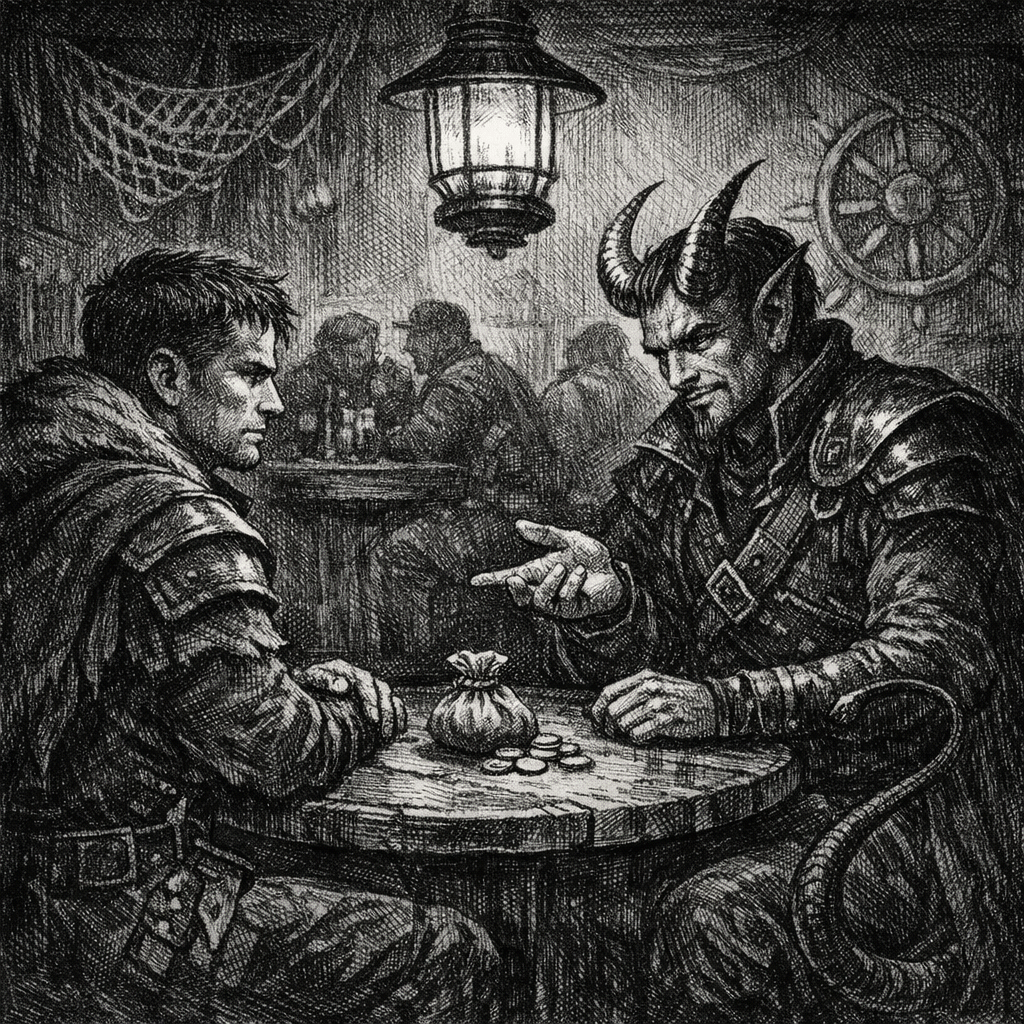
He led Raine to a corner table away from the main noise and sat without flourish. No small talk, no games. When he spoke, his voice was flat and practical, like a man discussing supplies.
“Not bad for outlanders,” Skath said. “You didn’t make fools of yourselves in front of the Speaker. That counts.”
He slid a small pouch of coins across the table.
“Call that a token of goodwill. A nod to your restraint. Maybe even a quiet encouragement to keep choosing your battles wisely.”
His tail flicked once, then stilled.
“Targos and Termalaine are in the middle of delicate discussions. The kind where timing matters. Where too many curious hands just make things worse.” His yellow eyes held Raine’s. “Their mine is their problem, and it needs to stay that way for now. They look inward. That has consequences.” He shrugged, armour creaking. “I imagine you and your friends have good instincts. Rushing in, swords drawn, hearts full. That would be… unhelpful. Disruptive.”
He pressed the pouch into Raine’s hand when the fighter made no move to take it.
“Your path is your own. No one is stopping you. But in Ten‑Towns, those who know when to step back are the ones invited deeper in. Targos keeps its doors open… to those who understand how things work.”
He leaned in, voice dropping.
“One more thing. There’s talk of a magical cauldron, something that could ease the worst of the hunger. The Speaker wants it used for the people, not to keep the tables of the elite full. You hear me?”
Raine nodded once.
“If you come across it, or hear anything, bring that news to me. Or, better yet, bring the cauldron. You’ll be rewarded. Properly. You have a friend in Targos, if you want one.”
He straightened.
“What I can tell you is that the folk in Easthaven are scheming for it. That cannot be allowed. Food must not become a weapon.”
With that, he rose and headed for the stairs.
Thelonius, who had been hovering near enough to listen for an opportunity, moved quickly to catch up with him on the landing. Something in Skath’s manner, or maybe Dorbulgruf’s words about druids, had been gnawing at him.
“Captain,” Thelonius said. “You seem like a man who’s seen things. You ever heard of someone turning into a creature? An octopus, say. A wolf. Other things. Not quite human for a while.”
Skath barely broke stride.
“We call them lycanthropes,” he said. “Silvered steel works best. Ask the smith. You see one, you kill it.”
He did not slow down. Did not ask why Thelonius was really asking. The tiefling disappeared around the corner and left Thelonius at the foot of the stairs, no closer to understanding himself and with more questions than before.
While Raine was dealing with Skath and coin, Felwar spoke quietly to the others.
He told them Dougan’s Hole had cast him out. Not for theft or murder, but for words. For calling the Children of Auril what they were, a cult, and saying aloud what everyone knew and would not admit. That Auril’s “blessing” was a curse. That the endless winter would kill them all in the end.
He did not know how yet, but he meant to see it ended.
On his way back to the table, Raine barely had time to tuck the pouch away before another voice called his name.
“Raine. Been too long. Sit. Sit, damn it. Buy a drink or steal mine, just don’t stand there like a ghost.”
Halmar Erendson looked like a man who had lost his work and not yet found what came next. Once a caravan boss, now he sat slumped over an early‑morning drink, face flushed, eyes glassy. With him were three dwarves — Hruna, Korux, and Storn — all bearing the marks of hard winters: frostbitten ears, missing fingers, faces carved up by wind and cold.
Hruna peered up at Raine. “Who is this man, Halmar?”
“Him?” Halmar snorted. “That’s Raine. He used to mind my cargo through storms that would put you under the snow for good. Man has sense, steel, and the stubbornness of a snow‑blind ox.”
He raised his cup in a shaky toast and drained it. “Better than me these days. Not much use swinging anything heavier than this bottle.”
He turned back to the dwarves. “I can vouch for him. And if he vouches for whoever’s at his table over there, that’s good enough for me.”
Hruna introduced herself properly. Raine greeted her in flawless Dwarvish. That eased her shoulders. She switched fully into her own tongue and got to the point.
“We are in a bad way. Only three of us left now, out of four. We were delivering a sled of iron ingots to Targos when a yeti came out of nowhere. My cousin Oobok did not stand a chance. We ran. Left the sled and him both.”
She took a breath. “We want the sled and the ingots back. There’s both time and money tied up in that shipment. We’re smiths, not warriors. We don’t have the strength to face that thing again. We asked Halmar, but…”
“But I’m too drunk and too damned broken,” Halmar said in clumsy Dwarvish, letting out a quiet belch. “That about sums it.”
Hruna pressed on. “If you and your companions can help us — go out there, recover the sled — we will make it worth your while. I will pay you a gemstone worth fifty gold. And the friendship of the dwarves of Icewind Dale. That is no small thing these days.”
“You’ll want snowshoes,” she added. “And someone with sharp eyes. The tracks are already fading, and the snow hasn’t stopped since we got back.”
The Brave Hearts did not need much convincing. Coin, reputation, a clean job that did not involve politics for once — it all sounded almost refreshing.
Several hours into their trek, the sky closed in. A blizzard rolled across the plain like a white wall and swallowed the world.
Between Felwar, Raine, and Thelonius’ combined experience, they threw together a makeshift shelter — tents and hides lashed down, a hollow dug out of the lee of a drift. It was cramped, far too intimate for comfort, but it kept the worst of the wind off while the storm clawed and screamed outside.
When the blizzard finally blew itself thin, they dug out and pushed on through a new, uneven crust of snow.
Ahead, barely visible in the flat light even to Felwar’s night‑tuned eyes, four goblins fussed around a sled. A headless dwarf lay nearby, half‑buried, long forgotten. The goblins were busy transferring iron ingots into sacks and whatever bags they could scavenge.
As the party approached, one goblin straightened, plastered a wide, nervous grin onto his face, and raised both hands — not quite surrender, not quite welcome. With one foot, he slyly kicked an ingot back into the snow behind him.
“Well, hello there,” he said, voice high and oily. “Lucky day for all of us, yes? Look here at this poor, poor dwarf. Was not us what did that. No, sir. He was like that when we got here. Terrible mess. We were just… ah… tidying up. Taking a few ingots, leaving the rest for you fine folk.”
Raine’s grip tightened on his sword. Old scars, older memories. Goblins on the roads. Screams in the night. Caravan fires on black hillsides.
“All goblins must die,” he said.
Whatever the others had expected him to say, it was not that.
The goblin’s smile snapped off his face. He went a paler shade of green.
The fight was sudden and ugly. Two goblins went down almost immediately, cut apart before they could decide whether to beg or run. The remaining pair bolted, scrambling up a rise toward a heavier sled — a proper war wagon bristling with spikes and scrap metal. Two polar bears strained in the harnesses, growling, eyes rolling white. They did not look happy to be there.
Raine gave chase without hesitation, boots churning through deep snow, arrows thudding into his legs and side for his trouble. Blood soaked into his trousers, into his boots. He barely noticed. Goblin blood joined his a moment later, splattering the white crust.
Thelonius called fire and hurled it into the war wagon, flames roaring across the ramshackle platform. Miquitzil fanned the blaze, his witchcraft turning a modest spark into an expanding wall of heat. Goblins shrieked as the war machine became a moving pyre around them.
Felwar hurried to the polar bears. He spoke to them in low, rolling growls — in their own language. With the flames licking closer, the bears listened. They promised, in the blunt, simple terms of beasts, not to harm him or his friends.
He cut them loose.
The bears tore into the nearest goblin in a blur of fur and teeth, scattering blood and armour scraps across the burning sled, then bounded off into the dark, free and gone.
When it was done, eight goblins lay dead. Their hunting wagon was a smouldering wreck. A trained raptor lay broken in the snow. Iron ingots — three hundred by dwarven count — remained, half‑buried, theirs to claim.
Only two goblins had escaped the slaughter — Hox, their shaman, and Bok, who stumbled after him bleeding through leather and fur where Raine’s blade had opened him. They vanished into the tundra, leaving their dead, their spoils, and their ruined war machine behind.
The wind blew across the scene, tugging at cloaks and scattering ash. Ten‑Towns’ problems did not get smaller. But for one group of dwarves waiting in Targos, things were about to get a little easier.
Disclaimer
This is a work of fan fiction. All relevant characters, locations, and settings remain the property of Wizards of The Coast (WOTC) and the story contained here is not intended for commercial purposes.
I do not own Dungeons and Dragons (D&D) or any of the related characters. D&D is owned by WOTC (and its parent companies) and all rights of D&D belong to them. This story is meant for entertainment purposes only.