Session 3
The King Is Chewing
Late in the afternoon, Elira, aid to Speaker Dorbulgruf, came to the Buried Treasures with a request. The Speaker was still too unwell to receive visitors but wished to dine with the party the following evening. Would they remain in Bremen one more night? The town would cover the cost.
They exchanged glances, quick, weary, unanimous. Raine’s shoulders loosened a fraction.
“One more night,” he said. “We’d be fools not to.”
That evening, as they ate, conversation started twice and died both times before it reached the end of the table. Steam curled from their bowls, but no one lingered over it. Every scrape of a spoon against wood brought back the sound of ice shifting, slow, deliberate, on the lake’s surface. Now and again a shudder would pass through them, the chill of the day’s events still clinging to their weary bones.
Cora hovered over them, and Felwar in particular. She refilled his bowl without asking, then fussed at him for letting it cool. She pressed an extra blanket into his hands and smiled when he thanked her—properly, carefully, as if each word mattered. Before the night was done, they had agreed to meet for a small picnic the next day on the bluff above the lake.
Miquitzil tried a homemade brew that warmed him from the inside out. A looseness came over him, not foolish, just… unknotted. He began to sing in the Ice Hunter style, a low, throat‑pulsing cadence that felt older than the timber of the rafters. Conversation thinned and then stopped. Even Bremen’s most hard‑bitten drinkers listened in respectful silence while the strange, lilting syllables rolled around the common room like distant surf.
Later, Cora invited them to try the sauna, a curiosity from better days, when travellers came to Bremen for more than survival. They did not know it, and Cora was not entirely sure of the details herself, but the place had been the vanity project of a long‑dead tavern owner who bought a trapped fire mephit, a tiny, raging elemental, and sealed it in a steel box beneath a constantly water‑fed tank. The furious creature boiled the reservoir day and night, the rising steam keeping the room at an even heat that had once been a marvel to visitors to Icewind Dale. With the roads to the south cut off, it had not been used in a long while. Cora gave it a quick clean before they stepped inside.
The heat hit like a wall. Skin prickled, sweat sprang, breaths came slow and heavy. In that swelter, as Felwar shrugged off his outer layers, Raine and Thelonius saw something impossible bloom across his back—a full tattoo, intricate lines and curling forms they did not recognise, all done in fine, dark ink.
Felwar felt their stares before they spoke. “What?” he asked, turning, but the angle defeated him.
“Your back,” Raine said slowly. “Looks like someone spent a week with a needle on it.”
Thelonius whistled. “It’s a beautiful butterfly, I think. Or a flower. It’s, erm… very bright, whatever it is.”
Felwar had no explanation. He swore he had never seen it before, never felt it, never asked for it. By the time they stepped out into the night, skin steaming in the cold, the mark had already faded away like breath on glass.
Back in the common room, Miquitzil offered his brew around. Thelonius and Raine each took a cautious sip and found their edges softened, shoulders unknotting by degrees. Felwar declined, uneasy enough with vanishing tattoos without adding unknown spirits to the mix. Miquitzil poured himself another, perhaps a touch more than he was used to, but suffered no lasting ill effects beyond a warm fog behind the eyes.
They slept expecting that tomorrow might bring answers, about the murder, the lake creature, and whatever else lay knotted beneath the snow.
That night, each of them dreamed strange, holding dreams. Whether it was the lingering touch of Maer Dualdon, the influence of Miquitzil’s brew, or something else entirely, none of them could say. Over breakfast they admitted only that the dreams had been odd. No one shared details. What they all agreed on was how clear the visions remained, even in daylight, refusing to fade the way normal dreams should.
As they ate, Raine caught the low voices of two fishermen at a nearby table.
“Well, here they are, the Boat Breakers themselves,” one muttered. “Let’s see how they manage to fuck over Bremen today.”
Raine did not rise to it. It was too early for grudges and far too early for fun. The ale was weak, the bread was warm, and he was not about to spoil either on the opinions of men who thought shouting counted as work.
Moments later, Elira came through the door with an older man in tow. His clothes were work‑worn and patched, his shoulders hunched against more than just the cold. A battered felt hat turned slowly in his hands, the brim crushed out of shape by worry.
“This is Jed Whitewatch,” Elira said. “He has come about a problem on his farm.”
Jed’s eyes flicked to the party and away again. “Ain’t got coin to pay proper,” he said, voice rough from years in the wind, “but it’s my barn… and it’s got the winter’s grain in it. There’s… there’s a goat in there now, won’t leave. Talks like a man. Claims it all for itself. If it stays, I don’t know how we’ll eat come thaw.”
That was enough to get them moving. Truth be told, all this sitting around was doing none of them any good.
At the Whitewatch farm, the wind came in off the lake with teeth in it. The great barn loomed ahead, doors shut, frost thick along the hinges. As they approached, a small hole near the bottom of one door twitched, and a white hare stepped out, upright on its hind legs, whiskers set in solemn outrage.
“Halt, lowly trespassers,” it declared in a surprisingly clear, carrying voice. “You stand before the court of His Regal Eminence, Baabras the Second‑First of His Name, Breaker of Salt Blocks, Prince of the Hill, Sovereign of the Grain Mound, and Defender of the Lofty Bale.”
The hare thumped its chest with one tiny paw.
“I am Whisper — the King’s Voice, Master of Ceremonies, Keeper of the Royal Salt Lick, and Chamberlain of this realm. You arrive without herald, without tribute, and without kneeling. State your business with precision or turn your boots about and shuffle back to whatever humble hovels spawned you. This hill is the King’s domain. And at present… the King is chewing.”
Raine tried logic. Then courtesy. Then threat.
The hare responded to each with a longer title, spoken slower, with the careful patience reserved for someone beneath notice.
Raine’s jaw worked. He shifted his weight, boots grinding against frost‑stiff grass, and said nothing—clearly an effort in itself.
“The only good rabbit I’ve met,” Thelonius muttered to the others, “was already dead. Skinned, at least, they’re good for fur, meat, and broth.”
He glanced back at the hare, still rattling off titles. “And a dead rabbit doesn’t talk none, either.”
Raine ignored the protests of the rabbit and hauled open the barn’s double doors.
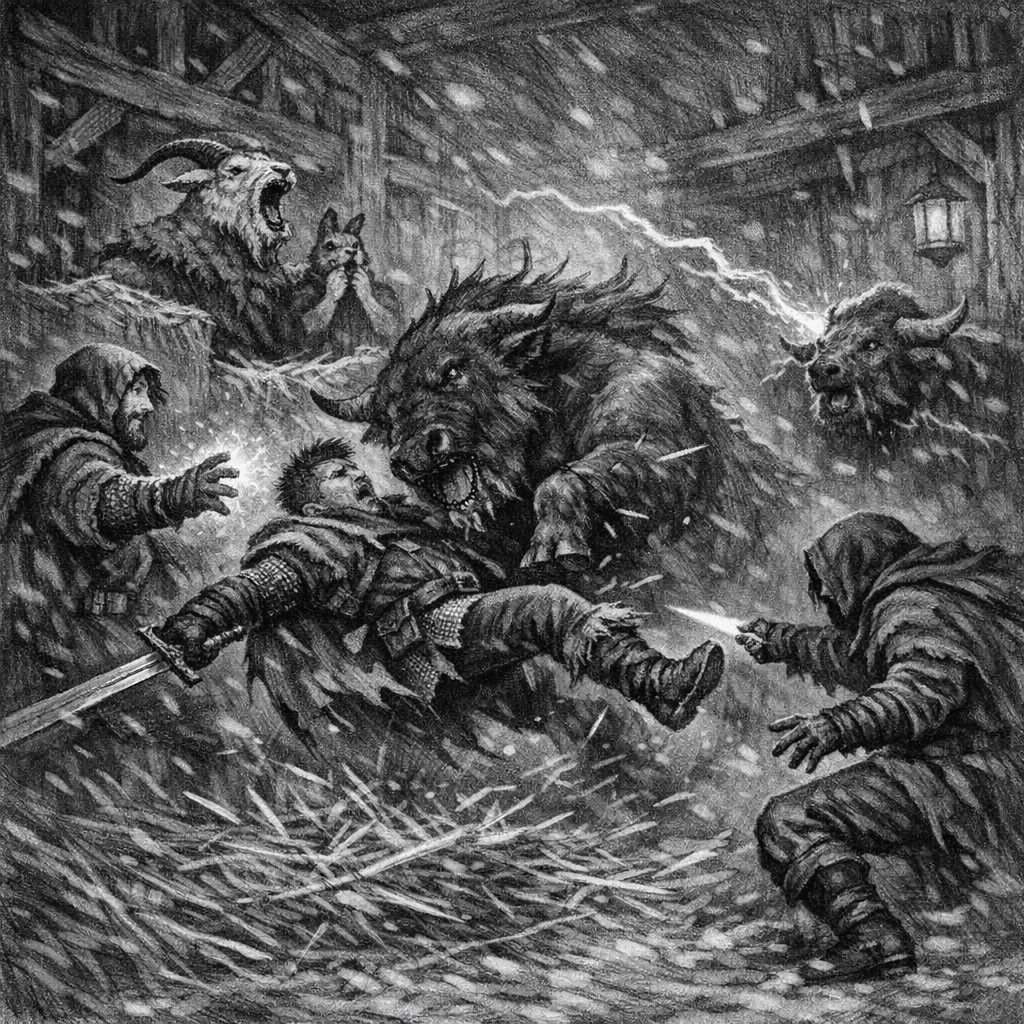
Inside, two massive musk oxen stamped and snorted on the straw, breath fogging in the cold like twin furnaces. Behind them, in a stall dressed up like a crude throne, stood Baabras — a large, self‑important goat with bright, calculating eyes, clearly awakened and utterly convinced of his claim to Jed’s winter grain.
Whisper scampered in ahead of them and dipped into a bow. “Your Majesty, the intruders refuse to depart. They come armed, unwashed, and unannounced.”
Baabras tossed his horns, beard swaying. “I can see that, Chamberlain. Even from here I can smell the peasantry.”
Raine folded his arms. “You’ve got a barn full of stolen grain and shit on your hooves, goat. Careful who you call peasant.”
The goat drew himself up as far as a goat could. “You address Baabras the Second‑First of His Name, Breaker of Salt Blocks, Prince of the Hill, Sovereign of the Grain Mound, and Defender of the Lofty Bale.”
“Right,” Raine said. “And I’m Raine of Now Out of Patience, Lord of the Sharp Sword and Duke of the Bloody Hurry Up.”
Whisper hissed. “You dare mock the royal style?”
“If the royal style looks like dinner, aye,” Raine said. “Step aside from Jed’s grain and we’ll leave you with your skin still on.”
Baabras snorted. “This hoard was abandoned. By the laws of the Hill, it belongs now to me and mine. You stand here as trespassers, rustics, common muck‑scratchers. Be grateful I do not have you thrown out on your ears.”
“The only thing getting thrown,” Raine growled, hand settling on his greatsword, “is you into a stew pot.”
Whisper’s eyes went wide. He hurried back to Baabras’ side and whispered furiously. The goat listened, then nodded once, offended dignity hardening into something uglier.
“Hear this, invaders,” Baabras called, voice ringing off the rafters. “Your failure to withdraw, your insults to my person, and your threats against my loyal subjects are hereby recognised as acts of war against the Crown of the Hill.”
The musk oxen pawed the straw, lowering their heads.
Negotiation, such as it was, died there. Every careful word they had tried had been twisted into an insult through the warped lens of courtly pride. Whisper and Baabras had reached their verdict.
The barn of Jed Whitewatch was now, by goat law, a battlefield
Raine stepped forward, greatsword already in hand. One look at his stance was enough — he was done talking. Steel was the only language left.
One of the musk oxen took that personally.
It lowered its massive head and came thundering across the straw. Raine barely had time to swear before the horns caught him square in the ribs and lifted him clean off his feet. He slammed into a stall wall hard enough to rattle the boards—breath blasted from his lungs.
“Behold!” Baabras bleated, rearing up on his throne. “The royal vanguard tastes peasant!”
Whisper hopped from foot to foot, whiskers quivering. “A telling blow, Your Majesty! Truly, his organs will compose sagas about this day!”
Raine staggered upright, teeth gritted, sword still in hand. “Right,” he rasped. “Now I’m angry.”
The first ox snorted and pawed, lining up for another charge.
Felwar moved. A tiny crackling seed of power bloomed in his palm and streaked across the barn, smacking into the beast’s shoulder in a burst of force and light that rocked it sideways.
“Assassins!” Baabras cried. “Regicide adjacent!”
The second ox thundered toward Felwar, but Thelonius snapped a hand up, lips moving through a slurred, vicious mutter. A shard of razor‑edged ice spun into existence at his fingertips. He hurled it with more spite than grace, but luck, or something like it, guided the throw.
The Ice Knife buried itself clean into the ox’s ear and vanished.
The beast blinked once, went cross‑eyed, then toppled like a felled tree, legs stiffening on the way down. It hit the straw with a slam that shook dust from the rafters.
Whisper clapped his tiny paws to his mouth. “The Royal Right Horn! Slain by sorcery!”
Miquitzil raised his hand and spoke a word that tasted like a storm. A jag of blue‑white lightning lanced from his fingers, cracking through the dim air to hook into the flank of the remaining ox. Witch Bolt wrapped it in a crawling net of light. The smell of singed hair filled the barn as the spell pulsed again and again, each beat snapping the beast closer to collapse.
Felwar’s second seed smashed into its chest, and the ox finally went down, smoking faintly in the straw.
For a heartbeat there was quiet.
Then Baabras screamed.
“You have butchered my champions! You have defiled my hall! By the laws of the Hill, I shall mount your heads on the very nails that once held my salt lick!”
He launched himself off his “throne” with surprising speed, hooves churning. The goat hit Thelonius full in the chest, bowling him over and trampling across him in a flurry of sharp hooves and furious bleats.
“Know the wrath of kings!” Baabras howled.
Flat on his back, Thelonius swore in a language no temple had ever sanctioned.
Raine stepped into the charge, ribs screaming, and brought his greatsword down in a two‑handed arc. The blade met Baabras at the shoulder and kept going. The goat’s royal decree cut off mid‑word as he crashed to the straw, very much deposed.
Silence fell in a rush, broken only by the hiss of cooling lightning and Raine’s rough breathing.
Whisper stood amid the bodies, chest heaving, eyes darting. Then he dropped to his knees.
“Mercy,” Whisper pleaded, ears flattened. “Spare me, noble slayers. Let me take my doe and eleven kits and we shall flee this blighted backwater. The King is dead. Long live whoever next claims the hill. We will trouble this barn no more.”
Thelonius pushed himself upright, straw clinging to his coat, face set like stone. He looked at the hare and, behind him, imagined eleven more mouths chewing through someone else’s winter.
“Mercy is expensive,” he said quietly. “And we’re not the ones paying.”
Without ceremony he ended Whisper, then went methodically through the nest. The work was quick, ugly, and done without joy.
The barn settled into a grim, smoky stillness. Felwar, Raine, and Miquitzil watched Thelonius for a long moment, the image of soft white forms in the straw sitting poorly in all their guts. Necessary, they told themselves.
It didn’t make it sit any easier.
They returned to Bremen with the news. Jed shook each of their hands with both of his, gratitude spilling out in rough, unpractised words. The crisis was over. The grain was saved, enough, at least, to see the farm through the worst of the winter. The party chose not to mention how much the “royal court” had already eaten or fouled. Some truths would only weigh heavier on a man already stretched thin.
Later, after he had cleaned up, Cora led Felwar up to the Beacon Hut — a frostbitten shack on the bluff above the lake. Once, long ago, a brazier there had burned nightly to guide fishing boats home through mist and dark. Those days were gone. Now it was just four thin walls, an old stove, and a view of the ice.
Inside, it was quiet at first, then warm, then private. Cora, pushing late thirties and fully aware the young warlock across from her was barely into his twenties, gave him a wry little smile and produced a bottle of strong honey mead, seventy proof, saved for better days. She coaxed him into a glass. He relented. It loosened them both. The afternoon passed in the kind of intimacy that felt earned, laughter, warmth, and simple food prepared with care. There was passion, but not hurried or hollow; more a careful kindness between a woman who had lived through too many winters and a man who had not yet seen enough. A softness they both needed more than either would easily admit.
Studying his face in the firelight, she traced a finger along his jaw and snorted a laugh.
“You don’t look like you’re from Dougan’s Hole,” she said. “Too handsome by half. Most of them down there look like they were carved out of driftwood, then dropped onto their faces. Most folk think the lot of them are inbred.”
Felwar had heard worse. He smirked. “Maybe my mother wandered in her youth.”
They laughed. The warmth in her eyes lingered after the joke had gone.
Later, her voice softened. She spoke of her husband, his fall from the tavern roof on a bitter morning, and of her son. The words slowed, faltered, as if she were touching old wounds with cold fingers. Felwar listened and laid his hand over hers. He promised, solemn and sincere, that if it was within his power he would bring Hu home.
Back at the tavern, a pair of men arrived to take the murder victim’s body away to somewhere less public. It had been stowed in the firewood hut, bound tightly in a thick leather wrap. The freezing air would keep the corpse preserved, and the leather would deny even the most determined scavenger a bite.
The room’s noise dipped out of respect as they worked, chairs scraping softly, voices falling to murmurs. Outside, the wind scratched at the shutters like something wanting in.
That night, the party was escorted to Speaker Dorbulgruf’s home. The ancient dwarf was in far better form than when they had first seen him, colour back in his cheeks, beard combed and oiled, hair neatly tied. Fine, if slightly worn, clothes had replaced the bedraggled nightshirt.
They dined together on roasted trout and spiced root stew, the warmth of the fire stealing the chill from their bones. Over the clink of cutlery and the quiet shuffle of Elira moving about the room, Dorbulgruf leaned forward and told them that the murder weapon, a blade of pure ice, had turned to mist there on his dining table. Gone without a trace. Obviously magical.
During dinner, Thelonius asked if the Speaker had ever heard of anyone spontaneously turning into a creature, an octopus, for example.
Dorbulgruf was thoughtful and measured in his reply. He had seen many things in his years, he said, but such transformations were rare. Only druids possessed the natural gift to change shape without sorcery or pact, and even then, it almost never happened by accident. In his view, that left no mystery at all. Thelonius must be a druid, whether he understood it yet or not.
Thelonius was unconvinced. If Dorbulgruf was so sure, and the change had not been intentional, then perhaps the cause lay elsewhere entirely. Privately, he wondered whether Cora had slipped something into the stew. It was easier, in that moment, to suspect the cooking than himself.
Dorbulgruf passed them two sealed letters, one for Speaker Naerth Maxildanarr of Targos, the other for Speaker Duvessa Shane of Bryn Shander and made it very clear these were to be delivered in person. Not to a clerk, not into a tray. Into the Speakers’ hands.
The Targos letter pleaded for temporary aid. Bremen’s last fishing vessels had been destroyed by the awakened creature in the lake, a talking beast the size of a wagon, leaving the town unable to fish or feed itself. Dorbulgruf asked that Bremen’s fishers be allowed to work from Targos’ docks under proper oversight. In return, Bremen would pay fair dock rates, house its fishers modestly within Targos, and provide a portion of each catch for local sale or use, ideally at reduced cost. The tone was humble but not begging. This was not charity. It was a request for the means to endure. He hoped that, despite the rivalry between towns, Targos might act in a spirit of unity until the lake beast was dealt with. May the cold spare your people and your harbour remain ice‑free, he wrote, signing his name by hand.
The Bryn Shander letter was formal and direct, addressed to Speaker Duvessa Shane. It described a murder in Bremen. The victim, one Duvik Sann, found frozen and impaled by a shard of unmelting ice, and noted that the method matched a similar death reported in Targos. Dorbulgruf vouched for the party as the ones who had ended an undead threat and brought a measure of safety back to Bremen’s docks. He urged Duvessa to grant them courtesy and access to records, and to allow her sheriff to speak openly with them. He believed the killings were connected. A rot spreading beneath the snow while the Ten‑Towns looked away. He closed with the old northern blessing: May your walls hold.
They left Bremen for Targos the next day, the murdered man’s body wrapped and tied to a sled driven by Gota and his team of six eager huskies. Roughly halfway through the three‑hour journey they came upon the heaving form of a fallen buffalo in the snow. As Raine approached, ice mephits erupted from the beast’s hollowed carcass and hurled themselves at the group. One conjured a fog cloud and screeched to summon more of its kind.
The Boat Breakers were not so readily defeated. Frozen wings and shattered limbs littered the snow in minutes, the mephits’ shrill cries dying away on the wind. They pressed on toward Targos, second largest of the Ten‑Towns.
Disclaimer
This is a work of fan fiction. All relevant characters, locations, and settings remain the property of Wizards of The Coast (WOTC) and the story contained here is not intended for commercial purposes.
I do not own Dungeons and Dragons (D&D) or any of the related characters. D&D is owned by WOTC (and its parent companies) and all rights of D&D belong to them. This story is meant for entertainment purposes only.