Session 19
The Pact Is Broken
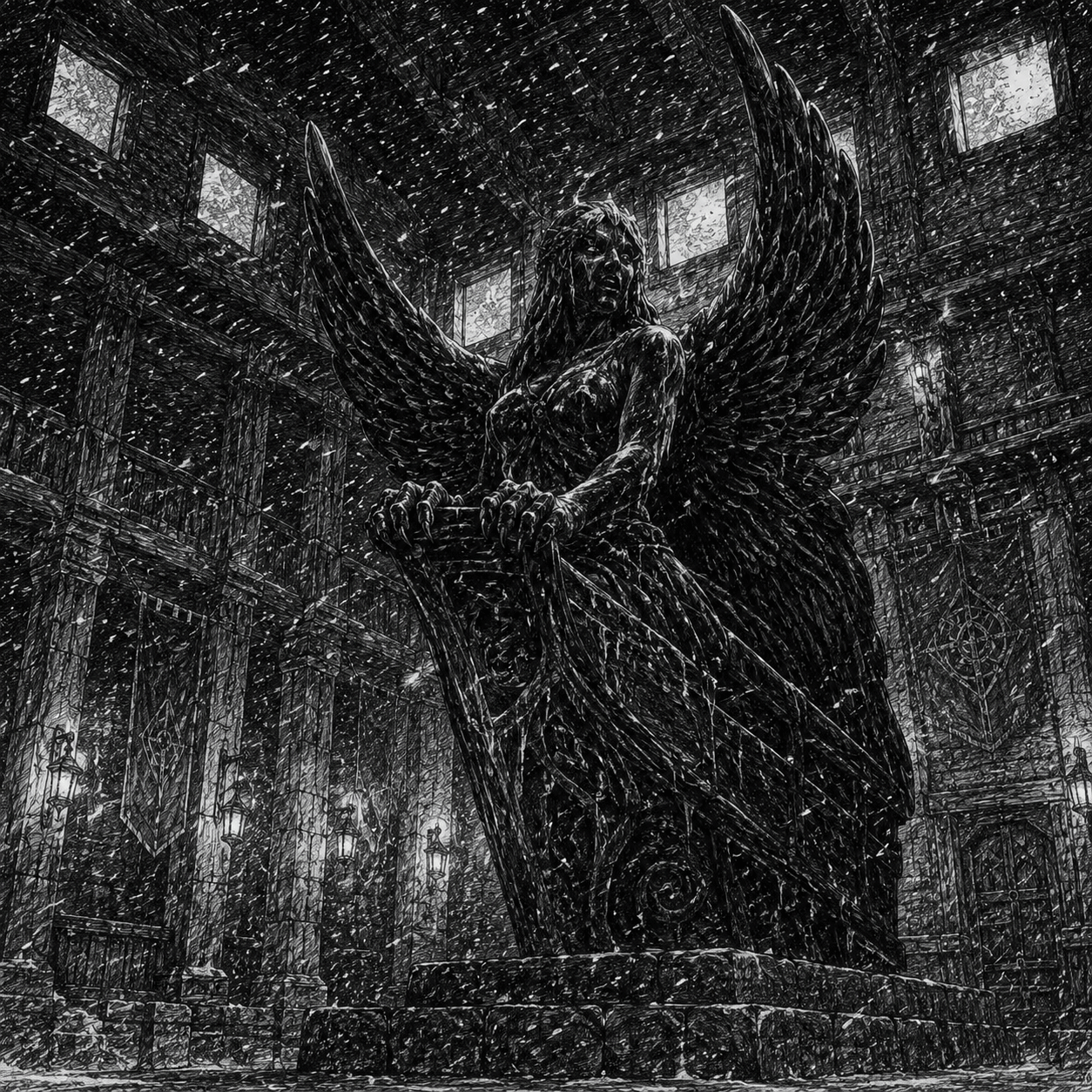
They woke late.
The Brave Hearts stumbled down the narrow stairs of the White Lady Inn, boots thudding on tired timber, breath misting faintly in the chill that even the hearth couldn’t quite beat back. The common room still reeked of last night’s smoke and spilled ale, with a stale undertone of wet wool and old sweat baked permanently into the walls.
Halfway down the stairs they had to sidestep a very drunk Scython weaving his way up, one hand on the rail, the other clutching a half‑empty bottle like a holy relic. He paused long enough to give them a bleary wink and mutter something slurred and heartfelt at Felwar, then lurched past and vanished toward his bed.
They found a table near the fire — or at least near the idea of a fire — and collapsed into their seats. Breakfast arrived soon enough: porridge, fried fish, hard bread, something pretending to be bacon. They ate in the heavy, grey silence of people who had slept badly and lived worse.
Thelonius finally broke it. He jabbed at his porridge with a suspicious squint, as if it might reach up and grab his spoon.
“So, guys… the evil grey dwarf arsehole on the ferry. You think he’s still hanging around? Or has he pissed off after we did a number on his boys?”
Felwar didn’t look up straight away. He swirled his honeyed mead in slow circles, watching it cling to the sides of the mug, then raised his eyes.
“Well, the captain — what was her name?”
Miquitzil wiped his mouth with the back of his hand, blinking away the last of the sleep.
“Imdra. Captain Imdra Arlaggath.”
Felwar pointed at him as if awarding a correct answer.
“Yeah, her. Captain Imdra. Remember she said she found a sketch of the Easthaven town hall? I reckon we should check that out before we move on. See if there’s anything interesting. Something the duergar wanted badly enough to draw it.”
A few quiet nods went around the table. The idea had weight.
They kept chewing, spoons clinking against bowls.
Then Thelonius cleared his throat.
“Before we move on… to where? You said ‘before we move on.’ Where are we going next?”
Before Felwar could answer, Raine cut in.
“Back to the witch and that two‑headed goblin,” he said, too quickly. “I want to end him and end her. What she did to those fishermen…”
He trailed off, shaking his head as the memory came back sharp and sour.
Thelonius gave a small, crooked smile, remembering too — though for different reasons.
“The cauldron,” he said. “As a bear it smelled incredible. Made me so hungry I wanted to climb in there and start munching. Maybe it’s some kind of magic cauldron that makes food smell amazing and taste even better.”
Raine froze, sausage halfway to his mouth. His hand dropped, fork clattering against the plate.
“Magic cauldron,” he echoed. “You know… maybe it is a magic cauldron. The one Skath asked me to find. He said it was around Easthaven. Do you think…?”
He didn’t finish. The thought hung there.
“Well, it’s not like we’ve been tripping over cauldrons lately, is it?” Thelonius said.
Felwar nodded slowly.
“What are the odds? It’s worth checking out.”
“Kill two birds with one stone,” Raine added. “Kill the evil hag and her mutant goblin and check out the cauldron.”
“Maybe it only smells great if you cook people in it,” Thelonius mused. “You know, that would be a pretty shit magic cauldron. ‘Hey, look, we can feed all the people — but we have to cook the Jackson family. Roger, over here, mate, into the pot. You too, Sally. Yep, and the kids.’”
The others stared at him, not entirely sure if he was joking.
“Clean the cauldron, check the magic,” Miquitzil said, practical as ever. He bit into something greasy and unidentifiable; juice ran down his chin, unnoticed. Hygiene was not high on Miquitzil’s list of priorities. “If it is evil, we drop it in the lake. If it is good magic, we bring it back.”
Felwar nodded and, out of habit, wiped his own chin in sympathy, as if that might somehow tidy Miquitzil by proxy.
“It’s a big cauldron. No way we can row it back here.”
“I’ve been thinking about that,” Raine said. “I’m not rowing across that damned lake again. No way. No how. Not a chance.”
He shuddered, remembering the cursed wind, the knives of cold biting through his clothes, the feeling of death skimming just under the hull.
“So instead, we get our dogs and go around the lake on the ice shelf. It’ll be thick enough. And we know where the caves are. Should be simple enough.”
Felwar snapped his fingers.
“Brilliant. Maybe we arrange another dog team or two from Easthaven. They haul the cauldron back to town, and we go north, then cut east to that spire Garret told us about.”
That opened the floodgates.
They talked through the other problems piling up on their shoulders.
There was the Black Cabin that Copper Knobberknocker had begged them to visit, to check on his tinker friend Macreadus — who was apparently working on some contraption to end the endless winter. The Brave Hearts all thought the idea ridiculous, but none said it aloud — just as they hadn’t said it to Copper.
There was the pirate ship, the Dark Duchess, that Cora’s son had spoken of. Felwar reminded them he needed to see Cora again, back at the Buried Treasure in Bremen, and tell her what had become of her boy — how he had thrown in with the Black Swords. That promised to be a hard conversation.
Then there was the duergar outpost marked clearly on the map at the base of Kelvin’s Cairn, further around to the east. A stronghold of grey dwarves, perhaps, begging to be dealt with.
And Perilou Fishfingers — the small, sad halfling woman who was done with travelling after the horrors on Kelvin’s Cairn. She had been Mokingo “Growling Bear’s” best friend and, though not his kin, she counted him as family. She had promised the Brave Hearts a magical ring if they carried out one last task for her: take news of his death to his people, somewhere in the Spine of the World. Tell them how he died saving two lives at the cost of his own. The Brave Hearts had agreed, and that promise lay on the pile with all the others.
Miquitzil added the matter of the closed mine in Termalaine — that lovely family whose father had lost his job, whose troubles still sat uneasily in his mind.
By the time they finished, they were exhausted just from talking. The list of promises and threats and half‑finished business stretched out around them like tracks in fresh snow. For a moment, it felt as if the burden of breaking Auril’s Rime and ending this winter had fallen on their shoulders alone.
Felwar clapped his hands once, sharp, breaking the spell.
“My dad told me, before he turned into a gods‑damned lunatic, ‘How do you eat an elephant seal? One bite at a time.’ So that’s what we do. One step at a time. Today we hit the town hall. Then we arrange some sleds. Then we go back and finish that hag. I never even saw her, but I heard her — and I want her gone every bit as much as you do, Raine.”
They wrapped themselves in cloaks again and trudged through Easthaven’s streets to the town hall.
Captain Imdra met them in the entrance hall — straight‑backed, no‑nonsense, armour polished despite the town’s gloom — and she nodded briskly.
She led them down a corridor and through a side chamber where they were introduced to the man running Easthaven.
Speaker Danneth Waylen stood waiting — a broad‑shouldered, weather‑worn man wrapped in a thick fur‑lined coat. His beard was ragged from stress rather than fashion, his eyes rimmed dark with too many sleepless nights and too many decisions made on too little hope. He looked like a man who had aged a decade in the last two winters.
“So,” Speaker Waylen said, voice rough but clear. “I hear you’re heading back across the lake to kill the witch who murdered four Easthaven folk. That is very commendable. Captain Imdra here will afford you every assistance this town can offer.”
Thelonius nodded earnestly.
“And we will bring back the magical cauldron, too.”
There was a beat of silence.
“The… what?” the Speaker asked, turning to Imdra. She shrugged. She clearly had no idea what Thelonius was talking about.
Felwar and Raine both snapped their gaze to Thelonius in unison, daggers in their eyes, silently begging him to shut up.
Thelonius, oblivious to politics or subterfuge, pressed cheerfully on.
“Yes, yes. A magical cauldron. The witch was cooking the fishermen in it, and it smelled lovely. But Miquitzil thinks we might be able to clean it out and, if what that guy in Targos said is true, the magic will feed all of the town.”
“The… guy in Targos?” Speaker Waylen repeated slowly.
He and Captain Imdra exchanged a sharp glance.
Felwar coughed loudly, eyes screaming at Thelonius to stop talking.
No effect whatsoever.
“Which guy?” the Speaker asked.
There was a serious glint in his eyes now. A dangerous one.
Thelonius turned helpfully to Raine.
“Which guy was it, Raine?”
Raine rubbed a hand through his hair, suddenly very interested in the floor.
“Ummm…”
Felwar stepped forward, trying to wave the whole thing away.
“None of that matters now. We will kill this evil witch and end the threat to the good people of Easthaven.”
Speaker Waylen did not blink.
“Yes, yes. I know all of that.”
He fixed his gaze on Raine.
“Which person in Targos?”
Raine shifted. Sweat prickled despite the cold.
“Captain Skath.”
“And what did Captain Skath say?” the Speaker asked, tone like a blade slipping from a sheath.
Thelonius, delighted to be helpful, added,
“And the Speaker! He spoke to you too, Raine. Remember? Upstairs. He told you all about the cauldron.”
Raine wiped his brow.
Felwar visibly died inside.
Speaker Waylen stepped closer.
“So, Speaker Naerth Maxildanarr told you about this device?”
Raine had to admit it.
“Yes. He said to find a cauldron and bring it back to him.”
“And what, exactly, did he say the cauldron could do?”
Thelonius nodded, now entirely confident he had helped.
“Oh yes, tell him, Raine. Tell him about how Naerth paid you to bring it straight to him and how it could feed all of the Ten‑Towns.”
Raine opened his mouth.
Felwar jumped in again.
“We do not know truth from fantasy at this stage. Let us deal with the hag first—”
But Speaker Waylen cut him off.
“Find a magical cauldron that could end hunger… and take it back to Targos.”
He folded his arms.
“How interesting.”
Thelonius beamed.
“Yes! I thought you’d be interested.”
“I am,” the Speaker said. “Very much.”
He turned to Imdra.
“Captain, send some dog teams with them. I want that cauldron brought back here.”
“Of course,” she said immediately.
“That is settled then,” Speaker Waylen declared.
Felwar closed his eyes briefly.
Raine sighed.
Thelonius looked proud of himself.
Miquitzil pretended he had absolutely nothing to do with any of this.
“Well then,” the Speaker said, already turning back toward his office, “I wish you good day, Brave Hearts. And good hunting.”
He strode away, fur‑lined coat swaying behind him, a man with twelve more problems to solve before lunch.
Captain Imdra gestured for them to follow.
“This way.”
Inside were several scratched benches, thin carpets, and the weary machinery of a town trying to pretend things were normal. Captain Imdra led them through a warren of corridors that smelled of ink, damp wool, and old smoke. Most of the rooms they passed were dull little offices — clerks hunched over desks, stacks of parchment about fishing licences, fines, quotas, the petty work of keeping people in line while the sky tried to kill them.
“Nothing exciting in here,” Imdra said, shouldering open one heavy door after another. “Paperwork. Arguments. Lost gloves.”
Finally, she stopped at a door set a little apart from the rest. There was a key for this one. She turned it, stepped inside, and the Brave Hearts followed.
Low‑burning lanterns cast a sickly glow over a single large shape in the middle of the room. A canvas tarp, stained and stiff, sagged over something tall and black, nearly fifteen feet high. The walls were bare. No windows. Just that thing under the tarp and the quiet hiss of the lanterns.
“An adventuring party hauled this statue out of the lake about six months back,” Imdra said, not moving any closer than she had to. “Horrible thing. We do not know what it is, so we left it here. Until someone comes along who thinks they do.”
“Adventuring party?” Felwar asked. “Who were they? We would like to meet them.”
Imdra let out a slow breath through her nose.
“I am afraid that will not be possible. Not long after they brought this in, they took work with a wizard who operated out of the Wet Trout and… something went wrong. The wizard killed them. All of them. Five in total.”
She flicked her fingers in the air, a sharp, dismissive gesture, as if blowing out a candle.
“Gone. Just like that.”
“A wizard killed five adventurers?” Miquitzil frowned. “How do you know this is true?”
“A hunter saw it happen,” Imdra said. “He is a friend of mine. This adventuring party were camped not far from town. And this wizard — he walked in and blew them apart. One fireball, then another. Up in flames, all of them. Burned to a crisp.”
Felwar already knew the answer, but he asked anyway.
“This wizard… that would be the one you burned the other night?”
Imdra nodded once.
“Exactly. We take murder seriously here, no matter if the victim is a local or an adventurer. A life is a life. The wizard will not be hurting anyone else, that much is certain.”
“Something is funny about this,” Thelonius muttered under his breath. The hairs on the back of his neck were standing up, though he could not yet say why.
Raine, standing closest to the tarp, glanced back at the others.
“Hey,” he said, gripping the heavy canvas. “Give me a hand with this.”
A page stuck his head in behind them.
“Captain, you are needed. Someone has broken Marianna Bawll’s windows again. She is, um, being very insistent.”
Imdra grimaced.
“Of course she is.”
She glanced once more at the covered shape.
“Have a look if you want. Just do not break it, burn it, or let it out.”
Then she was gone, the door closing behind her, leaving the Brave Hearts alone with the tarp and the cold.
For a moment, nobody moved.
Then Raine gave a sharp whistle for help, and with Thelonius and Felwar stepping in beside him, he gripped the heavy canvas with both hands and dragged it back.
Underneath stood a demon.
Eight feet tall, carved in the shape of a ship’s figurehead — only far too heavy for any lake‑faring vessel to ever carry. Wings stretched behind it, talons gripping an invisible prow, its face twisted into a snarl that promised nothing good. The entire thing was carved from black, glassy stone that seemed to drink the lantern light rather than reflect it.
Felwar’s breath hitched.
“That is chardalyn,” he said quietly. “All of it.”
Up close, the scale of it sank in. A single, solid mass of the stuff. A thousand pounds of cursed rock — the very material poisoning desperate people across Icewind Dale, and the same substance the grey dwarves coveted above all else.
Miquitzil didn’t touch it. He hovered his hand a few inches away, feeling the wrongness prickling along his skin.
“You could arm an army with what is sitting in this room,” he murmured. “Or damn one.”
The lantern flames fluttered, shadows sliding over the demon’s face so that, for a heartbeat, it seemed to lean forward out of the dark.
Thelonius cleared his throat softly.
“So,” he said. “Might have been better for everyone if those adventurers left this thing in the lake. It feels wrong.”
“Look here,” Raine said, dropping to one knee behind the slab the figurehead rested on. The base was chardalyn as well, carved and grooved to resemble wood. He ran a gloved finger along one edge.
“Chisel marks. Fresh ones. Someone’s been hacking at it. Maybe those ferry dwarves got in here and tried to take a sample.”
Felwar began to stalk the room, eyes narrowed, almost on hands and knees as he studied the floorboards and corners, searching for any other sign that someone — or something — had been meddling where they shouldn’t.
“Ah ha!” Felwar said at last.
In the far corner of the room, partly hidden by shadow, he found a small hole — narrow, deliberate, and partially plugged with dry dirt. He crouched, tugged the plug free, and a thin knife of outside chill sliced through the gap, making him shiver.
“I wager the little buggers have been sneaking in through here,” he said. “The grey dwarves, in tiny form. This is how they got close enough to take the shavings we found in that pouch.”
He looked back over his shoulder, expecting a question, a joke, something from the others.
But they were silent.
Motionless.
Mouths slightly open, staring at the statue.
Felwar straightened slowly, heart beginning to hammer. He stepped around the slab to see what they were looking at.
And froze.
Lashed to the figurehead with rough rope was a scrawny woman, dripping wet as if she had just been hauled out of the lake. Her long, white hair hung over her face in heavy strands, completely obscuring her features. Water pattered onto the floor beneath her, each drop loud in the quiet of the room.
She hadn’t been there a moment ago.
And now she was.
Felwar reacted on instinct.
A shimmering blue hand flickered into existence beside the bound figure, summoned with a sharp gesture and a muttered word. The Mage Hand reached out, delicate and trembling, and brushed aside the curtain of wet white hair.
The head snapped up.
Her face was the face of a drowned woman — skin bloated and waxy, lips split and grey, cheeks sagging as if waterlogged. Her eyes were two milky, bulging orbs, staring without pupils or mercy. Thin streams of lake water dribbled from her open mouth, pattering into a puddle on the floor.
Then she drifted forward — the ropes passing straight through her as though they were smoke — and she screamed.
Her jaw stretched wide and a scream ripped out — silent, yet somehow louder than anything they had ever heard. It knifed through them, sliding under skin and into marrow, a chill that felt like it had been waiting centuries for a throat to escape from.
Miquitzil and Felwar staggered back, terror flooding them so fast and so cold they couldn’t even raise their hands. Their eyes darted away from her face, unable to look upon it. The ghost filled their vision with the memory of ice water closing over their heads, lungs locking, dark hands dragging them down.
Raine fumbled at his sword belt, fingers numb.
“Shit—”
The ghost lunged.
Two long, white, wrinkled hands plunged straight into Raine’s chest.
He felt it. Not just the touch — the drain. His flesh tightened and blackened around her spectral grip, cold rot spreading under his skin like veins of ink.
His knees buckled. Breath punched out of him. For a moment he thought he was falling through the ice all over again, sinking into black water with no bottom.
The ghost’s eyeless stare never blinked.
Raine came to his senses and slashed at the dripping woman, steel cutting straight through her half‑solid form. The blade met almost no resistance, but the ghost shivered around the wound like smoke disturbed by a strong wind.
“It… it is… it is a ghost!” Miquitzil stammered, backing up a step. “The White Lady!”
The ghost ignored Thelonius completely — which was a mistake.
He spat a druidic phrase through clenched teeth and thrust his staff forward. A brilliant blue‑white column of moonlight ripped down from nowhere and slammed into the spectre, filling the space between them. The air itself seemed to burn cold. The Lady convulsed in the beam, wracked with visible pain, sloughs of ghostly matter peeling off her and hissing away into nothing.
“Good,” Thelonius growled. “That hurts her.”
Miquitzil forced his hands to stop shaking long enough to shape another spell. Crackling energy gathered around his fingers, then lanced out in a jagged bolt that hooked into the ghost’s chest. Witch bolt tethered them together with a snarling cord of lightning — but fear made his aim wild, and most of the power scattered across the ceiling and walls, scorching boards instead of spirit.
Raine had had enough.
His chest burned where the ghost’s claws had passed straight through him. He could feel the cold rot spreading under his ribs, every breath sharp as broken glass. Panic and fury churned together until he could hardly see straight.
Heal me, you prick, he hurled at Levistus in his mind. Do something.
But the favour of a devil is a delicate thing.
In the frozen oubliette of Stygia, Levistus stirred — a vast, chained presence, cold as the grave and twice as patient. A pact with such a creature demanded loyalty, obedience, respect. And Raine had shown precious little of any of them lately.
No aid came.
No whisper.
No gift of strength.
No blessed, desperately needed healing.
Only a distant, frozen silence.
Lessons must be taught. Even cruel ones. Especially cruel ones.
And Levistus excelled at teaching cruel lessons.
The grey dwarf on the ferry. This drowned woman. Every fight lately seemed to end with him bleeding on the floor while the devil’s “gifts” did nothing but mock him. Rage and humiliation burned hot in his throat.
Enough.
He raised his shield, teeth bared, and took three deliberate steps back — a controlled, tactical withdrawal. He was done being the ghost’s scratching post. Let the others deal with her. He was tired, wounded, and sick to death of relying on a patron who clearly thought pain was the only lesson worth teaching.
Felwar saw Raine stagger and acted on instinct. He flung a healing word across the space, green‑gold light stitching some colour back into Raine’s cheeks, then snapped his fingers and called down sacred flame on the ghost. Radiant fire flared above her, but the Lady slid aside, the blast hissing against empty air.
The spectre’s head spun, looking backward now, dead eyes fixed on Thelonius.
She rushed at him, mist trailing from her limbs, and tried to pour herself inside his skin. For a sick second his vision blurred, the world tilting — but something stubborn and wild in him dug its heels in. She found no purchase. The ghost was thrown back out, howling in that too‑high, silent way.
Thelonius dragged the moonbeam with her, shifting the pillar of light so it carved through her again, burning more tatters off her form.
Miquitzil tried to hold his witch bolt, but the Lady had already drifted up and over the statue, out of his line of sight. The crackling tether flickered once, then snapped with a sharp crack and vanished into the shadows.
He swore under his breath and shifted sideways, searching for her. His throat slipped into that low, uncanny singing that made the air seem to vibrate around him. He drew, loosed — the arrow flew straight into the ghost’s head, somehow lodging in that misty, half‑there nothingness.
For a heartbeat nothing happened.
Then her form convulsed violently, shuddering as if a storm had torn through her. Curtains of ghostly matter tore away in all directions, fading as they fell. A moment later she was simply gone, and Miquitzil’s arrow clattered to the floor, perfectly solid now with nothing left to hold.
Across the chamber, Raine ripped a chain from around his neck. An amulet swung at the end of it — a sliver of chardalyn, his father’s heirloom, and the conduit to Levistus. He slammed it onto the floor and stamped on it with his heavy boots again and again until the stone finally cracked with a dull, ugly sound.
“I reject you, you bastard,” he snarled. “I want no part of you.”
Time stopped.
For everyone except Raine.
The lantern flames froze mid‑flicker, shifting from yellow to a cold, poisonous blue. Shadows thickened in the corners, then slid together, filling the space with the shadowy, almost‑there visage of Levistus. Not a full body, not a face you could strike — just the suggestion of a being trapped in ice, eyes like twin chips of a dead sky, staring straight at Raine.
Raine clenched his fists, knuckles white, forcing himself not to look away.
“So,” Levistus said at last, voice a low echo under the world. “That is what you choose.”
Silence followed — a long, heavy pause, like something massive shifting in black water.
“I gift you strength. I steady your hand. I whisper the path through snow and ruin. And you repay me by flailing about with these… Brave Hearts. These stumbling, bumbling, soft‑skinned irrelevancies.”
A low, humourless laugh rolled through Raine, vibrating in his bones.
“You break my token like a child throwing a tantrum. You think stubbornness makes you noble? No. It makes you predictable. Weak.”
The cold tightened around him, pressing in against his skin.
“Listen well, Raine. I do not beg for loyalty. I trade for it. You wanted power. You wanted to matter. You wanted a way to claw yourself free of the life you were drowning in. I offered you hope and freedom, and you dare spit on my generosity?”
The presence seemed to lean closer, unseen ice grinding in the dark.
“I gave you a chance to save your daughter. I gave you freedom for your father. And now, by your little outburst, your daughter will be lost… and your father will suffer for all eternity at my side. I trust that will gnaw at you every time you lay your head down to sleep — what your tantrum has bought.”
A hiss slid close to his ear.
“All you had to do was hold the line. Show respect. Show loyalty. Not wilt like a flower at the slightest inconvenience or scratch. Without me you are nothing, will amount to nothing, and will always be nothing.”
The temperature dropped another impossible notch. His breath smoked in the frozen air between them.
“The boon is ended. The pact is broken. My favour freezes here. Now.”
A final whisper, equal parts promise and threat:
“But hear this, Raine. When you fall — and you will fall — do not look to me again. I will not offer my hand to a creature too frightened to take what it needs.”
Time lurched back into motion.
Raine’s lip curled.
“You fucking arsehole,” he spat. “I am going to hunt you down and kill you, you piece of shit.”
Thelonius looked from Raine to Felwar, to Miquitzil, and back to Raine again, brow creased.
“Who are you going to hunt down, big fella?”
Raine didn’t answer.
He just sheathed his sword and swung his shield over his shoulder, teeth clenched, boots hammering across the floorboards as he left the chamber. The lantern light caught the cracked remains of the amulet at his feet, but he did not look back.
He strode out of the town hall and into the cold, the ghost’s wail and the devil’s threat still ringing somewhere deep inside him.
They stepped out into the brittle midday air, boots crunching through the snow as they made their way back toward the White Lady Inn. Felwar set a brisk pace, shoulders high, jaw tight. Miquitzil followed with the wary posture of a man expecting trouble. Thelonius trudged happily along behind them, oblivious.
They turned a corner.
Felwar spun and slapped Thelonius across the back of the head.
“Magical cauldron this, magical cauldron that,” he snapped. “How about you keep your mouth shut from time to time.”
Thelonius rubbed his head, baffled.
“Huh?”
Felwar slapped him again, harder.
“We do not need to tell everybody our business — especially when we are still trying to work things out ourselves.”
“What do you mean?” Thelonius asked, genuinely confused.
“Telling the Speaker about the cauldron,” Felwar barked.
Miquitzil puffed on a short, fragrant pipe, exhaling a ribbon of blue smoke into the cold air.
“And how Raine met the Targos Speaker,” he added mildly.
Felwar jabbed a finger at him.
“Yes. That too.”
Thelonius frowned.
“What is the big deal? I was just—”
Felwar slapped him a third time.
“Our business is our business, that is all I am saying.”
He stormed ahead down the street, boots punching through the snow.
Thelonius watched him go, rubbing the back of his head again. Then he turned to Miquitzil.
“What the fuck did I do?”
Miquitzil took a long, thoughtful draw on his pipe, then exhaled an enormous, drifting cloud of bright blue smoke.
He said nothing.
By the time they pushed back through the doors of the White Lady Inn, they found Raine already there — sitting alone at a corner table, hood up, staring into the bottom of a cup as if it held all the answers he no longer had.
Felwar slapped a hand on his friend’s shoulder.
“Back in your old armour? It suits you.”
Raine managed a smile at that — thin, weak, but real. The comment eased something inside him. He felt lighter. Like a fog had finally burned off, a darkness scraped off his soul. He looked around at the faces of his friends. Thelonius was hoeing into a bowl of soup as if he hadn’t eaten in a month, and Miquitzil was plopping strange, meaty chunks into his mouth from one of his never‑ending pouches.
They didn’t care about Levistus or what had happened in that chamber beneath the town hall. But they had been there for him all the same. They had treated him no differently when he first entered the pact, and they would treat him no differently now. He was sure of it.
That meant something.
He turned to Felwar, who was watching him closely.
“I am fine, Felwar. Better than I have felt in years, in fact. I am keen to make a difference here. End this curse and knock this Auril woman down a peg or two. And with you three at my side, I cannot imagine anything could possibly stop us.”
Felwar grinned and clamped Raine’s shoulder again.
“That is the spirit.”
Felwar informed Raine they would leave in two days. Captain Imdra had promised to send two sleds with them — strong dogs, capable handlers — and the teams would haul the cauldron back to Easthaven once the Brave Hearts had dealt with the hag. The plan was set. Supplies ordered. Sled routes discussed.
For the first time in days, the path ahead looked almost simple.
The next morning, Felwar stepped out of the cobbler’s shop and into the cold with a spring in his step and a pair of freshly resoled boots under his arm. The cobbler had done good work. No more wet toes for at least a week. He was heading back toward the White Lady Inn, whistling through chapped lips, when he caught sight of something peculiar — and familiar — up the street.
Weaving slowly along the road on uncertain feet was the strange figure in the heavy trenchcoat they had seen earlier on the docks. Tall. Too tall. Moving like it was being piloted by three people who could not agree on a direction.
Felwar hesitated, then sighed and angled his steps to intercept.
“Good morning,” he called.
The figure froze.
The coat twitched once, sharply, as though something inside had elbowed something else.
“Yes, indeed. We also wake up in morning,” the figure blurted far too fast, voice pitched oddly high.
Felwar blinked, leaning forward just enough to peer into the shadows beneath the hood. What he saw looked… wrong. A vaguely dog‑headed “dragonborn,” muzzle too short, eyes set too close together, snout twitching like it was trying to remember how noses worked.
“…Right. Brisk out today, is it not?”
A long pause followed — the kind that suggested a committee meeting was happening somewhere inside the coat.
“Yes. So brisky. We — I think it the briskest seen, ever,” the figure replied. It lifted one gloved hand and attempted a friendly gesture, except the arm bent at entirely the wrong point in the sleeve.
Felwar frowned. “Are you… all right?”
Another pause. A shuffle from inside the coat. Then:
“Oh, yes. I buy oil for our lantern. Then I go back and hug my family. We eat at a table, with the food on top of the table. I use a knife to make the food smaller. Just like you,” the figure declared loudly, each word a shade too separate, as though spoken by someone who had only recently learned sentences existed.
Felwar raised an eyebrow. “Uh‑huh.”
The figure nodded — too many times, too quickly.
“Thank you for the normal greeting,” it said stiffly, and turned as if to walk away.
Felwar fought a smile and reached out, catching the sleeve.
His fingers closed on empty cloth.
The arm inside was somewhere else entirely — but he held fast, and the figure juddered to a halt.
“You sound… new in town,” Felwar said mildly.
The trenchcoat writhed slightly, as if several occupants were urgently disagreeing about the correct response.
Felwar’s expression hardened. “Tell me who you are,” he said, voice suddenly stern. “It is clear you are not a dragonborn.”
Three distinct squeaks of terror erupted from inside the coat.
Felwar stepped forward and, with a sharp tug, tore the trenchcoat open.
Three kobolds were stacked inside like terrified firewood, wide‑eyed and trembling. All three immediately shrieked in a rapid, high‑pitched language Felwar could not understand, arms flailing, tails whipping frantically.
“Enough!” Felwar barked. “I mean you no harm. Just tell me who you are. Maybe I can help.”
The shrieking subsided to nervous squeaks.
The top kobold — still trembling — piped up, “We get oil for our mistress.”
Felwar frowned. “Your mistress. And who might she be?”
The three kobolds turned to each other, jabbering frantically. After a moment, one finally stammered, “We… we take you to her. She likes best when our mouths shut.”
Felwar opened his mouth to question that, but the kobolds had already yanked the coat closed again, cinching it tight from within.
The topmost kobold’s snout poked out from inside the hood. “People… not like us,” it whispered. “We walk normal now.”
“Right,” Felwar muttered. “Normal.”
The trenchcoat nodded jerkily and set off down the road, wobbling but determined. Felwar followed, trying not to laugh — or worry too hard.
He considered going back for the others — truly, he did. But curiosity hooked him hard. He was here, the kobolds were here, and really… how dangerous could a meet‑and‑greet be?
Once they reached the edge of Easthaven and descended into a small dell of snow‑laden fir trees, the coat finally paused. The kobolds wriggled free of it like worms escaping a burlap sack. Two of them folded the heavy coat with practised efficiency, panting with effort.
Felwar raised a brow. “Better?”
Three vigorous nods.
One kobold stepped forward. “We let mistress know we approach with stranger.”
Another added nervously, “We not want to be hurt.”
The last, shivering, whispered, “Or turned into frog.”
Felwar sighed. “Um. All right.”
They chirped into the trees. Moments later, the same chirps answered back from deeper in the copse.
The lead kobold straightened. “It is safe now.”
He gestured for Felwar to follow.
The copse was just a kink in the tree line; a handful of wind‑gnawed firs huddled together against the sky. It did not keep the cold out so much as blunt it, but someone had made the most of it. Two low tents were staked tight, guy ropes good and straight, snow banked along the canvas to kill the wind. A shallow fire pit had been cut down to frozen earth, ringed in stones so the flames stayed small and steady instead of roaring wastefully into the dark.
Felwar realised, with a faint twist of annoyance, that whoever owned this camp knew how to live out here better than the Brave Hearts did.
A woman knelt by the fire, feeding it with short lengths of wood. Late fifties, maybe early sixties. A black patch over one eye, the other a hard little chip of grey that missed nothing. A snowy owl clung to her shoulder, talons sunk into thick furs, its round head turning to fix Felwar with a flat, unfriendly stare.
“Did you remember my oil?” she asked the kobolds, still looking at the flames.
All three started shaking so hard they squeaked.
She gave a long, put‑upon sigh. “Of course you did not. We will sort that out later. For now…” She straightened, joints clicking softly under the layers of fur. “Who have you dragged to my camp?”
Felwar stepped into the circle of light, the snow squeaking under his boots. Up close he could see the faint tremor in her hands, the lines at the corners of her mouth, the way the owl shifted to keep its balance when she moved. He could also see the sled behind the tents and the team of dogs lying close together, heads resting on paws, yellow eyes following everything without a sound.
This was not some lost hedge‑witch. This was someone who travelled. A lot.
“Felwar,” he said. “Of the Brave Hearts.” He flashed what he thought was one of his most charming smiles.
The woman’s good eye narrowed, then warmed with recognition.
“Oh, I have heard that name. Brave Hearts.” She let it roll around in her mouth as if testing the fit. “You are making something of a reputation. Turning up where trouble is and not immediately dying. That is rare enough to be worth noting.”
She smiled, and suddenly her voice softened into something almost grandmotherly.
“Vellyne Harpell. Come closer, deary. No sense freezing to death three strides from a fire. I promise I will not bite.”
The snowy owl clicked its beak as if it might.
Felwar came closer but did not quite relax. “You have me at a disadvantage, Vellyne Harpell. Who are you really? And why are you out here instead of in town?”
“At a disadvantage?” Her smile widened. “Good. Means you are paying attention.” She brushed snow from her gloves in small, practised flicks. “As I said — Vellyne Harpell. Wizard of the Arcane Brotherhood.”
She leaned in slightly, voice dropping to a conspiratorial warmth.
“I camp out here because Easthaven is not especially fond of my profession these days. And I much prefer warming myself by a fire… rather than in one, if you take my meaning.”
The snowy owl gave a soft, disapproving hiss.
One of the kobolds let out a small, frightened noise. She reached back and patted its head absently, the way someone might soothe a nervous dog.
She gestured for Felwar to sit. “Come, come. Sit. Let your bones remember what warmth feels like. You can tell your friends later that you met a Harpell and survived.”
Felwar lowered himself onto a log half buried in the snow, the cold biting straight through the leather. He had meant to keep things simple, but the words came anyway. He found himself talking about the Brave Hearts, about how they were trying — gods help them — to end the never‑ending winter and give the land back its seasons, let the circle of life turn properly again in Icewind Dale.
Vellyne listened without interrupting, her good eye fixed on his face, the firelight catching in the tired lines around it. She did not nod, did not smile, just watched him as if memorising every word.
When he finished, she let a breath out slowly.
“Icewind Dale is lucky to have you, Felwar. You are a good man. I hope I have the pleasure of meeting your friends one day.”
Felwar shifted on the log, suddenly aware of how much he had said and how easily she had drawn it out of him.
“Sure,” he replied, a little too quickly. He cleared his throat. “One day.”
He frowned, deciding he did not like being on the back foot.
“Tell me about you, Vellyne,” he said, trying to turn the weight of her attention back the other way. “What are you doing in Icewind Dale?”
“The Brotherhood sent three of us north,” Vellyne said, settling opposite him. “Dzaan. Avarice. Myself. A fourth — Nass Lantomir — invited herself by stealing something of mine and running ahead.”
Her mouth thinned when she said the name.
“Dzaan was an illusionist,” Vellyne said. “Clever. Too quick for his own good. Always looking for the shortcut, never the safe road. You saw how he ended. People who juggle power and crowds at the same time usually die loud.”
Felwar’s brow creased. “Dzaan was the wizard who died on the Easthaven pyre?”
She nodded once, the motion small but heavy. The snowy owl shifted on her shoulder and ruffled its feathers.
“Avarice,” Vellyne continued, “is a tiefling evoker. Hungry enough to chew stone and ambitious enough to swallow whatever is left. She wants her name shouted to the heavens more than she wants to keep her skin intact. Travels with a pair of gargoyles and has embedded herself in a retinue of wide‑eyed fools who think her path leads to glory.”
The kobolds nodded vigorously, though it was doubtful they understood a word.
Felwar did. A chill slid down his spine as the pieces fell into place.
“We met her,” he said. “In Caer‑Dineval. She has taken up with the Black Swords there — a group aligned with Levistus.”
Again, he realised too late how easily the words were spilling out of him.
“Hush, deary.”
Vellyne’s rebuke was soft but sharp enough to cut. Her good eye flicked to the trees, as if expecting them to be listening. “It is best not to speak the name of a lord of hell, no matter where you stand. Walls, snow, wind — they all have ears.”
She looked back to him, expression smoothing into something almost kindly.
“But yes. That is Avarice.”
“And Nass…” She clicked her tongue. “Nass is a sneak‑thief of a diviner with more nerve than sense. She stole my professor orb and ran ahead into the Dale, chasing the same secrets we all are, convinced she should be the one to claim them.”
She fed another stick to the fire, hands shaking slightly, then steadied them against her knees.
“I am the one who is meant to finish the job properly. Take notes. Survive. Bring something worth studying back south. The others seem determined to do the first part without troubling themselves with the second.”
Felwar watched her carefully.
“Finish what job?”
Vellyne glanced up at the trees as if checking for eavesdroppers, then back to him. Her voice lowered.
“Old Netherese work lies under this ice,” she said. “Not rumour — fact. The sort of secret the Brotherhood hoards and kills for.” She angled her patched side toward him, the gesture oddly formal. “Somewhere out here, buried deep enough that even this damned winter cannot smother it, lies magic that has not seen the sun in nearly two thousand years.”
The fire popped. The owl shifted.
Felwar felt the hair rise on the back of his neck.
“Wizards collect secrets, Felwar of the Brave Hearts,” Vellyne went on. “The older the secret, the sharper it cuts. That is why we are here. We were meant to work together, once.”
She gave a laugh then — a thin, dry, genuine thing that sounded as though it had been used more for bitter jokes than joy, yet it still warmed him in spite of himself.
“But wizards prefer to work alone. It is the natural order of things.”
Felwar found, quite suddenly, that he would not mind hearing that laugh again.
“And the winter?” he asked at last.
Her good eye narrowed, the firelight catching on the scar around the patch.
“This endless rime… it is strong, but it feels like a blanket thrown over something else. A noise to cover an older noise.” She shrugged one shoulder, the owl shifting with the motion. “If ending it lets me reach what is beneath the ice, I would be very happy to see it gone. The others would happily break the Dale in half if it meant getting there first.”
She looked back at the flames, face briefly tired in the flicker.
Then she straightened, the tiredness gone, curiosity sharpening her.
“You have been stomping around this frozen bowl for some time now, yes? Tell me what you have seen.”
Felwar hesitated, measuring her, then offered only the barest sweep of their travels. He kept names vague and details vague — or so he thought. He spoke of Kelvin’s Cairn, the Black Swords, of crossing paths with Avarice again, of the ancient devil‑seer, of grey dwarves moving in the dark under Easthaven, and the hag that stalked the lake with her corpse‑riddled home.
The kobolds nodded with grave solemnity, though it was clear they didn’t understand a scrap of it. The owl, meanwhile, fixed him with the cold, unblinking judgement of a magistrate weighing sins.
Vellyne did not blink. She watched Felwar as though the fire between them were a quill and he was writing his confession in smoke.
When he finished, her good eye narrowed ever so slightly, perhaps catching on the pieces he had tried not to say.
“Hmm,” she murmured, leaning back on her heels. The flames popped softly, casting her face in a shifting lattice of amber and shadow. “Quite a path you have walked, deary. And quite a collection of dangers you have survived.”
Felwar could not tell if it was praise, a warning, or both.
“Perhaps our paths align, dear boy,” Vellyne continued. “Perhaps we can help one another. I want the remnants of the Netherese.” Her good eye caught the firelight, sharp as a scalpel. “To find what is left. To study its magic. To survive the experience. And if ending this damned winter is part of that, I am not opposed to lending what assistance an old woman can.”
Her voice cooled, losing its softness.
“But Avarice and Nass… you would do well to stay wary. Warn your friends too. Those two will trade lives, towns, and gods know what else for the first chance to plant a flag. I would prefer something a little more… measured.”
Her smile returned — warm, pleasant, almost cosy.
It did nothing to ease the unease crawling along Felwar’s spine.
They sat a while longer by the fire.
Vellyne’s talk drifted from the weather to old books, from petty Brotherhood politics to the particular ache that settled in her knees when the wind swung north. None of it was vital. All of it was quietly fascinating. Felwar found himself listening like a boy at a hearth, drawn in by the cadence of her voice, the dry little asides, the glint of sharp humour that flashed whenever she spoke of other wizards.
For the first time in days, he almost forgot about the aching cold.
“Now then,” she said at last, rummaging in a battered tin. “Let an old woman do something useful. A cup of tea that warms your very bones, deary. Chases the chill right out.”
The steam rose dark and fragrant. It smelled rich, strange, not quite like any leaf he knew. The seed in his palm thrummed once, faint but insistent, and some instinct — old, stubborn, and self‑protective — stirred at the back of his mind.
Felwar smiled, genuinely reluctant to refuse.
“It is kind of you, Lady Vellyne, but I should not. The others will be waiting. I would rather not grow too comfortable while there is still a hag between us and a safe night’s sleep.”
Her good eye narrowed, amused. “Cautious. Sensible. You may live longer than most of your profession, dear boy.”
She did not press him.
Instead, she chirped a few quick words to the kobolds. They squeaked and stumbled to their feet, immediately beginning to clamber back into their trenchcoat disguise, tails and elbows jabbing until they found their awkward balance.
“They must fetch my oil,” Vellyne explained, smoothing a wrinkle from the coat as the top kobold’s snout poked out. “If I cannot read at night, I shall die of boredom before the winter ever ends.”
Felwar stood.
“I will escort them back to town.”
Vellyne reached up and patted his cheek with her gloved hand, the gesture unexpectedly gentle.
“Thank you, dear boy. Has anyone told you how handsome you are?”
He blinked, caught flat‑footed.
“I… that is…”
She shook her head, half sigh, half laugh.
“Of course they have.” A sly little smile tugged at her mouth. “If I were four or five decades younger…” She let the thought hang between them like a spark over dry tinder.
Felwar had no idea what a man was supposed to say to that, so he settled for what he knew. He bowed his head.
“I hope to see you again, Lady Vellyne.”
“As do I, deary.” Her voice softened. “Be careful across the lake. Hags and witches are not to be taken lightly.”
The snowy owl shifted on her shoulder, blinking slow approval. The kobolds wobbled into motion, coat swaying.
Felwar turned away, leading them back toward the darkness and the waiting ice, warmed more by the memory of her stories than by the fire — and still very glad he had not tasted the tea.
Felwar returned to the White Lady Inn with the chill still clinging to his coat and the smell of Vellyne’s campfire lingering faintly in his hair. The others were already gathered around a battered table, warming themselves with hot food and quiet talk. He told them everything — the kobolds, the owl, the strange comfort of her company, the way she seemed both harmless and utterly dangerous. He skirted around the tea, wisely, but made it clear she was someone the Brave Hearts should remember.
“Not an enemy,” he finished, lowering his voice. “But not someone we should underestimate. She knows more than she lets on. I suspect a great deal more.”
The rest of the day passed in the busy, almost civilised labour of turning their spoils into coin. Gems, ornate swords, curious trinkets pried from dead men and darker places — all laid out before an eager buyer in Easthaven, a retired Luskan pirate whose bad leg and worse sense of humour did nothing to dull his appetite for shiny things. He haggled with the enthusiasm of a man who missed the thrill of boarding an enemy ship, and by the end both sides felt they had won.
The sign, Felwar thought, of a very good trade indeed.
The following morning, beneath a sky black as spilled ink, the Brave Hearts stepped out into the cold with two Easthaven rangers at their side. Each ranger commanded his own dog team, their breath pluming white in the early dark. Together, the small caravan set off anti‑clockwise around Lac Dinneshere.
In places the ice shelf had crept several hundred yards toward the lake’s centre, but here the ice was thick, broad, and deceptively calm — no groaning fissures, no spiderweb cracks threatening to swallow them. The wind was every bit as cruel as expected, gnawing at exposed skin, but once they turned north the cliffs rose like jagged guardians and broke its worst teeth.
By late afternoon the cave‑mouths loomed ahead, carved into the cliff face like the sockets of some dead giant. The two rangers found a narrow nook in the stone wall — sheltered, hidden, as safe as anything in Icewind Dale ever was — and set up a small camp to wait for the party’s return. The plan was simple, if not easy. If the Brave Hearts succeeded, the rangers would ferry the cauldron back to Easthaven with their dog teams, while the Brave Hearts struck north, toward the stretch where the cliffs fell away and the land opened out. From there, they would cut east, hoping to find whatever remained of Garrett’s mysterious spire.
The sky darkened early, as it always did, swallowing the horizon.
They clambered up the icy shale to one of the cave mouths, boots slipping on loose frost and broken stone. At the threshold, Thelonius lifted a hand and drew them in close.
“A little druidic boon to help us along,” he murmured. “Make us quiet. Stealthy. Let us try to catch this bitch unaware.”
He traced the pattern in the air, whispered the words, and Pass Without Trace settled over them like a shadow drawn tight. One by one they tested their footing. Where there should have been the crisp crunch of ice under a boot, there was nothing at all. Even Raine’s armour — so fond of betraying him at the worst possible moments — dulled from a clank to the faintest, padded rattle.
They shared quick, sharp grins. For once, it felt like a mission was actually starting well.
Raine took the lead and slipped inside. Five steps in, he felt the faintest resistance against his shin — the snap of something thin and taut across his greave. A sliver of sinew, stretched from wall to wall, parted and fell to the stone.
He froze and flung a hand up, stopping the others in their tracks.
No bells. No grinding stone. Only the ceaseless howl of the wind threading through the tunnels.
Raine let out the breath he had been holding.
“Maybe she did not—”
The hag’s laugh hit them like a knife of ice, carried on the wind, ricocheting down the stone throat of the cave.
“Come to me, summer child,” Maud’s voice purred through the dark. “I will delight in slurping out your marrow…”
Thel muttered, “Balls.”
Raine lifted his torch a little higher, jaw tightening.
“Well. So much for surprise.” He drew his sword. “Let’s go kill this bitch.”
They pushed deeper. At the first intersection, the torchlight caught movement — four shapes clinging to the stone like glossy black tumours. Then they moved, and the Brave Hearts saw what they really were.
Giant fleas.
Shiny, bulbous, nightmarish things the size of large dogs clung to the cave walls. Their legs twitched with horrible precision, hooked barbs ready to latch into flesh. Their bodies pulsed faintly, as if something inside struggled to keep pace with the hunger in their eyes. The smell hit next — rot, old blood, damp fur. Four pairs of faceted black orbs stared back, blind and ravenous.
Miquitzil stepped forward, throat opening into that eerie, slow chant he had carried from his village — a lifetime ago and half a world away. Frost curled around his hands, gathering, sharpening, then roared out in a cone of white fire. Three of the fleas froze mid‑spring, entombed in jagged shelves of ice that slammed them against the walls.
The fourth skittered free.
Raine met it head‑on, blade flashing, carving a deep gouge in its shell. Thelonius snapped his fingers behind him, calling up a burst of campfire heat that hissed against the ice. Above them, his owl — sent ahead mere moments before — came tearing back through the darkness in a flurry of wings, hooting sharply, feathers puffed with alarm.
Felwar planted his feet and hurled a seed of force. It cracked into the loose flea like a hammer, sending the creature tumbling. Miquitzil’s arrow followed in the same breath, spearing the beast clean through. Its legs curled, and it sagged into stillness.
Raine stepped past the corpse, following the owl’s retreat. What he found turned his stomach.
What stepped into the torchlight was no mere corpse.
It lurched, scraping its bulk against the stone, and the shadows peeled back to reveal a thing stitched together from nightmares and spare parts. Two ribcages hung open down its front like a butcher’s display, jutting at odd angles, bones snapped and reset into a shape that should never stand. Three spines — twisted, fused, and re‑fused — snaked up its back in a writhing column that forced the creature to hunch like something dragging an invisible weight.
Its legs were long, wobbling stilts of mismatched bone, one ending in a fisherman’s boot half frozen to the flesh, the other in a naked, frostbitten foot blackened to charcoal. Each step made an awful grinding, as if the bones inside were rubbing the wrong way.
Two ruined heads crowned the monstrosity. One jaw had been broken clean off on one side and now dangled by a strip of gristle. The second head had no eyes at all — just deep, dripping pits — yet its mouth gnashed with mindless hunger, teeth grinding as if desperate to find a throat.
Its left arm ended in a fist gripping a different arm — a whole forearm torn from another corpse — wielded like a crude club. The right arm had rough steel blades lashed to each finger, hammered flat and uneven, turning the hand into a rusted fan of claws. Leather straps bit deep into dead flesh, keeping the metal in place.
And the thing was tall. Ten feet, maybe more, its hunched frame scraping the cave roof. Its breath rattled out of it in rasping shrieks that had no rhythm, no logic, no trace of the living creature it once was. Behind its ribs something pulsed — foul, sluggish, black — an imitation of life that seemed to ooze rather than beat.
Worst of all was the smell. Not just rot. Not just death. It smelled of work — wet muscle stretched the wrong way, bone scraped clean and wired back together, sinew braided like rope, flesh steamed and stitched while still warm.
A creature built by hands that understood anatomy only as something to spoil.
A creature that should not move — but did.
And when it saw Raine, it let out a low, eager gurgle, like someone trying to speak through a throat full of blood.
“Guys!” Raine shouted, voice cracking off the stone. “There’s… gods… there’s something wrong down here!”
The zombie surged forward. Raine brought his shield up a heartbeat too late. The thing swung its stolen forearm like a club and smashed into him, sending him sprawling across the stone, breath driven from his chest.
Behind him, the frozen fleas shuddered. One cracked enough to snap at Felwar. The teeth punched through cloak and leather, sinking into his arm. Poison burned through his blood, sharp and fast.
Thelonius snarled and unleashed a burst of starlight that blasted ice and flesh from the creature’s face. Felwar staggered back, rallied, and hurled another seed that smashed the flea’s head apart.
Miquitzil slipped to the side, loosed an arrow, then another. The last of the fleas twitched once, then lay still.
Now only the abomination remained.
Raine forced himself upright, teeth gritted and carved a brutal line down the creature’s chest. Black fluid spilled like oil. Thelonius struck again, starry light pulsing off the cave walls. Felwar’s force cracked more bone. Miquitzil’s arrows found the gaps between them.
The creature swayed, roared without a voice — then the architecture of its borrowed bones failed all at once. It collapsed inward, sinking into a steaming, hissing pile that spread across the cold stone like spilled offal.
Silence followed.
Only the wind moved.
Then, from the deeper dark — warm, sweet, seductive — a woman’s voice drifted toward them, threading through the cold like silk poured over skin.
“Oh, such sweetness…” it crooned. “Such a bright little ember in all this endless cold.”
The hair on Felwar’s arms lifted.
“So close now, fae‑blooded boy,” the voice whispered. “Come nearer. Let me see who you are. Let me taste the summer in your bones…”
Disclaimer
This is a work of fan fiction. All relevant characters, locations, and settings remain the property of Wizards of The Coast (WOTC) and the story contained here is not intended for commercial purposes.
I do not own Dungeons and Dragons (D&D) or any of the related characters. D&D is owned by WOTC (and its parent companies) and all rights of D&D belong to them. This story is meant for entertainment purposes only.