Session 20
No More Running
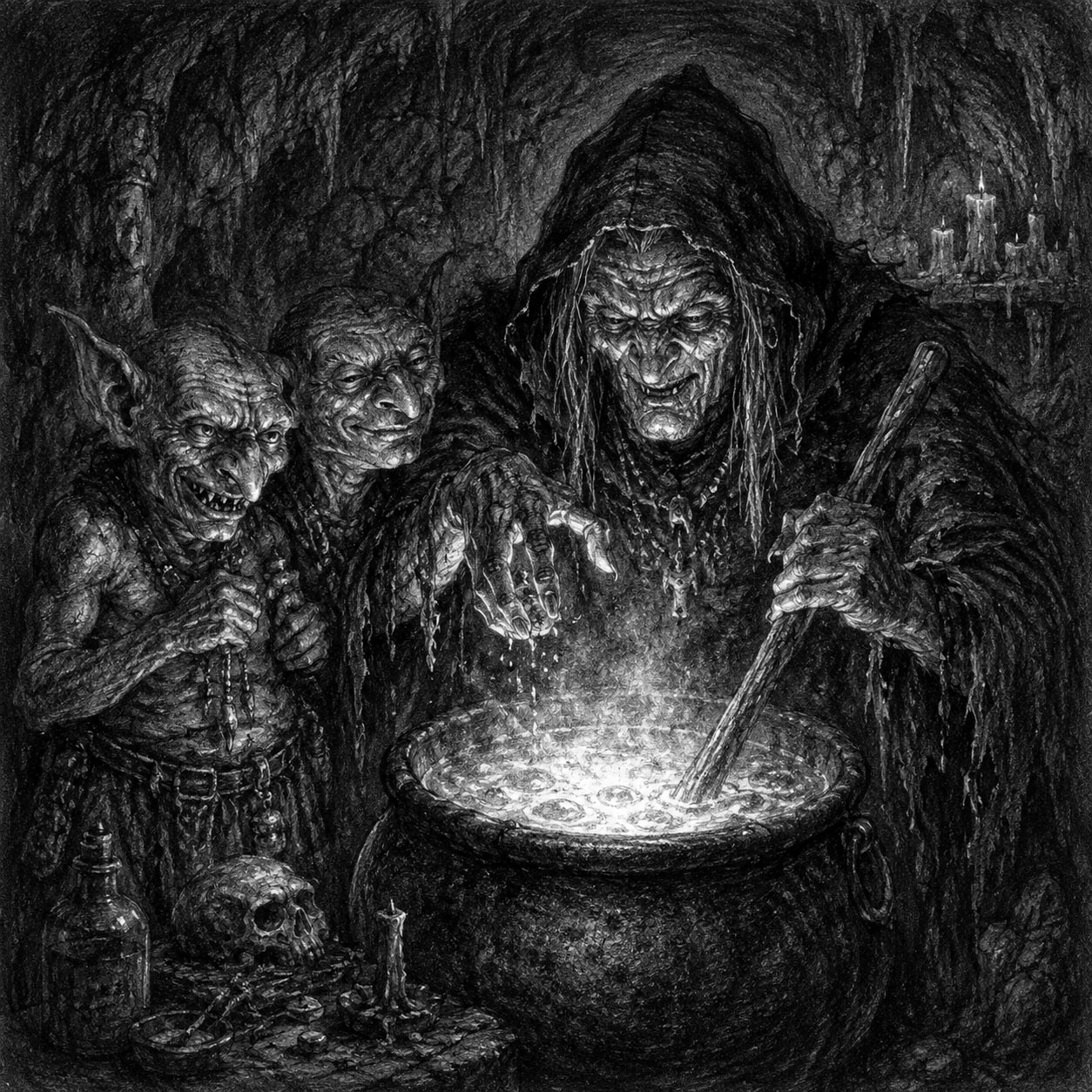
With the hag’s grim words still hanging in the air, Raine thumped his breastplate with a gloved fist. Leather on steel — sharp, final. He looked to the other Brave Hearts, searching their faces for the same hard edge burning in his own. The hag had murdered four working men — fathers, some of them — and she had that warped little goblin thing fetching and carrying for her like it was nothing. He meant to end them both.
“Ready?” he asked. No warmth in it. This was work — the only kind of work that had ever truly made sense to him. Fighting was serious. Killing was serious. And he took both deadly serious.
Last time they’d been in these tunnels she had laughed at him, that awful cackle chewing its way into his bones, and he had turned to water. Some spell, no doubt, but knowing that didn’t blunt the shame. The others never teased him for it — they weren’t idiots. You didn’t joke about a man’s courage, not when it was carved that bone‑deep. Even now, he could still hear her taunts echoing along the stone ahead, thin as a knife in the dark.
He didn’t wait for an answer. He had already turned, boots grinding on frost‑rimed stone, when a hand clamped down on his shoulder.
Thelonius.
“One thing, first.” Thelonius’s breath drifted out in a pale cloud, thick in the cold.
Raine felt irritation flare, sharp as steel on stone. He was wound tight, mind honed to the brutal simplicity of what was coming, and the last thing he needed was one of Thelonius’s wandering half‑thoughts.
“What now?” he growled.
“When we fought that ghost in the Easthaven town hall,” Thelonius said, glancing at Felwar and Miquitzil, “you stopped fighting. Remember? We were set up, holding the line… and you just backed out. You’re our front line, Raine. But you… well… left. Left us in the shit.”
Raine’s expression didn’t flicker.
“Do you have a point?” he asked, voice flat as hammered iron. Levistus’s abandonment burned in the back of his mind like an old scar being pressed.
“What was that all about?” Thelonius pressed. “Why did you walk off? Some magical compulsion?”
“I left willingly,” Raine said. “I had… an internal confrontation I was dealing with.”
Thelonius squinted.
“Internal confrontation. Right. Well… whatever it was… look, we’re walking into a hag who knows we’re coming. Lives on the line. I just want to hear you’re not going to have another internal confrontation. Are you? Do you think?”
Raine didn’t blink.
“There is no conflict any longer. I’m in it to the end.”
Relief loosened the tension in Thelonius’s shoulders. Before he could speak, Felwar lifted a hand.
“Wait. What about you, Thel?” Felwar said. “Last time we were here, you — in bear form — tore off through the tunnels on your own. Will—”
Thelonius raised a finger, neatly severing the rest of the sentence.
“I was a hero, Felwar. Leading the hag away. Keeping you — all of you — safe.” The pride in his voice was rock solid; he clearly believed every word. He dropped his gaze, muttering into his whiskers, “Didn’t even get a thank you. Not a one. Some hero.”
Felwar wasn’t buying it.
“I need to hear that you won’t be reckless. Don’t go charging off alone or doing anything that gets you killed. It’s exactly what you just asked of Raine. All four of us need to be smart. Stick together. Stick to the plan. Communicate.”
“Yeah, sure. Stick to the plan,” Thelonius said, already losing interest. “Let’s go get this stinky bitch.”
Raine didn’t wait for another word. He turned and strode down the tunnel.
“Wait.”
This time it was Miquitzil, his deep baritone stopping Raine mid‑step.
Raine exhaled through his nose.
“What now?”
Miquitzil touched his throat and let a low, resonant note hum through the cold. Raine’s shield flared with sudden, steady light, gleaming like a fresh dawn trapped in steel.
“It will last an hour,” Miquitzil said. “If she smothers our torches — which is exactly what I would do if I could see in the dark and a group of humans were after me — we will not be blind.”
Raine nodded, checked the others’ faces for any final doubts, and moved toward the narrow icy bridge that spanned the frozen river below.
The rope they had fixed here last time was still in place, stiff with rime but firmly anchored to the piton. Raine gave it a hard tug.
“Solid.”
He wrapped his gloved hands around it and slid the fifteen feet down to the ice‑choked stream below.
He bit off a scream halfway down.
The rope was not as they had left it. Hidden in the fibres were dozens of thin fishbone splinters and hair‑fine wire spikes, set at just the right angle to catch a descending hand. The fishbones mostly skated off his thick leather, but the wire slid straight through leather and skin alike.
He hit the ground with a grunt, breath steaming, hands burning. His face told the story before he could speak. He looked up.
“Do not follow me,” he ground out.
They winced as he peeled the gloves off slowly, each motion dragging needles free. Blood welled from dozens of pinpricks and pattered onto the ice while he worked, jaw clenched, breath hissing through his teeth. He tore a strip of cloth and bound his hands quickly, fingers already stiffening.
“Bitch,” he muttered.
Above, the others fixed a fresh rope to the piton and hauled the trapped one up, its cruel little barbs catching the light. Moments later they were down beside him, boots crunching on the frozen stream as Raine led them around to the north.
Thelonius sent his owl familiar ahead, the silent shape gliding through the dark. To their surprise, it soon revealed another opening in the rock — a second way in. A back door to the hag’s lair, perhaps.
The tunnel spat them out into a wide, echoing chamber, the ceiling a forest of stalagmites, all but lost in shadow. Under the glass‑clear skin of ice at their feet, shapes loomed — huge, pale, and perfectly still.
Giant skeletons lay entombed beneath them in layered heaps. The lowest were little more than drifts of shattered bone and splintered tusk, crushed under the weight of ages. Higher up, nearer the surface, the bodies were almost whole — titans laid down in their last repose, ribcages still and silent, massive skulls turned toward the ice above, rusted rings of mail and the hint of enormous weapons still clutched in bony hands. It felt less like walking on ice and more like treading a graveyard window, every step a trespass.
Their lantern and magical light slid over the crystal sheet, turning hollows into black mouths and eye sockets into bottomless pits. Somewhere deep in the frozen layers, a cracked jaw grinned up at them, the fractures glittering like teeth.
Felwar felt it the moment he stepped fully into the chamber. A tight knot drew in behind his ribs, small and mean. Warmth crept into his fingers despite the killing cold — a heat that had nothing to do with the air. For a heartbeat there was a sharp little pulse inside his chest, bright and jarring, gone almost before he could recognise it. His feet itched to move, muscles twitching, as though his body couldn’t decide whether to step back into the tunnel or stride forward across the dead. His next breath tasted faintly metallic, like he’d bitten his tongue.
Something in him wanted to recoil. Something else entirely wanted him to lean in, to charge ahead. He felt sick but kept it to himself.
They pressed on, boots whispering over the ice while the giants watched from below, patient in their frozen fall.
“You bring summer here, boy? How dare you? Well, come closer. Let me drink my fill.”
Maud’s voice crawled through the chamber, thin and sharp and wrong, echoing off the ice until it sounded like a dozen hags hissing at once. They all twitched reflexively. Raine swept his sword out, weight shifting, fully expecting her to come shrieking out of the shadows.
But there was no hag. Just the incessant howling of the wind threading through the caves.
The chamber warped with cold and shadow as they entered — and Maud stepped from the dark. Then another Maud. And another. And another. Four hags, four silhouettes crawling free of the dim. Their hair hung wet and rope‑heavy. Their faces were wrong angles, teeth too many, smiles too thin.
Only one was real. The others moved like perfect sisters — weight, breath, malice — but each shimmered faintly where the torchlight clipped them.
Raine saw it first.
“Shit,” he breathed, blade rising. “There’s four of her.”
From behind the cauldron, Flub‑Dub scampered forward, bladed glove held high. Poison dripped from the edges, sizzling where it struck the ice.
He slashed at Raine, but the armour turned the blades aside.
Raine barely flinched.
“You will die this day.”
The nearest Maud cackled — a guttural, evil sound that slithered straight into his spine. Raine’s knees shook. The fear hit him raw and sudden, a cold hammer behind the ribs.
“Not again,” he sputtered, unable to force himself those last few steps to bring his sword to bear. His breath hitched. The chamber felt too small, too close. He glanced around wildly, mind blanking.
He could only do one thing.
He stepped back — a hard, stumbling withdrawal — hoping to drag them with him.
They did not.
The remaining three cackled in perfect unison, a serrated harmony that scraped at the walls.
Flub‑Dub hissed, ripped the useless glove from his hand, and reached over his mismatched shoulders. Both heads snarled as he armed himself with two shortbows, one in each hand. He scrambled backward toward the cauldron, feet skidding on the ice, and fired wildly at Raine as the man retreated.
What happened next took barely a minute — a blur of steel and spell, a battle so fierce and frightening it left no room for breath. First one, then another, then the last of Maud’s phantasmal selves vanished, torn apart under the Brave Hearts’ assault, leaving only the real Maud standing.
Her two‑headed goblin loosed arrow after arrow, but he was a terrible shot, panicked and flinching. Most of his arrows shattered uselessly against the ice‑slick stone.
Maud was chained to Miquitzil by a crackling witch‑bolt — pulses of deadly electricity flashing every few seconds — and to Felwar by a vicious mind spike, a taut, invisible tether that promised there would be no escape. He would feel her wherever she ran. He would find her wherever she hid.
She hissed and cursed and scrambled up the cavern wall in desperation, glass‑skin fingers clawing for purchase, but there was nowhere to go. The Brave Hearts closed in, working as one. Raine had thrown off the last of his fear and laid into her, sword hacking viciously. Blood, fleas, and other foul ichor leaked from beneath her voluminous rags.
“Let me live and I will bring from the depths the White Lady’s chest. I alone know where it is. Such treasures. They can be yours.”
Thelonius simply laughed — a low, grim sound.
“No deal. You must pay for the evil you have done.”
Desperate now, Maud turned to Felwar, voice cracking like thin ice.
“Save me, boy — and I will give you answers to the mysteries you so desperately crave. I have the key to the lock that opens your world.”
Felwar stepped forward, eyes burning.
“There is nothing I want from you, hag.”
His hand snapped out.
A tiny seed of force erupted from his palm, streaking straight into her chest.
Maud shrieked, her black‑green skin cracking. She staggered, body trembling, two heartbeats from death. Fifteen feet up the wall now, she blurred at the edges and misty‑stepped away, putting precious distance between herself and the Brave Hearts.
She reappeared in a burst of white fog, still clawing near the roof as she dragged herself toward the giant‑skeleton chamber. Thankfully for Maud, the witch‑bolt link had severed when she vanished, and Miquitzil let out a curse.
Bloodless cracks spidered through her limbs. She clutched at the ice with shaking fingers, iron claws scraping, dragging herself spider‑like around the wall until, inch by inch, she slipped from sight.
Thelonius roared, body twisting, bones reshaping. Fur burst across his skin as he collapsed forward into dire wolf form. He sprinted after her—
The moment his paws hit the polished ice, he slipped.
Hard.
The dire wolf spun in several undignified circles, legs splayed, claws scraping wildly across the ice. His head swung side to side as he fought for balance, trying to pick Maud out of the shadows.
“I see you,” he growled through snapping jaws, voice half‑wolf, half‑man.
If Maud had breath left to laugh — and if death were not so near — she would have.
Then Miquitzil stepped out onto the ice. The Ice Hunter smiled as he uttered the phrase, and a volley of arcane darts flew unerringly from his fingers and into Maud.
“Arghh!” she screamed as her fingers slipped. She lost her grip and hit the ice hard. By the time she landed, her life‑force had already bled away — dead.
Fleas by the thousand erupted from her rags and scattered across the ice. For a moment they skittered in every direction — then they surged back together, a hopping, biting swarm that hurled itself into the dire wolf’s thick, lush fur.
But it was no haven. The fleas found no purchase there. The druid’s magical form was anathema to these bitter, unnatural things, and they sprang away almost as quickly as they landed.
The dire wolf scrambled to his feet, paws skittering on the ice, head cocked sideways as the fleas leapt from him and onto the frozen lake. They hopped a few frantic steps, then lay still — a dark carpet of bodies, a stain on the near‑pristine ice.
“You don’t see that every day,” he muttered, padding back toward the tunnel where the others had gathered.
“She’s dead then?” Felwar asked, though he already knew. He felt it in his bones. His stomach unclenched, and that uneasy pressure behind his ribs finally eased.
After a short respite — wounds bandaged, cuts cleansed — the Brave Hearts spread out and rifled through the hag’s belongings. The cold gnawed at the walls, but the silence after Maud’s fall felt almost warm.
Miquitzil crouched beside the great copper cauldron, running his fingers along the green‑aged metal. He whispered the words, the spell settling over the object like frost on glass. A moment later he exhaled softly.
“It’s remarkable,” he said.
The group gathered as he explained: add water, stir for a minute, and it produced a hot, nourishing stew. Enough to feed more than three hundred people a day. No curse. No hidden spite. No inherent evil. Just a powerful relic with the potential to feed all the people of Dougan’s Hole and Good Mead combined.
Raine let out a low whistle. “Not bad for a hag.”
“It’s more than not bad,” Thelonius said, eyes bright. He flipped through the pages of his druid book, searching for a passage he had marked. “Listen. You need to understand why this matters.”
They turned to him.
He pushed hair from his face and began pacing in that excited, half‑lecturing way he’d developed since discovering what he was.
“Everything’s connected. Everything. The sun goes away for two years and it doesn’t just get cold — it breaks the whole bloody ladder of life. Flora first: trees, shrubs, moss, all the green things that drink in the light. They’re starving now. Slowly. Quietly. They can survive a while, but not forever. They’re already thinning out. You’ve seen it.”
He gestured toward the cavern mouth, where the endless grey waited.
“And when the flora suffers, the fauna follows. Reindeer, caribou, buffalo, hare, elk, fox — all the creatures that live off those plants, scraping by on bark or lichen or whatever they can find. Their ribs start showing. Their young stop surviving the winter. Then the predators starve next. Wolves, bears, owls, big cats. Some turn desperate. Some disappear entirely.”
He held up a finger.
“And humans are predators too. We sit right near the top. If the reindeer fail, and the fish stocks crash because the lakes are ice‑choked, then we’re next. Not because people are weak — because the land is dying under our feet. The balance goes out of shape. One piece falls, then the next, then the next. It’s a long chain, and the first links are already snapping.”
He took a breath, flushed from the rush of explaining it all.
“So, a cauldron like this? Something that can turn water into food? Enough to feed most of Easthaven? This isn’t just useful. It’s life. It’s time. Time for the people not to freeze or starve while the world tries to remember what summer feels like.”
He grinned suddenly — wide, earnest, almost proud.
“So, yeah. That’s why this cauldron is so amazing and valuable to Icewind Dale. It gives us time to do what we need to do — end the curse and restore the circle of life.”
He had come a long way, Thelonius. From a fugitive who barely spoke, a raging alcoholic clawing his way through the days, to a proud druid standing firm in the frozen dark. The others saw him clearly now — his fur cloak set proud over one shoulder, his eyes bright with purpose. He wanted to make a difference not just to the people of the Ten‑Towns, but to nature itself. There was a new steel in him, a quiet, growing determination, and they nodded as he finished his lesson.
Raine was first to speak.
“We’ll end this curse, the four of us. I have no doubt.”
Felwar knelt beside his cloak, where he had gathered treasures and trinkets from near the hag’s bed. “I found these,” he said, pulling the fabric open.
Inside lay a muddle of coin, old keepsakes, and quiet cruelties: mixed Ten‑Towns coin; a silver locket with a young Reghed girl’s face sketched inside; carved bone needles; a battered fishing journal thick with weather notes and rough maps of Lac Dinneshere. From her shelves and baskets they had taken bone rings, dark obsidian knives, a stolen healer’s tonic, a defiled wooden idol of Chauntea, a pair of thick wool socks hiding a tiny sapphire, a silver ring sewn into a mitten, and a handful of small children’s carvings — bear, elk, wolf, boat, fish, owlbear — all laid out in a sad little line.
As Felwar quietly catalogued the finds, Miquitzil’s gaze drifted to Raine. The warrior stood a little apart, threading the four ears of Flub‑Dub onto a length of cord and tying it off to his pack with neat, practised fingers. Miquitzil watched for a moment, then gave an approving nod.
“You should salt them over dry heat,” he said. “They will keep for months that way.”
Raine frowned. “Why in all the hells would I eat goblin ears?”
Miquitzil paused, genuinely puzzled. “You can use smoke for added flavour,” he offered.
Raine stared at him, disgust plain on his face. “Are you mad? These are trophies of my kill.”
Miquitzil simply shrugged. In the tongue of his tribe he muttered, “Food is food.”
They rolled the cauldron out of the caves with aching arms and numb fingers, its clawed feet squealing against the ice as they hauled it toward the edge of Lac Dinneshere. The rangers waited with three sleds — their own and the Brave Hearts’ — breath smoking in the air as the party approached with the hulking copper pot glinting dully in the cold light.
The story came out in pieces: the hag, the dead fishermen, a dead goblin, and a cauldron that could fill bowls for a town with water as the only ingredient. The rangers listened with flat faces and hungry eyes, the way hard folk did when they heard the word food. Felwar watched them all the while, saying little. He studied the way they glanced at one another, how quickly they looked away from the cauldron, how their grips eased on their weapons instead of tightening. He weighed the set of shoulders, the quiet nods, the way none of them tried to stand between the Brave Hearts and the sleds.
Only when he was certain did he give a small nod of his own.
“You know what it is,” he said. “You know who needs it. Take it to Easthaven. Straight there.”
“We will,” their leader replied, voice steady. Felwar believed him. “I’ll see it into the Speaker’s hands myself.”
When the sleds bearing the cauldron creaked away across the ice, the Brave Hearts turned north. They cut through a forest of stone pillars that jutted through the frozen surface like broken spears, the shore of Lac Dinneshere looming sometimes perilously close at their side. Little by little the cliff to their right began to shrink, sheer wall giving way to chopped, uneven ground, until at last they were able to drag the sleds up and back onto solid land.
“I will miss the ice,” Miquitzil said quietly, looking back over his shoulder. The others did not hear him.
The lake lay behind them in a hard white sheet, the wind off it razor‑sharp and familiar. Even without salt on the air, it felt like home. It hurt like home. The warmth in his chest soured. That place was closed to him now — his village turned to knives and cold stares, his family wrapped in blame and fear. They had tried to spill his blood on the snow, called him the cause of a curse that was never his. They had sent a kill‑squad after him.
The memory settled over him like a heavy cloak, and he fell into a bleak, restless silence as they trudged east.
From time to time the sleds were pulled to a stop, the dogs breathing hard, stamping and tossing their heads, impatient to run. Raine and Thelonius would unfold Garret’s map on the sled, the parchment snapping in the wind as they argued quietly over ridgelines and tree‑marks, tracing routes with gloved fingers.
“We will not know for certain until we stand in front of it,” Raine said at last, checking the harness and giving the last buckle a sharp tug. “The strange tower is hard to find. Garret was clear on that. But he left good notes. We should be fine. A day or two at most.”
They pressed on, the wind needling their faces as the land rose beneath their sleds. Ice gave way to broken drifts and scattered stone, the world growing quieter with every mile. Even the dogs fell into a tense rhythm, ears flicking toward a line of larger hills ahead. By the time they crested the next rise, the wind had fallen to a whisper — and the shallow bowl below revealed itself, a place where something terrible had passed only hours before.
They moved down into the churned snow, stepping past torn hides and scattered supplies. The stink of old blood hung thick in the cold air. Miquitzil knelt beside a shattered spear, turning the broken haft in his fingers. Thelonius lifted a burnt flap of hide from the collapsed tent. Felwar sifted the snow with careful, gloved hands. Raine moved among the bodies with the quiet familiarity of someone who had seen too many camps end this way — or at least had heard enough grim tales to know the shape of such tragedies.
It took only a moment to notice what was missing.
“Women and children only,” Raine muttered, brow tightening. “No men. They were off hunting, then.”
It had happened within the last day. The tracks told the tale cleanly enough. Raiders had come from the east — at least a dozen — and had hit the camp so fast there had been no chase, no running, no chance. One tent had burned from the inside, someone’s last desperate defence before the flames guttered and died.
Blood lay in wide sweeps across the snow, dark and crusted. Some of the dead had been butchered like game, limbs taken with clean cuts, prized organs gone and the offal left in a foul heap. Thelonius recognised the work all too well and winced as old memories clawed at the back of his mind. Others had not been killed at all. Drag marks cut long grooves leading away from the camp, and in the churned snow beside them were small footprints. Children. Forced east under duress. About five taken, by the look of it, though the chaos made certainty difficult.
Miquitzil crouched beside one of the bodies, fingers brushing the cut of a hide‑shirt, the stitching on a torn sleeve.
“Reghed,” he said quietly. “One of the northern tribes.”
Thelonius glanced over. “Reghed?”
Felwar had heard the name in passing, but it was a hollow place in his education. He stepped closer, cloak brushing the snow, listening as Miquitzil continued.
“Barbarian clans of the tundra,” Miquitzil said. “Nomads. They follow caribou, reindeer, bison across the north. Four main tribes most speak of — Bear, Elk, Tiger, Wolf. Some will trade and drink with the Ice Hunters, my people, and with the Ten‑Towners. Others raid and take what they please. Hard to tell which at a glance. Harder in a place like this.”
Felwar found a torn braided bracelet half‑buried beneath a drift. Thelonius held up a broken tooth, white against the reddened snow. Raine lifted a broken bone‑handled knife — clearly orcish in design — then crouched beside a print deeper than the rest, broader too.
“Half‑ogre,” he said, then added, “or maybe full ogre.”
He pointed at another line of tracks, heavy and uneven.
“This one drags his foot. An old injury.” He straightened and held up a charm carved with three crude arrows, iron beads rattling in his palm.
Felwar frowned. “Three arrows?”
“Many‑Arrows,” Raine said. “Orcs of the worst sort. They don’t creep in small bands and steal a goat or two. They come in numbers, hit hard, leave nothing but bone and ash. You see this mark — you know it wasn’t an accident.”
Thelonius had followed a set of erratic, looping prints that circled and doubled back, as if the walker had traced a prayer circle in the snow where the blood was thickest. Knee‑prints marked the centre of it, pressed deep. Raine came over, crouched beside the strange, ritualistic pattern, and studied the marks in silence.
“What does that one mean?” Felwar asked.
Raine’s jaw tightened. “An Eye of Gruumsh,” he said at last. “A shaman walks with them. He blessed this killing.”
Together, the shape of the raid came clear. Women and children butchered and some taken. Men absent. No looting. No theft. Only killing, cutting, and carrying off what they wanted. Meat and malice.
Raine stood, scanning east. “They didn’t rest. They ran hard.”
Felwar nodded. “That way, beyond that ridge.” A jagged line of black basalt rose from the tundra like broken knives.
Miquitzil stepped beside him, breath frosting the air. “They are close,” he said. “A few hours at most.”
The Brave Hearts tightened their grips, the cold settling around them like iron, and turned their faces east. The hunt had already begun.
The sled churned through the drifts, the dogs pulling hard, ears pinned back against the wind. The orcs had not bothered to hide their passage — gouged tracks and dragged furrows carved a brutal line across the tundra. For over an hour they gave chase until the trail pulled them up a low rise, where the air shifted and a faint orange glow flickered against the rocks ahead. Raine signalled a halt. They secured the dogs, quieted their harnesses, and crept forward on foot.
They descended from the north‑west, keeping low behind broken stone and wind‑carved drifts, the smell of roasting meat drifting up to meet them. Below, four orcs and a half‑ogre squatted around a fire. Something human turned on a spit, skin crackling in the flames as the raiders laughed.
Felwar’s stomach flipped as the truth of it hit him. That smell — the sweet, greasy reek of roasting flesh — was human. He swallowed hard, jaw clenching, forcing the rising bile back down. For a moment the world swayed around him, firelight flickering strangely across the snow. But he steadied himself, breath thin and tight between his teeth, and kept his eyes on the monsters below.
They planned it quickly. Anger rose in all of them — a hard, hot thing — as they watched the young girl’s red hair turn and twist over the fire while the half‑ogre slowly rotated the spit. She could not have been more than five.
Thelonius struck first. He drew a sharp breath and shaped the spell with a measured gesture; the whispered incantation carried safely west on the wind. Nothing happened. No glow. No hiss. The ground looked unchanged — smooth snow, scattered tents, firelight flickering as before. Only he and his companions knew the danger now lying quiet beneath the drifts.
Raine stepped forward into clear view and called out, drawing the raiders’ eyes.
The orcs froze for a heartbeat, looking up from their meal. Then one barked a sharp, guttural warning.
The half‑ogre surged to its feet, towering above the rest, hide armour creaking. It stormed up the slope toward Raine, bellowing, axe raised—
And the moment its weight hit the hidden spell, the snow erupted.
The drifts split apart in a violent ring as twisting nettles and vicious, thorned brambles tore upward from the snow. They coiled around the monster’s legs, waist, and belly, barbs biting deep. The half‑ogre ploughed on out of sheer momentum, anger and hate, ripping itself open with every staggering step, blood spilling hot across the snow.
It forced itself forward, snarling, shredding its own flesh against the thorns. It reached the far edge of the growth — took one final step — and collapsed face‑first, dead from sheer blood loss.
Thelonius laughed out loud, despite the seriousness of the situation.
“That went well, eh!” he declared, but nobody was listening.
The orcs roared in shock and scrambled back toward the tents, but the spike growth caught them too. Barbs hooked into shins and calves as they retreated. One fell screaming, dragging himself free and leaving a long smear behind him.
A shaman burst from the nearest tent and thrust a hand upward. An invisible dome of silence swallowed the ridge, muting the world in an instant. Thelonius mouthed a curse — nothing came out. Miquitzil spat and stepped sideways out of the deadened air, Thelonius moving in the opposite direction. Sound rushed back in, wind, fire, orcish shouts.
Then the chieftain emerged.
Broad as a winter bull, skin the colour of storm‑cloud steel. Thick fur cloak, skull‑clasp, braided red hair heavy with iron rings. His armour was patchwork but brutal, shoulders spiked, gauntlets ironbound. His glare burned like fresh coals in the snow. He lifted his axe — a slab of metal big enough to fell a horse — and roared.
Raine stepped up to meet him. No fear. No recklessness. Only a cold, simple need to punish the butcher.
The two crashed together mid‑field, blades ringing, snow exploding under their feet. Raine struck first, carving a line across the chieftain’s thigh. The orc swung back, full force, axe slamming against Raine’s shield. The blow drove him to one knee, but he rose again, snarling.
Spears whistled — ineffectually — from the orcs near the tents. One clattered off Raine’s pauldron. Another buried itself in the snow by Miquitzil’s boot. A third shattered against the rock beside Felwar’s head.
“Close,” the warlock muttered, loosing an eldritch blast in response.
Miquitzil answered with a web spell, thick strands firing from his outstretched hand. The nearest tent vanished behind a curtain of sticky white cords, trapping two orcs inside as they thrashed and cursed.
Thelonius summoned fire.
A sphere of flame bloomed near the tents, rolling forward like a living ember. He sent it crashing into the enwebbed orc — who died in a sticky, burning mass — then pushed it on into the tent behind where another orc had gone. The cords ignited at once, flames roaring high. Screams rose, sharp and brief.
Another orc tore out through the back wall of a tent, robes singed, eyes wild. It spat a curse at Felwar, hurled some crackling spell, and darted back behind cover.
Felwar’s lip curled. “No.”
He thrust out his hand.
A cloud of stinging, biting insects erupted on the tent — a swirling storm of wings and venom. The buzzing mass shredded the canvas, ripping it apart in strips. The shaman tried to flee through the side, arms raised. The insects met him in a furious cloud, tearing into skin and eyes. He staggered away half‑blind, screaming in a language Felwar didn’t understand.
Then he drew a wicked blade, spiked and cruel. The shaman of Gruumsh would kill this impudent human or die trying. Either way, it was an ending his god would welcome — blood spilled in Gruumsh’s name.
The dire wolf came next — Thelonius shifting shape with a low, guttural snarl before bounding forward. He slammed into an orc with full weight behind him, knocking the raider off his feet, jaws closing around the throat in a single savage bite. Another tried to flee, but Miquitzil’s arrow caught him cleanly between the shoulders and dropped him dead.
Felwar sprinted low, trading insults with the shaman still chasing him across the ridge. Neither understood the other’s tongue, but the contempt carried well enough.
One by one, the orcs fell. Burnt. Torn. Bitten. Slashed. Blasted. The spike growth had started the attack, and now the Brave Hearts tightened the noose.
At last, only the chieftain remained.
At last, only the chieftain remained.
He roared again — a sound thick with fury and something like satisfaction. Blood on his blade, a full belly behind him, a prayer to Gruumsh rattling from his cracked lips. Death was no punishment to him. This was the fate he would have chosen.
But he was alone now.
Raine struck the first blow. Miquitzil the second. Felwar’s magic crashed home. The dire wolf lunged for his arm. The chieftain staggered, dropped to one knee — and still swung until the end.
Then he toppled.
Face‑down in the snow.
The camp fell silent.
Revenge burned warm in the Brave Hearts’ veins, bright against the cold. The raiders were no more.
Disclaimer
This is a work of fan fiction. All relevant characters, locations, and settings remain the property of Wizards of The Coast (WOTC) and the story contained here is not intended for commercial purposes.
I do not own Dungeons and Dragons (D&D) or any of the related characters. D&D is owned by WOTC (and its parent companies) and all rights of D&D belong to them. This story is meant for entertainment purposes only.