Session 11
Fine Words
The five‑hour ride west passed without incident. Lanterns bobbed in the dark as the sled skimmed across the hard‑packed road, dogs eager to run. At last the walls of Bryn Shander loomed, black against the pale horizon.
As they neared the eastern gate, Raine noticed Thelonius pale and sweating despite the bitter air. His eyes flicked constantly, searching the city walls, his breath sharp.
Raine slowed. “You all right, Thel?”
The druid’s voice came low, tight with dread. “I’ll be honest, I’m shitting m’self. What if they recognise me at the gates? Or someone in town does? And I’m put back in prison — locked up so tight no number of rats could help.”
Raine set a hand on his shoulder. “Listen. Bryn Shander’s no quiet village. All sorts wash up here — cutthroats, mercenaries, folk fleeing debts or worse. Trouble follows them, and crime’s as common as snow. Whatever you did, it’s nothing compared to the blood spilled since. A week after you were locked up, no one would’ve remembered. Two years on? You’re a ghost. Nobody’s looking for you.”
Thelonius swallowed and gave a stiff nod, though the knot in his gut refused to loosen. Raine hadn’t been the one rotting in that dark, stinking, ice‑cold cell. He had. The memory of stone walls and silence clung to him still, and despite his friend’s words, the fear gnawed on.
The gates were shut tight for the night, but there was little trouble gaining entry. A lantern‑bearing guard shoved a ledger forward, demanding each of their names.
“For the ballot,” he said gruffly. “Sacrifice, when the new moon comes.”
One by one the Brave Hearts scrawled their names. As they moved through the gate, Miquitzil leaned close to Raine.
“When is the next new moon?”
Raine’s grin was almost boyish. “Not for twenty days. We’ll be long gone.”
Miquitzil let out a breath he hadn’t realised he’d been holding. His shoulders loosened.
Garret cleared his throat. “I’ve a friend in town. I’ll stay with him and see to the dogs.” He glanced at the Brave Hearts. “When will you be heading on to Targos?”
The companions looked to one another; none had given it much thought.
Felwar answered, “We have to meet the Speaker here first, so… after that. Maybe tomorrow afternoon?”
Garret nodded. “I’ll meet you here, then.”
Raine led them unerringly to his haunt of choice — the Northlook. The tavern’s roofline squatted against the wind, smoke curling from its chimneys. Within, the air was thick with pipe smoke, firelight, and the roar of mercenaries and adventurers drinking away their coin. The Northlook was the rowdiest house in Bryn Shander — which was saying something. At the same time, its taproom was where rumours travelled fastest, and more than one profitable venture had been struck at its tables.
Scramsax, the scarred proprietor and a retired sellsword, looked up from behind the bar. He waved them over, eyes narrowing with the quick appraisal of a man who had seen too many adventurers come and go.
“Adventurers?”
Felwar nodded. “Yes.”
“Then you can stay for free,” Scramsax said with a shrug. “I was an adventurer once. I know how lean it can be starting out. Once you’ve got your first score, we’ll settle the debt.”
Raine stepped forward, pressing a few coins across the bar. “Appreciate the offer, Scramsax. But we’ll pay up front.”
Scramsax scooped them up without a word, tucking them into his apron. His reputation was plain: generous in the short term, ruthless in the long. Few who owed him ever forgot the debt.
Meanwhile, Miquitzil and Thelonius had drifted toward the far wall, where a massive knucklehead trout hung in pride of place above the hearth. Stuffed and mounted, its scarred body still carried the weight of old battles. Its glass eyes gleamed balefully in the firelight. Locals called it Ol’ Bitey, and stories claimed it had dragged more than one fisher into the icy depths before finally being caught.
“That would feed a family for a month,” Thelonius muttered.
“Look at the size of those eyeballs,” Miquitzil said, reaching up as if to pop one free.
Thelonius slapped his hand gently aside. “Those are made of wood, my friend, painted to look real.”
Miquitzil’s face fell, genuine disappointment flashing across his features.
As if to answer him, the trout’s head twitched. Its jaw snapped at empty air, sharp teeth clicking together. A ripple of laughter ran through nearby patrons — Ol’ Bitey had its tricks.
Felwar turned from the bar, head cocked, that haunted look in his eyes. Across the room a group of rough‑looking men sat hunched over their cups, faces scarred by work and weather. He stepped toward them, drawn by a sound only he could hear.
“What was that you were singing just now?” he asked.
The men looked up, confused. None of them had spoken a word, let alone sung. One of them snorted. The biggest of the lot leaned forward, a crooked grin on his face.
“What’re you on about, pretty little girl?”
Felwar’s jaw tightened. He asked again, slower this time, measuring his words though the insult still burned. “I heard you. A song. One of you was singing, and I would know what song it was.”
The big man’s grin thinned to something meaner. His hand flexed against the table’s edge, knuckles whitening — a warning as plain as any weapon. “Best find your ears elsewhere, boy, before you lose ’em.”
Before it could turn, Miquitzil was at Felwar’s shoulder. He gave the man a sharp look, then seized Felwar’s arm and pulled him back. “Enough.”
The big man spat to the side and turned back to his drink.
As they crossed back toward the bar, Miq hissed under his breath. “What was that all about?”
Felwar shook his head, unsettled. “I hear… fragments. Music. A song that slips away when I reach for it. I thought they were singing it. But — I must have been mistaken.”
Miq studied him, troubled. “Next time you hear it, come to me first. Promise me.”
Felwar nodded, though his gaze was distant, still chasing echoes.
The next day, after a well‑earned rest, the Brave Hearts crossed Bryn Shander’s busy morning streets. Smoke drifted from chimneys, vendors called through scarves pulled tight against the cold, and the sound of hammers rang from the smithies. At the heart of it all loomed the town hall, austere and solid, its double doors watched by a pair of guards.
Inside, the air was warmer but close, filled with the scratch of quills and the shuffle of parchment. An officious clerk behind a high desk peered at them over a ledger
“You’ll leave your letter here,” the clerk said briskly, hand outstretched. “It will be logged and passed on in due course.”
Raine shook his head. “We promised the Speaker of Bremen this would go to Duvessa Shane herself. Into her hands. Not yours.”
The clerk sniffed. “All correspondence is received here first. Those are the rules.”
Miquitzil stepped forward, arms folded. “We keep our promises. Or would you have us break our promise to the Speaker of Bremen?”
Felwar added smoothly, “And this one is important. We will wait, if need be.”
The clerk bristled, quill tapping against the ledger. “Impertinent,” he muttered. “If you will not be reasonable, then the watch will deal with you.” He snapped his ledger shut and vanished through a side door.
Moments later a guard strode in, hand resting on the pommel of his sword. He eyed the companions warily. “No one sees the Speaker without clearance. Hand over the scroll and I’ll see it reaches her.”
Raine folded his arms, jaw tight. “We swore it would be given into her hands alone. We’ll not dishonour that. If it means standing here all day, then so be it.”
The guard’s gaze flicked to Felwar, then Miquitzil, then back again. He exhaled sharply through his nose. “Wait here.”
Silence stretched until the echo of heavy boots filled the chamber.
Sheriff Markham Southwell appeared — tall, broad‑shouldered, his dark skin stark against the pale stone walls. At six and a half feet he seemed to fill the space, his eyes sharp beneath a permanent scowl of discipline.
“What’s this commotion?” His voice rumbled low, carrying across the hall.
The clerk and guard began to explain, but Southwell raised a hand. His attention fixed squarely on the companions. “You insist this must reach the Speaker directly?”
Felwar inclined his head. “We do. It was her fellow Speaker who required it.”
The Sheriff studied them a long, silent moment. Then, after examining the seal on the scroll, he gave a single nod. “Very well. Follow me.”
He turned on his heel, boots echoing against the stone floor, and led them through the austere corridors of the hall. The walls were plain, functional, built for endurance rather than beauty, though here and there a lantern cast warm light across faded tapestries of Bryn Shander’s history.
At last Southwell stopped before a sturdy oak door. He rapped once, then pushed it open and stepped inside.
“Speaker Shane,” he said, voice steady. “Travellers from Bremen, bearing a sealed letter from Speaker Dorbulgruf. They insist it be given into your hands directly.”
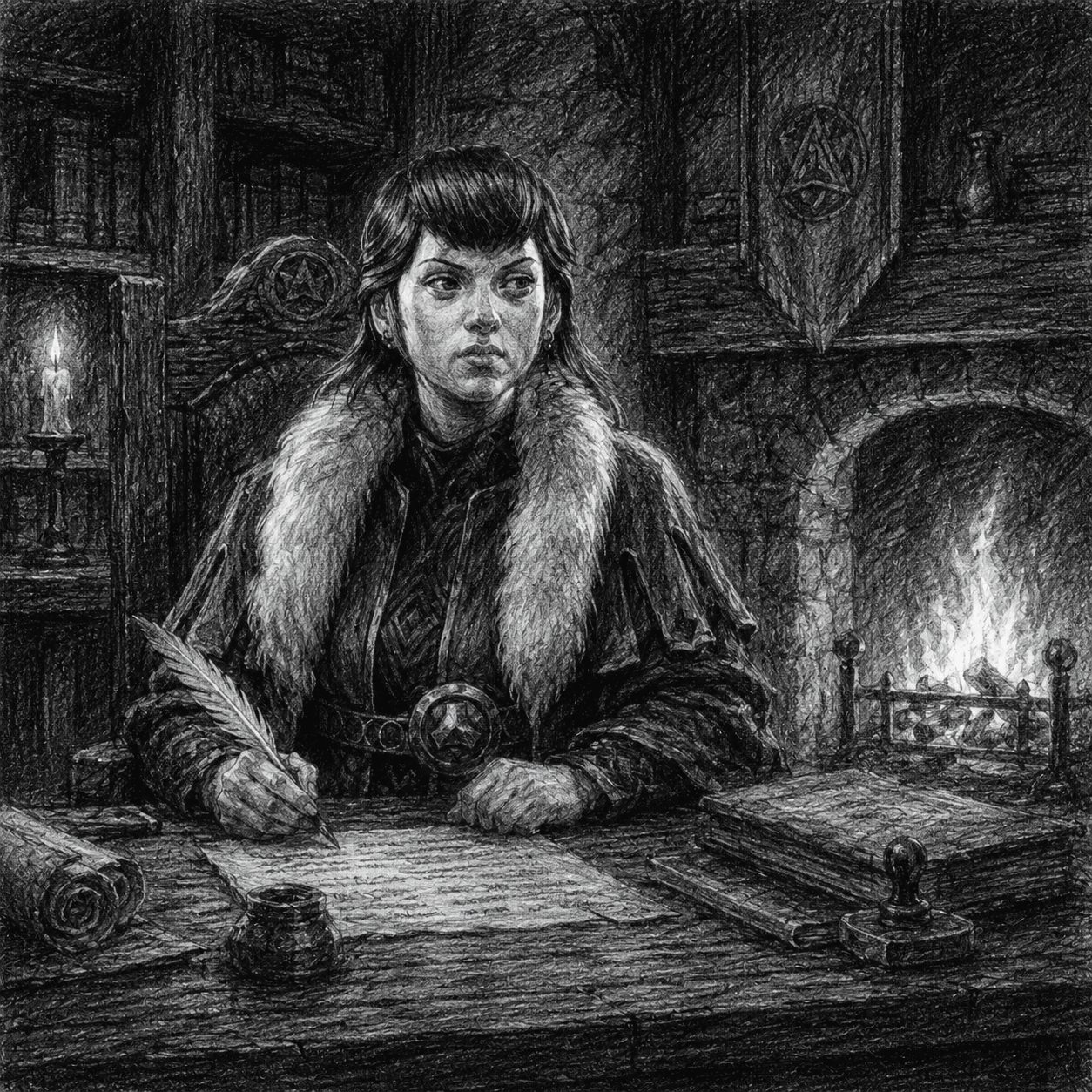
The chamber smelled faintly of woodsmoke and old parchment. At the far end stood Speaker Duvessa Shane, framed by tall windows that spilled pale winter light across the hall. She was younger than the Brave Hearts expected — barely into her twenties — yet she carried herself with a firmness that spoke of command. A blue cloak lined with white fur draped over her shoulders, and her brown hair was cut in a sharp fringe that only accentuated the seriousness in her eyes.
Shane’s gaze cut to the party the moment they entered. “So,” she said evenly, her voice carrying the cadence of someone long accustomed to debate. “You have a letter for me — bring it here.”
Felwar inclined his head politely. “Yes, ma’am.” He stepped forward and offered the scroll. “It is from Speaker Dorbulgruf Shalescar of Bremen. He read it to us, so we know its contents — and that we are mentioned within.”
Duvessa broke the seal without hesitation. She glanced to Southwell, then began to read aloud, her clear voice filling the chamber so the Sheriff could hear every word.
To the Honourable Speaker Duvessa Shane, Bryn Shander,
I hope this letter finds you beneath a roof not leaking and beside a fire still burning - luxuries I no longer take for granted.
I write with urgency regarding a murder that occurred in Bremen all too recently, and the individuals who discovered the body. The deceased, known here as “Dwvik Sann”, was found frozen and pierced by a shard of unmelting ice, killed in a manner I’m told resembles deaths reported in Easthaven and Targos.
We will have the corpse delivered to you for further investigation, as you see fit.
The group bearing this letter were instrumental in resolving a recent crisis for my town, and I trust them more than most I’ve paid in coin. They found the body, asked the right questions, and I believe they may be able to help uncover whatever hand is behind these killings - if you allow them to assist.
I ask that you receive them with courtesy, provide them access to what records you can, and permit your sheriff to speak plainly with them. I fear these deaths are not isolated, and the longer we blink at the snow, the deeper the rot beneath it grows.
If nothing else, they deserve to hear what’s known - and I suspect you’ll find them better equipped than most for this sort of trouble.
May your walls hold,
Dorbulgruf Shalescar
Speaker of Bremen
“I see,” Speaker Shane said at last. She rolled the parchment tight with neat precision and slid it back into its case. Her eyes lifted to the Brave Hearts, sharp and appraising. “Speaker Dorbulgruf puts great trust in you.”
She rested the scroll on the table before her, folding her hands atop it. “Perhaps you can tell me a little about yourselves. Starting with you—” her gaze fixed on Miquitzil, “—tribesman of the ice floes, if I am not mistaken.”
The Sheriff’s dark eyes followed her words, his towering frame shifting just enough to remind the companions that he was there — watching, weighing.
Miquitzil lifted his chin. “I am Miquitzil. Ice Hunter. An Akhaat of Nuvuk Thalu. Now I am here.” His arms folded across his chest. “They call us Brave Hearts, for our deeds and our courage.”
He sat back, crossing his arms as though that were the end of it.
But Duvessa was not so easily dismissed. She leaned forward, elbows on her knees, listening as closely as she watched. “Why did you leave your tribe — your family and people — for the southern towns?”
Miquitzil shifted, then leaned forward in turn, forearms braced on his knees. “I was exiled.” He leaned back again, arms folding across his chest.
She pressed on, voice steady, curious rather than sharp. “Why were you exiled?”
His eyes darkened. “For casting magic.”
“Your tribe has shamans, does it not?”
“Yes.”
“They cast spells, do they not?”
“Yes.”
“Then why were you exiled?”
Miquitzil’s jaw tightened. “For casting magic… different.”
“Different?” Duvessa’s tone was patient but unyielding. “How so? In what way is your magic different?”
Miquitzil said nothing at first, but the Speaker’s gaze did not waver. At last he muttered, “Different magic to Naartok the Grey‑Eyed, the tribe’s great shaman. Different is not… not a thing my people accept easily. I left. Now I am here.” He clamped his mouth shut, arms folding across his chest as if to bar further questions.
Duvessa studied him for a long moment, her expression unreadable. At last, she gave a small nod, accepting his answer and his desire to keep whatever secrets he protected to himself. Then she turned her attention to Felwar, seated next in the row.
“And what of you?”
Felwar lifted his chin, his voice calm but clear.
“I am from Dougan’s Hole. I am a warlock of Titania, Queen of the Summer Court. It is my purpose — my destiny — to see the seasons return to Ten‑Towns. To bring the sun back to our lives and end this cursed endless winter.”
Duvessa’s brows rose slightly. “An ambitious goal — one to be admired. Are your companions aligned in this?”
Felwar nodded. “I believe so, Speaker. My parents… they remain devout Children of Auril. They believe the lies.”
Her expression tightened. “That faith grows in every corner of the Dale. Freedom of religion is a tenet of my council, but the Children of Auril stretch that freedom into something far darker. A cult is no healthy root for a community.”
Felwar inclined his head, but his jaw worked. Something long held back threatened to spill. Duvessa noticed — her hands folded, her gaze patient, steady, waiting without pressing.
The air shifted. Raine leaned forward in his chair, wary. Miquitzil straightened, dark eyes fixed on his companion. Even Sheriff Markham, silent until now, adjusted his stance to give Felwar the weight of his attention. Only Thelonius seemed apart, slouched in his chair, sweat beading his brow as though the Sheriff might turn at any moment and drag him back to chains.
Felwar drew a breath. The words came rough, then steadied as conviction — and inspiration — found him.
“Speaker — the Dale cannot be judged by what it sacrifices. Towns must stand equal in the eyes of the gods, not raised up by spilling the blood of their neighbours. We will not be saved by burning food, by freezing to death in the snow, or by giving our lives to Auril.”
The chamber grew still. His voice strengthened.
“While the folk of Ten‑Towns bicker over how best to appease an uncaring power, a devil already builds his dominion at Caer‑Dineval. Levistus’ cult holds the keep. They call themselves the Blackswords. They gather the desperate and give them a choice: die in the cold, or live as slaves in his service, their souls traded. Many have chosen chains.”
The words struck like a hammer. Duvessa’s eyes widened. Markham’s armour creaked as his fists clenched, the sound sharp in the silence. Raine and Miq exchanged grim looks.
Felwar pressed on. “This endless winter makes it too easy. Life or death. Who would not take the devil’s bargain, if it meant survival? Those souls may be lost, but we must stop more from being taken. Only light will drive back darkness. Only warmth can break this cold. Only love can outlast hate. If we fail to stand together, then we will die alone.”
He rose slightly at the last words, his voice ringing.
“The Dale must be free.”
When Felwar’s words faded, silence clung to the chamber. No one spoke.
Raine leaned back slowly, a flicker of pride stirring in his chest at the eloquence of his younger companion. Miquitzil sat like carved ice, implacable, eyes fixed forward, his thoughts unreadable. Thelonius, meanwhile, hadn’t caught a word — his mind tangled in panic, heart hammering at the thought of chains and the cell he was sure awaited him.
At last, Duvessa stirred. Her composure cracked, replaced with cold fury.
“A devil cult in Caer‑Dineval?” she demanded, her voice ringing hard against the chamber walls.
She drew a sharp breath. “And what of the garrison?”
Felwar’s answer came low and grim. “Dead. Six humans, six dwarves. We saw them ourselves — their bodies sunk in the cistern, armour dragging them down.”
For the first time, Sheriff Markham’s mask slipped. His eyes widened, his jaw clenched. Duvessa’s face went pale, porcelain‑stricken.
“And Crannoc Siever? Speaker Crannoc Siever?” she pressed, her voice edged with dread.
“We did not meet Speaker Siever directly,” Felwar said, his voice steady but edged with bitterness. “But the rot in Caer‑Dineval begins with him. He still signs whatever papers are placed before him, yet the cult rules in his name. Their leader — Kadroth, a tiefling — boasted of Siever’s wealth. How he bleeds his folk to furnish tables hauled from distant Cormyr, to line his walls with costly art, to drink rich brandy and feast on cheeses and cured meats from across the Sword Coast — while his people go hungry.”
Duvessa’s expression hardened. She leaned forward, her voice like a blade.
“This Kadroth told you this?”
Felwar hesitated, then nodded once. “We saw it ourselves — the luxury, the waste. The trappings of a man living in comfort while his people freeze.”
Her eyes narrowed. “Let me tell you of Speaker Crannoc Siever.”
The chamber seemed to shrink around her words. Raine shifted in his chair, uneasy. Miquitzil’s gaze darted from Felwar to the Speaker, weighing the tension. Thelonius slouched lower, wishing himself invisible as if that alone would save him from imprisonment. Sheriff Markham remained still as a statue, but his hand closed around the pommel of his sword.
“I know Crannoc,” Duvessa said, her tone unyielding. “He is no tyrant, no thief, no weakling. The finery you speak of was not bought with the blood of his folk. Siever came north with his family’s considerable wealth, and he chose to spend it here — on nets, on ships, on men to sail them. Years before I took office, he turned a starving harbour into the lifeblood of Lac Dinneshere. For a time, Caer‑Konig itself was eclipsed. His people prospered from his ambition. Whatever you saw in those chambers was not stolen from their mouths.”
The words struck like a hammer. Felwar’s stomach churned, the realisation sinking deep. Kadroth had lied. Lied with detail, with confidence — and Felwar had carried that poison here, only to have it turned to ash in his mouth.
Duvessa pressed on, merciless. “If your tale holds truth, then devils now use his fortune for their own ends. That I cannot ignore. But do not mistake history — Crannoc Siever once raised his people high. If he has fallen, then he has fallen far. And if devils pull his strings now, I will see them cut.”
Duvessa shot a look at Markham. No words passed, only the flash of command in her eyes. The Sheriff’s jaw tightened like iron.
Felwar lifted a hand, urgent. “Speaker — do not rouse the towns against Caer‑Dineval. To liberate it would cost lives Ten‑Towns cannot spare. There are darker foes yet. Grey dwarves — the duergar — move in secret beneath our feet. Their aim is nothing less than the conquest of all Icewind Dale. If we turn our strength upon each other, we will bleed ourselves dry before they ever strike.”
Raine leaned forward, his voice steady and measured. “We have fought them, these dark dwarves. In Caer‑Konig we caught them thieving — four of them we slew with our own hands.”
Duvessa shook her head. “Grim news. But the devil cult must come first. If what you say is true, then it cannot be left to fester.”
The arrow was loosed. What had been spoken could not be taken back. Felwar pressed her still, urging her to leave Caer‑Dineval be, but she would not yield. Evil must be cut out, she said, if the people of Caer‑Dineval were ever to reclaim what remained of their lives.
Her gaze shifted then, settling on Raine. “And you?” she asked. “Your name, your history.”
Raine gave it plainly, a soldier’s answer. When she turned next to Thelonius, the druid blanched, trying to angle his face away from the Sheriff’s searching eyes.
“I… I am a potato farmer out of Dougan’s Hole,” he stammered. “My name is Brince.”
The others glanced at him sharply, but he pressed on, words tumbling over themselves. “I was breathed on by a caribou and shat on by an eagle. Three times. Now… now I am a druid.”
Silence held for a moment, awkward and brittle. Then Duvessa gave the faintest nod, accepting the answer without question. Relief washed over Thelonius, his shoulders sagging.
When she spoke again, her tone softened, reaching to all of them. “Do not be disheartened. Your passion does you credit. The Dale has long needed voices willing to speak of justice, of freedom, of unity. I share much of what you dream. I too would see this unnatural winter ended. I too would see our people free of fear — whether Auril’s, or any other.”
Her gaze hardened again. “But fine words are no shield against frostbite. Dreams do not put fish on hooks or wood on the fire. My folk are cold and hungry. The Children of Auril have convinced many that the sacrifices keep death from their doors. Even if I wished, I could not end it without something stronger to take its place.
“If your dream is to unite Ten‑Towns, then you must bring proof. And a way forward. I see now why Speaker Dorbulgruf recommended you to me. You are each made of the right stuff. If you can help us in this, then I will name you my wardens.”
She looked to Sheriff Southwell. He gave a single solemn nod.
“You will be housed, fed, and given a stipend,” Duvessa said, her voice steady, her gaze moving across each of them in turn. “In return, you will serve me — and through me, the Dale. Root out this curse. End the duergar threat. And strike down whatever else you judge fit along the way.
“But hear me well: you will break no laws. You are not vigilantes. You will act as though I were at your shoulder in all things. Honour and discipline must be your guide.
“What say you?”
The Brave Hearts looked to one another, and each nodded.
“Good.” She tapped the scroll case on her desk. “Then your first charge is already upon you. These so‑called Ice Murders. The Sheriff will take you down to the mortuary. Things are worse than you realise.”
Disclaimer
This is a work of fan fiction. All relevant characters, locations, and settings remain the property of Wizards of The Coast (WOTC) and the story contained here is not intended for commercial purposes.
I do not own Dungeons and Dragons (D&D) or any of the related characters. D&D is owned by WOTC (and its parent companies) and all rights of D&D belong to them. This story is meant for entertainment purposes only.