Session 12
Family
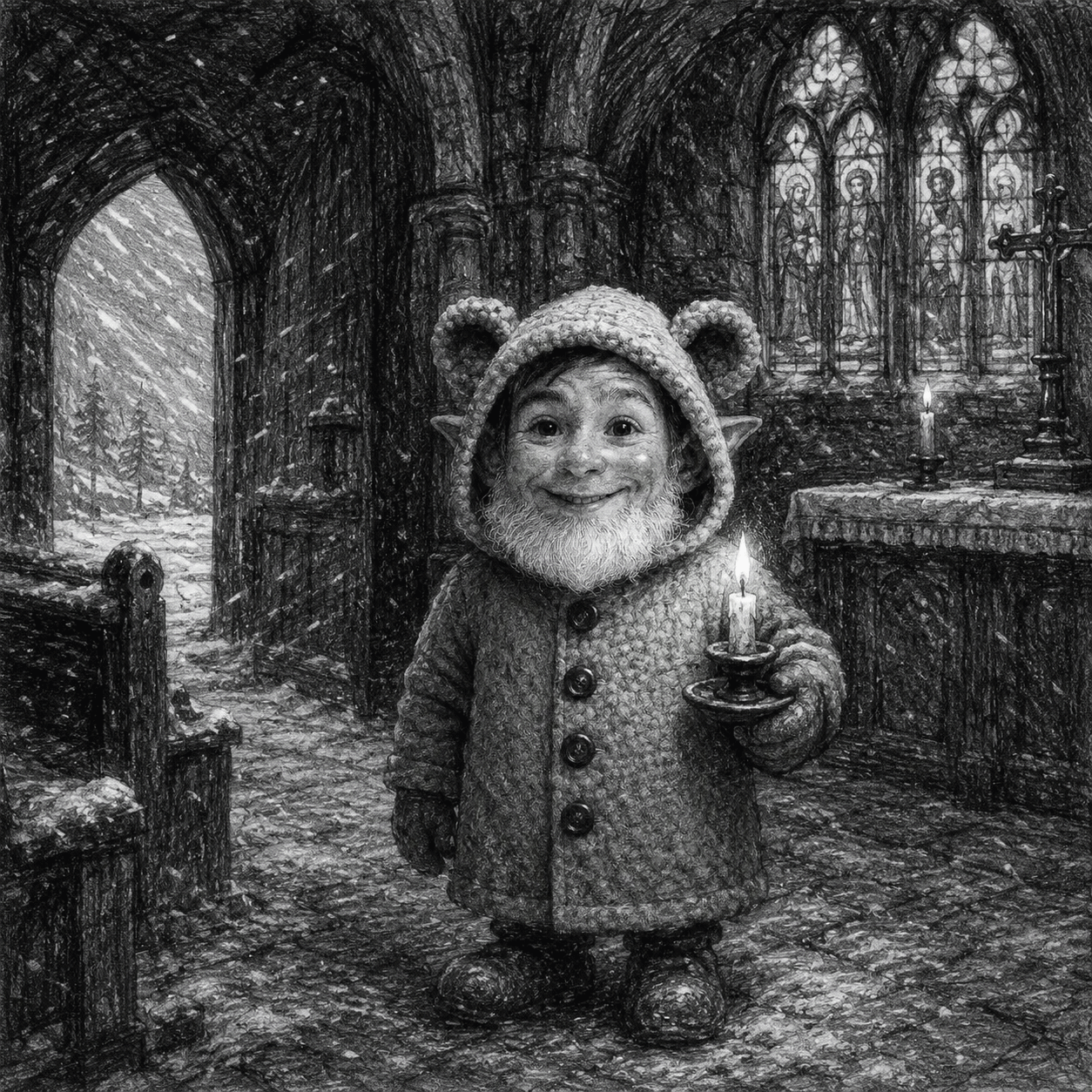
The Brave Hearts were admitted into Bryn Shander’s council hall, its long chamber filled with the murmurs of scribes and the stern presence of Sheriff Markham Southwell. As the party waited, Thelonius Jones drifted aside, his boots echoing faintly against the timber floorboards.
On the wall near the doors hung the WANTED board, sheets pinned one atop another, curling at the edges with use and age. Some pasted over three or four deep, names stacked upon names of outlaws, poachers, debtors, and brigands marked for justice.
Thel’s eyes flicked left and right to ensure no companion was watching. Then, with a slow hand, he lifted the most recent pages and found what he half‑expected — his own name staring back at him.
WANTED
By order of the Speakers’ Council of Ten‑Towns
++ THELONIUS “THEL” JONES ++
Human, male.
Formerly of Dougan’s Hole
Mid‑late 20s
5’9”, 160 pounds
Notable features: Dim‑witted. Feeble of body and mind. Greasy black hair. Pale, pallid skin. Alcoholic. Drifter, known poacher, prison escapee of no fixed address.
CRIMES:
• Poaching the Dale’s game in defiance of Speaker law.
• Assaulting a constable during his arrest.
• Escaping lawful confinement from Bryn Shander’s gaolhouse, leaving two keepers maimed in his wake.
REWARD:
• A purse of 5 gold crowns for his capture alive.
• Half that for proof of death.
WARNING:
Do not approach alone. Jones is potentially dangerous, with a criminal’s wickedness and total lack of common sense.
By decree of Sheriff Markham Southwell, Bryn Shander.
Thelonius stared for a long breath, the words burning deeper than he’d care to admit.
“I didn’t hurt any guards,” he muttered under his breath, voice low with a bite of defiance. His eyes skimmed back to the page. “Pallid skin? What the fuck does pallid mean?”
He yanked up a sleeve with one hand, prodding the flesh of his forearm as though the answer might be written there. “Pallid?” he said again, louder this time, and turned to Miquitzil.
The ice hunter only shrugged, dark eyes indifferent. He neither understood nor cared to engage, his attention fixed on Sheriff Southwell across the chamber, where Raine and Felwar were locked in quiet conversation.
Thelonius smoothed the sheet against the board, tucking it carefully back into place, masking it beneath the stack of other names. Then, jaw tight, he returned to stand with the others.
Sheriff Southwell concluded his exchange with Raine and Felwar, his heavy voice carrying across the chamber. He instructed the Brave Hearts to meet him later at the House of Rest — Bryn Shander’s mortuary, where the victims of the Ice Blade Murders lay waiting for answers.
With that, the group left the council building. Thelonius, still pale with unease after giving Speaker Shane his name as Brince but signing into Bryn Shander as Thelonius, pulled the others aside.
He whispered in a rush that he would slip out the east gate, sign out there, and then re‑enter through the south gate under the name Brince. Raine frowned and waved him off.
“Don’t bother. No one’s going to notice. Or care.”
But Thelonius leaned in close, conspiratorial. “I’m still on that poster. I can’t take any chance. There’s a five‑gold‑piece bounty for me — half that if I’m dead.”
Raine rubbed his chin theatrically, eyes flicking to the others. “Five gold pieces, eh? A tidy profit. All we’d have to do is march you back inside and we eat like kings for a day.”
Thelonius’ face drained, horrified, until the others broke into laughter. Even Raine’s hard mouth tugged into a grin. Realising the joke, Thelonius forced a laugh himself, though his nerves lingered. He still followed through with his plan, slipping around the city while the rest carried on. Forty minutes later, as arranged, they met again inside the south gate, his name freshly signed as Brince Jones.
After a quick bite of breakfast, Felwar led the companions toward the House of the Morninglord, where he intended to speak with its priest. Their route took them past another landmark — one that stopped them in their tracks.
The wide thoroughfare narrowed as they drew near the once‑proud House of the Triad. Its high stone walls and heavy buttresses still spoke of order and justice, but the details told another story. The carvings above the entry — the scales of Tyr, the open palm of Ilmater, the gauntlet of Torm — had been chipped and gouged away with hammer and chisel.
Raw canvas shrouds hung where masons had not finished their work, veiling the faces of gods cast out. In their place, rough wooden scaffolds clutched at the façade. Stonemasons laboured under the dark sky, chiselling blocks of ice‑blue granite. Half the street was blocked by wagons, ladders, and piles of tools.
From the centre of the worksite rose a statue still in progress — a towering woman of owlish aspect, wings curling upward, her face cold and pitiless. The companions recognised her likeness from the heights of Kelvin’s Cairn: Auril, the Frostmaiden.
Temporary banners of dyed blue leather snapped in the wind, their edges crusted with frost. The chapel doors — once carved with scenes of justice and martyrdom — were daubed with crude sigils of snowflakes and talons. Where pilgrims once gathered, workers now hauled stone, their work songs drowned by the ceaseless ring of hammers.
The air seemed colder here, though the street bustled with life. Some townsfolk hurried past with eyes averted, but others lingered, gazes bright with fervour as they watched their new goddess rise from the ruins of the old.
The Brave Hearts exchanged glances. None of them were devout, but the sight unsettled them all the same. The tearing down of Tyr, Ilmater, and Torm — faiths that had stood for centuries — was no mere change of stone. It was Bryn Shander’s soul being chiselled away and recast in Auril’s cruel visage. That it was allowed to happen so readily spoke to the town’s frayed spirit; the Frostmaiden’s roots run deep.
Further on, the Brave Hearts reached the House of the Morninglord, the town’s shrine to Amaunator, Keeper of the Eternal Sun.
The narrow street outside the small shrine was a crush of bodies and noise. A mob of townsfolk chanted and swayed, their breath steaming in the cold through balaclavas, crude symbols of Auril clutched high. The air shook with their voices:
“Close the doors! Tear it down! The Frostmaiden provides!”
At the edge of the throng, a lone woman struggled forward, her arms laden with a sack of food and supplies. Each step forced her into the press, where the crowd shoved her back with jeers. A loaf of bread spilled into the snow, splatters of icy mud caking the wrapper. She wore the vestments of a priestess of the sun god, and though she clung tight to the rest of her offering, it was plain she could not push through.
“This is my church,” she cried, her voice sharp with desperation. “Let me in!”
But her plea was drowned out. At the centre of the mob, a broad‑shouldered man raised a frost‑crusted talisman high, his voice booming above the din, practised and commanding.
“Friends, neighbours — look at what stands before us. This shrine, this house of a sun god. Mishann, here, clings to it still. But tell me: has the sun returned to our sky? Has warmth graced our fields? No! Not while this affront stands. It insults the Ice Maiden, and its doors must close. It is the will of the people, who sacrifice too much for this to continue.”
The crowd answered with a cheer — a blend of true believers among the Children of Auril and townsfolk swept along by the fervour. He jabbed a finger toward the priestess, forcing her back against the shrine wall.
“This is not faith — it is denial. Every stone here spits in Auril’s face, tells her we spurn her gift. And so she withholds her mercy. The longer it stands, the longer we suffer. Turn your back on this sun god. Embrace the Frostmaiden. Only when every heart beats with one devotion will she lift her hand, and we will be saved. You, Mishann — you are the one keeping the sun from our horizon with this blasphemy.”
The mob stamped and roared approval, shaking their ice‑sigils in the air. The sound rolled down the narrow street like a wave breaking against stone.
“Leave the Dale! Leave the Dale!” they cried, the chant building in force as more voices took it up.
Raine and Felwar exchanged a glance. Without hesitation, they pressed forward toward the mob, intent on breaking its grip and clearing a path for the priestess. Behind them, Thelonius and Miquitzil held back, watching warily as the mass of bodies shifted and surged, the frost‑lit fervour swelling against their companions.
Thelonius lingered, weighing his options. Then, with a nod to Miquitzil, he stepped to the side of the road. His familiar unfurled its wings and took to the air, gliding up to perch on a nearby rooftop. From there it peered down, giving Thelonius a vantage beyond the crush of bodies — a clearer sense of the confrontation unfolding below.
Raine and Felwar pushed into the edge of the press, shoulder to shoulder, carving a path toward the priestess.
“Stop this at once,” Felwar called, voice cold. “Threaten her no more.”
“Or you will answer to us,” Raine added, hand hovering near his sword.
The tall man at the mob’s centre turned toward them, talisman raised. “Begone. This is no concern of yours.”
“Go! Go! Go!” the crowd answered, a single animal shout.
The priestess moved to retrieve the fallen loaf, but a follower of Auril ground it into the mud with a boot.
“She is free to enter the church, and you cannot stop her. Will not stop her,” Felwar said — calm at first, then harder.
The crowd didn’t listen. Felwar’s jaw tightened; he thrust a palm outward and an eldritch crack leapt from his fingers, shattering the upper branches of a nearby tree. Splinters rained down. A few of the younger believers stumbled back, nerves fraying at the sudden display of power.
The tall man laughed. “Move along. Your threats don’t scare us. What are you going to do — commit murder?”
The mob jeered. The priestess pressed a shaking hand to her chest and tried to soothe the man, tears streaking her face. “No violence. Let me in. I live here. This is my home as well as my church.”
“This place is an affront to the Frostmaiden,” the tall man spat. “You’d be better off following the false religions south, out of the Dale. This is Auril’s land now.”
Felwar had had enough. He sent another blast into the tree; the crack made the nearest branches shudder. Thelonius’s owl — perched too close — flapped up and sailed to the chapel roof.
“Let her through!” Raine shouted, stepping forward, his face a menacing grimace.
The tall man stalked toward Felwar, only his eyes visible beneath a woollen balaclava. Raine’s hand tightened on his sword; the tension hummed between them.
In a single motion the man wrenched down his face covering and seized Felwar’s ear, just as he had done countless times in years past. For a heartbeat Felwar was no longer standing in the frozen street but back in that cramped home, a boy again, cowed beneath his father’s grip and displeasure.
“Move along, son. You’re not needed here. Else you’ll get a spanking like you used to,” the man growled, dragging Felwar toward the side of the road. The word son landed like spit, heavy with scorn.
“I am no son of yours!” Felwar spat, wrenching free. “And you were no father — not by a damned sight. You and the rest of these fools best move along, or we’ll crack some heads and hand you over to the city watch ourselves. Defending a lady’s honour will look a damn sight better coming from me than whatever feeble lie you can cobble together.”
He gave his father a withering glare; part of him felt good when the man recoiled. “I said — MOVE ASIDE.”
The Children of Auril wavered as Raine stepped among them, his greatsword loose and very present. The combination of Felwar’s magic, Raine’s stance, and the clear refusal to be cowed began to unnerve the crowd. Murmurs turned to uncertainty, hesitation to shuffling feet.
Felwar’s father spat at him — a thick wet loogie that slid down Felwar’s winter trousers and froze on the fabric. “I have no son,” the man said, each word slow and hard.
“Go home,” Felwar yelled after him. “Back to your drunk wife and sheltered, misguided life.”
The line of believers broke. They drifted away in small knots, muttering, blowing into their gloves.
The crowd melted away. Felwar and Raine watched them go, shoulders squared, eyes on the retreating knots of townsfolk until the last of the ice‑sigils disappeared down the street. The priestess, trembling, was finally able to step forward into the doorway of her chapel, clutching the remaining provisions to her chest.
Felwar stood with his back to the crowd, face stung by the spit and the name, while Raine kept ready watch until the last of the troublemakers had gone.
She stepped forward and invited them in. Felwar crossed the threshold first. Raine glanced back, then lifted a quick, sharp hand to signal Thelonius and Miquitzil to follow.
Amaunator’s chapel was modest — two storeys of timber and stone, its narrow windows built to keep the cold at bay. To everyone but Felwar the room was dim: faded murals of the sun, dust hanging in the still air, a single brazier throwing a small circle of heat.
But the moment Felwar set foot inside, the murals seemed to flare. Golds and reds burned fresh, the faint light from the high window swelled into a shaft that caught him square across the face. Where others saw only old paint and a trick of reflected light, Felwar felt warmth — a real, knitting warmth that eased the tightness in his shoulders and filled the hollowness inside him. For a heartbeat he stood made whole, as if the sun had touched him once again.
“Titania,” he whispered, awestruck.
The priest paused mid‑gesture, eyes widening. A faint vibration hummed at the edges of the room — not heat so much as presence — and Felwar felt the hair rise on his arms. To everyone else the chapel remained what it had been: a dim, quiet space with worn boards and the smell of tallow. Thelonius and Miquitzil slipped in last; Raine cast one last glance up and down the street, then closed the doors, shutting out the biting cold.
Mishann stepped fully into the nave and set the meagre bundle of supplies on the little table with careful, practised hands. She smoothed the cloth as if it covered something precious, then turned to face the Brave Hearts.
“Thank you,” she said, voice small but steady. “The Children of Auril are becoming bolder with each passing month. You were brave to stand up to them. It is troubling, and I am not sure how I can go on. But for now, today, I thank you again.” Her eyes lingered on Felwar and Raine; the gratitude there was plain.
“I am Sister Mishann, keeper of this modest chapel to the Morninglord. And you are all welcome whenever you like, to escape the wind and chill and find refuge here.”
Felwar still held his hand out, palm up, as if the warmth on it might be something he could gather and keep. Mishann’s smile was gentle and curious. “Are you a follower of Amaunator? It looks to me as though you have seen the light.”
“A devotee of the sun, that is true — but not of your god,” Felwar answered, respectful and a little awed. “I walk for Titania of the Summer Court, and doubtless she and your god would be friends if they ever shared a cup of sun.”
He introduced himself and the others in turn. Raine nodded, unease prickling at the edges of him; he pushed it down and kept his face still. Thelonius settled into the third row, taking it all in. Miquitzil had already slipped to the back, leafing through Astrix’s spellbook with distracted fingers.
Mishann thanked them each in turn, then offered a wooden cup to Raine and a heel of stale bread to the others. Felwar courteously declined. Raine, keen to try anything once, drank and took a bite.
“That is the morning dew,” Mishann said softly, taking back the cup. “And the dawn bread.” Raine managed a nod, tried not to think too hard about either name, and stepped back without a word.
She led them in the morning prayer, and the Brave Hearts sat quietly, patient and still, until her words dwindled to a hush. When she finished, the small room seemed steadier for it.
From above came the light tap of small boots, then a hurried clatter as a compact figure in a shaggy, fuzzy onesie bounded down the stairs and into the chapel. The gnome’s suit looked like a child’s sketch of a winter beast made real — sealskin panels quilted with snow‑hare fur, ermine trim around the hood, and a web of thin, flexible copper tubes stitched beneath the lining. A brass coupling peeked from his cuff. He flicked it with a nail and it chimed.
“Emergency kettle port,” he said, catching Felwar’s look. “On very cold nights I plug in, pump warm water through the under‑tubes, and simmer myself like a dumpling. Cosy. Slightly damp. Acceptable trade‑off. If Mishann hears whistling, she knows I’m al dente.” He giggled — then the mirth drained from his face. In a series of quick steps, he was at Mishann’s side, taking her hand with both of his. “They were monsters, all of them. Are you alright? Fingers, wrists, ribs? Take a breath — any pain?” Only when she nodded did his shoulders loosen.
“I’m fine,” she said, steadying. “Thanks to these brave heroes.”
At that, he brightened. He turned to the party, beaming, and trotted over to shake Raine’s and Felwar’s hands with a quick, earnest pump, then lifted a small, well‑loved plush polar bear hanging at his waist, one paw missing.
“I am Copper Knobberknocker — handyman, lamp‑trimmer, leak‑mender, brazier‑feeder, sermon‑listener when I must, sermon‑heckler in my head. This is Marvin. We watched from upstairs. Thank you for shepherding Mishann home.” He nodded solemnly, then tipped the bear in greeting toward Thelonius, whose wide‑eyed confusion made Copper grin all the more.
Copper bobbed toward the brazier, spreading his hands to the heat. “I used to keep tools at the House of the Triad too,” he added, face falling. “Until that… closed.” A small, awkward silence. He filled it with a sniff and a brighter tone. “Right. Work to be done. Winter to end. Hope to engineer.”
Felwar picked up on the curious phrase. “Winter to end?”
Copper leaned in, voice dropping to a conspiratorial rush. “Oh, why yes, of course. Listen. Auril’s grip — it will not last. How do I know? Because my friend Macreadus is holed up at the Black Cabin, and he is building a thing. A dawn‑machine. A little mad, a lot clever. Brass rings, glass tubes, a humming heart that talks to the sky. We don’t always see eye to eye, but he’s quite brilliant. He says — with calibration and courage — it might pry at the Rime and give us a crack of summer. Might. Or it might explode and give us a crack in the tundra. Both are data.”
He glanced at Mishann, then back to the Brave Hearts. “He does not write. He does not bathe. He forgets to eat unless his kettle whistles at him. If you find yourselves out that way, would you look in on him? Knock the door, check his pulse, stop the cabin from catching fire. Help if help is needed. And if he’s gone to folly, tell me. Yes? That would be good. Very good.” He rocked up onto his tiptoes and peered at Felwar, suddenly solemn. “Report back now, you hear?” He wiggled the polar bear’s paw in a little wave.
Copper dug in a pocket and produced a grubby scrap — a sketched line through wind‑bent pines, a dead elm like a hooked finger, the Black Cabin marked with an X. “Landmarks. Two boulders here — if you see them, you’re close. The cliff edge here — steer left when the drift looks like a sleeping whale. See?” He tapped the scrap. “Bring gloves, patience, and any spare food — and copper coils; you can never have too many of those. If you come back with news, I’ll make you something practical: hand‑warmers that don’t scald, a signal whistle only wolves hate, or a kettle‑loop like mine so you need never shiver quite so hard.” He lifted Marvin again, the bear’s stitched face earnest. “Marvin insists I say please.”
Felwar nodded, studying the sketch, and tugged Raine in beside him. “We will check on your friend when we are next up that way.”
Copper shrugged, beaming. “Maybe you lot are exactly what is needed to end this curse.” He tipped his chin toward Thelonius, raising his voice just enough to make sure he was listening. “Macreadus is his name. End the curse. Black Cabin. Overlooking a valley. North of Lonelywood. You might want to take notes.”
He leaned toward Raine in a conspiratorial whisper. “Is that one all right? Looks a little dim.” Marvin’s stitched paw gave a sympathetic wiggle, as if to soften the remark.
They met Sheriff Markham Southwell at the House of Rest — a squat timber building with black‑shuttered windows and the white cord of Ilmater over the door like a quiet blessing against the cold. Inside, the street‑level hall was plain and purposeful: a row of pine coffins along one wall, a scuffed desk with a ledger and quill, a battered donation box with a slit worn smooth by gloved hands.
“Downstairs,” the Sheriff said.
He led them around the side to a pair of storm doors set in the earth, iron rings frozen rim‑white. Hinges creaked as he heaved them open. Cold breathed out. Stone steps dropped into the dark.
The mortuary below was all damp stone and the metallic tang of old blood. Narrow windows at street height leaked a tired light mottled by frost, turning the day outside into a pale blur. Dyed blue leather curtains hung stiff in the corners, hiding alcoves of urns and tools. Along the centre of the room two lines of iron tables stood in order, each shape under linen too human, too final. A brazier burned weakly away from the bodies — warmth in symbol more than in fact. Lanterns fixed to the pillars guttered and fluttered, their little flames yellow and wary.
Raine stepped in. Thelonius and Miquitzil followed, Felwar last. Sheriff Markham came behind them, boots ringing once on the stone.
Then the lanterns flared as if a wind had found them and, all at once, every flame turned the colour of ice.
The room froze.
Breath hung like glass in the air and did not move. Thelonius halted mid‑step, one hand lifted. Miquitzil froze mid‑cough, mouth half‑open, the sound suspended in the cold. Felwar’s coat hem arrested in a ghost of motion. Sheriff Markham’s eyes fixed on nothing.
Only Raine felt his chest rise and fall.
Only Raine could move.
Mist drew itself out of the air and took shape above the tables — a vast face of ice and vapour, horns curling like glacial spires, features beautiful and merciless. The temperature bit through leather and cloth. When the voice came it was velvet over steel, intimate and freezing.
“You think you know your father’s life, Raine… but you do not know the truth.
“When he was still a young man — a junior in the Longsaddle militia — he came into possession of an amulet of pure chardalyn, a jewel born of the Dale’s frozen heart. It had wandered south through many hands, but in his it found purpose. For when he wore it, he heard my voice… and he listened. He pledged himself to me, and in return I gave him what no mortal commander could hope for. He became the Slayer.
“With the shard at his breast he rose quickly through Longsaddle’s ranks — not just a soldier but a legend. He saw what others could not, struck where others faltered, and inspired men to follow him into fire and shadow. Goblins whispered his name like a curse — rightly so, for he was their scourge. Longsaddle and the villages around it, cowed by goblins for generations, thrived in your father’s wake. Generations of goblinkin were erased thanks to his skill and his willingness to do what needed doing. Males, females, children, infants — no goblin was safe. His victories were not luck, Raine — they were destiny, sharpened by my gift.
“The people of Longsaddle loved him. His victories filled their larders, his courage sheltered their children, kept their property safe. They cheered him in the streets, raised their cups in his honour. His name is spoken there in reverence still.”
The mist shifted. Levistus’ vast face melted and reformed in the cold light: a man in chainmail with a black‑blue gem at his throat; a sword wet with battle as ranks lifted their blades; streets lined with faces bright with gratitude.
Then the face reformed.
“But there was one who did not share their gratitude — your mother. He was gone for days, weeks, months, and she was left to raise you and your sister alone. Her heart soured with resentment. When at last he came home from a long campaign, seeking succour, comfort, and love, she met him not with pride but with anger — with blows and bitter words. In the end he broke. To placate the woman he loved, he gave it all up. He buried the sword, the armour, the shard beneath his barn.”
Earth and wood swam in the mist — the family barn, an iron‑bound chest lowered into a shallow grave, a woman’s face tight with fury and relief in equal measure.
“But the goblinkin were not undone. They grew in number and boldness and whispered vengeance against the Slayer. Do you see? It was your family that paid the price for your mother’s selfishness. Your farm burned. Your wife butchered. Your eldest bled out on the floor. Your youngest stolen into the dark. This is the cost of turning from power, Raine.”
The pale blue eyes in the ice‑face brightened. The voice softened, nearer.
“But now the shard is yours. And you have my ear. His bargain flows in your blood. Through it, we are already bound. I will not have you make the same mistake. You can wield the strength he cast aside. You can protect what is left, reclaim what was stolen, and rise above the fate that broke him.
“So here is my offer. For nine days, I will set my strength upon you. You will fight as your father once did — fiercer, stronger, unbreakable. When those days end, you will choose. Accept me fully, and I will free your father’s soul in place of your own, release him to your mother’s side. And more — the instant you accept, I will set my agents in the south to secure your daughter’s safe return while you carry out my work here. Yes, she lives still. She is not beyond my reach, nor your vengeance, Raine. Not if you are mine.”
The face shifted, and the temperature in the room dropped.
“Or, after the nine days, refuse the full measure and reject the power I give you. Keep hold of your soul. Even so, align yourself with my purpose — scour the duergar from the surface — and you will keep my favour. When the Dale is secured, I will help you find your daughter. The Black Swords will be a tool you may one day wield, should you choose.
“Or turn from me utterly. Be free of me. Keep your soul, yes — but your father remains in Stygia forever, and your daughter’s fate is no concern of mine.”
The blue flames in the lanterns shrank to pinpoints. The smile that creased the ice was beautiful and terrible.
“Nine days, Raine. Nine days to seize what your father would not — and become more than he ever dared to be.”
Time lurched forward.
Yellow light returned to the lanterns. Breath moved again. Sheriff Markham finished his step without a blink, Thelonius lowered his hand, Miquitzil’s stalled cough finally burst out — a rough, belated bark — and Felwar’s coat hem settled. No one seemed to notice anything amiss.
Raine did.
He swallowed, slid to the back of the group, and kept his face still. He felt different — lighter on his feet, the world a fraction sharper, his pulse steady as a drum. Better in almost every way.
Much to think on in the next nine days.
Do I dare tell the others?
Perhaps it’s best they do not know. For now, at least.
Sheriff Markham cleared his throat. “Father Harvos Keldren,” he said, “Keeper of the Dead. Formerly of the House of the Triad.”
A thin, middle‑aged man stepped from an alcove, wiping his hands on a clean cloth. Mid‑fifties, tired but kind about the eyes. He rubbed a knotted cord at his wrist without seeming to realise.
“Wardens of Bryn Shander,” the Sheriff added, gesturing to the Brave Hearts.
Father Harvos inclined his head. His voice was soft, even. “I only keep their names and places, so they are remembered,” he said. “Why they died… that knowledge lies beyond now.” He took a breath, then led them along the line of tables. “Each of these, an ice shard through the heart, the neck, the back. Always the same, directed to the heart. The family come, they grieve, but I have no answers to give. I give them rest, nothing more.”
Father Harvos stopped at the first slab, drew back the sheet, and gestured with two fingers. “Note the wound — an ice blade, unusual in that it does not melt easily. And the pallid skin: blood drawn down, cold set in. It presents the same in each case.”
Thelonius, who’d been drifting, snapped to. “Pallid skin,” he muttered. “I don’t have dead‑man skin.” He pulled back his sleeve and held it out.
Raine didn’t look up. “It’s a colour, not a diagnosis.”
Felwar, dry: “Means ‘a bit pale,’ Thel.”
Thelonius tugged his sleeve down anyway. “Regular Dougan’s Hole glow, I’d have said,” he grumbled, then fell silent as Father Harvos moved on, removing sheets in turn.
The second, the third — seven in all. Each body pale under linen, each wound precise and cruel, a spear of glassy blue still lodged where life had ended. Faint incense tried and failed to mask the iron scent beneath. Frost feathered the edges of linen where cold had bitten deepest.
“At the end,” Father Harvos said, hand lingering on his cord, “is one unlike the others.”
He folded back the final sheet. A trapper, beard rimed hard, lashes frosted shut, skin gone the grey of river ice. He was frozen through — a stiffness beyond death — and yet there was no sign of thaw or change.
“Six days,” Father Harvos said. “No change at all.”
Miquitzil stepped forward, quiet as snowfall. He murmured the words and traced a small figure in the air; a sheen came over his eyes like oil on water.
He looked from table to table, then stilled on the trapper. “Transmutation,” he said, voice low. “Strong. Saturated.” His gaze flicked to a side tray where several recovered ice‑blades lay upon cracked leather. “And the blades glow as well.”
In his sight the edges bled a dull, steady aura — cold light that did not touch the room around it.
Father Harvos folded his hands. “I have their names,” he said softly. “Where they were found, I can give you those. But not the why.”
He fell quiet, the brazier’s weak fire ticking as if counting out the moments between answers and grief. Outside, the street noise was a smear through frost‑mottled windows. Inside, the eight still forms waited, and the questions waited with them.
They examined the bodies in silence while Father Harvos watched, hands folded, thumb rubbing the knotted cord at his wrist.
“They shall not be despoiled,” he said at last, voice even. “The dead are to be respected above all.”
Sheriff Markham made his apologies. “I’ll leave you to it, Father.” He gave the Brave Hearts a brief nod. “Brave Hearts.” Then he climbed the stairs and was gone, boots fading into the street above.
They spoke in low voices as they worked down the line. Different sexes. Different ages. Human, dwarf, halfling. Different towns, different occupations. No pattern anyone could name, save for the same cruel mark — an ice shard driven clean through.
After a long while Felwar said, almost to himself, “If only we could speak to them.”
Thelonius caught a flicker cross Father Harvos’s face. He turned. “What is it, Father? Is there a way we can speak to them?”
“No,” the priest said, too quickly. His hand tightened on the cord.
“We only need one,” Thelonius pressed, gentle but insistent. “One voice might be enough to give ten families peace.”
Felwar stepped in, palms open. “We respect the dead’s sanctity, Father — truly. And we respect what you do here, keeping them until they’re laid to rest. But the living deserve respect too, do they not? If a few words could keep another family from this table…” He glanced down the row of linen. “Justice is a kind of mercy.”
Father Harvos stood very still. The room ticked in the weak heat of the brazier. At length he exhaled.
“Five questions,” he said softly. “Only five. And only one departed. I will not make a habit of this.”
They nodded and drew aside to confer. After a brief, taut exchange they agreed on the clerk from Targos — Nisien Holt — the very man Captain Skath had accused them of murdering only days ago. They sketched a few first questions but kept them loose; one answer might pivot the next, and flexibility would be key.
Father Harvos led them to the table where Nisien Holt lay. He folded back the sheet to reveal a narrow face, beard stubble rimed with frost, ink stains faint at the beds of his nails. A tag on the strap at his wrist read N. HOLT — HALL OF RECORDS, TARGOS. The wound in his breast was a clean, blue spike, slightly faded now, dull as old glass.
Harvos closed his eyes and laid the knotted cord across his palm. He murmured a prayer under his breath, words too soft to catch. Somewhere in the room a lantern guttered and steadied. Miquitzil stood very still, eyes unfocused with the last remnants of his spell. Thelonius and Raine watched the priest’s hands.
Father Harvos opened his eyes. “Ask carefully,” he said. “Only five.”
He bowed his head over the corpse, and the mortuary seemed to lean in with him, as if the stone itself were holding its breath.
Felwar glanced at the others, then to Harvos, and spoke low. “Tell us who killed you.”
Air whispered through dead lips, frost crackling at the corners of the mouth.
“He came quiet… the window frosted before I heard the door. A brief whisper, a hint of a prayer… then the blade. Couldn’t see his face, but ice eyes, and the cold poured off him. Like the Rime itself walked in.”
Felwar paused, looked for assent, then asked, “Why were you killed?”
“Paid on credit to have my roof fixed by a man. All I had to do was pull his tile from the lottery.”
Raine’s jaw set. Thelonius’ gaze slid along the row of bodies. “Perhaps each of these found a way to dodge the draw,” he said softly. “And this is the punishment.” He swept a hand over the cold slabs.
“But who — and how would they know? Across all these towns?” said Miquitzil.
“Maybe it’s Auril,” Raine murmured. “Or some other magic.”
Felwar nodded once. “Did you lock your door that night?”
“I lock my door every night.” The corpse’s teeth ground together, a slow, unsettling scrape in the cold room.
They held a quick, tense counsel. Thelonius leaned in. “Ask for the name whose tile he pulled.”
Felwar turned back to the corpse. “Whose tile did you remove from the lottery?”
“Illfin Baloni,” came the breath of an answer.
They exchanged sharp looks — the alias from Bremen.
“So, he was to have his roof fixed by this Illfin fellow — payment for pulling his tile from the lottery,” Thelonius said.
Miquitzil frowned. “A name helps, but we still need more about the killer — a face, anything.”
Felwar weighed the last question, then asked, “Describe him. Be as specific as you can.”
“Tall. Powerful. Ice eyes. Wide shoulders. Clean‑shaven. Bare‑chested. Ponytail.”
Silence gathered, heavy as snow.
The corpse gave a thin wheeze and fell still. Father Harvos drew the sheet back over Nisien Holt’s face and stepped away, thumb finding the knots of his cord.
The Brave Hearts spoke at once, voices overlapping. “Torg’s,” they said, almost together — the travelling sellers with the near‑shirtless man they’d seen twice in killing cold.
They thanked Harvos, climbed the stone steps, and blinked in the grey light of the street.
“We have to find the caravan,” Thelonius said. “It could be anywhere.”
“Maybe it’s here,” Felwar said. “In Bryn Shander, I mean.”
They reported to Sheriff Markham at once, laying out the roof bribe, the lottery, the description. He listened, grim.
“Could be,” he said. “I don’t know the man, but I know Torg’s. That caravan moves around the Ten‑Towns — well, eight; they don’t make the trek to the Caers anymore on account of the roads. It could be anywhere.” He wished them luck, then added, “When you’re certain, bring him in alive — or the other way, if that’s how it must be.”
They met Garret at the tavern as agreed. Boy was overjoyed to see them, bounding from one to the other with his tail thumping. Gear checked, cloaks shaken out, last mouthfuls of warmth taken by the hearth. Heading out the Southern Gate, they turned their faces to Targos — wind at their backs, and the name of Torg’s in their mouths like a promise.
Outside the southern gate, no more than fifty yards along the road, a smell rode the wind. Felwar and Thelonius blanched; Raine swallowed hard against the urge to retch. To Miquitzil, it was the scent of home — whale blubber searing in its own fat.
He lifted a hand. “Hold.”
Garret reined the team; Boy’s ears pricked, and Natasha and the other marvellous dogs gave a chorus of impatient whines — only just getting started and already asked to stop.
Miquitzil followed the wind with his eyes and pointed to a low, round yurt tucked in the lee of a drift — walrus hide stretched over bent ribs, the kind his people pitched along the shores of the Sea of Moving Ice.
“That’s my folk’s work,” he said. “We should stop. I will speak with them.”
“Careful,” Raine warned, glancing to the others to make sure they were set. Thelonius flicked two fingers and his owl lifted, wheeling in lazy circles on the frigid wind to scout ahead.
Two young Ice Hunters rose from a fire where blubber hissed in a shallow pan. Qillaq and Suvak — faces wind‑burnt, hair bound close — watched Miquitzil with flat eyes, then lifted their hands in a gesture that was greeting only by form. In his mother tongue they called to Miquitzil, words tight and clipped; Qillaq, his cousin, used the kin‑name but without warmth. They beckoned him toward the walrus‑hide tent, careful to first remove the pan from the fire.
“Come,” Qillaq said. “Nukilik waits to speak with you.”
Inside the walrus‑hide tent, two more Ice Hunters crouched by a low brazier. Nukilik — apprentice to the tribe’s shaman — sat rigid, jaw set, bone and tooth charms woven into his braids. Beside him loomed Tiglik, the band’s alpha hunter: scar‑mapped and broad as a bear, the one who always took the most dangerous part of any hunt.
Nukilik rose, and Miquitzil’s stomach dropped as he saw the red thread knotted around Nukilik’s wrists — and the same on the others.
“Do not think this is hatred, Miquitzil,” Nukilik said. “It is not that. Naartok Grey‑Eye says the sun hides because of you. He says the poison in your ribs binds the storm to our people. Your life is the price we must pay to see the whales’ return.”
The trap snapped shut the moment Nukilik’s words left his mouth.
Qillaq and Suvak lunged with hunting spears, their red‑thread bracelets catching the firelight like drops of blood. Points drove low, hungry for flesh.
Behind them, Tiglik shouldered past the brazier and unfolded to his full height — scar stacked on scar, a wall of muscle bound in greasy furs. He lifted a whalebone axe that gleamed like carved ice, both hands tight on the haft.
At the flap, Nukilik raised a driftwood charm, his chant curling into something raw and venomous. A shaft of moonlight ripped down in a hard column, white fire sealing the entrance. It burned like a cage — keeping prey in, keeping help out. Thelonius’ owl wheeled once through the beam and came apart in a hiss of feathers and frost, nothing left but a glittering scatter in the smoke.
Miquitzil hacked at the wall — spearhead snagging in the tendon weave, scraping but never cutting clean. The hide yielded only a thin rent, no wider than his spear blade. No salvation there.
He drew back to strike again, but pain stole his breath — a spear rammed his ribs, heat flaring through his chest, lungs tearing open on a ragged gasp. Blood salted his tongue.
Instinct dragged the words from him, spat between clenched teeth, and the tent drowned in fog. Mist poured out in choking folds, swallowing firelight, smothering hunter and hunted alike.
Outside, Raine sprinted, boots hammering snow, still a long way off.
Inside, as the mist swallowed the firelight, Thelonius broke apart — bone warping, fur bursting, claws raking the snow. He slammed into the wall full‑force. The hide bowed, groaned like a straining drumskin, but held fast. Frustration turned savage. He set his bulk to it, claws ripping, teeth worrying at the lashings. Tarred sinew popped, hide splitting in long, ugly seams beneath the weight of his fury.
Felwar fought beside the bear, sword skittering across the tarred mesh. The wall mocked steel — a shallow tear, nothing more. Then the fog burst outward, rolling thick from within, choking out firelight and sight alike.
“Damn it—” Felwar pressed closer to the gap, but nothing was left to see. Only the sounds came through: the scrape of blades, the wet grunt of a spear finding flesh, Miquitzil’s breath ragged and harsh.
“No!” His shout cracked the night. He tore from the half‑cut seam and sprinted around the curve of the yurt, desperate for any angle, any opening. “Hold on! If I can reach him here… cut through… gods, guide me—” The words fell half‑prayer, half‑curse, his blade tight in hand, breath tearing cold from his lungs.
Inside the fog, Nukilik’s chant wavered. Fear licked his voice as he saw hide split and sinew pop under claw and steel. He spat fresh words, thrust both hands to the earth. Frost‑crusted weeds and brittle roots heaved up, twisting round the great bear. Snaring vines clawed for legs — but Thelonius in bear‑shape tore free with brute power, shredding the growth to pulp.
The moonbeam guttered out, broken under Nukilik’s concentration. For the first time the flap was open — and Raine stormed through it. His blade came down in a wide, brutal arc, and one of the young hunters fell screaming into the fog, blood splashing hot over the snow‑packed floor.
Raine fought like a man transformed — less swordsman than brawler, every strike wild, every swing meant to kill. Precision gone, replaced with raw strength, savage speed. But in the choking mist no eye could measure skill, only the weight of bodies hitting the ground.
Raine crashed into the tent, sword already swinging, but the Ice Hunter warriors barely spared him a glance. Their eyes — what little they could see in the choking fog — were fixed on Miquitzil.
Miquitzil sucked in a ragged breath and spat it out as frost — a cone of dragon‑born cold that blasted across the hunters. Ice sheeted skin, cracked bone, but still they stood.
Then Tiglik came — whalebone axe biting deep into Miquitzil’s side.
Thelonius tore the tent wide, hide splitting under claw, his teeth ripping at the skins savagely. The damage was done and the great bear squeezed in, his feet catching on sleeping furs and a crate of gear. Thel growled, “Fuck!”
Another wound, and the magical fog unravelled as Miquitzil’s concentration bled out with his strength.
Felwar shouldered through the flap behind Raine. The space was close — too close for Raine’s greatsword — every swing stunted by ropes, hides, and bone lashings. Fel called out words sharp as sleet, a glimmer of healing knitting into Miquitzil’s flesh — but the relief was fleeting.
Nukilik shrieked a curse and slammed both hands outward. Thunder cracked. Felwar and Miquitzil were hurled back through the hide, snow exploding around them. Miquitzil struck a jagged branch, blood flashing across his face, and fell still.
Inside, the bear raged against the cramped space, gear and bedding tangling in his claws, but still he tore into the hunters. Raine’s blade hacked another down, leaving only the shaman and Tiglik. The big man pushed past, taking cuts from Raine and claw alike, driven by single purpose — to reach the boy.
Again, the thunder came. Another wave blasted Raine, Felwar, and the fallen Miquitzil. Blood masked Miquitzil’s face, and once more he slipped into darkness. Tiglik loomed, axe rising, and drove it savagely into him.
Felwar stumbled to his knees, forcing a potion between his friend’s teeth. Miquitzil coughed, breath ragged, eyes snapping open. Around them Raine and the bear fought to hold Tiglik at bay, steel and claw biting into scarred flesh.
The shaman circled, eyes wild, lips moving around the same prayer — kill the boy, end the curse. He raised his hands again, but this time Miquitzil stood. His face was stone, his voice hollow.
“The world has gone mad. They tried to feed me to the winter once. She would not have me. She will not have me now.”
A blade of shadow coiled into his grip. He slid it into Nukilik’s chest, slow and deliberate, watching life ebb from the man’s eyes with no triumph, no satisfaction. Only silence.
Tiglik fell soon after, hacked down beneath steel and claw, blood pooling dark into the snow.
The Brave Hearts stood panting in the wreck of the yurt, the night full of their breath. Felwar glanced at Miquitzil, saw the heaviness in his face, and stepped close.
“You cannot choose the family you’re born with, my friend. But you can always choose the one you stay with — just as I have done. We will always have your back.”
For the first time that night, Miquitzil smiled. Once. Brief. Then the melancholy settled over him again like snow.
Disclaimer
This is a work of fan fiction. All relevant characters, locations, and settings remain the property of Wizards of The Coast (WOTC) and the story contained here is not intended for commercial purposes.
I do not own Dungeons and Dragons (D&D) or any of the related characters. D&D is owned by WOTC (and its parent companies) and all rights of D&D belong to them. This story is meant for entertainment purposes only.