Session 9
You Are Known
The next morning dawned bleak and bitter. A frigid wind came screaming down from the glacier, thankfully at their backs, but it carried sleet that cut like shards of glass. Cold seeped into every seam and fold of clothing, numbing fingers and stiffening joints until even moving felt like labour.
The road to Caer‑Dineval — a squat fortress‑town perched on the western bank of Lac Dinneshere — would take a little over two hours. Boy loped easily beside the sled, tongue lolling, while Natasha and the other marvels strained against their harnesses, paws scrabbling on the rutted snow. Garret and Miquitzil rode hunched against the wind, while the others trudged at the flanks. Raine held the reins, guiding the team with steady hands.
Another jolt rattled the sled over a half‑buried stone, clacking Garret’s teeth together. He grimaced. “It’s always been a god‑awful road,” he grumbled to Raine and Miquitzil. “I’ve told the lads at Frozenfar Expeditions a hundred times — if it weren’t for the bloody Easthaven ferry, they’d have smoothed this trail out long ago. But alas…” His voice trailed off, sharp with old annoyance.
As they pressed on, Thelonius slipped up beside Raine and clapped him on the shoulder. “What’s on your mind, old man?”
Raine gave a thin smile at the jab. “This cursed road.” He let the words hang before adding, “And just… what’s next. What the hell’s waiting for me — for us — at Caer‑Dineval? The face in the fire, it said I should come. Who or what was that? And why me? I’m a nobody. I don’t like uncertainty. I’d rather face things head‑on, direct‑like. You know?”
“I think so, yes,” Thelonius said quietly.
They walked in silence for a while, snow crunching beneath their boots.
Then Thelonius asked, “What do you feel when kids are around? Like all those kiddies at the party last night?”
Raine blinked. “There were kids there?”
Thelonius stared, incredulous, weighing whether Raine was joking. At last he decided he wasn’t. “Yes, buddy. Back corner of the room, near the little stage. Owly and I played with them half the night. I’m starting to get quite fond of healthy family dynamics.” He gave a short laugh. “My family were dysfunctional — and that’s putting it mildly.”
Raine only shrugged, uncertain why Thelonius was talking about children at all. The words scraped old wounds raw, darkness creeping back. He wished Thelonius would move away, leave him be.
“Funny little buggers,” Thelonius went on. “I had a great time just playing, you know? I don’t think I had a proper childhood myself, not like them. And that they were so happy, despite this endless night… it just goes to show.”
Raine didn’t answer. He just wanted Thelonius to stop.
“You have kids?” Thelonius asked, hesitant.
Raine clenched his fist, resisting the urge to lash out. “Yes.” His jaw tightened. “Two. But both of my girls are missing. I don’t know if they’re alive or dead. So I’m just trying to keep my shit together, you know? Taking it day by day.” He stared straight ahead, resolute. Why couldn’t this fool just walk away?
Thelonius rubbed his shoulder. “Heavy. That’s… tough to swallow.”
Raine’s voice roughened as he kept his eyes on the sleet ahead. “In the meantime, I kill things. Evil things. Goblins. Orcs. Giants. They must die. So no other families are broken up by their wickedness.”
He glanced sideways at Thelonius, the message clear. Hopefully he’d drop it now.
But Thelonius wasn’t done. Raine sighed into his woollen mask.
“A while back,” Thelonius said, “when we had to recover the ingots, with those goblins — I noticed you. You were on a mission. It was… unsettling. You charged forward, not caring if we were with you. I thought you were suicidal.”
He said it with a smile, but the smile died when Raine replied flat and cold, “Maybe I was.”
Coughing nervously, Thelonius pressed on. “I never had those feelings. Of vengeance, I mean. Extreme hatred for anything, good or evil.”
Raine said nothing.
Thelonius frowned. “Well, at least you’ve got a sense of purpose. I hope one day to find mine. And… I had a son, did you know that?”
The words caught Raine off guard. “No. Really?”
“Yeah. Poor blighter coughed himself to death, not long after he was born. Some sickness or other.” A silence stretched, then Thelonius gave a hollow chuckle. “I guess I must have… you know, got some bird pregnant.” He shook his head, eyes distant. “I don’t remember much, to be honest. I was drunk most of the time.”
Raine turned sharply, his voice hard. “How could you make a girl pregnant and not care?”
“Care? I didn’t even know I had a kid, let alone that he’d died. When I found out, I was… I don’t even know how I was. Boy, were her parents mad. Hell of a scene.” He shook his head at the memory. “What I do know is, I went back to the farm the next day.”
Raine said nothing.
Thelonius gave a bitter laugh. “Yep. Always work to do on a farm. Soil won’t till itself. My folks were furious — Pa gave me a proper walloping. But even that didn’t last. We Joneses move on pretty quick. I didn’t go into the ‘Hole much after that.”
Raine’s face hardened. “I’ve only ever been with my wife. Many years ago. And I’m not looking — not in a hurry to replace her neither.”
The wind swallowed their words, leaving only the rasp of sleet and the crunch of boots on frozen ground.
As the sled creaked and the dogs strained on, Raine raised his voice so the others could hear him over the gale. He sketched what little he knew of Caer‑Dineval: the spiralling descent from the Caer down to the harbour, the fishing traditions built on knucklehead trout, the cliffs, and the people’s stubborn resilience.
“The Caer’s still standing,” he added. “Unlike poor Caer‑Konig. That impressed me, the one time I passed through.”
Garret filled in the gaps with a half‑smile. “There’s a place called Dinev’s Rest Inn. Keegan and I stayed there once — got so sick on oysters we laugh about it to this day. And there’s a bigger house, The Uphill Climb — an inn perched like a watch over the whole town. The taproom there has the best view in Ten‑Towns, if you ask me.”
His smile faded. “But since the ferry shut down, things have been uneasy. Trade’s pinched tight. Both taverns will be close to running dry. No mead from Good Mead, no whiskey from Bremen. Folk are making do, but it’s grim.”
He tugged his cloak tighter against the sleet, voice muffled but steady. “The heart of the place, though, is the Caer itself. Built generations back by the first settlers of Dinev’s Rest. Hard folk — lake‑fishers and scrappy traders. They raised the Caer stone by stone to keep themselves safe from raiders, beasts, and the damned cold. Squat and ugly, but it’s stood all this time.”
Felwar squinted into the distance, as though picturing it. “And the Speaker lives there?”
“Aye,” Garret nodded. “The Sievers family have ruled it for generations. Speaker Crannoc Siever, I think his name is. Word is he keeps to himself, happy enough shut up in there more often than not. When I passed through with Perilou and the others, the locals said he barely stirs from the place at all.”
Miquitzil’s brow furrowed beneath his hood. “And the townsfolk? They still look to him?”
Garret hesitated. “They look to the Caer, aye. Safe as safe can be — sturdy walls, defendable. But whether they look to Crannoc himself… that’s another matter. The walls carry more weight than the man in them, if you take my meaning.”
The sled jolted over a drift, the dogs growling low as they pulled. Garret leaned forward, voice dropping against the wind. “Still, you’ll see it soon enough. The Caer watches the lake like a stone‑toothed sentinel. Hard to miss — but if you don’t live here, easy to forget.”
The streets of Caer‑Dineval lay silent beneath the sleet and wind, the only light spilling from shuttered windows where woodsmoke curled into the dark. No soul moved outside. The townsfolk kept to their homes, safe behind bolted doors while the gale prowled the crooked lanes.
The dogs strained as the sled creaked up the steep incline toward The Uphill Climb. Its lanterns were dark, shutters rattling in the storm. At the top they found the inn’s door shut fast. Raine rapped firmly, and after a long pause, it edged open.
A hand’s width of light spilled across the snow. A rugged, middle‑aged man peered out — weathered face, patched cloak, eyes sharp but tired.
“What d’you want at this hour?” he asked, voice rough with smoke and sleep.
“A room,” Raine said evenly. “Somewhere to wait out till the morrow. Five of us, and the dogs. We have coin.”
The man hesitated, then opened the door a little wider. “No rooms available. Not worth me bother.”
Felwar frowned, leaning in, disliking him at once. “This place looks closed. Seems to me like you’ve got every room available.”
“Aye,” the man admitted, chin lifting. “Name’s Roark. Not worth the warming, nor the cleaning after ye’re gone. So no — as I said, it’s not worth opening anymore. I’m closed.” He shrugged, as if that settled it. “If it’s shelter you’re after, try the Caer. Might be they’ll take you in.” He thumbed up the hill toward the looming fortress.
Raine narrowed his eyes. “And the Speaker? We’ve heard he’s missing.”
Something flickered across Roark’s face before he smoothed it away. “Missing, sick, busy — aye, all of that, perhaps.” Another shrug. “They up there have the answers, not me.” His mouth tightened. “Strange lot, though.”
“Strange how?” Raine pressed.
Roark held his gaze for a long, flat moment. “You’ll see.”
He shut the door and slid the latch home. The sound echoed through the empty street.
The companions stood in the wind‑torn dark, cloaks snapping, the only light the faint glow of the Caer brooding above the town.
Raine and Felwar turned back to the others and shook their heads. Thelonius tugged his jacket tight against the sleet. “Fucking marvellous.”
The sled laboured up the final rise, paws slipping on the frozen earth, until the dark bulk of the Caer loomed above. Its stone walls rose stark against the storm, massive gates shut, iron‑banded and silent.
Before anyone could call out, Thelonius crouched and whispered, his eyes clouding as his sight slipped into Owly’s. The fae‑owl lifted from his shoulder and circled over the walls, wings silent in the snow‑filled air.
Thel’s voice came flat, distant. “Outhouse in the yard. Couple of men working near a forge. Might be a kennel, though I can’t tell for sure. Muddy as all fuck in there. I’m guessing each tower’s manned.” His eyes cleared and he shook his head.
Two figures moved on the battlements above, bundled in heavy winter gear, fur hoods drawn low. Crossbows rested within reach. In the lantern glow, the only difference was the trim: one edged in pale fox, the other in dark, matted wolf.
The fox‑trimmed guard called down, voice rough and bored. “Who goes there?”
Felwar stepped forward, clutching his cloak tight. “Travellers. We seek shelter from the storm. The tavern’s closed, and we were sent here.”
“No,” the guard said flatly. “Go away.”
Felwar raised his voice against the wind. “Please. Speaker Trovus of Caer‑Konig sent us. He asked us to speak with Speaker Siever.”
“He’s not taking visitors,” came the same dull reply. “Bye.”
The wolf‑trimmed guard had been staring down the whole time, fiddling with the crossbow at his side. Thelonius nudged Raine, whispering low. “That one’s staring at you. You know him?”
Raine shielded his eyes from the sleet and shook his head. “No.”
Up above, the wolf‑trimmed guard leaned to his companion, words lost to the wind. Both fixed their eyes on Raine. A quiet exchange passed between them.
Then the fox‑trimmed guard barked again. “Hey, you! Yeah, you — the one with the two swords. Name?”
Raine’s hand drifted to his belt out of habit, but he answered. “Raine.” He let his hand fall. What was he going to do here — lay siege? Strike the gates?
The two guards shared another look, recognition unspoken. Without a word, the wolf‑trimmed guard turned and jogged out of sight along the battlement.
The fox‑trimmed guard spat into the snow, then called down. “Just wait here.”
Minutes later, another figure emerged above the gates. A tiefling woman, her cloak black with a trim of deep red, leather gloves pulled tight at the wrists. She cupped her hands, breathed into them, then pressed them briefly to her face. Her horns glistened faintly in the sleet.
“You’re Raine?” she called down.
“Aye,” Raine said flatly.
“We’ve been expecting you.”
“You have?” he asked, but she spoke over him.
“You can come in. The rest will wait outside.”
Raine started to protest, but she lifted a hand — sharp, commanding.
“You can come in and plead your case for them to follow. My orders are clear. They’ll be safe enough out here — and if they step forward, they’ll be free of the worst of the wind.”
The companions huddled close, voices low. None liked it, but the storm cut deep, and choice was thin. They were resigned. All but Thelonius.
He slipped behind the sled, crouching in the shadow of the padding. His fae owl wheeled down through the storm, wings beating against the gale. With a whispered word, Thelonius’ body shrank and warped, collapsing inward until eight legs stretched out into the snow. Now a huntsman spider, he scuttled up Owly’s talon and clung tight. The owl beat upward into the dark, carrying him into the howling wind. Snow and sleet battered Thel‑Spider, and he muttered in his head, Shit, clinging for dear life.
Chains clinked. Iron groaned. One of the great gates creaked open a narrow span. From the gap stepped the tiefling woman, her eyes sharp in the torchlight.
“My name is Kortha. Come with me.”
Raine glanced back at the others, shrugged once, then strode into the gatehouse barbican. Behind him the gate slammed shut. The outer portcullis rattled and began to lower, sealing him off. A sudden chill traced his spine. He felt very alone, but he set his jaw and walked on, refusing to show it. At least now, perhaps, he would find answers — about the face in the fire back in Targos, and why his name carried weight here.
Kortha led him across the courtyard toward the keep. Their boots crunched in the fresh snow, weaving through a scatter of footprints that trailed to doors along the perimeter. Ahead loomed the tall double doors of the keep, its upper floor lined with narrow arrow slits and barred windows that offered no welcome. To the east crouched a squat, single‑storey building with a slanted, snow‑choked roof. To the west, two merchant stalls sagged beneath torn and weathered canopies, long abandoned. Beside them a makeshift forge glowed, two men working in unison under a shelter of warped planks. In the northwest corner, tucked beneath icy stairs, stood a crooked wooden hut with a flimsy door marked by a crescent moon.
A guard straightened as they approached. Without a word, he pushed the heavy door wide, and they stepped inside.
The once‑grand hall lay dim under guttering candles. Chandeliers sagged above, most of their wax long melted to stubs. Three long tables stretched across the centre, littered with half‑cleared dishes. A servant girl, fourteen or fifteen at most, moved slowly between them, gathering plates into a box too large for her.
Stone staircases rose to a pair of balconies that hugged the walls, twenty feet above. Across from the entrance, a banner hung heavy on the north landing: the heraldry of Caer‑Dineval — a grey stone watchtower on a dark blue field, with a red fish swimming beneath.
The girl paused as Kortha’s voice cut through the hall. “Mere. Stop that. Go fetch the master’s brandy and some cheese. He has a guest.”
The servant attempted a curtsy, the box in her arms clattering with dishes and cutlery, then hurried off toward a side door.
“This way,” Kortha said. She knocked on a heavy oak door, then pushed it open.
The den beyond was warm and richly appointed. Dark wood panelling and shelves of books lined the walls, a thick carpet muffling Raine’s steps. Heavy drapes hung over tall windows, though they did little to keep out the howl of the wind. A brilliant fire roared in the hearth, throwing golden light across leather chairs, a polished desk, and side tables crowded with crystal decanters.
Raine couldn’t help himself — he stepped closer to the fire, turning his hands to the blaze, letting the warmth seep back into his bones.
Kortha crossed the room and rapped twice on a second door before slipping through. A moment later she returned, accompanied by another tiefling — a middle‑aged man in fine, if worn, attire. His horns swept back smoothly, his face sharp and clean‑shaven, his expression carrying the calm confidence of someone accustomed to command.
He extended a hand, his smile measured, his voice smooth and deliberate. “I am Kadroth. It is wonderful to finally meet you.”
Raine shook the hand reflexively, then blurted, “How do you know who I am?” His curiosity was sharpened by unease.
“Our lord and master Levistus made us aware of your arrival. He extended the invitation not a week past, if I am not mistaken. We are certainly glad you came.”
Kortha nodded silently as the door opened again. Mere entered, a guard holding it for her. She set a silver tray on the table — a crystal decanter and a platter of cheese — then curtsied and slipped out, the guard closing the door behind her.
“Thank you, Mere,” Kadroth said with a pleasant nod. Then, to Raine, “Delightful child, really. We are lucky to have her — and she us, I feel.”
Raine said nothing. He only watched as Kadroth poured two glasses of brandy, the amber liquid catching the firelight. Kadroth offered one across, but Raine set it down on a side table, untasted. Kortha withdrew quietly, not dismissed but clearly no longer needed.
“I trust the roads were kind to you,” Kadroth said, lifting his own glass, swirling the drink and inhaling its scent.
“No,” Raine replied flatly. “We were on Kelvin’s Cairn, then Caer‑Konig.”
“Kelvin’s Cairn?” Kadroth raised his brows. “What on earth were you doing up there?”
“Rescuing a party of adventurers.”
For the briefest instant, recognition flickered across Kadroth’s face — gone before Raine could be sure he’d seen it.
“How incredibly brave of you,” Kadroth said smoothly.
“Not just me. My friends. They are outside, and I would like them to come in.”
Kadroth blinked, genuine surprise breaking through his polished exterior. “Your friends? Why did nobody tell me? How many, exactly?”
“Four,” Raine said.
Kadroth’s smile sharpened. “And does this little company of yours have a name?”
Raine hesitated, the silence stretching a beat. Then he gave a small, steady nod. “Brave Hearts.”
At that moment, a tiny huntsman spider scuttled across the floor and up Raine’s boot. It climbed swiftly up his leg, keeping to his back, and tucked itself beneath his collar. Thel’s voice whispered in his ear: “Psst, Raine. It’s me. I’m a spider.”
Raine’s expression didn’t shift. He held his mask of calm, giving nothing away, even as Kadroth began to trace the motions of a spell.
Outside, the wolf‑trimmed guard leaned over the wall and called down. “Oi. You can come in. But you’ll hand over your weapons first — for your safety and ours.”
The companions exchanged a look.
Miquitzil muttered, “Unexpected, but welcome.”
Felwar gave a wry nod. “I suppose silvertongue Raine impressed them after all.”
The storm gnawed at their bones, and the promise of shelter was too tempting to refuse. The guards gestured toward a long table by the wall, its surface scarred and nicked from years of use. One by one, the companions stepped forward, unbuckling belts, drawing knives from boots, and laying down swords and blades. Steel rang dully against wood in the torchlight.
Felwar was the last to comply, his hand lingering on the hilt a heartbeat too long. At last he placed it with the rest, comforted by the knowledge that he was never truly without a weapon.
One of the guards turned to Garret. “The dogs can stay here in the barbican. They’ll be cared for. We don’t want them tangled with our own.”
Garret hesitated, brows knitting. Natasha whined softly, Boy’s tail giving a nervous thump against the floor. At last, with a reluctant nod, he crouched beside them. He stroked Natasha’s thick fur, murmured quiet words, then pressed his forehead briefly to Boy’s.
“Be good, both of you,” he whispered. “Look after the others. I’ll be back soon.”
The dogs watched him rise, ears twitching, as the guards moved to secure them.
Their arms collected, the companions were led inside and shown into the great hall. Torches guttered in their sconces, shadows stretching long across the stone. At one of the trestle tables the tiefling woman in the black‑and‑red cloak waited, her bearing calm but commanding.
“I am Kortha,” she said smoothly, gesturing toward the benches. “Please, sit. You are safe here.”
Mere, the serving girl, was still stacking plates into her box when Kortha’s voice carried across the chamber. “Mere. Raine’s friends must be hungry and thirsty.”
The girl froze, bobbed her head quickly, and hurried off, skirts flapping around her legs as she vanished through a side door.
With guards posted at the exits, the companions’ attention turned back to Kortha. Felwar pressed her with questions, suspicion sharp in his tone. She parried each with clipped replies and practiced calm, her tail flicking once behind her cloak. At last she admitted, with a touch of pride:
“I belong to the Knights of the Black Sword — or simply the Blackswords. We desire only to help the folk of Caer‑Dineval and, by extension, the people of Ten‑Towns.”
Her voice was steady, but her eyes shifted from face to face, measuring their worth.
Kortha’s tail flicked again as she cut off further questions. “Master Kadroth will answer what he chooses, in his own time.”
Felwar leaned forward, brow furrowed. “This Kadroth… he is the master of this keep?”
Kortha inclined her head, deliberate. “Yes. And Master Kadroth assists Speaker Siever in the running of this place.”
“I see,” Felwar murmured. His gaze lingered on her a moment longer before he sat back.
Long moments passed. Felwar, Miquitzil, and Garret waited — patient, though not without unease — for Raine’s return. Felwar’s gaze wandered over the hall: the high arches of stone, the flagstones underfoot, the heavy tapestry on the far wall, the guards silent at their posts. His eyes settled on one in particular — a boy of perhaps seventeen winters — and something stirred at the back of his mind.
He nudged Miquitzil. “Does that one look familiar?”
The ice hunter squinted, then shook his head. “Should he?”
Felwar ignored the question, eyes narrowing. “Those dimples. You see them?”
Miquitzil peered again, baffled. “Huh?”
“He has the same dimples as—” Felwar cut himself off. Abruptly, he rose and strode across the hall toward the boy.
The young guard stiffened, standing straighter as the stranger approached. “Yes?” he asked, the word more challenge than courtesy.
“Is your name Huarwar? Hu?”
The boy frowned, puzzled, then gave a small nod. “Yes…” The word stretched, drawn out with uncertainty.
Felwar’s tone softened. “I know your mother. Cora, in Bremen. She’s been looking for you. Asked me to find you.”
The boy’s brows rose. He gave a quick, humourless nod. “Well, you found me.” His voice tilted toward mockery. “So… now what?”
“She wants you to come home. She misses you.”
“I am home.” The boy’s tone was flat, final. “This is my home now. Tell her goodbye for me.”
“But—” Felwar began, only for Huarwar to snap around on his heel and stride away without another word.
Felwar’s eyebrows shot up. He let out a breath and shook his head. “Well. Mission accomplished, I guess.” He turned back toward the table.
Bootsteps scraped the stone. Huarwar had stopped a few paces off. His shoulders lifted and fell once before he turned back, his voice softer.
“I owe you more than that. Owe her. Tell her, please… my place isn’t in Bremen anymore. It’s here, with the Black Swords. I’ve found a new family, a new purpose. I was given another chance when I should have frozen to death on the tundra. I won’t throw that gift away just to do chores in a dying tavern, in a dying town.”
He paused, searching Felwar’s face.
“I appreciate you coming all this way, man, I really do. I might have, uh… a little nugget for you. Find me after dinner.”
He glanced aside quickly, then strode off, leaving Felwar staring after him.
Inside the Speaker’s den, the fire roared bright, warmth seeping into Raine’s bones at last. He relented, reaching for the brandy and cheese. The drink burned pleasantly down his throat, and the cheese — rich, sharp, far better than he’d expected in such a place — vanished piece by piece until the plate was bare. If Kadroth noticed his appetite, he gave no sign. When Raine reached for the last crumbs, Kadroth merely smiled and poured another measure into his glass.
“So,” Raine said around the final mouthful, “who is this Levistus fellow?”
“Fellow?” Kadroth’s brows lifted, amusement flickering in his eyes. “Oh no, no. Levistus is no mere fellow. He is the Archdevil who rules Stygia — the sixth layer of Hell itself. And he has shown a particular interest in you. That interest aligns you to me, and me to you.”
Raine’s hand stilled on the glass, but Kadroth went on smoothly, voice low and steady.
“You are welcome here, in this keep. To come and go as you please. You will be fed, given shelter, whenever you require it. More than that, I extend to you an invitation — to stay. Permanently, if you wish. You would be of great service here. The Knights of the Black Sword hunger for strong leadership. And you…” His gaze flicked to the swords propped at Raine’s side, the longsword and greatsword still sheathed. “…you are quite the swordsman, are you not?”
Kadroth leaned back, folding his hands as though the offer had already been accepted.
Raine gave a small shrug. “I guess so. I enjoy combat. Killing evil where I find it.”
The words were blunt, without flourish — and Kadroth’s sharp eyes missed nothing. He set down his glass, steepling his fingers.
“Evil,” he repeated softly. “A dangerous word, that. Too often wielded like a blade, swung at anything simple folk don’t understand.” He leaned forward, firelight dancing across the curve of his horns. “But tell me, Raine — do you think Levistus is evil simply because he dwells in Hell? Because priests wag their tongues and call him devil? Then you are mistaken. Evil is not what you’ve found here… and evil is not what found you.”
Raine’s face remained a mask, but suspicion weighed heavy behind his eyes.
Unfazed, Kadroth gestured lightly toward the hall beyond. “What you find here is order. A keep that still stands. Townsfolk who still eat. Guards at their posts. We see to their defence, their survival, while the Frostmaiden strangles the world. That is our work, Raine. Not cruelty. Not conquest. Protection.”
Kadroth’s eyes gleamed as he pressed on. “And consider this — Levistus himself is no free tyrant. He is the Chained One, entombed in ice at the heart of Stygia. Why? Because the other archdevils — and Asmodeus above them — fear him. Fear his methods. Fear his vision. They shackle him because they cannot match him. Does that sound like a mere conqueror? Or a reformer whose time has not yet come?”
He tapped a neat stack of ledgers on the desk. “People do not sacrifice to Levistus, Raine. The folk of Ten‑Towns are not burning their neighbours alive in his name. Levistus has no need of such waste. He does not demand their blood. What he wants is simple: to provide, to protect, to see Ten‑Towns strong again. When we arrived, Caer‑Dineval was withering. We arranged food. Sent hunters. Repaired storm damage. Drew up firewood schedules. All of it — by us. By the Knights of the Black Sword. Speaker Siever was happy to let the place rot. But not us. And we are evil? Please.”
Raine said nothing, letting Kadroth’s words hang heavy in the firelit den. An archdevil not only knew his name, but favoured him? It seemed absurd. He wished Felwar, Miquitzil, or Thelonius were at his side — they were better at word‑games. He was a man of blades, not barbs and bargains.
He started slightly when Kadroth’s voice carried on, unhurried.
“…you will need to meet the soothsayer who resides here. Hethyl. A cantankerous bitch, yes — but…” He raised a finger, smile thin. “…favoured of Levistus. And so we are kind, gentle, forgiving of her dwindling faculties and irrational demands. Such is the lot thrust upon us. Our burden, as it were.”
For a moment, Raine wondered if the man was still speaking to him, or to some unseen council only he could hear.
Kadroth paused, letting silence settle before continuing. “She has the sight, you see. A blessing and a curse, or so she claims.” He shrugged, as though the matter were nothing at all.
“And you must meet Avarice as well. She is new here — new to the Blackswords. Though…” his voice dropped, eyes sliding toward the bookshelf as if she might be listening just beyond it, “…that cunt would flay me alive if she heard me bind her to us so casually. She has her own… agenda. But devout, make no mistake. A faithful servant of our lord, and thus an ally. A Blacksword without a sword, you might say.”
He forced a small laugh, brittle in the firelight. “We mustn’t mistake rudeness and an overinflated sense of self for evil.” He wagged a finger at Raine, the gesture half‑warning, half‑concession, before letting it fall back to the desk.
“Ahem. Yes, you may wish to speak with her too — in time. For now…” Kadroth rose smoothly, brushing an invisible speck from his sleeve. “Your friends will have been brought inside by now. I would like to meet them. Introduce me, will you?”
He led Raine back through the den into the great hall. The companions were gathered at one of the trestle tables, cloaks steaming faintly by the fireplace. Guards stood watch at the doors, crossbows at rest.
Kadroth spread his hands in welcome, a smile quick to his lips. His eyes swept the group as though counting. “Just the four of you then? Well.” He gave a short bow, smooth and deliberate. “I am Kadroth. Steward of this keep, and servant of Levistus. Welcome to Caer‑Dineval.”
Raine gestured to each of his companions in turn, speaking their names aloud. Kadroth inclined his head and raised a hand to each, blessing them with the theatrical grace of a priest.
When the introductions were done, Felwar rose, his voice steady. “I would very much like to see Speaker Siever.”
Kadroth’s smile thinned. “That, unfortunately, is not possible just now. Speaker Siever is frail, unwell, and prefers to remain in his chambers. You’ll forgive him if he does not greet every traveller who comes knocking.”
Raine nodded, picking up Felwar’s lead. He folded his arms. “So who does speak for Caer‑Dineval, if not the Speaker?”
Kadroth spread his hands, smooth as silk. “The Speaker speaks for himself, when able. He signs every order, every edict, and makes decisions as he always has. I am merely the executor of his will. I apply my own logic to his… often confusing requests and demands.”
Felwar’s eyes narrowed. “I don’t understand.” His voice was cold, untrusting.
If Kadroth was insulted, he gave no sign. “When we first came, the Caer’s guard numbered fewer than twenty. Half were green boys with more fear than steel. A few dwarves among them, but Siever had them wasting their strength chiselling filigree into the brickwork — pretties for his walls. And the humans? Hauling deliveries, polishing floors, tending his comforts. Serving Siever, not the folk of Caer‑Dineval. Anything but preparing for war.”
Garret, until now half‑forgotten at the edge of the table, repeated the word under his breath. “War?”
Kadroth’s hand swept toward the hall, his voice firm with pride. “Look around you now, and during your stay. My Blackswords drill daily. They are ready. Ready for what? For the grey dwarves. The duergar are massing below, and soon enough they’ll spill from their holes to put Ten‑Towns to the torch. Someone must prepare.”
Thelonius leaned forward, voice dry. “And Siever prepares by… staying in his chambers?”
Kadroth’s tone sharpened, polish set aside by choice. He gestured with sudden force, words cutting like a blade. “Exactly. Siever poured Caer‑Dineval’s coin into luxuries. A desk of Cormyrean oak, dragged a thousand miles across the Realms — and for what? Paper lies just as flat on pine as it does on oak. Curtains of Damaran silk. Rugs from Calimshan. Fine bone china from Shou Lung. Trinkets. Baubles. Vanities.”
His eyes narrowed, voice hard with disdain. “He squandered a generation’s wealth, and now the Dale groans under curse and endless night. The duergar rise from below, and what have the Ten‑Towns to show for his rule? Nothing. Is Caer‑Dineval prepared? No. Is Bryn Shander prepared? No, also.”
Then, as though a switch had been thrown, Kadroth’s smile returned — thin, deliberate. His voice softened back into velvet. “But where are my manners?”
As if on cue, Mere reappeared, this time with another tiefling woman at her side. They carried trays heavy with food and set them neatly across the table. The aroma of roasted fish and spiced root vegetables filled the hall, mingling with the smoke of the hearth.
Felwar squinted as the second tiefling straightened. “Astrix? Is that you?”
The woman gave a curt nod, keeping her hands busy with the platters. As she bent, the companions noticed a small black stone sword dangling from a chain around her neck. A glance confirmed the same symbol hung from Kortha’s collar, from the guards, even from Kadroth himself.
Felwar’s eyes lingered on the pendant. The carving was crude but unmistakable — a tiny facsimile of the black stone they had found with Astrix atop Kelvin’s Cairn.
Felwar frowned. “What are these swords you wear? The stones about your neck?”
Kadroth stepped closer, lifting his own pendant. The tiny black blade gleamed dully in the torchlight. “Symbols of our order,” he said smoothly. “The Knights of the Black Sword. Each is a mark of our devotion — and our bond.”
He lowered the charm and gestured toward the food. “Eat. Relax. Kortha will show you to your rooms when you are ready.”
Raine leaned forward, voice even but firm. “I… we would like to speak to the seer. All of us.”
Kadroth nodded without hesitation. “Of course. When you are ready, Kortha will take you. But be warned — she is very, very old. Frail as parchment. I rarely get much sense out of her. Yet…” His lips curved faintly. “She has been expecting you. She has seen your arrival.”
After their meal — finished quickly, hunger leaving little room for talk — Felwar, Raine, and Miquitzil were led upstairs by Kortha. Thelonius‑the‑spider remained tucked safely beneath Raine’s collar. Garret, meanwhile, was invited to assist with feeding the hounds, a task he accepted gladly, his face brightening at the chance to see to the dogs.
The torches in the corridor burned low, their glow stretched thin across the stone. The air smelled faintly of smoke and damp mortar, the chill clinging to the walls as if it had seeped in centuries ago and never left.
Kortha stopped before a plain oaken door. When she spoke, her voice was pitched just above a whisper, as though not to disturb what lay beyond. “Her name is Hethyl,” she said. She rapped once with her knuckles, then stepped aside. “I’ll be just down the hall.”
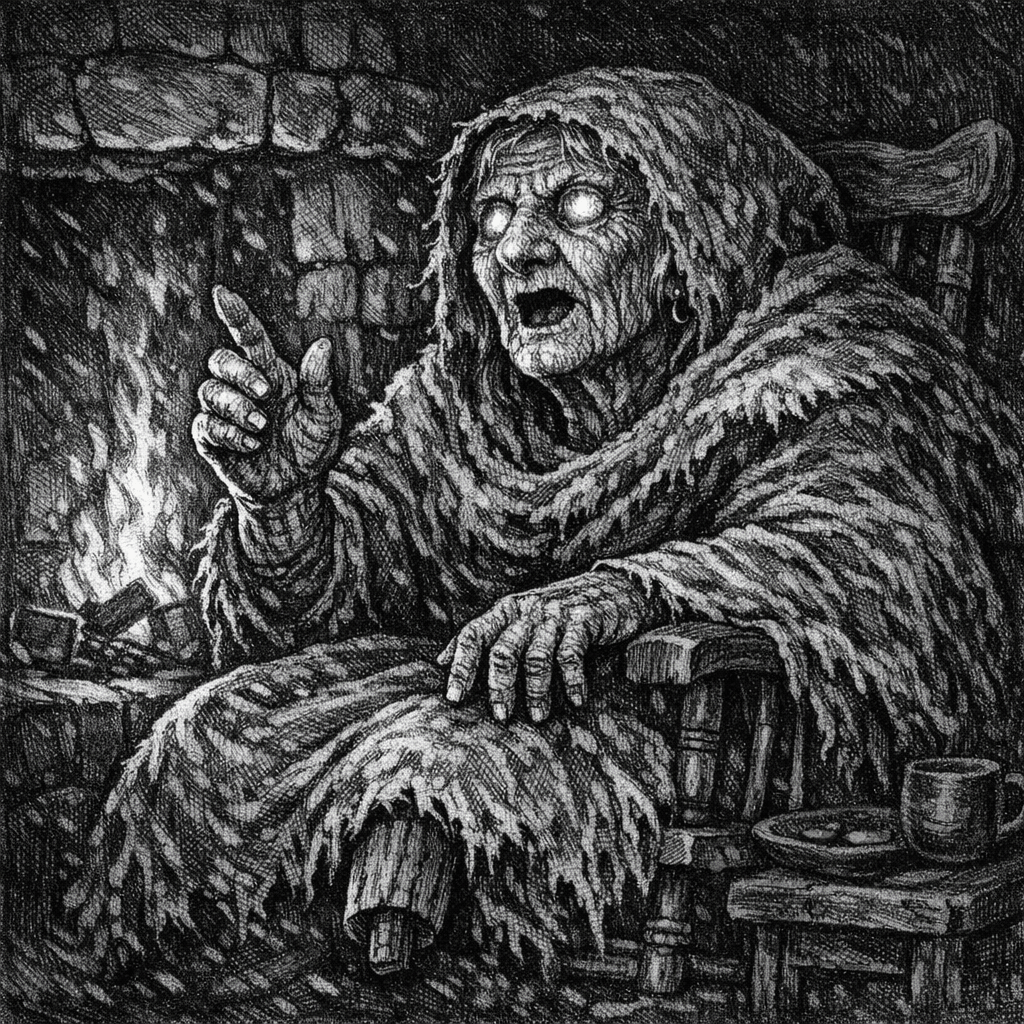
The door creaked open. A chilly draft spilled out, cutting through even the warmth of the roaring fire within. Bundled under a thick quilt and hunched in a squat rocking chair sat a venerable shield dwarf. Her face was a map of deep lines, her eyes thick with cataracts that caught the firelight like milky stone. Where her right foot should have been, a carved wooden peg jutted from beneath the quilt. A plate of food rested on a low table beside her — knucklehead trout smothered in goat’s milk. It lay untouched.
Her voice rasped, thin and wheezy, each syllable an effort. “Don’t just stand there. Come in, then. Sit… on the floor, where I can see you.” She lifted a bony finger, shaking with the strain, pointing toward the rug. “But don’t… block my fire. It’s my only pleasure.”
The companions shifted uneasily, lowering themselves in front of her.
Her head tilted, cloudy eyes narrowing. “Where is… the other one? The druid?”
They froze.
Her breath rattled, the words dragged out with stubborn force. “I have seen… this moment. And he sits there. Between the two of you. My breaths… are numbered. I will not waste them. Waste my time no longer. I have… a place to be.”
Felwar glanced at Raine, then at the others. Raine’s jaw tightened. “Thel,” he muttered.
Behind them, hidden in the folds of Raine’s cloak, the huntsman spider shifted uneasily. Thel’s faint, stubborn voice whispered from the many‑legged form. “No. I’m staying a spider.”
“Now,” Hethyl rasped, cataract‑clouded eyes flaring with sudden, unnatural intensity.
Miquitzil tapped his foot, impatient. “Come on, Thel.”
Reluctantly, the spider twisted and stretched, limbs warping, body swelling back into human form. Thelonius crouched on the rug, pulling his cloak tight around him with a scowl, like a boy dragged somewhere he didn’t want to be.
Hethyl gave a single nod, as though nothing unusual had occurred. “Good. Now… listen. For I have little time left, and I will not… say it twice.”
Her head dipped forward, cataract‑clouded eyes half‑closing as she gathered what breath remained. When she spoke again, her voice was cracked stone — faint, halting, forcing the companions to lean close to catch the words.
“I have always… seen the future. But today, with your coming… through that door, my sight ends. No more tomorrows… for me. Only this… one last telling.”
Her gnarled fingers clutched the quilt. “There is a name… you do not yet know. Xardorok Sunblight. A duergar… warlord. If left unchecked… he will conquer Icewind Dale.”
She sucked in a long, rattling breath. “He has a fortress… hidden in the Spine of the World. Within it… a forge. Fed by the still‑beating heart… of a red dragon.”
Her cloudy eyes flicked from face to face, unseeing yet piercing. “Not chance raids… no. A plan. The end of Ten‑Towns. Burned and broken… one by one. You will find proof… in his stronghold. If you dare it.”
Her shoulders shook with the effort, each word scraping her throat raw. “Go too soon… and you will die there. You must prove… yourselves first. Test your strength… against the horrors… that stalk this frozen land. Only then… may you live long enough… to face the perils of… Xardorok’s halls.”
The companions shifted uneasily. The fire popped, sparks leaping, but the old dwarf barely stirred. She raised her chin once more, stubborn and unyielding despite the weakness of her voice.
“The grey dwarves… the duergar… were hollowed long ago. Illithids stripped them bare. Joy… pride… even love… gone. Left only spite. They strike, burn, and kill… not because they want to… but hoping it will stir something inside. It never does.”
Her voice cracked into a wet cough. She clutched the arm of her chair with startling strength, wood creaking under her grip.
“Asmodeus… Lord of the Nine Hells… hides behind the name… of Deep Duerra. The duergar god of conquest… or so they believe. But it is not him… the fools are deceived. He tempts them… with lies. Xardorok… aye, he felt a spark once… a taste of joy. And now… he spills blood across the Dale… chasing that moment… in service of a god who is not his god.”
Her grip slackened, yet she forced the words out, each one a labour. “They ain’t like us anymore. Beetle blood… runs in their veins. Chitin on their backs. Black eyes… layered too deep. Purple water… for blood. Not right. Not dwarf. Not anything… that should’ve been born.”
She sagged back into her chair, rocking faintly, her breath rattling shallow and uneven. “Their forges… make steel strong as any… but ugly. What they make is always ugly. Iron for killing. Nothing more.”
Her gaze drifted, firelight glinting off her milky eyes. “Not like… the weapons the dwarves of the halls made… no. I remember… just. Axes bright as fire… blades with songs etched in the steel. Every hammer‑fall… a prayer. Beauty and craft… both, in equal measure. We were proud then… proud of what we made.”
Her voice faltered, sinking to a whisper, nearly lost beneath the crackle of the fire. “All gone now. Lost.”
The words faded. She slumped deeper into her chair, chest barely rising. Long moments passed. The companions waited, half‑wondering if she had already slipped away.
Then, scraping her soul bare for one last effort, she forced the words out.
“To kill… a duergar… is mercy.”
Each syllable dragged from failing lungs.
Her cataract‑clouded eyes blinked once, slow and final. “Levistus… will see the truth of it. He always… does. Trust in him.” Her head lolled, gaze sweeping the party one last time. “That goes for… all… of… you.”
Her breath caught, rattled, and slipped from her chest like wind through stone. Her eyes closed.
The room fell silent.
Felwar was the first to rise, slipping quietly toward the door.
Thelonius stepped closer, peering at the seer but careful not to lay a hand on her. He gave a curt nod. “She’s gone.”
One by one, the others followed Felwar, none daring to disturb the scene. The fire still crackled in the hearth, and the old dwarf sagged further into her chair with a sudden shift that made them start. They wanted nothing of her, nothing of this room — unwilling to risk even the shadow of blame for her passing.
Kortha waited in the hall. She looked at their faces, then past them into the chamber. If she felt surprise, she hid it well. Her voice was calm, almost rehearsed. “We were forewarned. The soothsayer said she would pass soon after you arrived.” Her gaze lingered on Raine for a beat, then slid away.
If she noticed Thelonius among them — one more man than she had led upstairs — she gave no sign.
From the balcony, Kortha’s voice carried down, flat and untroubled, as though she were calling for a ferry rather than announcing a death.
“Mere! The old crone is dead. See her room is cleaned, and her body tended to. I’ll inform the master.” She paused, then added almost absently, “Have a Blacksword help you with the body.”
The girl froze, fingers tightening on the edge of her apron. Her eyes flicked to the companions, wide and uncertain. But no tears came, no protest. Only a stiff nod before she hurried away, shoulders hunched, already bowed beneath the weight of the task.
Kortha turned back to the group. “Your quarters will be made ready shortly. A Blacksword will fetch you. Please, wait here a little longer.”
As Kortha moved toward Kadroth’s office, the great hall doors creaked open. The two smiths who had been labouring outside strode in from the courtyard forge, their chests bare, slick with sweat despite the winter cold. Steam rolled from them in ghostly waves, curling upward like an upside‑down waterfall.
One of them whistled a tune — sharp, jaunty, and all too familiar. “Taters Rolling Home.” A stupid farm song, one Thelonius had whistled a hundred times in his youth. The notes wormed into his memory, sour and insistent.
He turned, frowning, until his gaze locked on the man’s face. Their eyes met.
The smith stopped dead. His voice cracked like a hammer on stone. “Thel? What the fuck are you doing here, you prick?”
Thelonius reeled as if struck. His mouth opened soundlessly before he managed to stammer, “B… Brince? Is that really you?”
“Yes, brother. Who else would it be?” Brince strode forward, arms wide, and swept Thelonius into a crushing embrace. The black‑stone sword pendant thumped against Thelonius’ cheek, hot with his brother’s sweat.
“I… I thought you were dead,” Thelonius said hoarsely.
“I thought the same about you.” Brince pulled back just far enough to sneer, jabbing a finger into Thelonius’ chest. “But I remember, clear as day. You took the family tap, you bastard. That wasn’t yours to take.”
Flushing, Thelonius fumbled at the chain around his neck. He tugged free the battered heirloom and held it out with both hands, as if to surrender it. His voice was low, almost pleading. “Here. Take it. It’s yours.”
Brince barked a harsh, rolling laugh that echoed through the hall. He shoved the trinket back against Thelonius’ chest with a flat palm. “I don’t want it. Not now, anyway. Look at me.” He spread his arms wide, muscles gleaming in the torchlight, a grin splitting his face. “I feel fucking great. I haven’t touched a drop in longer than I can remember. But when I woke up and you were gone — gone with the tap — I could’ve killed you.”
The companions stepped back, giving the brothers space, though their eyes stayed locked on the exchange. The other smith, silent until now, slung a thick fur over his sweat‑slick shoulders and held another ready in his arms, waiting.
Thelonius’ voice cracked with disbelief. “What happened? How did you end up here?”
Brince leaned back on the bench, eyes unfocused as memories stirred.
“When I woke that morning… belly full of cold stew, head thick with piss‑wine… you were gone. Chair empty. Fire out. And the tap? Gone with you.”
Thelonius swallowed hard. “Brince… I—”
Brince waved him off, sharp. “Don’t. For a while I just sat there in the rocker, staring at the hearth like it might bloody speak. Thought maybe I should’ve gone with you. But I didn’t. Couldn’t. Wouldn’t. So I stayed.”
His mouth twisted at some bitter taste. “Tried to tend the taters that morning. Dug a row, turned the soil. Kept muttering to myself about the top paddock — all the blood, sweat, and tears, the grand old spirit of Cragborn Jones.” He gave a short, humourless snort. “By the second day, that fire was out too.”
Thelonius frowned. “So you just… stopped?”
“Gave up, just like you did.” Brince’s laugh came out hollow. “A ruined field. An empty barn. Pantry bare but for the taters. Ghosts for company. So I went to forget. Strapped on Pa’s shitty snowshoes and trudged up to the ridge by the Two Crossed Pines. You remember it — we’d buried those two small whisky barrels we stole from Pa years before. Took me hours to dig one out, sweat freezing on my back the whole way. Soil was a bitch.”
Thelonius let out a breath, a half‑smile flickering despite himself. “Aye. I remember. Our rainy‑day stash.”
Brince nodded once, but his face hardened. “Sat in the snow and drank till the sun was just a rumour. Meant to keep drinking till the world ended.” He glanced down at his hands, voice lowering. “But before the drink could kill me, something else found me.”
Thelonius straightened, unease prickling his skin. “What? What found you?”
Brince’s eyes burned, his voice dropping low and fierce.
“A voice. Not sound… more like a weight inside my skull. Pressing through me, into me. It offered me a chance. A chance to start again. To be something. To be the best version of me. To learn from my mistakes. To be free of Mum, Dad, you, the drink, the stinking, rotten farm.”
His gaze flicked away, then back, unsteady. “When I was ready to die, the voice made me an offer. And when I accepted… I knew where to dig. My hands just… knew. And there it was — a shard of rock. Chardalyn, they call it. I dug it out of the dirt like it had been waiting for me. And when I held it — it filled me. Healed me. Cleared my mind. It brought me here, to the Caer.”
His eyes glistened with desperate intensity. “A chance to be healthy. To fuck a woman — again, many women if I want. To laugh, to dance, to sing. He offered me life, Thel. Life! The one thing you and I never had.”
Brince leaned forward, gripping Thelonius’ arm with calloused fingers. “Do you hear me? When I was nothing — a ghost, a piss‑soaked shell waiting to die — he gave me everything. And all he asked in return…” He looked aside, jaw tight. “…was my soul.”
He said it quickly. Simply. Quietly.
Thelonius’ gut churned as he stared at his brother’s transformed body — clear skin, hard muscle, even a handsome face he barely recognised. But behind the new strength, he saw it: the light in Brince’s eyes was gone, hollowed out.
Thelonius spat the words like venom. “You took a deal with a devil? Are you fucking crazy?”
Brince’s eyes darted aside — not shame, but stubborn resolve. “Yes. He offered me a deal, and I took it. Said he’d save me from death, restore me. All I had to do was pledge him—” He broke off, raking a hand through his wet hair. “The one thing I’ve got no use for. Not really. The one thing I don’t even believe in. Soul? What’s a soul to me? You can’t drink it. You can’t eat it. You can’t hold it in your hands. So, as far as I can tell, I traded nothing… for this!”
He spun in a circle, muscles taut, long hair whipping in the torchlight. His grin split wide, teeth white and sharp. “Look at me, Thel! I’m alive. Strong. Free.”
Thelonius was stunned. He just stared, hardly recognising his brother — the one person he had spent the most time with in all his life. They had fought, hurt each other, even hated each other. But was he not still his brother?
He pushed the thought aside. Brince was watching him closely now.
“So! Tell me your story, Thel,” Brince said, voice deep and clear. “What happened after you left? I’ll be honest — I thought you’d hung yourself in the forest somewhere, buried the bloody tap as a last fuck‑you to me.”
Thelonius’ throat tightened. When he spoke, his voice was distant, the words spilling out before he’d even shaped them.
“I was saved, like you,” he said at last. “But… it was rats that saved me.” The words tumbled out before he could stop them, and even to his own ears they sounded pathetic. He grimaced, but pushed on. “And now I’m here. I guess I’m reborn, too. I have friends now — friends who accept me for who I am. And I’ve got dreams. New dreams.”
Brince laughed — cruel, yet all too familiar. “Dreams? What dreams? Your dreams used to be killing critters and drinking piss.”
“Not anymore.” Thelonius’ mouth tugged into a defensive, almost embarrassed smile. “I’ve changed too. Heaps. Got shit on by an eagle — three times. Had a vision. Met a moose. I can do magic now. Take animal form. I’m… changing, in my own way, and I think for the better.”
Kortha, standing nearby, shifted closer, her tail twitching. “Are you a winter druid?” she asked suddenly.
“No,” Thelonius answered reflexively, not even sure what the question meant. He turned back to his brother. “I can do things now I never dreamed I could. And it’s given me hope that—” He hesitated, afraid saying it aloud might make the wish fade. But he forced the words out. “It’s given me hope that one day I’ll have my own family. Set them up on a farm, once the dark days are over. Have a few kids. Teach them things Pa never taught us. How to fish, and cook, and dance, and play.”
If he hoped to be taken seriously, he was disappointed.
Brince laughed in his face — a deep, rolling laugh that grew louder until tears pricked his eyes. “A family? You want rug rats? Another fucking farm? Big dreams, brother. Huge.” He wiped his face with the back of his hand, still grinning.
His smithy colleague, bored of waiting, stepped forward and draped a heavy bearskin over Brince’s sweat‑slick shoulders, steam still rising faintly from his skin. Without a word, he turned and left the room.
Brince nodded after him, grin unbroken, before turning his gaze back on Thelonius.
“Get up early. Work your fingers to the bone. Go to bed. Do it all again.” He barked another laugh. “You always were the stupid one.”
He dragged the bearskin tighter around his shoulders. “I’m freezing my tits off. Catch you later, brother.” Still chuckling, he started after his colleague — then glanced back over his shoulder. “If you’re still around, that is.”
Raine had heard enough about families for one day. He turned to Kortha, his voice flat. “I want to speak to the one they call Avarice. Kadroth said she’d requested a meet.”
Kortha inclined her head and led the party back through the den into Kadroth’s office. The steward sat at his desk, spectacles perched on the bridge of his nose, muttering figures as his quill scratched across parchment.
Felwar paused at the doorway. “Kadroth, sorry to interrupt. May I have a word?”
Kadroth looked up, irritation flickering before he smoothed it away. “Felwar, isn’t it? Of course. Sit.” He gestured to the chair opposite while Kortha and the others waited near the wall. “I trust the meal was to your liking?”
“Yes, yes. It’s not food I want to talk about.” Felwar remained standing. “Speaker Trovus has asked us to deliver a message to Bryn Shander — to call a Council of Speakers. May I tell Speaker Shane that Speaker Siever of Caer‑Dineval will attend?”
Kadroth’s quill tapped once before he set it aside. “Oh, I don’t think so. Speaker Siever is far too frail to make such a trek in this cold.”
Felwar pressed. “So who will represent Caer‑Dineval, if not Speaker Siever?”
Kadroth leaned back, removing his spectacles and placing them carefully on the desk. “The Blackswords can spare no one, unfortunately.” His gaze flicked briefly toward Raine and the others, weighing them, then slid away. “Perhaps you might ask Avarice to go in the Speaker’s stead. She is… quite the wordsmith. Highly capable.”
He pinched thumb and forefinger close together, a wry little gesture. “A touch prickly, mind you. One must choose words carefully with her. But capable, oh yes — eminently equipped to attend.”
He nodded to himself, the thought clearly settling. “Yes. I recommend you extend her the invitation. The Council would be well served.”
Felwar’s brow arched. “And who is Avarice? All we know is she wanted to meet Raine.”
Kadroth crossed to a sideboard, poured himself a drink, and downed it in a single swallow. “Avarice is… a delight. Only been with us a short while, but she claims a direct line to Levistus, as do I. Technically, she works for me, but she chooses to dwell below. Must enjoy the damp. Who am I to judge?” He returned to his desk, gathering up his quill. “Now — these ledgers won’t balance themselves.”
Raine shifted, his tone flat. “Come on, Felwar. Let’s go.”
Kortha gave a small gesture, and a Blacksword guard heaved a bookshelf aside, revealing a narrow, hidden passage. It sloped downward toward the base of one of the towers, stone walls slick with damp and age. At its end, set into the floor, lay a heavy wooden trapdoor.
“She’s down there,” Kortha said quietly. “She prefers the quiet.”
One by one, the companions gripped the rungs and descended. The iron ladder bit cold through their gloves, secured to the wall with thick brackets, dropping them twelve feet into a narrow stone hall. Mortared walls closed in tight, the chamber lit and warmed only by four sputtering torches that spat more smoke than flame.
To their left, a short side passage opened into a cold‑storage chamber. The air was sharp with the scent of frozen meat. Wooden boxes were stacked against the walls — some squat and square, others long and narrow — their lids rimed with frost. Between them, carcasses of moose, bison, and cattle hung stiff from iron hooks, shadows swaying in the torchlight.
Straight ahead, stone steps led down into icy water that disappeared into a twenty‑foot‑wide arched tunnel stretching into darkness. The roof rose twelve feet overhead, the black water below eight feet deep. A rowboat bobbed gently at its tether, the wood groaning faintly with the current. It looked sturdy enough, though the cold radiating from it gnawed at their bones.
Thelonius shivered. “We should go back and get our jackets. It’s fucking freezing down here.”
With Miquitzil resting safely in their quarters above, the trio judged the fit. Tight, but manageable. Raine steadied the craft as they climbed in — Felwar next, then Thelonius, who had secured a torch from a nearby sconce. Plates of thin ice cracked and shifted as the boat rocked off the mooring.
They rowed only a short distance before a narrow passage opened to the left. Thelonius clambered out awkwardly, boots slipping on the wet stone as Raine and Felwar steadied the boat.
He raised the torch. “Just a storage room. Sacks and shit.”
His eyes adjusted — and caught movement. A rat hunched in the corner, gnawing industriously at a burlap sack until a stream of frozen peas spilled free.
Thelonius crouched low. “Hello, ratty?”
The creature flicked him a glance, then went back to eating.
“Well done, little buddy. Don’t eat ’em all in one sitting.” Chuckling, Thelonius slid back into the boat, and they pushed on.
Further along, another passage yawned to the right. This time Felwar slipped out to investigate. Thelonius offered the torch, but Felwar waved it away.
Frost glazed the floor of the fifteen‑foot chamber. To either side, narrow tunnels disappeared into darkness, but what held his gaze was the shape across the room: an eight‑foot pillar of solid ice. Trapped within was the faint outline of a horned, pale‑skinned figure, limbs pressed against its crystal prison. Black chains wrapped the pillar like bindings, their ends vanishing into the ice itself. Behind it, the wall was slick with brown fungus, mottled and wet.
Felwar shivered, though not from the cold.
He slipped into a narrowing corridor that opened into a smaller, unlit room. The air was dead still. The only feature was an iron lever jutting from a plate in the north wall. He crouched, frowning.
What would this open? Or close? His thoughts leapt back to the cistern — the marble slab ahead, too neat, too deliberate to be natural. A barrier. And this lever… the means to move it.
His fingers hovered on the grip, but he drew back. Best not to test it without the others.
Straightening, Felwar retraced his steps, the conclusion already on his tongue as he returned to the boat. The others were still debating whether to pull the lever when Felwar stiffened. A prickle raced his spine.
He spun.
And there she was.
An albino tiefling stood not a dozen paces away, her presence filling the corridor like a storm front. Skin pale as snow, hair white as frost, and eyes a glacial red that caught the torchlight like blood through ice. A raven perched on her shoulder, feathers oily‑black against her pallor, watching as intently as its mistress.
Her expression was severe, sculpted, as if her face had never known warmth. Not monstrous — but sharpened into something cold, commanding, undeniable. Power radiated from her in silence, pressing on Felwar’s chest, daring him to move.
In her hand she held a staff topped with a shard of ice‑blue crystal, jagged and cruelly beautiful, its frozen light refracting across the wet stone walls. The wood of its haft was bound in leather, but the shard itself seemed alive, humming faintly with a killing chill.
When she finally spoke, her voice was calm, low, and utterly devoid of patience.
“What,” she asked, crimson gaze narrowing, “is all this noise in my halls?”
Felwar blanched despite himself. Forcing his shoulders straight, he found his voice — thinner than he intended. “I am Felwar, a companion of Raine. He has come to meet you. Kadroth—”
Her head tilted. She cut across him like steel striking stone. “Raine. Come here. I would look upon you.”
Felwar’s mouth snapped shut.
Raine’s boots scraped against the damp stone as he stepped from the boat, water dripping steadily from its hull. The command in her voice tugged at him like a leash, and though every instinct warned caution, he moved toward her. Finally, he thought. Maybe I’ll get some answers. Torchlight caught on the steel at his hip, the hard lines of his jaw, his face unreadable as he closed the distance. One hand fell to his sword — just in case.
Thelonius followed, silent but watchful, eager to take the measure of the tiefling woman. He folded his arms, bracing against the unnatural chill radiating from her staff. Owly shifted on his shoulder, feathers puffing against the cold that seemed to hum in the air.
Avarice’s raven cocked its head, crimson eyes glinting like blood‑ice, and loosed a harsh, rasping squawk. Its wings twitched once — a threat compressed into a heartbeat.
Owly did not stir. He only blinked, first one golden eye, then the other, slow and deliberate. The silence that followed stretched taut, not mere quiet but a gauntlet cast between them.
Together they came to stand beside Felwar at the junction, the three of them forming a ragged line before the albino tiefling. The corridor felt narrower for it, the damp air sharpened by the icy hum of her presence.
Her crimson eyes lingered on Raine, unblinking. When she spoke, her voice was soft, but each word landed like the point of a knife.
“What makes you different? What hidden thread drew you here, into my halls? There is no such thing as chance, not in matters like these. So tell me — what flaw, what spark, what anomaly in you demanded Levistus’ attention?”
Raine shifted under her gaze, shoulders stiff. He gave a small shrug. “I’ve no idea why I was called here.”
Avarice tilted her head, studying him with a cold precision, as though cataloguing his worth. Then she exhaled faintly through her nose — disappointment, clinical and certain.
“Quite underwhelming. What are you then? A soldier? A sellsword?”
“Caravan guard,” Raine answered, plain and honest.
The words hung in the air like frost.
“A caravan guard.” Avarice’s voice dripped with contempt. Then she tilted her head back slightly, as though speaking past them to someone only she could hear. “My lord… what have you sent me?”
Her crimson gaze slid away from Raine and pinned Thelonius. “What about you? Your name — and your function.”
Thelonius cleared his throat. “I’m Thelonius. I’m… just a farmer.”
Her reaction was instant, like flame catching dry tinder. Her lips curled, voice lashing like a whip. “A farmer? Do not insult me. Perhaps once, yes. But not now. Not with that thing on your shoulder.” She stabbed a finger toward Owly, who shifted uneasily under her gaze. “Not with magic bleeding from your skin like steam.”
Thelonius faltered, words tumbling. “I think… I think I’m a druid. At least, I can shift into animal form. Cast spells I never could before. There was a strange moose, the eagle shit… um, I can trace—”
Her hand snapped up, palm out. Thelonius’ mouth clamped shut, silenced as surely as if she had cast a spell.
For a heartbeat, there was only the hum of the crystal and the raven’s rasping breath. Then Thelonius muttered, low but defiant, “Well… I am a farmer.”
The words landed like a spark in powder. Avarice’s eyes flared, scarlet brightening to a cutting gleam, her tail lashing hard against the stone. Her temper gathered like a storm about to break.
Before she could strike, Raine moved sharply between them, hand raised in placation. “Please forgive him,” he said, steady but quick. “He is a dumb farmer at heart, not adept in social graces. I will have him removed from the Caer immediately.”
The tension held — then, slowly, Avarice’s lips thinned. The glow bled from her eyes. She exhaled, sharp as frost. At last she inclined her head, a faint, mocking curl at the corner of her mouth.
Her attention wheeled to Felwar. Her tone softened, dangerous in its suddenness. “And who are you, handsome boy?”
Felwar hesitated, the word sticking in his throat. At last he forced it out, clipped and reluctant. “Felwar.”
“And what skills do you claim, Felwar?”
He lifted his chin, but his answer was deliberately vague. “I cast spells.”
Her fury flared like a storm breaking. Eyes widened, nostrils flared, her tail lashed hard against the stone. In a heartbeat she closed the distance, so near Felwar could smell the clove‑sweetness of her breath, undercut with iron and ash. Her words came soft, slowly, a blade wrapped in velvet.
“What manner of caster are you?”
Felwar swallowed. “A warlock.”
Her eyes narrowed to burning slits. “And who is your patron, Felwar, handsome warlock of Icewind Dale?”
He hesitated, then forced the words out, low. “The fae queen of the Summer Court.” He would not speak Titania’s name in this dark, frozen place.
For a moment, silence. Then Avarice’s mouth twisted into a cruel curl. “The Summer Court?” Her crimson eyes glinted with mockery. “You must be cursed indeed, Felwar — warlock of sunlit groves and golden days — to find yourself here, shackled in endless winter and endless night.”
She let the words hang heavy with scorn, then stepped back, amusement flickering cold across her face as she looked them over. “You are known. And you are dismissed.”
The companions needed no further prompting. They backed away, hurrying for the boat, not daring to look back. Questions gnawed at them still, but it was plain she would offer no answers. She had made that clear without saying it.
They rowed back in silence, the little craft creaking as it cut across the black water. The echoes of Avarice’s voice seemed to cling to the stone, heavy as frost.
Thelonius broke the quiet first. “What a bitch,” he muttered. Then, with a shrug, almost philosophical: “Maybe it’s just the old enemy‑of‑my‑enemy thing. Maybe she’ll help fight the duergar.”
Raine and Felwar said nothing. The oars dipped and rose. Silence closed back in.
At last, the prow bumped against the landing. Felwar was first to clamber out, his boots skidding on the wet stone. Thelonius followed, muttering as he hauled himself ashore. “Weren’t you supposed to invite her to the Council of Speakers?”
Felwar turned, his cloak heavy with damp, and gave him a look that made the very question seem absurd. He said nothing — only shook his head faintly before stepping aside.
Behind them, Raine was the last to rise from the boat. He planted one hand on the slick stone, then froze. His voice came low, steady. “Guys.”
The others turned. Raine lifted his torch over the cistern, nodding toward the black water.
The firelight rippled across the surface, and as it stilled, what had seemed like pale driftwood resolved into bodies. They lay just a few feet below, swollen and half‑frozen, their faces bloated, pale and distorted. Chain shirts glimmered faintly in the wavering light, the weight that kept them tangled on the bottom.
A dozen in all, six human, six dwarf, their armour anchoring them in silence.
Their eyes stared upward, wide and glassy. Their mouths hung frozen open mid‑cry, as if the moment of their deaths had been preserved forever in the black water.
Disclaimer
This is a work of fan fiction. All relevant characters, locations, and settings remain the property of Wizards of The Coast (WOTC) and the story contained here is not intended for commercial purposes.
I do not own Dungeons and Dragons (D&D) or any of the related characters. D&D is owned by WOTC (and its parent companies) and all rights of D&D belong to them. This story is meant for entertainment purposes only.