Session 8
The Brave Hearts
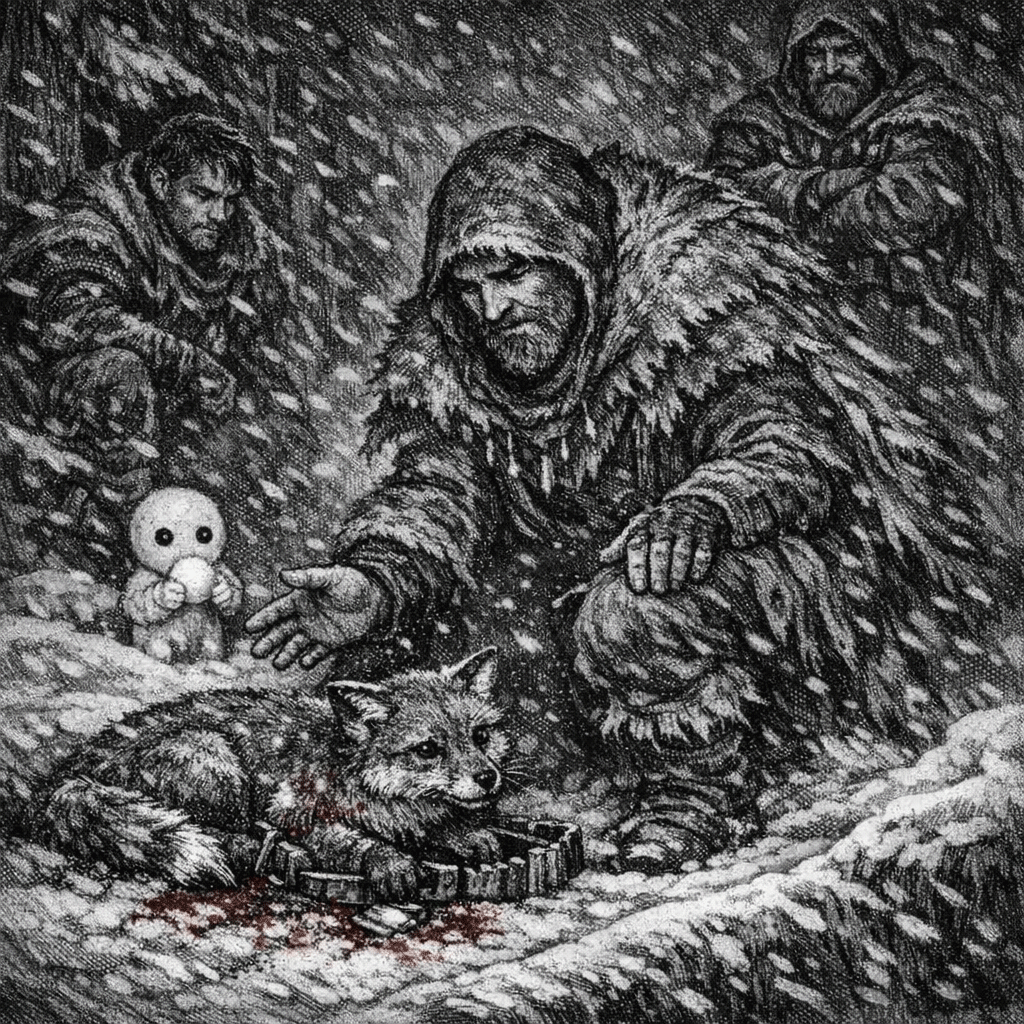
Slowly, with the battle done, the forest found its voice again. A jay shrieked from a branch above, sharp and angry. Somewhere deeper among the trees, a fox barked twice before falling silent. Snowflakes drifted down, settling on the cabin roof and the cooling corpses of the fallen duergar.
At the not‑so‑abandoned cabin on the edge of Caer‑Konig, the companions paused, drawing breath before setting to their tasks. They scoured the dark dwarves for any hint of intent. On the leader, they discovered a handful of tarnished gold coins of unfamiliar mint and a small pouch of beaded pearls. Stitched into the leather was the crest of Frozenfar Expeditions. Felwar took the pouch, swearing he would return it to his friends — Atenas Swift and Jarthra Farzassh.
Raine and Felwar trudged to the large storage shed at the rear, its heavy door half‑buried in snow. Miquitzil, drained from the clash, slumped on the porch with a smoke, frost catching in his dark hair as he exhaled. Meanwhile, Thelonius prowled through one of the two bedrooms — the same one Felwar had smashed into moments earlier.
Raine and Felwar heaved through the drift and shouldered the shed door open. The air inside bit at their lungs, each breath clouding in the gloom as they stepped across a floor dusted with sawdust and frost.
Inside lay sled runners and lengths of pre‑cut timber, faint chalk still marking the wood. Several barrels of mead stood stacked near the back, their seals intact but rimmed with ice. Nearby were coils of rope, sacks of dried beans and barley, and bundles of furs lashed with rawhide thongs. A few crates of nails, hinges, and iron fittings had been shoved into the corner beside a half‑empty cask of lamp oil and a heap of fishing nets stiff with frost.
The shed was not packed to the rafters as they might have expected. Supplies had been set out in tidy rows, leaving empty gaps between them, as though more had once stood there — or more were still meant to come.
Back in the cabin, Thelonius rifled through the cupboards, pushing aside discarded clothes and scraps of paper, checking under the bedframe. He pulled back the heavy quilt, finding nothing but stale air and sweat‑stained linen. At last, his eyes settled on a squat chest against one wall: two feet by three, banded in iron, its lid scarred and pitted with age.
He worked the clasp open — and a sudden sting lanced his hand.
“Mother fucker!”
A spring mechanism snapped, driving a poisoned needle deep into his skin. Agony flared.
“Oh… not good.”
Thelonius staggered back, jaw clenched as fire raced through his veins. He crashed to the floor, limbs twitching, breath rasping between his teeth. For a moment he could form no words, only a strangled sound as he tried to call out.
The convulsions passed in a blur. His vision cleared slowly, leaving him pale and sickly. Shapes loomed above — his companions, shaking him, voices rising in alarm. He managed to stammer through cracked lips: “The chest… shot me… with an arrow. Dying.”
“Trapped chest,” Raine said, an edge of excitement creeping in. Thelonius wasn’t dead yet — good enough for him. “You only bother with traps when there’s something worth keeping inside.” He shot Thelonius another glance — pale, sweating, cramping, but alive — before turning back to the chest.
Felwar frowned. “Be careful. Here, let me try.” He whispered an incantation and sent his mage hand to tug at the lid, but the chest was too heavy for the cantrip. “Bugger.”
With Thelonius still groaning on the floor, Raine stepped up to the chest. He slid his blade between lid and rim and forced it open a fraction with a grunt. The lid gave way, and he leaned in to peer inside.
“There it is,” he said, pointing to the tiny needle on its spring, glinting and wobbling in the dim light.
It was small comfort to Thelonius. His chest still burned, and he muttered through clenched teeth, “Hurt like a bitch. A poison needle, on a chest. What kind of madman would do such a thing?”
Raine’s reply came with a wry shrug. “Quite common, really. Caravan masters used them all the time. We were always reminded to be extra careful.”
Thelonius had never heard such a thing. He looked to Raine and nodded glumly, grateful in that moment to have someone older and world‑wise at his side — though the sting still burned. “Where was all this wisdom five minutes ago?” he snapped, bitterness cutting through his ragged voice.
“Searching elsewhere,” Raine answered easily. With a shrug and a wink to Felwar, he added, “Be more careful next time.”
Still feeling like death warmed up, Thelonius muttered, “I’ll be sure to keep that in mind. Hurts like a bitch.”
Raine continued, steady and almost reassuring. “Cold comfort now, but the owner would have known the one safe way to open it. Let’s see what goodies we’ve found.”
He flipped the lid fully open, and it crashed against the wall with a thud. He and Felwar leaned in. Inside was a neat, if modest, hoard.
On top lay a pouch of coins — fifty‑five gold pieces and a heavier scatter of silver, a hundred and twenty in all. Six uncut bloodstones, dull but promising, were wrapped in a scrap of cloth. A small vial of cloudy liquid rolled against the side, its contents catching the light with an odd shimmer. Beneath it rested a folded scrap of paper, two words scrawled in an unfamiliar hand. Miquitzil, when he saw it, frowned at the sight, muttering that it looked like dwarvish. He admitted, though, that he could only speak the tongue, not read its script.
At the bottom of the chest lay several folded furs, softer and finer than the usual trade stock, faintly scented of cedar oil. Packed beneath them was a colourful lantern — almost certainly the one stolen from the Northern Light.
As Thelonius slowly recovered, the companions gathered to take stock. From what Speaker Trovus and the folk at the Northern Light had said, much of the stolen loot had been reclaimed. Cataloguing it all would take time, but that was a task for someone else.
Felwar watched as Raine tucked the bloodstones and coins into a sack and slid it into his pack.
“So, uh… what about the gold and the gems?” he asked carefully. “What if they belong to the people of Caer‑Konig?”
“Then they can ask for them,” Raine replied, matter‑of‑fact. “And I’ll hand them over.”
Felwar nodded, but the words snagged at him. Too smooth. Too easy. Something in Raine’s tone unsettled him — something he couldn’t quite name.
The path back to Caer‑Konig was little more than a smear of untouched snow in the dark. Far off, the town’s lanterns flickered faintly, five hundred yards away. The companions trudged on in silence, snow crunching beneath their boots — until a sharp, high‑pitched sound cut the still air. The desperate whine of an animal.
They turned to see a fox half‑buried in the drift, its hind leg clamped in a rusted iron trap. The animal thrashed and yelped, blood spattering its fur where the metal teeth had bitten deep.
Raine crouched low, hands open and empty, voice soft. “Easy now… easy…” He edged closer, but the fox only fought harder, twisting and tearing at the wound. The sound made Raine wince, and he backed away. “Dogs usually like me,” he muttered, rubbing his whiskers.
Thelonius gave the trap a cold glance. “Gods‑damned fox. Bastard got what was coming. Lop its head off and let’s move. I still feel like shit and need to sit down.”
But Felwar stepped forward before the words could settle. From his pouch he drew a small rectangular tin, rolling back the key with a faint metallic scrape. The smell of oil and salt filled the night as he plucked out a tiny sardine — or perhaps a pickled trout. He snapped it in half, popped one piece into his mouth, and flicked the other onto the snow before the fox.
Ravenous, the animal snapped it up in a single gulp. The fight went out of it then. Panting, ears low, eyes fixed on Felwar, the creature seemed caught between fear and hunger.
Felwar whispered an incantation, pressing a hand to his chest as the spell took hold. His gaze softened as he stepped closer. “I’m going to help you get free,” he said, voice steady now, words carrying meaning for the beast.
The fox whimpered and pulled back, but Felwar kept his movements calm, speaking gently as he bent to the trap. His fingers traced the rusted iron, probing its cruel design. “If I hold this and slide that… aha. Easy.” With a protesting squeal of metal, the jaws sprang wide.
The fox shot upright, a blur of blood‑matted fur. It bounded a few paces, then stopped, wheeling about with a wary curiosity to face them.
And then, behind the fox, something shifted.
It was no taller than a child’s knee, scarcely a foot and a half high. Its body resembled a tiny snowman come to life — a round head atop a stubby torso, with short tubular arms and legs that moved in jerky, deliberate steps. Its snow‑white form was smooth and unmarked, as though shaped by careful hands. Two black eyes gleamed like river stones above a narrow slit of a mouth. In the tales, chwinga wore masks of bark or straw, but this one bore none. Raw. Unadorned. A thing from the whispered stories of Dougan’s Hole — believed only by children, until now.
In unison, Felwar and Thelonius breathed the word: “Chwinga!” — a memory from their childhood given form.
The creature squeaked and jibbered in high‑pitched chirps, bouncing with excitement. Felwar stared wide‑eyed, then gave a helpless shrug. “I don’t understand you, little one.”
It squeaked again and stroked the fox’s flank. Then, with sudden purpose, it scooped up a pinch of snow and rolled it between its tiny hands into a perfectly round ball. Step by step it approached Felwar, who stood frozen, curious and unafraid.
Without warning, it hurled the snowball with surprising force.
The ball burst against Felwar’s forehead in a puff of white. He sputtered and coughed, brushing snow from his eyes. The others broke into laughter despite themselves, the night’s tension cracking.
“Hey! What gives?” Felwar spluttered, but the chwinga was already turning away. It scrambled onto the fox’s back, perched like a rider, and with a final squeak and wave, vanished into the drift.
Thelonius blinked, eyes wide, poison and weariness forgotten. “That was a chwinga,” he breathed, wonder cracking through his voice. He turned to Raine, almost laughing. “A bloody chwinga — riding a fox.”
Felwar stood very still, a strange warmth stirring inside him. Something had brushed against him — a blessing, a charm, a touch of the uncanny. His voice came quietly, almost reverently. “Yes. I believe it was. I used to dream of them as a child. Fancy seeing one.”
Raine shivered and pulled his cloak tighter. “All very exciting,” he said, tone flat, more weary than amused. “Anyway, let’s go tell Speaker Trovus the good news.”
As they trudged back toward the small town, Thelonius muttered, half to himself, “Maybe we should’ve caught it. I heard chwingas were good eating.”
Felwar turned his head sharply, searching his companion’s face, uncertain whether Thelonius was joking or not.
Back at the Northern Light Inn, they found Speaker Trovus slumped in his usual booth, a half‑full tankard clutched in one hand, snoring like a dragonborn at peace. Felwar wondered idly if the man even had a bed of his own, or if the booth had long since become it.
The tavern was alive with firelight and chatter. Word of the hunt had already run ahead of them, and townsfolk had gathered, eager to hear of the stolen goods and the heroes who had gone after them.
They shook Trovus awake and told him what they had found: with the help of Garret’s faithful hound, Boy, they had tracked the thieves to a lonely cabin west of town.
Trovus blinked blearily. “Cabin?” he mumbled, rubbing his face. “No, no, the tracks went toward the mountain, I saw them myself…” Confusion clouded his features until they explained how the trail had doubled back. He squinted, trying to follow.
But when they spoke of dwarves — grey‑purple skinned, able to appear from nowhere and swell to giant size — something cut through his haze. Trovus straightened. Not sober, but roused.
“Grey dwarves, you say? Duergar…” He rolled the word on his tongue like it hadn’t passed his lips in years.
Thelonius frowned. “Duergar? What’s that?”
“Never saw one myself,” Trovus admitted, wagging a finger as though recalling a half‑forgotten lesson. “But my old wizard companion — gods rest his soul — he told me plenty.”
He leaned forward, eyes narrowing. “They’re dwarves, aye, but twisted. Mind flayers did it. Stole ’em away into the deep dark, bent ’em till their bones near broke. Made ’em cruel, bitter things. They don’t belong up here, no, no. Hate the sun, hate the open sky… hate the very air. And yet you’re telling me they’re crawling over the Dale’s snow?” He shook his head, then stopped, staring at the table as though the thought made it spin.
His eyes hardened, voice thick but sharp. “Stealing? Stealing from Caer‑Konig — my Caer‑Konig?” He slapped the table with the flat of his hand, sending ale slopping over the rim. “Bastards, the lot of ’em.”
“What drives them up, up and out of their stinkin’ holes, eh? Can’t be just… just nothing.” Trovus muttered, words thick but urgent, eyes shining in the lanternlight. He reached for his tankard, then shoved it away with a grimace. “Always greedy, always scheming, wanting to see their dark world brought low. And now, with no sun in the sky…”
He faltered, pressing two fingers to his temple as though trying to hold slippery thoughts in place. For a long breath he sat hunched, muttering into his beard, before rasping, “Gods above… the winter itself might’ve given them courage.”
Raine cleared his throat. “By our count, there were four of them,” he said plainly.
But Trovus shook his head, jaw set stubborn. “Four, aye. But duergar don’t wander half a mile from their holes without reason. No, something’s stirring them. Something dark. And it’s here, in the Dale.” He leaned forward, gripping the table edge as though he might drag the truth out of the wood itself. “That’s the question we should be asking. Not how many. Why.”
He slumped back, voice dropping low. “I’ll tell you plain — when I saw those footprints, I feared the valley dwarves were the culprits. I prayed I was wrong. Cori gets all her ale from them, now the ferry don’t run. And other goods too — we trade with them plenty. Jarthra brings the stock up.”
He shook his head, chasing the thought away. “No… no, I never truly thought it was the dwarves.”
A short chuckle bubbled up, half‑funny memory tangled with hiccup and burp. Spittle clung to his chin; he wiped it away with his sleeve and carried on as though nothing had happened.
At last, he peered at them through watery eyes. “You got them all, then? None slipped off into the snow?”
When they confirmed the kills, Trovus broke into a grin, slamming his fist on the table so the tankard jumped. “Then by the gods we’ll drink tonight in your honour! Caer‑Konig will remember this, I promise you that!”
Word spread quickly. Before long, the Northern Light Inn was alive with more commotion than it had known in years, the air thick with warmth and voices. Cori hurried forward as Raine offered her the recovered lantern, but when he tried to press it into her hands, she shoved them away and, to his surprise, kissed him wetly on the lips.
“What a hero you are,” she said breathlessly, eyes shining. “All of you!”
Raine said nothing, only placing the lantern in her grasp.
“No, old man — we’ll hang her up immediately.” Cori turned, calling over her shoulder, “Sister! Get your bony ass out here!”
Allie appeared from the kitchen, flour still dusting her apron, and together with Raine and Cori they lifted the lamp high, rehanging it above the inn’s doors. The shutters were thrown wide. Multicoloured light spilled into the night, scattering across the snow like a beacon, and soon more townsfolk drifted in, drawn by the glow.
Speaker Trovus, swaying but loud enough to command the crowded room, raised his tankard and declared to all that these four brave‑hearted men had recovered the stolen goods. A cheer went up. And slain the thieves who had taken them, to another cheer, louder still. With a grin and a burp, he promised a night of festivity: food aplenty and drink without end, all on his purse.
The mood caught like wildfire. Two pipers struck up a jaunty tune, and a woman laughed as she cast off her heavy cloak, her dress a bright swirl of blue and white that shimmered as she danced.
The townsfolk pressed forward to thank the companions, each with their own small worry.
“Did you see my oars?”
“What about my candles?”
“I’ve been missing my oil flasks.”
Trovus cut through their clamour with another booming decree: “Tomorrow, we sort the details. Tonight — we drink!”
By then the inn was bursting, bodies pressed shoulder to shoulder, laughter echoing under the beams. Winter woollens were cast aside, the crush of humanity heating the room to a comfortable glow.
Then Cori clambered up onto the bar, Allie clutching at her legs and laughing, steadying her as she banged two pots together for silence. The crowd turned, and the music faltered. Swapping the pots for a tankard, she raised it high and pointed, naming each of them.
“To Felwar! To Raine! To Thelonius! And to Miquitzil — wherever he’s hiding himself.”
She drew a breath, her cheeks flushed with ale and joy. “A toast! To our brave new friends, who put a stop to the terror that haunted us — to the Brave Hearts of Icewind Dale!”
The inn erupted, the rafters ringing with it: “The Brave Hearts! The Brave Hearts!” Tankards slammed, feet stamped, and the name stuck.
Miquitzil sat in a corner, hood pulled high, his face lost in shadow. Unrecognised by most, he had had enough. Too much humanity in too small a space, he muttered, still worn down from the trek. Rising, he excused himself and slipped upstairs to his room, leaving the noise of the heaving taproom behind.
Thelonius, by contrast, seemed to thrive in the press of bodies. Though weary and, truth be told, still mildly poisoned, he lingered among the crowd, smiling at the closeness of so many voices filling a single room. “So, this is what community feels like,” he murmured to a passing villager. The man frowned, unsure whether it was jest or confession, and shuffled on without reply, leaving Thelonius to savour the thought alone.
Children had been dragged along by their parents, and soon Thelonius found himself at their centre. He showed them his owl, spun strange tales, and joined their games with surprising joy. As the hours passed, he laughed with them like a child himself, and in quieter moments thought of family — of wanting one, of a warm farmstead where the hearth burned bright against the cold.
Even Perilou Fishfinger arrived, walking stiffly, Garret with her, pale but upright.
Felwar spotted Jarthra and Atenas at the bar and went to greet them. They clapped him on the back, their voices loud with delight. When Felwar handed Atenas the recovered pouch of pearls, the pair embraced him warmly, relief breaking across their faces. They begged for details of the fight, and Felwar obliged, recounting the tale with broad gestures that drew others closer to listen.
Before the night was through, he pulled Jarthra aside and pressed the scrap of paper into his hand. “Can you make sense of this? Miquitzil thinks it might be dwarvish.”
Jarthra squinted, lips moving as he studied the rough scrawl. “Aye, lad, it is — though the dialect’s a poor one. Lucky it’s short. Just two words and spelled wrong at that. Says ‘Easthaven Ferry,’ best I can tell.”
Taking the paper back, Felwar thanked him, unsettled, and turned the words over in his mind.
What business would duergar thieves have with the ferry?
Much later, when Felwar finally found a pocket of quiet, Garret wandered over, Boy padding faithfully at his side. Felwar greeted him warmly and bent to ruffle the husky’s ears. Boy’s tail wagged furiously, eyes bright with simple joy.
“How are you feeling?” Felwar asked. “Ready for the road tomorrow?”
Garret gave a weary smile. “Aye. I miss my bed, my kitchen, and my Keegan. It’s been tough, I’m not going to lie.” His gaze dropped. “I lost two of my dogs on that cursed mountain. That damned owlbear.” He clapped Felwar on the shoulder. “But you freed three, and… gods, I hope they made it down and turn up safe. Boy here feels it too — he knows something’s wrong.” The husky whined softly, pressing close to Garret’s leg.
Garret sighed, shaking his head. “I think… I think I’m going to retire. No more mountain treks, no more frozen trails. It’s time.” He hesitated, then drew Felwar aside, lowering his voice. “I can’t thank you boys enough. Keegan and I aren’t rich folk. Truth is, we still owe Barsnely for lending you Natasha and her crew. But when we get home… remind me. There’s something I can give you. A reward of sorts. Not gold, but better.”
Felwar nodded solemnly, sensing the weight in Garret’s words.
Later still, with most of the townsfolk long since returned to their homes, Felwar, Raine, and Thelonius found themselves sharing the Speaker’s booth. The fire had burned low, casting the room into deep shadows. Empty tankards and abandoned plates cluttered the table, and the only sounds were the crackle of the hearth and the occasional snore from those who hadn’t made it home.
Somehow — despite the sheer volume of drink they had seen him put away — Trovus spoke earnestly, his voice steadier than it had any right to be. He leaned across the table, eyes glassy but intent.
“Brave Hearts, you did well — damned well,” he said. “But just four duergar? That stinks of something deeper. Keep your eyes open, ears sharp. There’s more to this. I’ll wager my last flask on it.”
Raine gave a half‑smile. “Four seemed plenty to us.” His words slurred, but nobody seemed to notice or care.
Trovus shook his head. “Four don’t travel alone, not that far from their holes.”
Felwar frowned. “Then what were they doing here? Stockpiling nails and rope like common thieves?”
“That’s the rot of it, lad,” Trovus muttered, jabbing the table with a finger. “They don’t steal barrels and furs for their own backs. They’re building toward something.” He rubbed at his chin, silver scales catching the flicker of the fire.
Thelonius leaned forward, voice low. “Another thing. We saw something atop Kelvin’s Cairn. At the very top there was a bird — enormous, wings wide enough to carry five horses. And riding on its back was… an owl woman.”
Raine nodded, arms folded, recalling the awful sight. “And she cast some spell. Same colours as the aurora.”
Trovus’ bleary eyes widened. He sat up straighter, ragged awe in his voice. “That’d be her, then. The Frostmaiden. Auril herself — the bitch who curses us with this endless night and endless winter.” He clenched his fist. “You should’ve put an arrow in her eye.”
“She was out of range,” Raine said evenly.
“Well, maybe she’ll come back. So, best you go back up there and wait.”
Thelonius barked a short laugh. Raine smirked at the absurdity of the suggestion. Felwar allowed himself a brief smile.
But when their eyes returned to Trovus, he wasn’t laughing. His expression had hardened, jaw set, the pale scales on his cheeks catching the firelight in dull flashes of silver.
One by one, their chuckles faltered and died, leaving only the pop of the fire and the faint murmur of sleepers drifting through the inn.
At last, he leaned back and yawned, rows of jagged, yellow‑stained fangs on full display. A curl of frost edged his breath. “So then,” he rumbled, voice rough but steady, “what next for you lot?”
“Bryn Shander, then on to Targos,” Thelonius answered. Felwar and Raine nodded. “We need supplies, maybe answers.”
Trovus nodded slowly. “Bryn Shander. Good. That’s where the heart of the Dale still beats. Let the Speaker there know that Speaker Trovus of Caer‑Konig is calling for a Speaker Summit. Enough’s enough. No mead, no Bremen whiskey, fine — but dark dwarves? That’s another matter entirely.”
“A Speaker Summit?” Felwar asked.
“Aye,” Trovus said, wagging a finger for emphasis. “A gathering — all the Speakers of Ten‑Towns. I call it a summit, some call it the Council of Speakers. Whatever the name, it runs the same: bitching and moaning, each one tugging for their own slice of comfort.” He gave a dry laugh, then leaned forward, voice lowering. “But maybe this time, with duergar sniffing round our doors, maybe that’ll end.”
Felwar’s brow furrowed. “You think they’ll listen?”
“Duvessa Shane,” Trovus said, nodding. “Speaker of Bryn Shander. Serious woman, sharp as an axe. She’ll listen. Tell her there be duergar in the Dale. She must pull the other Speakers together, and soon, or we’ll all be gnawed to the bone before we know it. As if things aren’t grim enough?”
He leaned back, a crooked smirk tugging at his muzzle. “Aye, I know what you’re thinking. Trovus — drunkard, fool, snoring in his cups. But if I could keep clear of the sweet drink, maybe… maybe I’d be half the Speaker I was meant to be. Closer to what the folk of Caer‑Konig truly deserve.”
He laughed then, a rough, genuine sound that faded into a cough. “Duvessa. She’ll see sense, if anyone will.”
Raine folded his arms. “If she’s half as serious as you say, why hasn’t she done it already?”
Trovus snorted and spat something vile into an empty cup, then slid it away. “Can’t say for sure. Maybe they’ve already had a summit, and I wasn’t invited.” He chuckled, shaking his head. “Or maybe because she hasn’t seen what you’ve seen. Not yet.”
He sagged back, the weight of the night settling on him. “And while you’re at it, speak plainly about our troubles. With the Easthaven ferry iced in, we’re cut off. Even Torg’s caravans won’t come this far north anymore. Caer‑Konig’s being treated like we’ve got the wasting rot.”
Felwar glanced at Raine, then back to Trovus. “If the roads are all but closed, not just to Caer‑Konig but to the lands south, how are we supposed to hold together at all?”
“Exactly,” Trovus said, pointing with a wobbling hand. “That’s why it must be said and said loud.”
He scratched at the silver scales along his jaw, words spilling quickly as though he had to force them out before they slipped away. “Oh — and I’ve heard whispers the folk of Caer‑Dineval haven’t seen their Speaker, Crannoc Siever, in a long while. I used to get a nasty letter from him every few months, like clockwork, but there hasn’t been one of those in… too long. So, if you’re passing through, check on him. Doesn’t sit right, that. Not one bit.”
Thelonius tilted his head. “And what if Caer‑Dineval has got grey dwarves — duer… duergar problems?”
Trovus’ mirth drained away. He stared into the dregs of his tankard before answering. “Then the Vale’s in deeper trouble than I feared. Crannoc Siever’s not the sort to handle shadows creeping at his door. If the duergar are nosing round Caer‑Dineval, it won’t just be their problem — it’ll bleed into all our towns.”
He tapped the rim of his empty cup with a calloused finger, as though willing one last swallow to appear. “Best you lot keep your eyes sharp if you pass that way.”
Silence settled between them, broken only by the crackle of the hearth. At last, Trovus gave a weary grin. “Hells, listen to me — an old drunk keeping heroes from their beds. Go on, then. Tomorrow’s waiting. I’ll be here.”
He leaned back, his tankard slipping limp in his hand. Before long, his head lolled against the booth’s high back, the fire painting his scaled features in tired shades of silver.
Disclaimer
This is a work of fan fiction. All relevant characters, locations, and settings remain the property of Wizards of The Coast (WOTC) and the story contained here is not intended for commercial purposes.
I do not own Dungeons and Dragons (D&D) or any of the related characters. D&D is owned by WOTC (and its parent companies) and all rights of D&D belong to them. This story is meant for entertainment purposes only.