Session 7
It Meant Violence
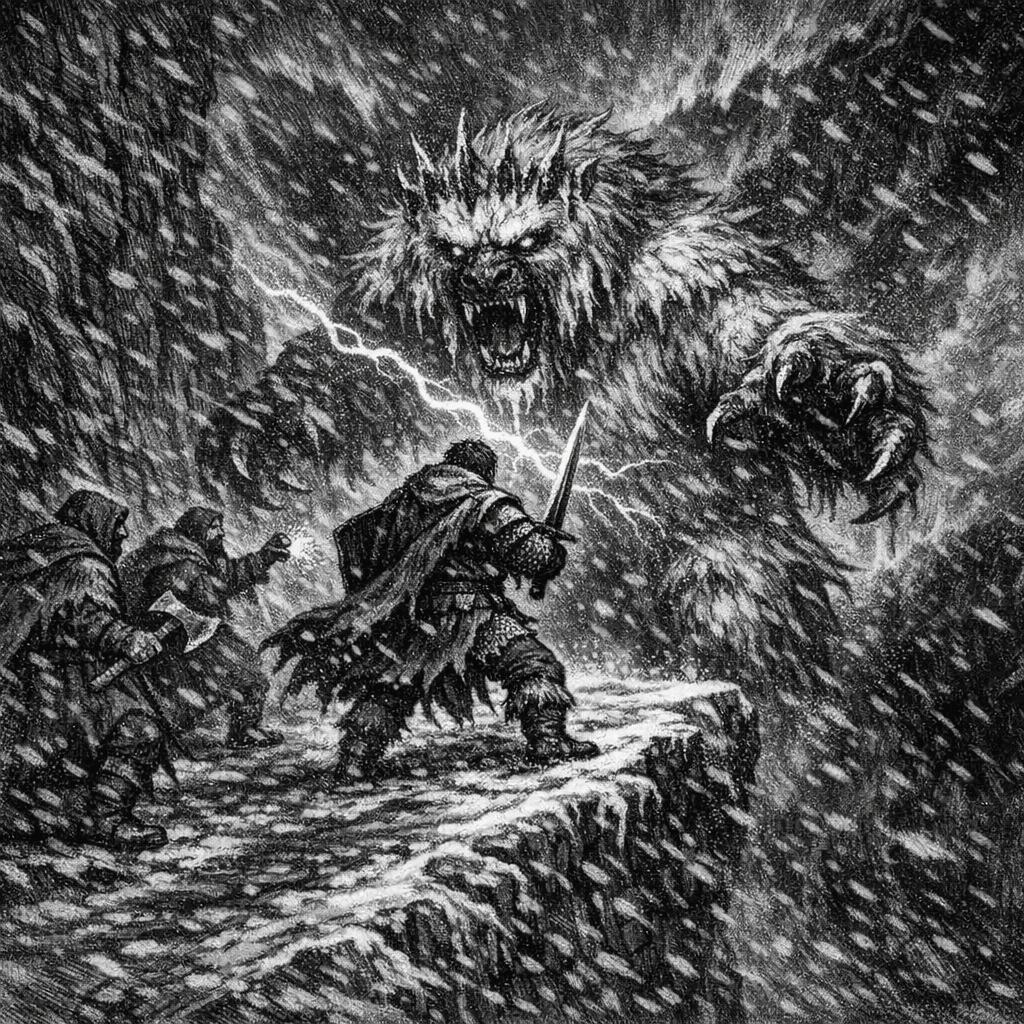
On their left, the mountain rose in a sheer black wall, disappearing up into the blizzard. On their right, beyond a lip of wind‑scoured ice, the slope simply fell away — a pale nothing of flurries and dark that might as well have been the edge of the world. The path between was barely ten feet across, hard‑packed snow and old ice polished smooth by years of storm.
They were halfway along it when the weather tore open.
Wind sheared aside like a curtain ripped down, and the Beheader stepped out of the white in front of them — bigger than the cave‑mother, bigger than anything had a right to be. White fur clotted with old blood, icicles hanging in its mane like a crown. Its eyes burned with a hatred that was not human, not even animal — just hungry.
It roared. The sound hit them in the chest and bones at once.
Thelonius Jones and Miquitzil were past tired. They were hollowed out, running on the last scraping dregs of whatever stubborn thing sat behind the heart and refused to lie down. There was no room left for fear.
The Beheader came on fast, snow fountaining from its claws. Raine and Felwar dropped the blue‑booted dwarf as one, the corpse thumping into the drift between them. Steel came free in the same heartbeat.
Raine did not wait. He stepped off the safer ground without thinking about it, putting himself between the monster and the others, boots crunching on ice a spear’s length from the drop. He planted his feet and met the charge head‑on, greatsword flashing in the stormlight.
The first impact almost knocked him off his feet. One massive claw hammered his shield, another raked sparks from his armour, screeching across the metal as the yeti tried to bully him sideways toward the fall.
Miquitzil flung up a hand. Words ripped from his throat in the old Ice Hunter cadence, raw and hoarse. Lightning snapped out, slamming into the Beheader’s chest and sticking there in a crackling green‑white tether. Witch bolt. The smell of burnt fur cut through the stink of ice and old meat.
The monster’s gaze tore off Raine’s shield and locked onto his face. Its eyes went black and bright together.
Cold punched through him. Joints locked. Breath froze half‑out. For a heartbeat, he was nothing but meat on ice, every muscle seized as the Beheader’s magic tried to turn him into a statue standing on the cliff’s narrow lip.
“Fight it, Raine!” Thelonius bellowed from behind, bear‑hide cloak snapping in the gale.
Raine’s jaw clenched. He forced air through his teeth in steaming bursts. “You won’t freeze me, you fucker,” he snarled. Inch by inch he dragged feeling back into his arms, prised his fingers open and shut on the sword hilt. With a roar, he wrenched himself free of the paralysis and drove forward, blade punching through fur until he felt it bite hide, then meat.
“Ha! Hurts, doesn’t it?” he spat into its face.
Thelonius answered with the sky.
He called, and something answered. A column of hard, silver light speared straight down through the spinning snow to smash into the Beheader’s shoulders. Moonlight, bright as a god’s eye. The yeti shrieked as the beam burned into it, fur blackening, flesh blistering. Snow hissed and sagged into slush around its feet, running in quick, bright rivulets before vanishing as steam.
Felwar came in on Raine’s flank, crampons careful on the treacherous edge. They caught each other’s eye for half a heartbeat — thanks, recognition, and the shared, unpleasant knowledge that one wrong step meant a very long fall.
Then they were in it together, shoulder to shoulder at the cliff’s edge, hacking into the Beheader while lightning crawled over its hide and moonfire chewed at its back.
Miquitzil’s lightning crackled and surged, scorching fur and filling the air with the stench of burning hair. He followed with another spell that struck true, and the Beheader’s movements faltered for a moment, its bulk slowed. But the bitter cold woven into the magic rolled harmlessly across its hide, leaving its fury undiminished.
“Immune to cold,” the Ice Hunter muttered into the storm, nodding grimly. “But it will slow you down.”
The Beheader fixed its baleful gaze on Miquitzil, its eyes burning with unnatural frost. The Ice Hunter’s body stiffened, frozen in place, and the witch bolt tether flickered out as the paralysis gripped him.
The creature turned, claws hammering into Felwar. One savage strike landed, but he roared in defiance and unleashed his rebuke — a burst of fire that seared across the yeti’s chest. The beast recoiled, bellowing in real pain for the first time. Fire — the one thing it could not abide. Something like fear flickered in its monstrous eyes.
Thelonius held his ground, the moonbeam still blazing down upon the yeti, radiant light carving into its form. He raised a hand and launched a starry mote of power, striking the creature in the shoulder. The radiant burst scorched its hide, leaving the monster wreathed in yet another layer of dim light.
Felwar struck again, his blade finding purchase before he vanished in a taunting misty step, reappearing out of the creature’s reach. Raine, suddenly alone before the beast, felt a jolt of fear — but he said nothing, jaw tightening as he braced himself against the monster’s fury.
Miquitzil remained frozen, trapped within the yeti’s chilling paralysis, struggling with all his will to break free but unable to move.
The beast howled, reeling under the twin bite of the moonbeam and starry magic. Thankfully, the yeti was as stupid as it was strong, and the thought of stepping out of the burning light never crossed its primal mind.
In that instant, Raine saw his chance. Timing his move with the flare of radiant pain, he surged forward and drove his longsword up through the monster’s gaping maw. The blade slid deep into its skull, ending the creature in a single, savage thrust.
The Beheader gave one final, terrible cry, then collapsed in a thunderous heap. Snow and ice shook loose from the cliffs above, falling in drifts around them as the fierce wind howled on, driving sleet and snow across the mountainside.
Inside the cave, they finally let themselves stop.
They hauled Garret out of the rapidly cooling yeti carcass and got him sat up against the wall. Perilou Fishfinger, Boy, and the others drew in close as Thelonius called up another bonfire, flames guttering and flaring in the draught. Its heat barely pushed back the cold, but it was something — a small, stubborn miracle against the storm howling outside.
Garret edged nearer, holding his yeti‑gore‑soaked jacket toward the flames while wrestling himself into the heavy coat taken from the fallen goliath. The sight made Perilou flinch, her face tightening as if someone had pressed a thumb to a bruise.
Felwar noticed the halfling’s cuts and bruises, the way she favoured one side from the yeti whelp’s rough play. He stepped over without a word and laid healing magic on her. Warmth spread under his palm. Colour crept back into her cheeks. She thanked him, and as they spoke quietly of Titania and Yondalla, he steered her thoughts away from the broken shape of Mokingo in the snow and toward the fact that she was still breathing. Her laughter, when it came, was small, but it was there.
They talked about leaving. They talked about nothing else for a while. Every nerve in them wanted off this cursed mountain — away from its caves and its teeth and its tricks. But wanting and doing were different things. Miquitzil and Thelonius were wrung out to the bone, shaking and hollow‑eyed. Garret drifted in and out, head lolling whenever they tried to rouse him. The guide could barely sit up, let alone climb down an ice‑choked slope in a storm.
The choice was no choice at all. If they tried to descend now, they would be adding their own bones to the mountain’s collection. They would endure the night here and take what strength they could steal back.
Thelonius stood watch beside the fire, casting his bonfire again and again as it burned low. Every time the flames faltered, he dragged them back, feeding the cave a little more of himself. The others dozed and patched wounds as best they could. He did not rest, but nobody missed what he was giving.
Raine’s spare javelins, Miquitzil’s spear, and strips cut from the goliath’s clothes were lashed into a rough stretcher to drag Garret down when morning came. It looked flimsy enough, but Raine gave it a testing shake and nodded once. It would serve until something better broke it.
Near the fire, Perilou and Felwar huddled in the not‑quite‑warmth, cloaks wrapped tight. The halfling talked in fits and starts about Mokingo Growling Bear of the Akannathi — younger than his size suggested, strong, stubborn, and kinder than most with that much muscle. He had come down from the Spine to prove himself, and she had run a handful of adventures with him before Astrix joined their company. Quiet Astrix. Swore like a sailor. Smarter than both of them put together, if Perilou was any judge.
Mokingo, she said, came from Skytower Shelter, a high, hard goliath hold where the world was small and the choices for a mate smaller. He hadn’t complained, not exactly, but she had heard what he did not say. Something was wrong between his people and another clan — a rift he wanted healed, a future he wanted bigger than the little ledge of sky they called home. Among goliaths, pride and silence went hand in hand. He never named the feud. Would not risk shaming his kin by speaking the crack out loud.
Perilou gave a little shrug. “I am an open book,” she said. “Most halflings are. That is why we are so beloved, you know.”
Felwar did not entirely buy it, but he inclined his head and let her have the comfort.
Her voice thinned. She sniffed and rubbed at one eye with the back of her glove.
“But Mokingo’s dream ended here,” she whispered. “In this cave.”
Silence stretched. Fire popped. Wind moaned at the cave mouth. She stared into the flames long enough that Felwar began to think she had finished, then she spoke again, softer.
“When we are down from this mountain,” she said, “I think I will go back to Caer‑Konig. My little rented room will still be there, quiet as ever. And that will be it. No more mountains. No more long roads. Just peace. That is all I have left in me now. Maybe when the passes open, I will head south. Somewhere kinder.”
She glanced sidelong at him, a small, crooked smile tugging at her mouth.
“If you could carry word of Growling Bear’s passing to his kin — and how he faced his end — it would mean more than you know. Families deserve to know. Deserve an ending. It would be a kindness to them. And to me.”
Her gloved fingers fidgeted in her lap. At last, she tugged the glove off and held out her hand. A simple ring gleamed there in the firelight — plain work, but solid, with a quiet strength to it.
“This ring of protection has kept me safe,” she said. “I have little need of such things now. If you carry Mokingo’s story back to Skytower, I will give it to you. Let it guard you as it has guarded me — but not before. Only once his family has their closure.”
Felwar bowed his head, accepting the weight of it without taking the metal. A pattern was emerging. Women with long, hard tasks seemed to find him, one after another.
He was starting to wonder why.
Meanwhile, Miquitzil and Raine turned their attention to the satchel Astrix had left behind.
Inside were two stoppered vials, glass cloudy with frost. Raine turned them in his hands while Miquitzil muttered the words to detect magic. One potion shimmered and blurred at the edges when he focused on it — invisibility. The other burned steady and bright in his sight — a potion of greater healing.
But it was the leather‑bound book that truly claimed Miquitzil. He brushed the crusted rime from its cover and opened it with something close to reverence. Neat, angular arcane script filled the pages — alter self, cloud of daggers, comprehend languages, detect magic, expeditious retreat, scorching ray, shield, suggestion, Tenser’s floating disk. A solid, workmanlike collection, and more besides if the later, frozen‑together pages could be teased apart.
Why any wizard would abandon such a thing in the snow was a question that sat badly with all of them.
Before they left the cave, Felwar knelt by the blue‑booted dwarf they had dragged down from the peak. The ice was mostly gone now, thawed to a thin, slick crust along beard, boots, and mail. Felwar chipped carefully at the last of it, fingers numb, until they could work through the stiff layers of cloth and leather.
A hidden inner pocket gave under his searching hand. Inside, he found an envelope as hard as thin stone from the frost. The paper inside crackled as he eased it open. Fragments of a journal in tight dwarvish script spilled into his palm — broken pages, half‑thoughts and scattered entries rather than a complete account, but still something of the dwarf’s story left behind.
He tucked the pieces away. The dwarf would not be abandoned twice.
The floor lurched.
A deep, rolling growl ran through the rock under their boots, turning icicles into knives and shaking frost from the ceiling. Shards rattled down in a bright, glassy rain. For a few long heartbeats, it felt as if the mountain itself meant to shrug them off its hide — then the tremor eased and stopped.
The silence that followed was wrong. Heavy. Close. Even the endless scream of the wind outside had fallen away. In that stillness, faint green and yellow ribbons of light shivered along the ice walls, reflections from a sky they could not yet see.
They stepped out into a world holding its breath.
The storm had vanished. In its place, the night hung clear and bitter, the air so cold it felt thin in the lungs. Curtains of green and yellow light streamed across the heavens, bending and folding as if the sky itself were alive and restless.
High on the sail‑like crown of Kelvin’s Cairn, something waited.
A bird — if bird was the word for it — stood outlined against the aurora, vast beyond reason. One half‑furled wing could have roofed a longhouse. Talons the size of wagons had bitten deep into the stone, cracking it like thin ice. Frost drifted from its feathered mantle in slow curls, smoking faintly as it fell, turning the air to glass around it. Looking at the sheer bulk of it, Raine thought — not entirely joking — that the thing could have plucked the Easthaven ferry from its moorings and flown off with it like a child’s toy.
Astride the monster where neck met body, a rider sat.
From this distance it was little more than a cut‑out of darkness, but the shape told its own story. An owl’s head crowned with curling horns. A cloak of hard ice, jagged at the hem, snapping in a wind they could not feel. The aurora burned behind, throwing the figure into knife‑sharp relief as it surveyed the land below.
The rider leaned forward, gazing south — over the lakes, over the specks of Ten‑Towns clinging to the ice, further still toward the jagged white serration of the Spine of the World. Then its arms opened wide, slow and deliberate, as though to gather all of it close. From the ends of those long, black talons, rime poured — a pale, shimmering stream of green and yellow that curled upward and joined the lights above.
Breathing grew hard. Or perhaps they simply forgot to do it. The cold pressed deeper, coiling tight around their hearts. Miquitzil felt it most keenly — a wicked, familiar chill that reached for the old scars under his ribs. He folded his arms across his chest before he realised he was doing it, as if he could shield the shard inside him from that gaze.
With a thunderous beat of its wings, the great bird launched.
Stone shook under their boots as its talons tore free. Snow and ice sheared from the peak in sheets. The creature rose on a column of its own power, climbing into the aurora until bird and rider were swallowed by light and distance both — one last dark stroke against the sky, then gone.
For a long while, nobody spoke. The only sound was the faint hiss of disturbed snow settling back into place.
When Felwar finally found his voice, it came out thin. “So,” he said. “Was that Auril herself, or just one of her… pets?”
Nobody rushed to answer. It was easier not to put the thought into words.
Raine cleared his throat, forcing the world back into motion. “Let us get the hell off this mountain.”
“Absolutely,” Miquitzil muttered, rubbing his arms. “I am sick and tired of being sick and tired.”
They turned their backs on the peak and began the long way down.
The descent was easier than the ascent, but easier was not the same as safe. They pulled out climbing gear with stiff, half‑frozen fingers, hammering pitons into stone and hard ice, threading ropes through and checking knots twice. Every step was measured. Every handhold tested. One slip here and a man’s story ended with a long, silent fall into the dark.
Garret lay lashed to the rough stretcher they had made. What strength he had was gone, but his mind still knew the mountain, and he guided them in a hoarse, steady voice — pointing out safer shelves, warning them away from wind‑sculpted cornices and drifts that would not bear weight.
They moved as a unit, rope lines taut between them, steadying each other when boots slid or hands slipped.
At last, boots hit level ground.
The mountain’s broken face fell away behind them, and the blizzard gave way to the open plain at its feet. Natasha and the sled team waited there, tails thrashing, breath pluming in white gusts. They barked and whined, stamping with impatience as if offended that the party had taken so long.
Relief hit like a blow to the gut — they were cold, bruised, one wrong move away from collapse, but they were alive.
“Where to?” Someone asked, and the question turned them all back to the problem of distance.
Garret’s home lay in Targos, but there were six of them now, and the dogs were already loaded near their limit with Garret, gear, and whatever was left of their strength. By Raine’s rough reckoning, trying to sled all the way to Targos would mean a fifteen‑hour haul, maybe more, and that was assuming nothing else tried to kill them on the road.
Caer‑Konig was closer. It was also where Perilou was bound. From there they could rest, thaw, and take stock before pushing on to Targos by way of Caer‑Dineval. Raine reminded them, not without a certain grim humour, that he still had an invitation waiting there.
“And from Targos,” Felwar added, “back to the cairn where I found that axe. I want it returned to the dwarf it belonged to.”
Miquitzil hunched deeper into his furs. “Gods,” he muttered, “I am sick of cairns.”
Natasha barked once, sharp and bright, as if to say enough talking. Raine took the driving position, the others climbed aboard, and the dogs surged forward into the frozen dark.
The trek across the tundra from Kelvin’s Cairn to Caer‑Konig was, mercifully, dull.
With the mountain and the worst of the wind behind them, the going felt almost easy by comparison. Garret, Thelonius, and Miquitzil rode bundled in furs and blankets on Natasha’s sled, the dogs’ steady lope sending a gentle shudder through the runners. Felwar and Raine trudged alongside, boots crunching over hardpack, breath steaming in the brittle air.
For a long while, nobody said much. The only sounds were the rasp of leather, the creak of the sled, the quiet chuff of the dogs, and the distant groan of the endless ice.
As the first weak lights of Caer‑Konig finally began to flicker against the frozen horizon, Felwar broke the silence.
“I have never been here before,” he said, breath fogging. “What are we walking into?”
“Hopefully,” Thelonius muttered from the sled, not bothering to lift his head, “a warm taproom — and who cares about the rest.”
That pulled a ragged chuckle from the others, though Raine’s was closer to a grunt.
It was Perilou and Raine who knew the place best. As they moved, stamping feeling back into their feet, they pieced the town together in words.
Caer‑Konig, they said, squatted on the northern edge of Lac Dinneshere, its houses built in terraced rows that climbed from the shore like frozen steps. At the top of those steps stood what remained of the old caer itself — the broken shell of a castle that had once given the place its name. Orcs, ice, and neglect had all taken their turns at it. Now it was just jagged teeth and half‑fallen walls, a memory of stone.
The town had started as a mountaineers’ camp, before stubbornness and bad sense turned it into a permanent settlement. It had never been rich — too far from everyone, too close to everything that wanted you dead — but its people were tough and made do. Fishing when the lake allowed it, trading when anyone bothered to come, guiding dull merchants and over‑eager fools across the dale, up Kelvin’s Cairn, further north, even south into the Spine of the World when the passes were open.
The lake freezing had cut it off even further. The ferry to Easthaven sat locked in ice. The trail between Caer‑Konig and Caer‑Dineval was a bad joke in good weather, and worse now. To most of Ten‑Towns, Caer‑Konig was an afterthought, left clinging to the edge of the wild and expected to like it.
Still, there was warmth, if you knew where to look.
Perilou told them she, Astrix, and Mokingo had taken a room at the Northern Light — a modest but comfortable inn run by two sisters with more backbone than sense. Mokingo, of course, had preferred a rougher hole called the Hook, Line, and Sinker. Louder. Smokier. Filled with the sort of company a young goliath with too much pride and not enough fear naturally gravitated toward. For folk heading into the wilds, Frozenfar Expeditions served as outfitter and supplier, though its shelves had grown thin these last winters.
“That is Caer‑Konig,” Raine finished, his voice rough with cold. “I think I came here once before. It did not leave much of a mark.”
Felwar snorted. “Cold, stubborn, and clinging on?”
Raine nodded. “Still a shitload more welcoming than that gods‑damned mountain.” He twisted at the waist to throw a middle finger back over his shoulder at Kelvin’s Cairn, now just a dark tooth on the horizon.
“And with a warm taproom,” Thelonius added, stubborn as ever on that point.
That drew one more tired laugh from the group as Natasha’s team dragged the sled down toward the scattered lights of Caer‑Konig, the promise of heat and four walls pulling them on.
Caer‑Konig revealed itself slowly — first as a scatter of lantern‑glow on the frozen slope, then as the dark shapes of houses huddled against the wind. The terraced streets climbed toward the broken teeth of the old caer, its ruined walls jutting like a crown of black stone above the town. Smoke curled thinly from several chimneys. Somewhere a dog barked. Somewhere else, a door slammed against the cold.
It wasn’t much. But after Kelvin’s Cairn, it looked like salvation.
Perilou pointed with a gloved hand. “There — the Northern Light. Allie and Cori run it. Warm beds, warm food, and warmer tempers, if you’re lucky.”
Raine grunted approval. Felwar nodded. Thelonius perked up at the word warm.
They angled toward the inn’s lantern-lit porch.
As they neared the Northern Light, a drift of snow to their left suddenly erupted. A silver dragonborn lurched up out of it in a shower of powder, cloak and scales rimed white.
“A‑ha! Found you, thieves!” he declared grandly — then spoiled it by belching once, twice, a third time. He took a long swig from a half‑frozen bottle, blinked blearily, and peered at them. “I mean… who goes there?”
Raine’s hand slid off the pommel of his sword. He squinted. “And who are you?”
“Speaker Trovus, at your service,” the dragonborn announced with another hiccoughing belch. He started a bow, thought better of it halfway through when his balance betrayed him, and settled for a vague flourish. “Ever‑vigilant protector of Caer‑Konig.”
Thelonius shook his head. “Let’s get you inside. I’ll buy you a drink.”
Trovus brightened at once, whatever hunt he had imagined forgotten in a heartbeat. “Marvellous. Brilliant idea. That is why I — burp — always liked you best.” He raised a clawed finger in solemn warning as they guided him toward the door. “Word to the wise. Allie is a delight, but her sister Cori…” He winced. “Wicked woman. Tongue like a whip.” He tapped the side of his head with exaggerated care. “Keep that in mind. And a fierce left hook,” he added as they reached the porch.
Raine helped carry Garret inside, then turned back to the sled while the others followed Trovus toward the taproom. He moved down the line of dogs, rubbing their flanks, checking traces and paws, breath misting in the cold.
“Good work,” he told them quietly. “Strong, brave — you carried us home when no one else could. Thank you.”
Tails thumped weakly. One dog pressed its muzzle into his gloved hand and sighed.
Only once they’d been fed and then curled together against the drift did Raine secure the sled and step away.
Inside, snow thudded from cloaks and boots at the threshold. Heavy coats and armour went up on hooks by the door, frost falling away in clumps as they stepped into the tavern’s dim warmth.
Relief washed through them in a slow, aching wave. They were alive. Garret would live. Perilou was safe. Mokingo Growling Bear lay dead on the mountain, but beside him they had done what they set out to do. Astrix was another matter entirely — odd, unsettling questions clung to the tiefling wizard — yet she had not died on Kelvin’s Cairn, and for now that counted as a kind of victory.
Speaker Trovus wove across the taproom, bounced lightly off one table, then another, and collapsed bonelessly into an empty booth. His snoring started almost before his head hit the wood.
“So much for that, then,” Thelonius muttered, amused, as he dropped into a nearby table with the others.
His eyes were already drifting toward the woman approaching with a tray and a bright, professional smile. She was dark‑haired, pretty, and moved like someone used to working twice as hard as anyone else in the room.
“And what’s your name, then?” Thelonius asked, leaning forward a touch too eagerly.
“Allie,” she replied, setting the tray down. Her frame was slight, but the tightly laced bodice did her curves no disservice. Thelonius’ gaze lingered a fraction too long.
“Lovely…” he breathed, then dragged his eyes up to her face and cleared his throat. “Lovely place you have here.”
If Allie noticed, she gave no sign. Her smile never slipped as she took their order and moved on.
With Garret settled under Perilou’s watch in her small room upstairs, the others finally let themselves sag. Later that evening they drifted back to the taproom. Allie and her sister Cori worked the floor between the few regulars, keeping the fire fed and mugs filled, while a marginally more coherent — but still thoroughly drunk — Speaker Trovus rambled from his corner booth.
Thelonius recognised the type. A high‑functioning drunk, just steady enough to pass, always half a step from collapse. Felwar’s jaw tightened. His mother’s drinking rose from memory — slurred charm, tired jokes, the stink of stale spirits — and Trovus’ swaggering, self‑mocking banter soured quickly for him. Where others saw a roguish fool, Felwar saw a man bleeding out his usefulness at the bottom of a bottle.
Yet it was Felwar who brought colour back into the room.
With a casual twist of his fingers, he whispered power into the frost‑rimed pots on the windowsills. The drooping stems straightened. Buds swelled, burst, and in a breath the Northern Light was filled with fresh blooms — rich greens and impossible petals, colours that Ten‑Towns had not seen in years. Allie gasped. A few patrons applauded outright.
Felwar allowed himself a small, self‑conscious smile.
Cori’s eyes narrowed. She watched the tall, handsome stranger who could conjure spring from dead soil, and made a quiet note to keep him in sight. Men that beautiful, that generous, that talented all at once rarely came without a catch.
Ale loosened tongues. Thelonius, now well lubricated but not drunk, spoke more freely than usual. He told them of parents worked to death and buried out the back of a small, failing farm. How, when they were gone, he had left the plot — and his brother, Brince — behind. Whether he had walked away by choice or been driven to it, he did not say, but the hurt lay heavy behind his eyes. Drift and drink followed, then violence; animals, himself, anyone unlucky enough to be nearby. Prison after that. The others listened in silence, careful not to interrupt for fear he would stop. That he had somehow come out of it a druid, sharing a table with them in a warm tavern at the edge of the world, felt less like luck and more like some cruel joke the gods had not finished explaining.
Talk turned, as it always did in small towns, to local trouble.
Allie told them of the magical lantern that once burned outside the Northern Light — a steady blue glow that guided travellers in from the dark — now stolen. Others at nearby tables chimed in with their own losses. Food. Firewood. Lantern oil. A locked strongbox gone without a splintered lid. A set of scrimshawed knucklebones that one old fisherman had prized for years. Useful supplies all vanished in the night.
Always at night, and always on evenings when fresh snow fell thickest. No forced locks. Rarely was there a footprint left behind. Just… absence. Suspicion had settled on Caer‑Konig like a second winter. Neighbours eyed each other sideways. Some swore it had to be outsiders.
“Not our folk,” Trovus said firmly, leaning across the table with mead‑heavy breath. “No chance. Too quiet, too neat. Has to be travellers, or worse.”
He admitted, in a rare moment of honesty, that twice he had found tracks leading out of town, trailing into the dark toward Kelvin’s Cairn. The party shivered at that — fresh from avalanches, yeti claws, and Auril’s silhouette against the aurora.
They offered to help. Trovus scoffed, the sound slurred but proud. “If I cannot catch them,” he muttered, “no one can.”
Cori snorted at that from behind the bar, though he either didn’t hear or pretended not to.
As the ale ran deeper, the dragonborn’s armour of humour slipped. He glanced down at his clawed hands, tracing a scar on his palm with one thumb. He stared into his mug, scales around his eyes tightening.
“I cannot even stop a few petty thieves,” he mumbled. “What sort of leader is that?”
The words sat there between them. Then he huffed, tried to blow the weight away with a crooked grin and another long pull of drink.
Felwar’s jaw clenched. “Maybe,” he said, voice low but clear, “if you stopped your fool‑headed drinking for a week, you might have the clarity to catch them.”
The table went still. Trovus’ eyes lifted — glassy, but suddenly very sharp.
“Oh, that right?” he slurred. “Lecture from the flower‑summoning pretty boy. Tell me, lad — how much crime have you stopped between your tricks and your hair?”
A couple of locals snorted into their cups. Felwar pushed back his chair.
“You want to prove you’re not a joke, Trovus?” he said, standing now. “We can always settle this outside.”
Trovus’ grin widened into something mean. “Gladly,” he said, levering himself up with both hands. “Let us.”
For the first time all evening, there was something like sober focus in his eyes. He swayed once, caught himself, and gestured grandly toward the door. “After you.”
Felwar stalked out into the cold.
The door slammed behind him.
Through the window he saw Trovus dust off his hands, puff out his chest, and stagger back to his booth, accepting a few chuckles and claps on the shoulder from locals who had seen the trick before.
Felwar stared at him, blinked once, then simply opened the door and walked back in. He crossed the floor without remark and took a seat at the bar as if nothing had happened at all.
Allie, still talking with Raine and Thelonius. The town, she explained, had always struggled more than most of Ten‑Towns. Too remote. Too hard to resupply. No trader came to Caer‑Konig unless they had to. They did not trust Easthaven or Targos — “Them bigger places, they look after themselves, they do, not us” — and their rivalry with Caer‑Dineval was older than any of the fishers at the table. One man shook his head, nursing his ale.
“With the ferry frozen solid, there’s only the road,” he said. “And that’s a bitch of a road, if I’m a judge.”
Later, when the mugs were lower, and the fire burned down to coals, Trovus’ bravado cracked again. He stared into the dregs of his drink.
“I will do better,” he muttered, maybe to them, maybe to himself. “Have to.”
The party exchanged glances and, one by one, promised they would help however they could — after a night’s sleep, a hot meal, and a chance to feel human again.
Out in the dark, the wind worried at Caer‑Konig’s broken walls. Inside the Northern Light, the fire held, the sisters worked, and the Brave Hearts let their guard down — just a little.
The next morning Felwar made his way alone through the frosted streets to Frozenfar Expeditions. The squat timber building smelled of leather, oil, and wet fur. Its walls lined with battered gear and old stories. Outside, sled dogs barked and whined in their kennels, eager for a trail that was not coming.
Inside, he was greeted by Atenas Swift, a ranger gone stiff in the joints, and Jarthra Farzassh, the shield dwarf who now took most of the guiding work. The pair needled each other the way people did when they had shared one too many winters — jabs with a warmth underneath.
When talk turned to goliaths, Atenas’ mood soured. He spat into the corner and told Felwar in no uncertain terms that goliaths were not to be trusted — violent, unstable, their thinking twisted compared to normal folk.
“Do not go looking for Skytower Shelter,” he warned. “You’ll find nothing but trouble up there.”
Jarthra snorted but did not argue the point.
Changing the subject, the dwarf offered to see Garret safely on to Targos once he was fit to travel. Garret’s old work with Frozenfar Expeditions was remembered fondly, and both Atenas and Jarthra agreed it was the least they could do.
Felwar shook his head. “We made a pledge to his husband to get him home. That is on us.”
Jarthra studied him for a long heartbeat, then gave a sharp nod and clapped him on the shoulder. “Good man,” he said simply.
Felwar reached into his coat and produced the ice‑stained journal fragments taken from the blue‑booted dwarf. The parchment crackled softly in the warmth. Jarthra squinted at the cramped script along the bottom of one page.
“Barthoom Hammerhome, if I’m not mistaken,” he muttered, tracing the shaky runes with one thick finger. He read on in silence for a while, lips moving, then set the brittle scrap down with an extra care that said more than his face did.
“A sad tale, laddie,” Jarthra said at last, voice gone low. “Best left up on the Cairn, I’m thinking.”
Felwar’s eyes stayed on the parchment. “Read it to me,” he said quietly. “Please.”
The dwarf nodded. He fished out a pair of spectacles, perched them on his nose, and lifted the first page. The guttural roll of dwarvish slipped into Common, his voice steady as stone.
“Kelda says the Frostmaiden calls tae her. I tell her stone is stronger than wind. She doesnae hear. The lasses laugh in the snow, thinkin’ it a game. I pray Moradin guard them, but my forge lies cold and empty.”
Jarthra frowned, squinting closer. “Kelda will be his wife, I reckon,” he said aside. “Poor lass. Sounds like the endless winter got into her head. And they had daughters too.”
He cleared his throat and read on.
“I came hame tae silence. Only the snow spoke. Their tracks led north. I followed, but the night swallowed them whole. The wind carried their names, and I was too slow.”
He drew a slow breath.
“Hammerhome has nae hearth for me now. The walls press close, and every face is pity. If the cold took them, then the cold must take me as well. Better the mountain than the alehouse.”
He glanced up. Felwar’s jaw was clenched, eyes fixed on the page.
Jarthra unfolded the final fragment, his voice dropping almost to a whisper.
“I climb. The blue boots she gave me bite the snow. Kelda, if ye are here, call me, my love. Show me where the lasses sleep. My bonnie wee twins, the light o’ my life, Kel. Och, why did ye take them wi’ ye? My hands are cracked but still I carve yer name in stone, so it willnae vanish.
The storm circles abune. I see lights in the dark, three shadows in the white. I lay down my pick. If this is the Frostmaiden’s breath, let it carry me tae ye. The human folk cry her Auril — if she has ye and my bairns, then she can bloody well take me too.”
Jarthra let the scrap fall back to the table and rubbed his brow. “And that is the end of him.”
The shop went quiet. Even the dogs outside seemed to have lost some of their noise, their barking dulled by the snow.
Back at the Northern Light, Miquitzil finally emerged from a long, much‑needed sleep. He packed his pipe with his strange herb and drew on it until the harsh taste steadied his hands. He took a seat by the hearth, watching the flames through a veil of smoke. The rest had eased his bones, but the mountain still sat in him like grit under the skin.
Thelonius offered to send Owly to watch the town, hoping to catch the thieves in the act. Speaker Trovus, bleary but eager, agreed at once. The owl went circling out into the night, slipping over rooftops and alleys, but saw nothing that should not be there.
Come morning, a middle‑aged woman named Jayne approached Trovus’ booth, face pinched with worry. Three of her four crocks of fish oil had been stolen in the night, she said, and her scrimshaw tools taken straight from the back room.
The party agreed to look into it.
They searched the yard and street outside her home, boots crunching through thin new snow. No clean prints — only faint scuffs along the fence where something, or someone, had brushed past. It was not much.
They were ready to call it a dead end when a thought struck.
“Boy,” Felwar said. “If we bring Garret’s dog and tell him what we want — get him to track from these scuff marks — he might find what we cannot see. Worth a try.”
They fetched Boy, and with a few quiet words in the tongue of beasts, Felwar explained what they needed. The dog’s tail wagged, ears pricking with purpose. He nosed along the fence, then set off at a steady lope.
Boy led them out of Caer‑Konig and north toward Kelvin’s Cairn, paws biting into the snow, then looped in a wide arc and came back around. The trail swung them to the edge of town, to a half‑hidden cabin crouched among frost‑laden trees. Its timbers bowed under the weight of ice. Shutters were sealed with rime. No smoke. No light. No footprints. No sign of life.
Felwar crouched and scratched Boy behind the ears. “Clever dog,” he murmured, running a hand along the hound’s head. “Go on — back to your master. We will take it from here.”
Boy’s tail beat furiously. He licked Felwar’s cheek once, then turned and tore off through the snow toward the Northern Light.
Thelonius sent Owly wheeling overhead, but the cabin’s small windows were cloudy with grime and ice. Whatever was inside stayed hidden. The party spread out and crept into position around the yard.
“If they bolt, we catch them,” Raine said. “Simple.”
They tried for quiet. The mountain had taken some of their luck with it. Thelonius slipped on an icy patch and snapped a branch, the crack echoing across the still yard. A heartbeat later, Miquitzil caught a root and went down with a grunt that was only half muffled.
Raine winced. “Place is probably empty anyway,” he muttered, and stepped for the front.
He eased the door open as quietly as he could and slipped inside.
A wide central room lay before him, with rough walls, a table, and a few battered bunks. A corridor stretched off to the left into the shadows. At first glance, it looked deserted.
Then he saw the mug on the table, a thin curl of steam still rising in the cold air.
Not empty, Raine thought, and felt the old thrill stir. He drew his sword, raised his shield, and moved in.
Steel flashed from nowhere.
Two invisible shapes solidified as they struck — duergar, dark dwarves, their stocky frames grotesquely swollen by foul magic. Their skin was corpse‑grey purple, their eyes flat and murderous. Both wore banded mail. One swung a jagged mining pick, the other a heavy warhammer, each blow landing with the force of something twice its natural size.
All hell came with them.
Thelonius roared as his body twisted and thickened, bones stretching, fur bursting through skin. A brown bear shouldered past Raine and went straight through the cabin’s rear door, the flimsy planks exploding off their hinges. By ugly luck, a third enlarged, invisible duergar stood directly behind it. Door and dwarf hit the floor together in a tangle. As the bear lumbered over them, a fourth duergar flickered into view at his flank, hammer smashing into fur and muscle.
Outside, Miquitzil advanced to a window and smashed it in with the butt of his spear. He thrust out a hand and loosed a crackling bolt of magic through the gap. Inside, Felwar shattered a side window with the pommel of his blade, vaulted in over a rotten bunk and a heap of stolen goods, and cut in at an angle that took some of the pressure off Raine.
The bear took hits from both sides, warhammers crunching into his ribs and shoulders. Thelonius answered with tooth and claw, mauling one duergar, then another, blood spraying across the walls. But the weight of the blows kept coming. One dark dwarf scrambled onto the table to gain height and brought his hammer down again and again until the brown shape crashed to the floor in a bloody heap, bones and form twisting back into the too‑small shape of a man. Without ceremony, a duergar drove a boot into Thelonius’ neck to make sure he stayed down, while another moved to check the rear in case more enemies flanked them.
Raine held the line in the centre of the room, trading strike for strike. His shield caught just enough steel to keep him upright. Every swing of his blade came in hard and close, sending a shock through arm and shoulder, each cut another fraction of ground wrestled back from death.
Outside, Miquitzil narrowed his eyes and drew a long breath, focusing through the broken window. Power gathered along his arm. His next shot flew straight and true — a crackling arrow that tore through the room and buried itself in the neck of the duergar leader. Older, heavier armed, clearly in command. The dark dwarf, already bloodied by Raine and Felwar, staggered, clutching at the wound as his legs buckled. He slid down the wall, choking, and did not rise.
One of the duergar who had been beating on the fallen bear leapt across the room and rammed his pick through the window toward Miquitzil, the jagged edge tearing across the wizard’s chest and leaving him reeling, blood soaking into his furs.
But the tide had shifted.
Felwar called on the Summer Queen, words sharp and bright in his mouth. Warmth surged from his hands into Thelonius’ broken body. The druid jerked, dragging a rasping breath into battered lungs. Alive again, if not yet in the fight.
Felwar did not linger. He turned, eyes gone cold, and drove his conjured blade into another duergar’s skull. Bone split with a wet crack. The dark dwarf dropped where he stood.
Raine barked a hoarse laugh, even as he fought on. There was a wild light in his eyes — part admiration, part the simple joy of not being dead yet.
The last two duergar had seen enough. Scouts, not fanatics, and their leader was down. They broke for the door, shrinking to normal size as they ran, hoping speed and snow would cover what courage could not.
Hope did not help them.
One went down face‑first in the yard with an arrow in his back. The other managed three staggering steps into the drift before Raine’s javelin punched clean through his neck and pinned him upright in the snow. He slid slowly down the shaft, leaving a smear of purple‑black on the pale crust, and hung there, still.
Silence crept back in, thin and cold.
Inside the cabin, the only sound was the steady drip… drip… drip from the mug on the table, its spilled contents spreading in a slow, dark fan across the warped floorboards.
Disclaimer
This is a work of fan fiction. All relevant characters, locations, and settings remain the property of Wizards of The Coast (WOTC) and the story contained here is not intended for commercial purposes.
I do not own Dungeons and Dragons (D&D) or any of the related characters. D&D is owned by WOTC (and its parent companies) and all rights of D&D belong to them. This story is meant for entertainment purposes only.