Session 31
Cold things in the dark
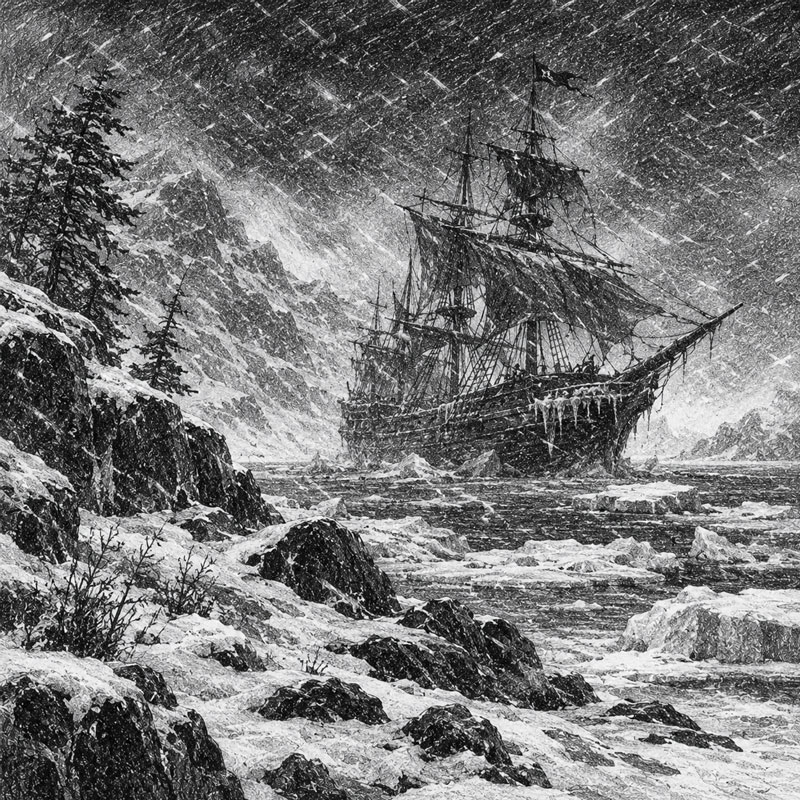
When at last they left Bremen behind and pushed out across the tundra in search of the Dark Duchess, the journey began well enough. The first day passed without much trouble. On the second, the world began to change. The air grew sharper as they pushed north, and beneath the frost there came the faint taste of salt. The sea was somewhere ahead—not yet visible through the white and distance, but near enough now to make itself known.
As that scent found him, Miquitzil seemed to withdraw further into himself. He had never been a talkative man, but this was a different kind of quiet. Tighter. More inward. As though something old in him had heard a voice it had hoped not to hear again.
Thelonius noticed. He noticed such things now.
For a while he said nothing. Then, judging his moment, he moved around the supply sled and caught up to fall into step beside Miquitzil. The runners hissed softly over the crusted snow. The dogs pressed on, steam rising from them in the bitter air. Atop the sled sat Sanhar, implacable and unreadable, like some macabre ornament.
“This is bringing things back, isn’t it?” Thelonius asked quietly.
Miquitzil kept his eyes ahead. “It is.”
He did not want the conversation. But he was astute enough to know that if he told Thelonius to leave him be, Thelonius would only worry at it harder, perhaps even drag the others into the mess. So, he let him walk beside him and asked the sea to keep its ghosts to itself.
“The coast,” said Thelonius. “Your people.”
Miquitzil nodded once. “Farther north,” he said. “North and west. But yes. The salt air reminds me of the place I once called home.”
He hoped that would satisfy Thelonius and send him back to his own thoughts. It did not.
They walked on a few steps in silence, the dogs leaning into the traces, the runners whispering over the snow.
“Do you expect to see them again?” Thelonius asked.
“No.”
The answer came at once. Too quickly to be invented.
Thelonius glanced at him. “And if we do it? If we bring back the sun?” He adjusted the strap across his shoulder. “What does good look like for you then?”
That made Miquitzil turn his head. His face was as unreadable as ever, but his eyes were heavy with something older than the road beneath them.
“If the winter ends,” he said, “they can no longer hold me responsible for it.”
Thelonius absorbed that in silence.
Miquitzil turned his gaze forward again.
“Would you go back?” Thelonius asked after a while. “When the seasons return, I mean.”
There was a pause before the answer came.
“Perhaps,” said Miquitzil. “I have not thought that far.”
Thelonius scratched at his jaw. “You should.”
Miquitzil gave him a sidelong look.
“I mean it,” said Thelonius. “If you don’t have a dream, you don’t have a purpose.”
That drew the faintest shift in Miquitzil’s expression, as though the words had found a place in him, he had not expected them to reach.
Thelonius huffed a breath and looked out across the white.
“The longer I’m away,” he said, “the more I realise I won’t ever go home. Not really. It wasn’t home for a long time before I left. My parents are dead in cold graves. Brince and I never talked—not proper. We just fought. Our farm is a dank, rotting hole in the arse‑end of Dougan’s Hole.” He gave a crooked shrug. “For me… maybe I’ll do up that tavern in Lonelywood. Make it proper nice. I’ve never had a place with a roof that doesn’t leak and a privy out the back. I can tend bar with Brince—or, more likely, let Brince do all the real work—and while he’s doing that, I can teach people a thing or two about nature. Help folk live with it instead of blundering through it.”
Miquitzil nodded, though only half of him was listening now. The word home had put old thoughts back into motion, and they did not sit quietly once stirred.
Thelonius went on, filling the silence as he often did when left too long alone with it.
“First, I’ll have to save Brince from that devil—though I’m still not sure how. Then I’ll take him back and show him my grove. We’ll set it to rights, make it proper again. He was always better with a hammer and saw than I was.” A small smile came and went. “I reckon he’ll make it liveable.”
They walked on for a while after that with only the hiss of the sled runners and the dogs’ breathing between them.
Then Thelonius glanced across again. “So, yeah,” he said. “That’s what I’ll do. You?”
Miquitzil took his time answering.
“When I travelled,” he said at last, “I heard many stories. Barmen. Fishermen. Woodsmen. Trappers. Common folk with long memories and little reason to lie. They all spoke of Icewind Dale as it once was. Hard, yes. But beautiful.”
He drew in a slow breath. The salt was stronger now, cold and raw in the lungs.
“I have not thought much beyond the winter,” he said. “But I think I would like to see the Dale in all its seasons. Travel its breadth. See with my own eyes what it is we are trying to restore. Autumn on the trees. Spring thaw in the streams. Open water on the lakes. Green things growing where now there is only frost.”
Thelonius said nothing.
Miquitzil kept his gaze ahead.
“When I go back,” he said, “if I go back, it will be after that.”
For a while after, neither of them spoke. They only walked north through the bitter air, the sled whispering behind them, and the sea waiting somewhere ahead.
The wind moved over them. The snow hissed underfoot. Ahead lay the white waste, the frozen coast, and whatever waited for them on the ice. But for a little while, walking there in the bitter cold, it seemed each of them had let the others see a little further in than before.
Later that same day, with darkness and blowing snow hemming the world into little more than what their lanternlight and sharp eyes could reach, it was Felwar who saw it first.
At a distance it was only a black mark on the tundra—a flaw in the blankness, no more than a scratch against the endless white. But the farther they travelled, the more certain it became that it was no trick of light or drifting shadow. Something lay out there.
Felwar narrowed his eyes against the wind and pointed. “There. Off to the right.”
Raine followed the line of his hand, grunted once, and put a little pressure on the lead line. The dogs veered. The sled hissed over the packed snow as they angled toward it, Sanhar sitting atop the supplies with the same corpse‑still poise he seemed capable of maintaining through anything short of an avalanche.
As they drew near, the shape resolved itself into wreckage.
A sled. Smashed and half‑buried. One runner split clean through. The frame twisted and stove in as though some immense force had struck it from above and driven it sideways into the snow. A torn tarp snapped and cracked in the wind, its edge frozen stiff where blood had once soaked into it. Crates and bundles had spilled out across the drift and then been slowly claimed by weather. Rope lay stiff as iron. A barrel had burst. A sack of something granular had hardened into a useless lump beneath the ice.
The party came to a halt around it.
No one spoke for a few moments. The wreckage said enough.
Raine crouched first and picked up a ration pack from the snow. The leather was rimed white. He flicked it open with a thumb and found the contents frozen solid in a single hard block. He pressed at it once, then snorted and let it fall shut.
“Not recent,” he said.
Thelonius had already moved to the front of the broken sled. He crouched there, frowning at the tangle of traces and shattered harness. “No,” he muttered. “Not recent.”
The dogs were gone. All six of them.
Not loosed. Not unhitched. Gone.
The harnesses had not been unclasped—they had been torn. Leather straps hung ragged and chewed. One buckle still held a twist of coarse winter fur caught fast in the metal. On another strap, dark brown stains marked where blood had dried and frozen. More of it lay in the snow beneath, half‑hidden now under newer falls, the old violence dimmed but not erased.
Thelonius lifted one ruined strap between finger and thumb. Fur was caught in the buckle. Blood had dried dark on the leather, and more of it marked the snow beneath, half‑buried now under fresher falls. He frowned, then looked up sharply.
“Oi,” he called. “These dogs didn’t run. They were torn out of the harness.”
He let the strap drop, no closer to guessing what had happened here.
Miquitzil had moved wider about the site, his gaze not on the wreckage but on the snow around it. Felwar, seeing him pause over something in the dark, stepped away from the sled and joined him.
Some yards off from the broken cargo lay a shallow depression in the snow. Broad. Smooth‑edged. Wrong. Not a drift hollow, nor the kind of shape the wind made by chance. It was long rather than round, the centre pressed hard beneath newer falls, as though something heavy had struck there or settled there for a moment and then gone.
Felwar stood at its edge and frowned. “Do you see it?”
“I do,” said Miquitzil.
Thelonius looked up from the traces, then crossed through the snow to join them. “What is it?”
Felwar pointed with the toe of his boot. “I don’t know yet. But that is not natural.”
Raine came over, ration pack still in hand, and peered down into it. “Something fell there.”
“Or landed,” said Thelonius. He looked up into the dark, snow‑choked sky.
Miquitzil said nothing at first. He stepped carefully down into the hollow, the snow crunching underfoot, then crouched and ran a gloved hand over the packed centre. He rubbed thoughtfully at his frost‑rimed whiskers.
Thelonius came to the edge beside Felwar, peering down into the dark shape. “Some kind of blast?”
Miquitzil shook his head. “If it were a fireball or similar magic, I would expect a rounder mark. This is too long. Too deep at the centre. Too even in all directions.”
Felwar studied it a little longer. “A beast, then?”
“Perhaps,” said Miquitzil. “Something large. Very large.”
That made Thelonius glance out across the darkness as though expecting something to rise from it. “One of those slug things, that attacked the Termalaine kids?”
“They were lake monsters,” said Raine at once.
“The great bird we saw on Kelvin’s Cairn?” Thelonius asked. “That thing was big enough.” He held his hands out as though measuring it in the air, imagining the beast dropping from the dark and striking the snow here with all its weight.
Felwar did not dismiss it. “Could be. Though I’d sooner not find out by meeting it again.”
He stood at the edge of the hollow a moment longer, looking down into its packed centre. There was something in the shape of it that tugged at memory—not enough to name at first, only enough to make the back of his neck prickle. Then it came to him. That other place. That strange basin in the snow. The silvery liquid pooled where no such thing ought to have been.
Without saying why, Felwar stepped down into the hollow and dropped to one knee. He brushed snow aside with his gloved hand, then dug harder at the centre, testing what lay beneath.
Raine watched him for a moment, then, with the resigned air of a man indulging a line of inquiry he did not expect to matter, handed him a shovel from the sled. Felwar took it without a word and drove it down through the crust.
Snow gave way to harder‑packed ice. Then more compressed snow. Then frozen earth.
Nothing silver. No unnatural shimmer. No hidden gleam beneath the white.
Felwar sat back a little and rested both hands on the shovel haft. “Nothing.”
Miquitzil, who had said nothing through any of it, looked down into the shallow pit. “You were expecting something.”
Felwar glanced up at him. “Perhaps.” He looked back into the hole. “It reminded me of that pool we found. The one with the silver liquid.”
Recognition flickered across Miquitzil’s face. “Ah.”
“No,” said Felwar, rising and handing the shovel back, “it is not the same.” He brushed the snow from his gloves. “And I’m grateful for that. I didn’t like the look of that pool.”
Raine had already wandered back to the spilled cargo and was kicking through it with practical disdain. He picked up a bundled hide, worked a gloved hand into the fold, then let it drop again.
“Nothing valuable,” he declared. “Seal hides, mostly.” He nudged one of the bundles with his boot.
At that, Thelonius bent and lifted one of the frozen skins himself. It unfolded with stiffness, glazed at the edges with old frost. He turned it once in his hands, jaw tightening.
Raine glanced across. “What?”
Thelonius dropped to one knee and held up the hide for Raine to see. “The blood’s old, but it’s still got some colour in it. Same with the leather. And the hunter didn’t clean the fat off properly.” He ran a thumb along the stiff inner side of the skin. “That tells me they thought they’d be back before it turned. Scrape it clean. Start curing it. Never got the chance.”
He straightened, still holding the hide.
“Whoever this hunter was, the killing happened perhaps a week ago. Maybe a little more. But not a month.”
Raine looked past him to where Miquitzil and Felwar were still at the strange depression in the snow. “Recent enough to be a worry, then.”
Thelonius nodded, but he was only half listening. He was looking down at the seal skin again now, his expression hardening into something sadder and uglier.
“All that killing,” he said quietly. “And for what?”
He let the hide fall back onto the broken sled.
It landed with a dead, frozen slap.
Thelonius stood there a moment longer, staring at the spilled cargo—at the ruined haul, at the blood in the leather, at the fur trapped in the buckles where the dogs had died in harness. These were not merely goods to him. Seals had died for these hides. Dogs had died dragging them across the snow. And now all of it lay spoiled beneath the frost, serving no one.
Anger rose in him then, hot and immediate against the bitter cold.
“Waste,” he muttered.
No one answered him. The wreckage said enough.
The wind moved over the site with a low, mournful sound, worrying the loose edge of the tarp so that it snapped and cracked in the dark. Behind them the dogs shifted uneasily in their traces. Beyond the reach of lanternlight, the tundra kept its secrets.
At last, Raine looked once more over the wreck and jerked his head north. “Whatever did it, it’s gone.”
“For now,” said Felwar.
Miquitzil’s gaze lingered on the long depression in the snow. “Or ahead of us.”
That sat with them.
Then, with the wreckage left to its cold grave and its questions unanswered, they turned the sled once more toward the north and the frozen coast beyond.
Not long after, another blemish showed itself in the waste ahead—not much at first, just a darker interruption in the snow when the wind eased enough for their eyes to carry that far. The dogs slowed as they drew near, uneasy now at every shape the tundra offered them. Raine brought the sled round in a careful arc, and the Brave Hearts spread out once more to see what fresh ugliness the dark had laid before them.
This time it was stranger still.
A length of rope jutted from a mound of snow, stiff with frost and half‑buried, its end twitching faintly whenever the wind caught it. No post. No sled. No bundle lashed beneath it. Just rope, emerging from the drift like something trying to claw its way free.
Raine frowned at it. “Well, that’s promising.”
Felwar crouched, brushed snow from the exposed length, then gave it a testing pull. The rope resisted. Something heavy lay beneath.
“Help me,” he muttered.
Raine joined him, and between them they hauled. The line came free in jerks, shedding powder and clumps of packed ice, until at last the thing at the end of it broke loose from the drift and slid out into the open.
It was a seal.
Dead. Frozen hard. The rope was tangled tight about its middle and trailing behind it in a mess of knots, as though it had once been part of a net or catch‑line and then been taken up with the animal. The carcass itself was slick with frozen slime and half‑rimed over, its body bloated and wrong in a way none of them liked.
For a moment no one said anything.
Thelonius stared at it, then out across the inland dark as though the coast might somehow have crept up on them unannounced.
Miquitzil stepped closer, his face unreadable beneath the frost that had gathered in his whiskers. He looked from the carcass to the rope, then out toward the hidden north.
“Far from the coast,” he said.
Raine glanced at him. “How far?”
“Far enough,” said Miquitzil. “A seal has no business being here.”
Felwar crouched beside the carcass, studying it without touching it at first. “No bite marks,” he said. “No tearing either.”
Miquitzil said nothing. He looked from the seal to the rope, then out into the darkness, his face unreadable.
Raine frowned. “You think something brought it here?”
“Hard to say,” said Felwar. “But a seal tangled in a net rope, without a net, this far inland…” He let the thought hang.
Thelonius’s eyes moved over the snow around them, searching for some sign that refused to appear. “Then how in all the hells does a dead seal end up in the middle of the tundra?”
No one answered.
The wind moved over them in a low, cold hiss. The rope shifted against the hide with a dry, frozen rasp.
Felwar rose slowly. “Whatever happened here,” he said, “I don’t like it. Not knowing sits poorly with me.”
Raine nudged the carcass once with his boot and grimaced. “That makes two of us.”
Thelonius looked down at the seal, at the rope biting into it, and some fresh flicker of anger crossed his face. Another beast dead out of place. Another bit of waste. Another sign that something ugly had been moving through the dark ahead of them, leaving only scraps and questions behind.
Sanhar, still perched atop the sled like some funerary idol lashed to their gear, said nothing at all. He lifted one shrivelled hand and brushed the snow from his dead eyes with the absent care of a man clearing rain from a window.
For a few more seconds they stood there in the blowing snow, none of them liking the shape this trail was beginning to take. Then Raine gave the dogs the signal to move on, and they left the seal where it lay—rope‑bound, frozen, and far from any place it should ever have been.
By the time they reached the shore of the Sea of Moving Ice, the talking had thinned.
The tundra did not so much end as break apart.
What had been hard snow and wind‑scoured ground gave way all at once to chaos—black water, grinding ice, and jagged white plates rising and falling against one another in slow, murderous labour. The floes shifted restlessly in the dark, pressing together with deep groans and splitting apart again with sharp cracks that carried over the water. Bursts of black sea surged up between them, spraying high before falling back in freezing mist. Nothing here was still. Nothing here was firm. After the long, flat certainty of the tundra, the sea looked alive in all the wrong ways.
They halted on the edge of it and said nothing for a moment.
Then, practical as ever, Raine pulled Hu’s instructions from where they had been stowed, and Felwar moved in beside him. Together they bent over the notes, lanternlight trembling on the page while the wind snapped at the corners.
“South from the landing point,” Felwar read, voice low. “Then along the shore until the wreck can be seen among the floes.”
Raine looked out across the broken waste. “Helpful.”
Felwar folded the note. “Immensely. Provided either of us has the faintest idea what he meant by the landing point.”
Raine shrugged.
Felwar squinted into the dark. “What even is a landing point?”
He lifted his gaze again, narrowing his eyes against the blowing snow. The shore ran both north and south, a long, broken line of white, rock, and shore‑ice fading into darkness in either direction. Beyond it, the sea heaved and shifted like shattered glass in motion.
Raine looked one way, then the other. “South?”
Felwar glanced again at Hu’s notes, then tucked them away. “South. If we are wrong, we shall at least be wrong decisively.”
So, they turned south and picked their way along the edge of the Sea of Moving Ice, keeping the black, shifting water to their right and the relative safety of the tundra to their left. It was slow going. The ground was more uneven here, the wind bitter, and more than once they were forced inland around shelves of broken ice thrust up along the shore like the ribs of some dead leviathan. Felwar kept as near to the coast as he could, straining to see as far out among the floes as the dark and blowing snow would allow.
Thelonius sent Owly up in search of a better view, but the cold and wind caught the familiar at once. The little owl was buffeted hard, wings beating more for survival than direction, spun sideways over the shore, and very nearly dashed into a ridge of ice. Thelonius swore and called him back at once, gathering the shivering creature into the shelter of his cloak before the weather could do worse.
With every mile south, Felwar’s unease grew. Hu’s directions had been vague to the point of insult, and the coast gave them nothing back but more darkness, more wind, more broken shore. The ship might have sunk long ago. It might lie farther north, and every step they took now might only mean bitter backtracking later. How far were they meant to keep this up—another mile, half a day, until the cold drove them back?
Then he saw it.
At first, it was only a shape at the limit of sight, barely more than a darker wrongness among the floes. Felwar stopped dead, narrowed his eyes, and stared into the blowing snow until the shape resolved itself into wreck and mast and ruin.
“There,” he breathed.
And then, with feeling enough to surprise even himself, “Thank Titania.”
At first the Dark Duchess was only a shape at the edge of vision, no more than a deeper black against all the other blacks. Then the eye took hold of it. A wrecked hull caught some hundred and twenty feet from shore, trapped among the grinding floes and forced over at a slight angle as the moving ice held it propped and canted to one side. One mast was gone entirely. What remained of the rigging and sails flapped and cracked in the wind like torn banners over a battlefield. The ship seemed less anchored than imprisoned. Squeezed, lifted, and slowly murdered by the pressure of the sea around it.
No one mistook the problem.
Reaching it would not mean walking across a frozen surface. There was no frozen surface. There were only slabs of ice of every size and shape—some broad and flat, others tilted like broken teeth. Some shifted only a little under the sea’s pressure. Others rocked visibly or sank fractionally at the edge before rising again. Between them ran channels of black water, some narrow enough to step, others too wide by half, all of them cold enough to kill a man in moments if he went in wrong. Here and there, two floes ground together with such force that splinters of ice burst upward between them. Elsewhere, a gap widened and closed by turns, as unpredictable as breathing.
Thelonius stared at it and let out a low whistle. “That’s no path,” he said. “That’s bloody suicide.”
Raine folded Hu’s notes and tucked them away. “Can be done,” he said, with more confidence than he felt.
Felwar did not answer. His eyes were on Miquitzil.
The Ice Hunter had said nothing since Felwar had pointed out the ship in the darkness. While the others argued over wreck and distance and the general unpleasantness of the task, he had simply stood there, the wind tugging at his furs, his gaze moving over the floes with a concentration that bordered on reverence.
For him, this was not alien ground. This was the shape of an old life.
He stepped forward at last to the very edge of the shore ice and studied the shifting field as though reading a page written in a language no one else knew. His eyes moved from slab to slab, from channel to channel, tracing routes and rejecting them, measuring distance, angle, and drift. Then, without a word, he drew an arrow, murmured a spell over it, and the shaft bloomed with white light.
The glowing arrow hissed out into the dark and struck a floe some distance ahead, where it quivered upright and bathed the ice around it in cold white light. Miquitzil watched what the light revealed—the floe’s size, its tilt, the black water shifting at its edges, the way it pressed against the others and gave a little under the sea’s slow violence.
Then he drew another.
Another Light spell. Another arrow sent out into the dark. Another patch of ice brought briefly into sharp relief. Some floes sat broad and steady enough to trust for a step or two. Others shifted too much, or dipped too sharply at one side, or stood too far from the next to make a safe crossing.
He worked on in silence, building the route piece by piece.
Not by guesswork. By reading the ice.
The others said nothing and let him work.
Raine and Thelonius turned instead to the dogs. They brought the team back from the shore and settled them as best they could behind a low rise of ice where the wind cut less sharply. The animals were restless, hackles lifting at the groans and cracks from the sea, but they trusted the routine of hands and harness enough to stay in place.
Sanhar remained perched atop the sled with the calm of a man who had long ago ceased to fear death, having already settled the matter.
Raine glanced up at him. “You stay here. Watch the dogs.”
Sanhar gave the smallest tilt of the head. “At last,” he said dryly. “A duty suited to my talents.”
Thelonius snorted once. “Try not to let them wander off.”
“I shall do my best,” said Sanhar, brushing a drift of snow from one dead eye. “Though if they are seized by a sudden desire for freedom, I warn you my authority over hounds is imperfect.”
Raine grunted and left him to it.
Thelonius found himself smiling. He was beginning to enjoy the unintentional humour of the undead elf.
By then Miquitzil had loosed half a dozen glowing arrows into the dark, each one briefly sketching some part of the route before guttering out or vanishing into the black water below. At length he lowered the bow.
No one hurried him.
He stood a little while longer, reading the moving field with that same grave attention. Then he turned back to them.
“I can lead us out about halfway safely,” he said.
Raine looked at the floes, then at him. “Half?”
Miquitzil nodded once. “No farther. Beyond that it becomes too dangerous to trust to footing alone. Some floes will roll if the wrong weight lands on them. Others are rotten beneath the snow. In places the gaps are too wide.” He looked back toward the wreck, the white spray leaping black around it. “A man might cross them once by luck. I would not ask it of all of you.”
Thelonius folded his arms. “Aye. There it is. That’s the bad part.”
Miquitzil ignored that.
“We go halfway,” he said. “I will take you the rest.”
Felwar’s brow rose slightly. “Take us?”
Miquitzil looked at him as though the answer ought to have been obvious. “I will fly you. One at a time. There is enough solid ice at the base of the ship. I will ferry each of you across.”
That bought a short silence.
Then Raine said, “All of us?”
“Yes,” said Miquitzil. “One at a time.”
There was the faintest edge of impatience in it. He had already said so once.
Thelonius stared at him. “You can do that?”
Miquitzil’s expression did not change. “For a short distance,” he said. He glanced back to the wreck. “And when the time comes, you will do exactly as I say.”
Raine looked again at the impossible black water, the grinding plates of ice, the ruined ship leaning in its frozen prison. Then he gave a single nod.
“All right. You lead.”
Miquitzil turned back to the Sea of Moving Ice, already tracing the first steps in his head.
Behind them the dogs whined softly in the dark. Ahead, the Dark Duchess waited among the floes, broken, canted, and half‑swallowed by ice. Between here and there lay a path no sane man would willingly choose.
With the route half‑solved, Miquitzil led them out onto the floes.
He moved without hesitation now, picking his way from slab to slab with the sure‑footed economy of a man who had grown up reading ice the way other men read roads. Once or twice, he lifted a hand to halt them, waiting while two floes ground together with a wet, murderous crunch before stepping across the seam as though it had never been there. Once he sent them in a crooked line around a broad white plate that looked solid enough to Raine’s eye but dipped and rolled treacherously when Miquitzil tested it with his staff. Black water breathed between the channels, spraying up in bitter bursts. More than once the others felt the ice shift beneath their boots and heard the deep groan of the sea below. But Miquitzil’s path held.
At last, he brought them to a broad shelf of ice some way out from shore—not safe, exactly, but stable enough to stand on without feeling death move underfoot every second.
There he stopped and looked back toward the wreck. The Dark Duchess loomed closer now, her hull canted, her torn rigging snapping in the wind, the broken stump of her mast jutting black against the night.
“From here,” Miquitzil said, “you do not walk.”
Then he began the spell.
Felwar went first, light enough that Miquitzil bore him across in a single clean passage, both lifted by cold arcane force over the black channels and shifting floes to the harder ice gathered at the base of the ship. Thelonius followed, less graceful and rather louder about it, but no less safely delivered.
Raine was another matter.
Miquitzil looked once at the armour, then at the distance still to be crossed. “Not in one trip,” he said. “Too heavy.” His eyes flicked up to Raine’s face. “I will carry you in two.”
Raine did not look pleased by the prospect, but neither did he argue.
So Miquitzil took him across in stages—first the man, then the weight of what he wore and carried—working carefully, without hurry, while the wind worried at them and spray froze on cloaks, lashes, and steel. There was nothing graceful in any of it. The wreck reared larger with every crossing, the Dark Duchess looming above the floes like something caught half‑risen from the grave. But Miquitzil did not falter.
By the time he came over with Raine’s gear, the others were not where he had left them.
Felwar and Thelonius had drifted a little way off along the thicker shelf of ice at the base of the wreck, drawn by two low mounds in the snow. They stood about two feet high, oddly neat, too uniform to be natural. Not drifted by wind. Not thrown up by the sea. Just there, side by side, as if something had tried to bury them and then thought better of the task.
Thelonius crouched first and began scraping at one with gloved hands. Felwar joined him at once. Snow came away in powder and crust. Then ice. Then shape.
A face.
Small. Sharp‑featured. Mouth pulled wide in a frozen scream. Hands raised as if to ward something off. The other mound held its fellow—another kobold, equally small, equally locked in the final panic of its death. Both were perfectly preserved beneath the ice, their terror as clear as if it had only just happened.
For a moment neither man said anything.
Then Thelonius let out a slow breath through his nose. “Gods.”
Felwar stared down at them, his face twisted with confusion. “What in the hell are kobolds doing here?”
Thelonius gave a small, doubtful shrug. “Maybe they were crew.”
Felwar nodded once, though he did not sound much more convinced than Thelonius. “It’s possible.”
When Miquitzil at last joined them with Raine’s gear, he followed their gaze and said nothing either. No one had much to add. The Sea of Moving Ice ground and muttered around them, and above, the Dark Duchess leaned over them in the dark like a broken thing still listening.
Raine at once busied himself with donning his armour, hands moving quickly despite the cold, buckling straps and settling weight into place while the others stood beneath the hull and took in the ship above them.
That was when they heard it.
A heavy, muffled thump from somewhere within the dark belly of the wreck. Then another. Slow. Weighty. Not the shifting complaint of timber under pressure, nor the random blow of ice against hull.
Thump. Thump.
The sound travelled through the slanted body of the ship and down into the ice beneath their boots.
Thelonius looked up sharply.
Then came the other sound—lower, uglier, and far more alive.
A growl. Or perhaps the beginning of a roar, muffled by timber and distance, but unmistakable for what it was: something large, something angry, and something still inside the Dark Duchess.
No one spoke for a heartbeat.
Then Raine set to his armour with new urgency, fingers working faster now as he looked up into the dark.
Clambering up the rigging proved easier than they had feared. Ropes still hung over the ship’s side—some snapping and whipping in the wind, others dragged low by frozen tackle or pinned fast where the ice had taken hold of them. Raine went first, testing each line with a gauntleted hand, putting his weight on one, discarding another, until he found the safest way up. Then he climbed, boots braced against the hull, fingers closing on stiff, salt‑crusted rope, and at last hauled himself over the rail onto what had once been the forecastle at the bow.
The others followed in turn. By the time they had joined him, Raine had already moved to the railing and was looking aft over the ship proper.
The Dark Duchess was a ruin.
Beyond the forecastle the deck dropped away at an ugly angle into shadow. What had once been open, orderly space was now a slanted wilderness of ice‑glazed planks, shattered spars, frozen ropes, and wreckage half‑buried in snow. The wind tore across it without mercy, driving sleet and salt in stinging sheets that scourged wood, rope, and flesh alike. Every surface was crusted in rime. Nets lay frozen mid‑tangle. Ropes hung stiff as iron bars. The timbers groaned underfoot, warped and split by frost.
And everywhere were the marks of something immense.
Deep gouges scored the deck, claw marks driven so hard they had split planks and bitten into the beams beneath. Sections of railing were crushed inward or torn away entirely, as though some vast weight had landed here repeatedly, claiming the wreck as its own.
Toward the centre of the ship, the damage became catastrophic.
A great hole had been torn open in the deck, jagged and splintered, as if the vessel had been ripped apart from above. The edges were smashed inward, black wood exposed beneath the frost, and the gap yawned wide enough to swallow a wagon. Beyond it there was only dark—thick, absolute, and depthless. Whatever lay down in the belly of the ship was hidden from sight.
Then it came again.
Thump.
The answering growl rolled up through the wreck, low and rough and full of warning.
Raine’s eyes narrowed.
He did not take them off the darkness ahead as the others clambered over the rail behind him.
“Miquitzil,” he said, voice low and hard, “light on the shield.”
He unstrapped it from his back and held it out, ready to turn the polished face of it into a lantern for whatever waited in the black heart of the ship.
Cold white light spilled over the forecastle and out across the broken deck. Loose snow whispered over the planks and poured into the open wound of the hold below, vanishing into darkness.
The Dark Duchess was not abandoned. Something was in its belly, and it was angry.
“Sounds large,” Felwar said, moving in beside him as he drew his blade.
“Yep,” said Raine.
He shifted his footing, feeling at once how treacherous the deck was beneath the crust of ice and snow. Without crampons, every step would have to be careful. Low. Balanced. One bad plant and he would be on his back before the real fight had even begun.
He started down the steps leading from the forecastle to the deck below, Felwar close behind. Thelonius and Miquitzil took position at the top of the stair, watching the dark and waiting.
Raine turned the shield and aimed the light down into the jagged hole that yawned into the hold.
The answer came at once.
The growl that rolled back was far louder than before, far more urgent, and close enough now that it seemed to shake the broken deck beneath them.
First came a claw over the jagged lip of the hole.
Not a hand in any human sense. A hooked shovel of pale flesh and black nails, big as a shield and slick with half‑frozen filth from the dark below. It gripped splintered timber hard enough to make the deck complain. Then another came after it, digging in beside the first.
Then the head rose into the shield‑light.
Grey hide. Black bristles crusted white. A broad, ugly face with amber eyes sunk deep in it and tusks yellow as old rot jutting up from the lower jaw. The mouth opened and the growl that came out seemed to bring more cold with it, as though the thing had swallowed winter and was breathing it back into the world.
It hauled itself from the hole in a slow, horrible heave, shoulders bunching, claws biting, great corded arms dragging up a body too large for the wreck to hold. Fifteen feet of ice‑rimed muscle and hunger. When it rose to its full height the air around it changed. Not just colder. Sharper. Meaner. Frost raced across the planks. Breath turned thick as smoke. The chill of the Sea of Moving Ice had been one thing. This was another. This was cold with intent.
Raine did not wait for it to settle.
He came off the last step in a low rush, boots finding treacherous purchase on the slanted deck by spite more than grace, sword already moving.
“You’re mine!”
He cut first across the troll’s thigh, a hard chopping blow that bit through hide and into the pale meat below. Black blood sprayed over the ice. His second strike turned on a ridge of frozen flesh and skipped wide, but he was in on it now, shield up, weight low, trying to stay beneath the reach of those arms.
Miquitzil had come down only far enough to see over Felwar’s shoulder. He lifted one hand and fire leapt from it in three hungry streaks. The first ray struck the troll high in the chest and burst there in orange light. The second hissed past its ear and blew splinters from the mast stump behind. The third cracked into the broken railing and showered sparks.
The troll screamed then, its head snapping toward Miquitzil at once, Raine forgotten. The sound was so loud and so close it seemed to shake rime from the rigging. It did not like fire, and the Brave Hearts knew it.
“It’s a troll!” Thelonius shouted into the wind. “Fire stops it healing—only way to kill the bastard!”
Then it moved.
Too quick. Far too quick for a thing that size.
It came off the hole in a bound, not toward Raine but up the rise of the deck and the stair where Miquitzil stood. Raine slashed at it as it went by and opened another bloody line down its flank. Felwar lunged in after it, green fire racing along his blade, but the ship shifted under him and the cut missed by inches.
The creature’s cold rolled over them as it passed. Raine felt it bite through boot leather and greave straps and into the bone. Felwar sucked in breath that burned like knives in the lungs. Frost flowered over rail and stair and shield rim in an instant.
At the top of the stair the troll lashed out at Miquitzil.
One claw smashed into the rail hard enough to tear frozen wood loose. Another whipped past the Ice Hunter’s face close enough to make him flinch. Then the troll lunged in with its jaws, and those yellow tusks closed on Miquitzil’s side. He cried out as it bit down and hurled him staggering backwards, boots skidding on the ice, blood dark and immediate against his furs.
Felwar came on hard then, sword still burning green, and cut for the thing’s ribs. Nothing. The troll twisted, the blade shaved sparks and frost from splintered timber, and Felwar was left cursing himself and the deck and the cold all at once.
Thelonius answered with fire.
He thrust out a hand and the Flaming Sphere rolled into being beside the troll—a lump of fire like burning pitch made solid, thick and hungry and altogether unnatural in that place of frost. It smashed into the brute’s leg and spread in clinging streaks, little runnels of flame dragging behind it as it rolled on. The troll shrieked and jerked back.
Where the Sphere touched the deck, the thin skin of rime hissed and vanished in a burst of steam. Frost turned to water, water to vapour, and beneath it the old timber showed black and wet for an instant before the heat bit deeper, drying it, threatening to kindle it. Here and there a spiteful little flame began to show itself under the melting crust or along a frozen rope, but Thelonius kept the Sphere moving, never letting it linger long enough for the ship to truly catch.
He went in with the stubbornness of a man settling something personal. One strike missed. The next landed. Then he pressed harder, faster, shield up, sword chopping in short, vicious arcs, each blow driven by shoulder, back, and spite. Steel bit into hide, then bit deeper. One cut split its forearm. Another hacked into its side. Then he found a rhythm and kept it, brutal and workmanlike.
“You’re mine!” he snarled again, as if saying it often enough might nail the fact into the world.
Miquitzil disengaged, slipping away from the stair with blood down his side and his jaw set hard. No wasted movement. No panic. Just distance, breath, calculation.
The troll chose Felwar.
It wheeled with shocking speed and one huge, clawed hand closed around him before he could get clear. For a heartbeat he was simply gone into that grip, green fire guttering around the trapped blade, ribs creaking under the brute’s strength.
Felwar snarled and answered at once.
Green flame burst over the troll’s face and shoulders, sudden and vicious, wreathing it in hellish fire. The creature screamed—a raw, furious sound—and the smell of scorched hide cut through sleet and salt.
Then it flung him.
Felwar went over the rail and out into the dark.
He hit the skin of ice beside the ship hard enough to break it. It cracked beneath him with a sound like split glass and gave way at once, dropping him into the black water below. The cold was beyond pain for a moment. It was shock. Oblivion. Mouth open, no breath, every inch of him seized and stabbed at once as the sea tried to drag him under.
He surged back to the surface blindly, choking, one hand finding the edge of the ice. For an instant he thought he might haul himself clear. Then the thin sheet broke under his weight and collapsed back into the water with him. He caught another edge, scrabbled at it, felt it crumble in his hands. Again. Again. Each desperate pull only shattered more of the never‑quite‑frozen crust and pitched him back into that murderous cold.
Above him loomed only the black slant of the hull and the torn bones of the rigging. He could hear the fight still going on up there—boots thudding, timber groaning, the troll bellowing through fire and wind—but he could see none of it. Not his friends. Not the creature. Just the underside of the wreck and the dark.
Felwar spat seawater and forced himself to think.
Then he vanished in a tearing pulse of mist.
He reappeared twenty feet away, on a thicker shelf of ice beside the ship, one knee crashing down hard, one hand splayed against the frozen surface to steady himself. For a moment he stayed there, coughing up black seawater, soaked through and shaking, sleet and salt freezing into his lashes. The cold had him to the bone now. His fingers felt thick and useless around the sword hilt.
He pushed himself up anyway.
The Dark Duchess towered above him, canted and ruinous, her hull black with ice. Somewhere up there his friends were still fighting for their lives. He could not see them. Could barely see much of anything. Ice was freezing across his face now – his eyes blurred with salty slush.
“I can’t fucking see!” he shouted into the wind.
No one heard him.
He scrubbed at his eyes with the heel of one hand and moved along the thicker edge of the shelf, skirting the treacherous skin of thinner ice near the ship. The prow loomed above him, dark and steep. Then he saw the railing where he had climbed before.
Felwar vanished in a tearing pulse of mist and reappeared there, boots slipping on the frozen timbers as he caught himself against the rail. His friends were alive. So was the beast.
Shivering hard, half‑blind, sword still in hand, he began to slide and step his way back toward them.
Thelonius cried out as the creature flung Felwar over the side. He drove the Flaming Sphere after the troll again, rolling it up the stair and into its legs. Fire clung. Smoke rose. The deck burned in angry patches now, red and gold under the sleet.
Raine had hauled himself back from the rail and set his feet once more. He struck. One hit. One miss. He drew a rough breath, found a little more life somewhere in the wreckage inside himself, and went back in.
Miquitzil raised a hand again and this time his three scorching rays found their mark.
One ray bored into the troll’s shoulder. Another burst against its throat. The third hit it square in the face and blew a spray of flame and black blood across the sleeting deck. The creature staggered. For one hopeful instant it looked near enough to falling.
Then it turned on Raine.
One claw missed and tore up splinters where he had been standing a blink before. The second struck his shield and nearly ripped it from his arm. The third came in low and vicious and caught him full. Not just a hit—a butcher’s blow. It smashed through his guard, took him off his feet, and hurled him down onto the frozen planks with a sound that turned everyone cold in a different way.
“Raine!” Felwar shouted, the name half‑choked with saltwater and fury.
“No!” Thelonius barked it at the same moment, already moving.
But the troll was not done. It left Raine where he lay and came on through the smoke and sleet toward Thelonius, dragging cold with it, one side burned black, one eye weeping fire.
Felwar, still blinking through a world of blur and pain, let go of the sword for an instant and flung both hands out. His eldritch blast was no crude bolt. Two tiny seeds of charged light snapped from his fingers, bright and vicious, and burst against the troll with concussive force—one in the ribs, one in the ruined shoulder. The brute lurched sideways.
Thelonius rolled the Flaming Sphere straight into it again, burning it hard, then did the bravest thing he had done all day. He ran past it.
Not away. Past.
Past the claws and the cold and the reek of scorched troll flesh, down onto the murderous deck toward Raine. His boots nearly went out from under him once. He caught himself on one hand, got back up, and dropped to his knees beside the fallen man.
“Come on,” he muttered, hands already going to him, half prayer, half order. “Come on, you bastard.”
Raine lay grey‑faced and bloody on the ice‑rimed boards, still enough to frighten any man who had come to rely on him.
The troll turned on Thelonius then, meaning to smash him into the deck where he knelt.
But Miquitzil had a better answer.
His throat was raw now from the deep singing of his spellwork. He had not wasted the seconds the others had spent fearing the worst. While Thelonius threw himself at Raine’s side, Miquitzil had been gathering fire again, blood drying black on his furs, one hand pressed to his bitten side.
Now he lifted the other and cast.
Three rays leapt out.
The first hit the troll in the skull with a crack like splitting timber. The second punched into the chest where Raine had hacked it open. The third, brighter than the others, drove deep into the wound and burst there in a savage flower of flame.
The brute gave one last roar, a sound more rage than life. It stumbled. Fire ran through black blood. Then the knees went and the whole monstrous weight of it crashed to the deck hard enough to shake the ship.
For a moment no one moved.
The sleet hissed on fire and troll flesh. The Sea of Moving Ice ground and muttered below. Somewhere aft a rope beat a slow rhythm against a mast. The troll twitched once, twice, and then was only meat.
Thelonius was still bent over Raine when the fighter’s eyes snapped open and he sucked in a breath like a drowning man breaking surface.
Raine rolled to one side, dragged himself up on an elbow, took one look at the smoking heap that had very nearly killed him, then leaned over the rail and vomited into the dark.
Miquitzil was having none of it.
He sent fire after the fallen brute again and again, each bolt striking into the carcass with a spit and crack of flame. Once might have been caution. Twice, prudence. By the third, it was clear he meant to make certain. Trolls were vile things to kill and worse things to leave half‑dead. He had no intention of fighting the bastard a second time.
At last, Felwar joined them where Raine was wiping the worst of it from his beard.
“The door,” he said, pointing through chattering teeth. “We have to get out of this wind before I freeze to death.”
Only then did they properly see the state he was in. He was soaked through, seawater still running off him, ice already forming in his hair, on his clothes, along the edge of his lashes. If not for Titania’s blessing, Felwar knew, he would likely already be dead.
Raine did not waste time.
He went first to the aft door and tried the handle. It turned, but only with effort, the iron stiff beneath his gauntlet. Something in the latch gave, yet the door itself did not move. Ice and rime had sealed it fast in the frame.
Raine set his shoulder to it and drove hard. The wood gave with a splintering crack, the swollen frame grudgingly yielding inward under the shove. A gust of air colder even than the deck breathed out from within, stale and sharp with frost, old wine, and the long‑shut stink of death.
It was the captain’s cabin.
The aftcastle was taken up almost entirely by the one room—once spacious, once grand enough by the rough standards of a pirate ship, though now it looked like a tomb dressed in naval pretensions. Frost covered every surface and furnishing. The table. The chairs. The bunk built into the wall. Shelves glazed white. A lantern hanging dead and black from a beam. Every bottle, every iron fitting, every splinter of wood wore the same thin skin of rime.
Against the port‑side wall sat a corpse.
What little flesh remained on it was drawn tight and brown across the bones, the whole thing half‑mummified by cold and time. A jacket still clung to it in stiff folds, and a broad‑brimmed hat had slipped low enough to hide most of the skull. Its left arm lay draped across part of a heavy metal chest tucked beneath an alcove under the stair. Under its right arm, as if guarded even in death, was a journal. Empty wine bottles lay scattered across the floorboards around it, rolling gently whenever the ship complained in the ice.
No one spoke for a moment.
Then Felwar staggered in behind them, and whatever mystery the room held had to wait.
“The door,” he said again through chattering teeth, needlessly now. “Gods.”
Only in the relative shelter of the cabin could they truly see what state Felwar was in. He was wet through to the bone. His hair was freezing where it hung. Seawater clung to his clothes in a shining crust already hardening white at the hems and cuffs. Even his lashes were stiff. His lips had gone pale. His hands shook when he tried to work the buckles at his wrists.
“Stay out in that any longer and we’ll be talking to your corpse,” said Raine.
Felwar gave him a look that might have become a retort in warmer circumstances, but the cold had stolen too much of him for wit. “Helpful,” he said, and even that came out thin.
Thelonius was already moving. He kicked the scattered bottles aside, clearing a patch of floor, and ushered Felwar over. “Get those off,” he said. “The outer layers. Wring them out. Miquitzil, give us a hand.”
There was no hearth. No stove. No blessed iron brazier waiting to be used. Only a frozen ship and the things within it. So, Thelonius improvised.
“Raine,” he said, jerking his chin toward the heavy chest beneath the stair, “tip that out. I’ll use my magic to make us a little fire in it. We can use it to dry his clothes.”
All Raine wanted in that moment was to sit down somewhere, close his eyes, and stop hurting. But he did as he was asked. Before moving the chest, he searched the corpse and found what he had expected—a key.
He unlocked the chest. To his surprise, it opened easily.
Inside, it was divided into two compartments. On one side lay a dozen or more corks. On the other sat a large velvet bag, rich even beneath the frost.
“Be warm, my love,” Raine read aloud. The words were embroidered across it in gold and red thread.
He frowned at that, turned the bag over once in his hand, then slipped his fingers inside. No warmth. No hidden pocket. Nothing obvious at all.
“‘Be warm, my love?’” he muttered, cursing under his breath.
He set the bag aside, tipped the contents from the chest, broke out the divider, cleared that away too, and dragged the emptied chest into the centre of the room.
By then Felwar had stripped as fast as numb fingers allowed. Cloak first, then sodden outer coat, then his studded leather armour, then the worst of the soaked layers beneath, each one peeled away with visible misery. Water splashed black onto the floorboards. Thelonius and Miquitzil bundled the wet things together and twisted them hard until brine ran from them in icy streams. Then Thelonius cast his spell.
A little bonfire sprang to life within the emptied chest, mean but hot, and in that frozen cabin it felt like wealth.
Steam rose at once from Felwar’s clothes where they were hung and spread nearby. Not too close—no one wanted the captain’s cabin catching alight around them—but near enough that the worst of the wet began to leave them. The room filled with the rank smell of thawing sea‑brine, damp wool, and old smoke. Felwar sat stripped down to what modesty and survival could jointly permit, wrapped in blankets dragged from the captain’s bunk and one heavy jacket Miquitzil had found stuffed in a corner. He crouched close to the feeble heat with his hands spread toward it, shivering so hard at first his teeth knocked audibly together.
But little by little—and quicker than he would have thought possible—the cold began to ease.
Not because the makeshift fire was much to boast of. The cold still owned the room and most of the ship besides. Yet Felwar could feel something else at work beneath it—a slower warmth, faint at first, but steady. Titania’s blessing. The Summer Queen’s gift had not spared him the shock of the sea, nor the misery of it, but it had kept death from getting too firm a grip. Warmth crept back into his fingers in painful needles. Then into his face. Then deeper, into the centre of him, until the shivering eased from violent to merely miserable. He still looked wretched but no longer like a man on the edge of freezing solid.
While Thelonius kept the little fire going and Felwar shifted his clothes now and then to help them thaw, Miquitzil and Raine began a proper search of the cabin.
Miquitzil moved through the cabin with the quiet care of a man who knew treasure, death, and traps often kept close company. Then cast Detect Magic.
The captain’s boots glowed.
“Magical boots,” he said.
At once the bag made sense. Raine slid a hand into one of the boots and found that the space within was not warm, exactly, but warmer than anything else in that cursed room.
Miquitzil gave a small smile at that. One worry down. He himself was protected from the cold by the mysterious shard pressed into his side. Thelonius had his druid’s cloak, and perhaps his staff besides. Felwar had the Summer Queen’s blessing. But if the boots lent warmth even in such conditions, then Raine ought to have them.
“Put them on,” said Miquitzil. “Now. You will need to attune.” He glanced toward Raine’s clothes, still steaming faintly in the cold air. “We will be resting here a while anyway.”
Raine pulled the boots from the captain’s feet. He was not squeamish about the task. He had seen death too often for that, and knew a dead man had no use for magic if the living still did. He shook them out, then slid them onto his own feet.
Miquitzil nodded once. “In an hour, you should feel something.”
Boots on, Raine turned at last to the book tucked beneath the captain’s arm.
“Captain’s log,” he said. He turned it over once in his hands, then looked up at the others. “Listen. I’ll read the last few pages. Might tell us what happened here.”
Felwar opened the captain’s log and read by the mean little fire while the others searched and thawed.
The entries painted their picture quickly enough. Captain Rudolph Bluemoon had been what most pirate captains were—cruel, vain, greedy, and convinced that profit excused everything. He mocked his crew, hoarded the drink, prized the cargo above the men hauling it, and met every new hardship with the sort of arrogance that only grows meaner when cornered.
Then the tone changed.
“Fast in the ice,” Felwar read aloud.
That was where the real trouble began. The Dark Duchess had not run aground, nor been wrecked by men, but had simply been taken by the frozen sea. Men deserted. Food ran thin. Something heavy moved along the hull at night. Then came the truth of it.
“We are no longer alone out here.”
A few pages later:
“A dragon.”
That word settled over the cabin like another layer of frost.
Bluemoon described it as ancient, vast, and white against white, so large the eye refused it at first. The crew wanted to abandon the cargo. Bluemoon refused. Later, the dragon landed on the ship itself. It did not strike him at once, nor breathe on him when it first came down, but only watched in that slow, awful way of something old and terrible, as though it had only gradually decided he was there at all.
“She has taken an interest in my treasure.”
By the final pages, the captain’s bluster had curdled into fear, drink, and the lonely ramblings of a man who knew exactly what sort of end was circling overhead.
“That damned white dragon is back,” Felwar read. “Circling above me like a vulture.”
The last words had barely left Felwar’s mouth when Thelonius’s head turned sharply toward the door.
“Shh.”
He listened.
For a moment there was only the creak of the ship, the mutter of the fire, and the distant groan of ice against the hull.
Then it came again.
A faint bleat, somewhere out in the wreck.
Thelonius frowned. “Goat.”
Raine looked up. “What?”
“I heard it.”
The sound came again—thin, wavering, unmistakable. This time they all heard it.
Thelonius was on his feet at once. “There’s a bloody goat on this ship.”
He took a step toward the door.
Felwar, still wrapped in the dead captain’s clothes, looked up at him. “I am not going anywhere,” he said, voice rough from cold, “and neither are you. The goat—or whatever it is—can wait a little while longer.”
Thelonius looked torn, but sat back down with obvious reluctance, listening hard for the next bleat. There was a real pang in his chest. The animal was crying out for help, he was certain of that, but Felwar was right. This was no time to go wandering the ship alone, not with something ugly already dead on the deck and a dragon somewhere out in the dark.
Miquitzil was the one who put it together.
“The sled,” he said at last. “The hollow in the snow. The seal.”
Raine looked up. “What about them?”
“The same thing,” said Miquitzil. “A dragon landed by the sled. Killed the driver. Tore the dogs free. Left the wreck behind.”
His eyes shifted toward the dark windows.
“And the seal?”
Miquitzil gave the smallest shrug. “Taken from the ice, perhaps. Dropped inland after.”
Felwar frowned. “Dropped?”
“Or spat out,” said Miquitzil. “If the rope displeased it.”
They turned it over between them and found no better answer. With the captain’s journal, the great hole in the deck, the smashed sled, and the seal lying absurdly far inland, the shape of it seemed plain enough. A dragon had been here. More than once, perhaps.
Felwar held his clothes a little closer to the fire. “The sooner we’re out of this room, the sooner we can search the ship,” he said. “We need to find the Codicil of White. Perhaps it’s here.”
Miquitzil looked at him. “What makes you say that?”
Felwar gave the smallest shrug. “A guess. Maybe it found its way into the dragon’s hoard.”
Miquitzil raised his eyebrows at that—unconvinced, but willing enough to consider it.
An hour later Felwar had his clothes back on.
They were damp still—nowhere near dry—and clammy in all the worst places, but Titania’s blessing had done its quiet work. The cold had lost its grip on his bones, and that was enough. He looked wretched, but alive, and in Icewind Dale that counted for a great deal.
Raine, meanwhile, was almost cheerful.
The boots had begun to do whatever strange magic they were made to do, and the change in him was plain. The hard edge of cold that had followed him since stepping onto the wreck had eased away. He stamped one foot, then the other, testing them, and gave a grunt that came as close to delight as Raine was ever likely to allow himself in front of company.
“Good boots,” he said.
That was praise enough.
So, they left the captain’s cabin and searched the ship.
Room by room, hatch by hatch, they picked their way through the Dark Duchess. Empty quarters. Empty stores. Frozen hammocks hanging like shrouds. Broken lockers. Frost‑rimed walls. It all tracked with the captain’s log. The crew had taken what they could and abandoned the Dark Duchess to its fate.
In the surgeon’s room, one name leapt from the page of a frozen, half‑ruined ledger.
“Sephek Kaltro — lost at sea.”
Felwar read it once, then again. “Do any of you recognise that name?”
Miquitzil did at once. His face hardened. “The Iceblade killer.”
Raine looked up sharply. “Sephek?” He frowned at the page. “Well. Seems he was crew on this ship, then. Lost at sea.” He gave a short, humourless breath through his nose. “Funny way to end up alive and working guard for a caravan.”
“Levistus,” said Thelonius. “He offers men like that another path when death already had a hand on them.”
Felwar was not fully convinced. “Perhaps,” he said. “But Sephek was bound up with Auril in the end. He was doing her work—killing those who cheated the lottery or helped those who did.” He glanced from the ledger to the others. “And we found no sign of devils in his room. No chardalyn. Nothing of Levistus. Only that wretched shrine to the Frostmaiden.”
That left them quiet for a moment.
Outside the room, the ship groaned in the ice. Somewhere in the dark belly of the Dark Duchess, something shifted and settled, as though the wreck itself disliked old truths being dragged back into the light.
Then, below deck, they found the door.
It stood at the end of a cramped stretch of passage where the ship’s slant made every step awkward and the air felt close despite the cold. The wood of the door was smashed and splintered, marked by great fist‑sized dents where something had pounded at it with monstrous force. The floor before it was raked with deep scars, and the boards nearby had been torn up altogether in places, as though the troll had tried not just to batter its way through but to claw under or around whatever lay beyond.
It had come close. But not close enough.
Thelonius stared at the damage, then at the still‑shut door beyond it. “Why,” he said.
No one had an answer for that.
Then Thelonius stepped closer and called through the wood.
“Hello? Goat?” he called, then tried a bleat of his own—higher‑pitched and far less convincing than he probably meant it to be.
For a moment there was only silence.
Then something answered.
Not a bleat. Not this time.
A high, sharp yelp came back through the door. Then another, and another after that—quick, nervous little cries, like a small dog cornered somewhere dark.
Thelonius frowned. “Dogs?”
Raine’s face changed at once. He knew that sound.
“Kobold,” he spat, not all that quietly.
Felwar caught him by the shoulder and pulled him back a step. Then he held one finger to his lips.
“I’ll handle this,” he whispered.
He stepped nearer to the battered door, careful to keep his voice warm and steady.
“Hello,” he said. “My name is Felwar. You are safe. We killed the troll that was trying to get in.”
From beyond the door came a flurry of quick little chirps and nervous yips—frightened sounds, dog‑like at first, all piled over one another. Then silence.
Felwar waited.
“Do you understand me?” he asked. “Do you speak my tongue?”
A pause.
Then, in a high, careful voice with a thick accent but perfect earnestness:
“Hello please and thank you. We are good now. Goodbye.”
For a moment no one said anything.
Then Thelonius’s mouth twitched. Even Raine looked briefly wrong‑footed by it.
Felwar blinked once, then smiled despite himself. “That was very polite,” he said. “But perhaps don’t say goodbye just yet. What is your name?”
There came a burst of hurried whispering from the other side of the door, the sort of frantic little conference only very small creatures could have.
“Ankel,” the voice said once their discussion concluded.
“Well met, Ankel,” said Felwar. “I’m Felwar. My friends are Thelonius, Miquitzil, and Raine.” He glanced back at Raine before adding, “Raine sounds worse than he is.”
Raine grunted. “Debatable.”
That caused another tiny scramble of whispering behind the wood.
Then Ankel said, with grave politeness, “Hard names to say. Except Raine. Raine is a good name.”
Thelonius gave a surprised bark of laughter. Raine did not laugh, but some of the murder went out of his face.
Felwar crouched by the door. “And are you alone in there, Ankel?”
“No,” said the kobold at once. “This is Tow. This is Finga. This is Nee.”
A pause.
Then, as if remembering his manners, he added, “They are my family. They are hiding very professionally.”
That properly got Thelonius.
Felwar put a hand over his own mouth for a moment, either to hide a smile or keep the scene from slipping away from him entirely. “I’m sure they are.”
Three softer little chirps came from inside, one after another, as though Tow, Finga, and Nee had been nudged into acknowledging themselves.
Felwar lowered his voice again. “What are you doing in there, Ankel?”
“Hiding,” came the answer. “Waiting until safe.”
“Safe how?” said Felwar.
There was a hesitation.
Then Ankel said, “No dragon. We not serve her any more.”
Felwar frowned. “You served the dragon?”
“Yes,” said Ankel, and for a moment there was the faintest puff of pride in the tiny voice. “The mighty Arveiaturace.”
That made Felwar and Miquitzil exchange a look.
“If you served her,” Felwar said carefully, “why are you hiding from her? Why be afraid to leave?”
There was a long pause at that.
Then Thelonius crouched beside the door, making his voice as gentle as he could. “We’re not going to hurt you,” he said. “You can tell us.”
He threw Raine a hard look as he said it.
Raine lifted one hand. “Fine,” he said. “If we open the door, I won’t hurt them.”
From inside came a tiny, deeply suspicious, “Promise?”
Raine shut his eyes for a moment, as though life were doing this to him on purpose. “Aye,” he said. “Promise.”
Another pause.
Then, quieter now, Ankel said, “She killed my family.”
That stilled all of them.
No one spoke for a few beats. The ship creaked around them. Somewhere deeper in the wreck the wind moved through old timbers like breath through broken teeth.
And all at once the two frozen kobolds they had found outside made terrible sense.
Felwar’s expression softened completely. “I see,” he said.
There was a little sniff from the other side of the door. Then, in a much smaller voice:
“I am being brave for the others.”
That did it.
Thelonius looked stricken. Felwar closed his eyes briefly. Even Raine’s face shifted at that—not soft, exactly, but no longer hard.
“You are,” said Felwar. “You’re doing a fine job of it.”
A tiny pause.
Then Ankel asked, “Even though Tow bit me before?”
“Tow did what?” said Thelonius.
“He was frightened,” said Ankel, with heartbreaking dignity. “And also confused.”
A single miserable chirp came from behind the door.
Felwar’s mouth twitched. “That seems fair.”
Then he leaned a little closer to the splintered wood. “Ankel, if we open this door, are you and your friends going to panic and stab us?”
There was another quick burst of whispered kobold debate.
Then Ankel answered, with painful honesty, “Maybe only a little.”
This time even Raine made a sound that might almost have become a laugh.
Felwar nodded. “All right,” he said. “Then let’s all agree not to do that. Listen—if you don’t stab or bite us, we’ll give you some food. I expect you’re hungry. Would you like some food?”
And from behind the door came Ankel’s careful, earnest reply, all in a rush:
“Yes, please thankyou goodbye hello.”
Then, after the briefest pause:
“That is a very good plan.”
There was a frantic burst of whispering from the far side of the door, then the scrape and clatter of small hands pulling things aside. Wood dragged over timber. A crate thumped once, then again. Something light toppled and rolled. There came a hissed argument in Draconic, a yelp from one of the others, then Ankel’s voice, strained with effort but still trying for dignity.
“Open now,” he announced.
Raine tried the handle, and at last the door cracked inward.
He pushed it wider and stepped through first.
Their four little spears lay abandoned just inside the threshold in a pitiful pile, as though some last burst of courage had been dropped there and forgotten. Raine gave them a sideways kick, sending them skittering harmlessly out of reach.
“It’s safe,” he said.
Only then did the others come in behind him.
The room beyond was cramped, cold, and half‑filled with scavenged clutter—crates, broken tackle, old sailcloth, a few pilfered bottles, and anything else the kobolds had thought might make a wall between them and the world. In the far corner, three kobolds were squashed tight together, eyes wide and shining in the gloom.
And in front of them stood Ankel.
Or rather, tried very hard to stand.
He had planted himself before the others with one arm resting on a crate as if this were a casual social call and not the end of all things. His chin was up. His narrow snout was set in what he likely imagined to be the expression of a seasoned guardian. But his knees were knocking together audibly, a tiny wooden rattle of terror that spoiled the effect somewhat.
Still, he held his ground.
Tow, Finga, and Nee peered around him in turns, each trying to hide behind the others and failing because they were all the same size and equally dreadful at it.
Ankel swallowed, squared himself as much as a creature that frightened could square itself, and said, “Hello please.” Then, after a beat, “We did not stab.” He held up both thumbs and nodded quickly. “We go now. Before she returns.”
Raine frowned. “We’re not going yet.”
That stopped Ankel dead.
Raine jerked a thumb past them, further into the wreck. “We’re searching for treasure.”
Ankel’s eyes went wide. Very slowly, and with profound alarm, he raised one claw and pointed past the Brave Hearts toward the far end of the hold.
“There,” he said. “In the corner. Her treasure hoard.” He swallowed. “You best leave it. She is not nice about her treasure. No please, thank you, goodbye. She is not nice at all, thank you.”
One of the other kobolds chirped nervously from the back, and Ankel nodded at once.
“Yes,” he said solemnly. “She is not sharing and she is not caring. Please goodbye.”
He wrung his hands as he spoke, and now the other three were doing the same, a little chorus of tiny distress.
“We go now, please thank you, back to land,” Ankel said. “And then you come back.”
Raine looked at him for a moment. Then, to his own surprise as much as anyone else’s, he said, “We’ll come back for you.”
Ankel blinked.
“Or,” Raine added, glancing toward the door, “you can go now. The dragon’s not here.”
Ankel shook his head at once. “Cannot go, please. The ice too far. Too cold. Deep.”
Felwar stepped in then, gentler than Raine had managed. “Close the door,” he said. “Stay quiet. We’ll come back for you.”
Ankel looked at him with deep suspicion. “You will?”
Felwar met his eyes. “Yes,” he said. “I promise.”
Ankel considered that for a long second. Then he raised one clawed finger in solemn warning.
“Do not touch her treasure,” he said. “It would be bad. Goodbye please.” He flashed two thumbs and all his tiny teeth in what, in kobold terms, was presumably meant for a reassuring smile.
Felwar nodded as if accepting a perfectly reasonable condition.
Raine had already backed out of the room with Miquitzil at his shoulder, heading toward the far end of the cavernous hold where, sure enough, something glittered beneath the dark and the frost.
The hoard lay in the far corner beneath four, perhaps five, distinct layers of ice, each one laid over the last as though winter had been poured onto it in careful sheets. Treasure glimmered between them—coins dim and yellow through the frozen glaze, gems burning with trapped colour, cups and bits of silver caught like flies in amber.
Raine held his shield closer, the white light striking the hoard and shattering across it. Ice and treasure threw it back in shifting crystal reflections, so that the walls and ceiling of the hold seemed to flicker with cold fire. He crouched near the mound and peered into it, breath fogging the clear blue skins of frost.
“There’s layers here,” he said. “Four, maybe five.”
The outermost held coins—hundreds of them, gold, silver, and copper pressed together beneath the glaze, with gems trapped among them. Deeper down he could make out stranger shapes: rolls of fabric, little gleams of cut stone, the outline of a chest, more coins, and lower still the upright shape of a sword buried scabbard‑up in the ice. Beneath even that, something else seemed to sit at the very bottom of the mound, half‑seen and impossible to name.
By then the others had joined them, drawn by the flickering light and the promise of what lay frozen there. Miquitzil stepped closer, narrowed his eyes, and cast Detect Magic.
A minute later, the spell answered.
He let his gaze travel slowly over the mound, sorting the glow from the clutter only he could see.
“The scrimshaw archer,” he said first, pointing into the second layer. “Magical. And two scrolls beside it.” His finger moved lower. “The sword. A driftglobe. A quiver.” Then he fell silent for a beat, staring deeper into the ice. “And something beneath all of it. Stronger than the rest.”
Raine shifted the shield, angling the light where Miquitzil pointed, but of course the magic itself was hidden from his eyes. All he could do was follow the line of Miquitzil’s hand and make out the shapes imprisoned there—the rolls of indigo fabric lined with what looked like gold thread, three large pieces of quartz, a brilliantly cut aquamarine with a crack down the centre, the scrimshaw archer, the scroll cases, the sword, the marble griffon, and the deeper glimmer of things still locked away.
Felwar’s eyes fixed on the lowest part of the mound.
“It has to be the Codicil of White,” he said. “The thing at the bottom. It has to be.”
“No time to stand admiring it,” said Raine.
There wasn’t.
With Miquitzil’s firebolts and Thelonius’s bonfire, they set about the ice at once. Fire licked and hissed over the outer crust. Steam filled the hold. Meltwater ran in black rivulets across the planks, then steamed away again where the magic touched hottest. But the layers did not yield as fast as any of them had hoped. This was no mere drift or accidental freezing. It was thick, deliberate, old, and stubborn against the flame.
Two hours passed before the first layer of treasure was finally freed.
By then the air in the hold was wet with heat and brine, and all of them were sweating under their furs despite the cold ship around them. Raine and Felwar were first to the exposed coins, scooping up the more worthwhile gold and silver while Miquitzil watched for the newly uncovered shapes beneath. Thelonius kept the fire moving, careful not to scorch what still lay entombed below.
Even then Miquitzil was not satisfied. He crouched by the softened edge of the mound, touched the half‑melted ice with gloved fingers, and frowned.
“Too slow,” he said. “Fire gets us through the surface, but not the depth.”
So, they changed methods.
From a nearby storage space, they found old picks and hand‑axes, their heads furred with rust and frost but sound enough for work. Once the fire had weakened a layer, Raine and Thelonius went at it shoulder to shoulder, chipping and cracking the softened ice loose in great ringing plates. It was brutal, clumsy work, and it shook through the arms and into the spine with every blow, but it worked far better than flame alone.
The second layer came free in another hour.
Raine’s shoulders were beginning to ache in earnest by then, and Thelonius was blowing hard through his nose every time he lifted the pick again. Miquitzil crouched beside the growing pile of recovered treasure, sorting, cataloguing, and stowing what they pulled free with the care of a priest tending relics. The indigo cloth. The quartz. The cracked aquamarine. The magical scrimshaw archer. The scrolls. All of it passed through his hands and into order.
Felwar kept watch at the stairs, damp clothes still clinging to him, eyes fixed on the dark above. He prayed for quiet and trusted none of it.
Then they set to the third layer.
More ice. More steam. More hacking and cracking. The sword emerged first, still scabbard‑up in its prison, then the marble griffon, the black pearl, the leaf‑shaped peridot, the driftglobe, the quiver, and yet more coin. Each time another item came free, Miquitzil’s gaze dropped at once to the layer beneath, to that stronger, deeper mystery his spell had marked out. Perhaps Felwar was right. Perhaps this was the Codicil of White.
“It has to be there,” he said again, quieter now but no less certain. “It has to.”
At length Raine straightened, rolled one aching shoulder, and handed off the pick with a grimace.
“I… I need a rest.”
He left his magically lit shield propped beside the hoard and made his way up to where Felwar kept watch at the stairs. Felwar’s damp clothes still clung to him, but Titania’s gifted warmth was holding at bay what the sea had tried to do.
Below them, Miquitzil’s eyes never left the deeper glow hidden under the remaining layers of ice.
Raine wheezed, “We’re making better progress now. I’ve broken one pick already, so we have to take care of—”
Felwar clamped a hand over his mouth.
Raine froze.
Not from the hand. From Felwar’s face.
The warlock was staring upwards, every bit of colour gone from him, one shaking finger raised toward the dark above the stair.
At first Raine heard nothing. Saw nothing.
Then it came—a sound too large to belong to any ordinary thing. A slow, leathery thunder somewhere high above the wreck. Not constant. Measured. Each beat of it followed by a moment of dreadful absence, as though the sky itself were pausing to gather strength for the next.
Wingbeats.
Ancient wingbeats.
A shadow crossed the stairwell mouth. Then another. Vast. Silent between the beats, but full of weight all the same. The dark above seemed to deepen, and with it came a colder draft than any the ship had yet offered them—a dead, high, bitter cold that had nothing of weather in it.
Raine’s eyes widened.
Felwar removed his hand only long enough to mouth the word.
Dragon.
Raine did not answer. He did not need to. He was already moving.
The two of them backed down the stair at speed but without sound, boots finding each tread by care and luck together. Below, Thelonius and Miquitzil looked up at once. One glance at their faces was enough. Felwar gave a tight nod and mouthed it again.
Dragon.
Miquitzil reacted first. With a small gesture he snuffed the magical light at once.
The hold was plunged into near‑blackness, broken only by the faintest ash‑glow of recently worked fire and the cold glimmer of the hoard beneath its skins of ice. The darkness felt sudden and intimate, like diving under black water.
Then the ship shuddered.
Not a lurch. Not the old complaint of ice working at timber. This was impact. A deep, whole‑bodied shock that ran through hull and beam and plank alike, as though the Dark Duchess had just taken the weight of a falling house upon her back.
Above them came the sound of claws meeting deck.
A heavy scrape. A splintering groan of timber. Then another. And another. Slow. Deliberate. Possessive.
The creature had landed on the forecastle.
No one moved. No one breathed louder than they had to. In the dark, Raine could hear Thelonius’s breath coming fast through his nose. He could hear the faint tremor in Felwar as the warlock fought to master his shivering. Miquitzil was only a shape beside the half‑freed treasure, perfectly still, as though he had become another piece of the wreck.
Then Raine edged back down one step.
The others winced at once, their eyes flashing toward him in silent appeal. Stay still.
But Raine moved with a thief’s care. Slow enough to shame the dark itself. He stooped, scooped up his shield without letting the metal scrape, then slid the newly freed sword and scabbard through his belt. Only when it was done did he ease back into stillness, as if he had never moved at all.
Above them, the dragon moved.
Clomp. Scrape. Shuffle.
Each step sounded impossibly heavy, the claws grating across the ice‑rimed boards, the ship giving little wounded groans beneath her. It was not hurrying. Why would it? There was nothing aboard this wreck that could threaten such a thing. It moved with the dreadful leisure of an apex predator in its own domain.
The sound drew nearer the hole in the deck.
Then stopped.
For one heartbeat there was only the mutter of the sea in the ice and the hard pounding of mortal blood in mortal ears.
Then a head descended into view.
Not all at once. First the pale curve of a jaw. Then the hooked ruin of teeth, long as daggers and yellow as old ivory. Then the snout, vast and ridged and white against the black, crusted with old frost and scar‑scored where age and battle had left their work. Then one eye—clouded, milky, wrong, yet dreadful all the same, rolling slowly through the dark as if sight were not the only sense it trusted.
Arveiaturace lowered her head into the hold like a winter moon descending into a grave.
Her nostrils flared.
She breathed in.
The sound of it was soft, and that was what made it terrible. Not a roar. Not some theatrical noise fit for stories. Just one long, deep inhalation as old lungs drew in the scents of the hold—old wood, fresh‑broken ice, troll flesh, damp wool, salt, fear, living breath. All of it. The kind of breath that did not merely smell the world but sorted it.
Raine felt his entire body tense to the point of pain. Beside him Thelonius’s fingers had closed white‑knuckled around the haft of his tool. Felwar stood utterly rigid, lips parted, not daring so much as a swallow. Somewhere in the dark a single drop of meltwater fell from the treasure mound and struck the boards with a sound as loud as a hammer.
The dragon’s head moved fractionally, sweeping the hold.
Slowly.
Patiently.
Her breath steamed faintly in the dark, spilling pale coils over the broken edges of the hole. Her jaws parted by an inch. Then two. Black strings of old saliva glistened and stretched between the teeth before snapping soundlessly.
Still, she breathed in.
Still, she searched.
And below her, hidden in darkness, the Brave Hearts stood frozen among stolen treasure and melting ice, while death itself leaned down into the belly of the ship and tasted the air.