Session 29
Light Safe
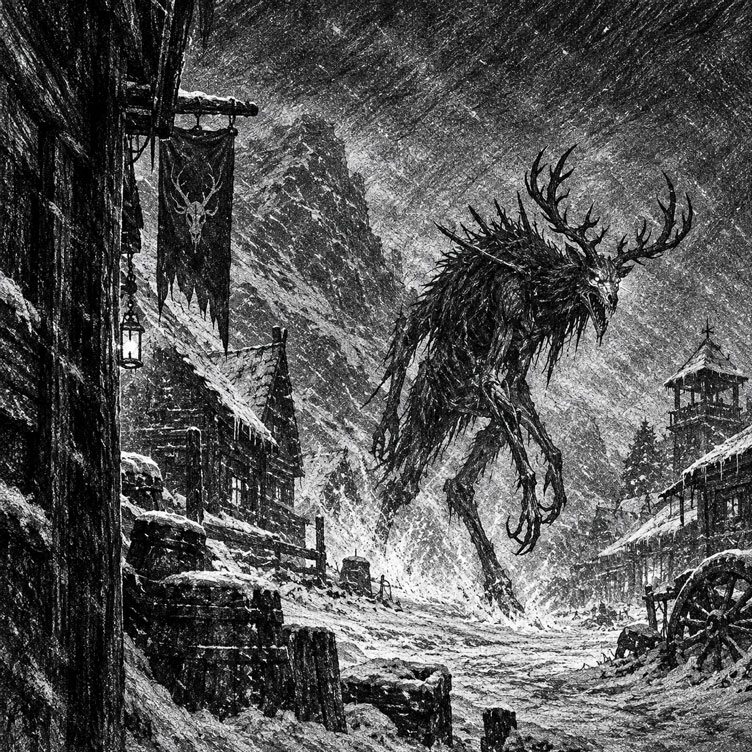
By the time they neared the outskirts of Bremen, such daylight as Icewind Dale could still manage was already thinning. Auril’s curse kept the sun below the horizon, but there was a pale brightness to the middle hours, a cold and joyless sort of light that showed the world without warming it. Somehow, after the Black Cabin, it felt worse than before. Having known true sunlight again — felt it on their backs, heard the meltwater falling from branches, watched the dogs lose themselves in play — this half‑light now seemed like a mockery. A thing mean enough to remind them of what had been taken.
One of the dogs gave a low, unhappy whine.
Bremen should have been making noise.
Even in the endless winter, there ought to have been something — a dog barking, a door slamming, the dull ring of an axe, a voice thrown across the snow. Some small proof that people still lived here.
Instead, the town lay under the dim sky like a body beneath a sheet.
Snow had drifted hard against the low buildings, swallowing fences, half‑burying fish racks and boats hauled from the lake long ago. Most of the huts were little more than crooked white mounds now, roofs bowed under ice, walls crusted thick with frost. Chimneys stood dark. No firelight showed behind shuttered windows. No one moved in the streets.
The wind slid between the buildings with a thin whisper, pushing streamers of loose powder across the packed ground. Here and there were signs that whatever had happened here had happened quickly — a dropped mitten frozen stiff, a bucket on its side, a fish knife half‑buried near a doorway hanging open one inch too wide.
And yet Bremen was not empty.
They felt it before they understood it. A pressure in the air. A wrongness. The unmistakable sense of being watched by something patient and starving.
The whole town seemed to be holding its breath.
Ahead, the Buried Treasures crouched low beneath snow and rime, more bunker than tavern now. Its windows were boarded from within. Weak amber light leaked through the cracks in thin, trembling lines. The door had been reinforced with planks and rope, the sort of work done by frightened hands in failing light. Behind the boards, they could just make out movement — shadows pressed close, listening, waiting, praying that timber and nails would prove enough.
Then something moved.
Felwar saw it first with those strange warlock eyes of his, catching what the others could not. Yet even for him it was not close, nor clearly seen — just a shape slipping between two buildings at the far edge of sight.
Too fast.
Too tall.
For the briefest instant it showed itself against the snow — all sharp angles and jerking limbs, a silhouette wrong in ways that stung the eye. Long legs folding and unfolding with insect speed. A hunched body. A hooked head.
Then it was gone.
“There’s something out there,” Felwar whispered, pointing. “Something big.”
The others squinted into the half‑light, seeing nothing. Then another dog gave a low, uneasy whine, and the hair on Thelonius’s neck rose.
“I can’t see shit,” the druid said at last.
Felwar did not take his eyes from the gap between the buildings. “They’re all holed up in Cora’s place. Let’s go.”
They urged the sled on, the dogs quickening at once, claws scrabbling over the packed snow as they raced for the tavern. The Buried Treasures loomed ahead like a besieged fort — low, squat, crusted in snow and rime, its windows boarded from within, weak amber light trembling through the cracks. Faces were visible behind the planks now. Pale, frightened faces. Eyes wide. Watching.
No one came to open the door.
Instead, a voice called from within, strained almost to breaking.
“Run! It’s not safe!”
And it wasn’t.
It came down the street in a blur of black movement and flying snow.
At first, it scarcely seemed real — too fast, too wrong, too large for the eye to accept.
Then it hit the open ground and showed itself fully.
It was easily fifteen feet tall, perhaps more when it reared to its full height, but its size was the least terrible thing about it. Long, stilted limbs struck the snow with a jarring, insectile violence, joints folding the wrong way and unfolding again with impossible speed. Each stride covered half the street. Each bound sent powder blasting up around it like surf.
Its body was gaunt and furred in ragged black, though not with any honest beast’s coat. A filthy, wind‑torn pelt clung to a frame too thin and too long, as though something had taken a starving thing from the woods and pulled it apart until nightmare spilled out. From its shoulders jutted hard, splinter‑like protrusions that made its silhouette even more jagged, more unnatural.
Its head was worst of all.
A stag’s antlers rose from it, great black tines branching up into the dimness like dead trees. Beneath them was no noble beast’s face, but a skull‑like ruin with a maw full of needled teeth and eyes that shone with a cold, devouring light. They burned white in that broken face, fixed and pitiless, and when they fell on the Brave Hearts, it felt less like being seen than being chosen.
The thing did not run as a wolf ran, nor leap as any stag might leap. It bounded with a horrible, spring‑loaded grace, each movement too sudden and too far. One heartbeat it was in the street. The next it launched itself, clearing the snow in a single monstrous arc, and vanished around the side of the tavern with a scrabble of claws and a spray of ice.
The dogs went mad at once — barking, yelping, straining against the traces. Somewhere behind the boards, someone inside the Buried Treasures began to sob.
Sahnar, beneath the tarpaulins, kept his mouth shut, blissfully unaware of the danger.
Felwar answered the thing in the only language he trusted: magic. He cast Spirit Shroud, and at once pale fey shapes began to flicker and wheel around him, tiny fairylike forms darting through the cold air in restless orbits.
Thelonius, standing close enough to feel them brush past, recoiled a fraction. “Are those things safe?” he called.
“Safer than what’s out there,” Felwar said.
Raine was already peering hard at the corner where the creature had vanished.
Then he moved.
He sprang around the side of the tavern with his weapon already in motion and hacked at the darkness, putting all his strength behind the blow. But the Wendigo was not there. His great blade smashed into the tavern wall instead, timber splintering with a crack that made someone inside scream.
At the same moment, Miquitzil spoke a word of power and rose from the ground.
The others had never seen him do that before — but there was no time to marvel at this new power. He climbed swiftly, fifty feet into the air above the street, cloak snapping in the wind as he searched for the creature from above. Yet even there he could see little. Roofs. Snow. Angles of darkness. Nothing more.
Then Thelonius stepped forward.
He had wanted this spell ever since the Black Cabin. Wanted not memory, not longing, not half‑light, but the sun — or something close enough to wound the dark. He flung out a hand and the magic burst into being from a point ahead of them.
Sunlight.
Not lantern‑light. Not moon‑glow. Sunlight.
It spread in all directions in a blazing sphere, flooding the street and the surrounding buildings with hard, impossible brilliance. Snow flashed white‑gold. Frost glittered. The walls of the tavern leapt into sharp relief. Beyond that first burst, dimmer light bled outward still, pushing the shadows back another long stretch.
And there — caught in that merciless radiance — was the creature.
It had been pressed flat against the side of the tavern, scarcely feet from Raine, folded somehow into the shadow there so perfectly that it had seemed part of the wall itself. Impossible — and yet it had done it.
White eyes burned in its gaunt face, and it turned to Raine. Its claws flexed and the click‑clack noise was the most frightening thing Raine had ever heard.
It was close enough to have opened him from shoulder to hip.
But its gaze slid past Raine and fixed upon Thelonius.
Its white eyes locked on him at once, full of starving hatred. Then it screeched.
The sound was unbearable — sharp enough to make their teeth ache and their ears ring at once, a tearing, metal‑on‑bone shriek that seemed to claw at the inside of the skull. It was the kind of sound that made the body flinch before the mind had caught up, an awful noise no living thing should have been able to make.
Pure hatred.
With a violent skitter of limbs and claws it sprang away from the wall, towering over Raine. For a heartbeat its full shape showed again in the false day — all angles, antlers, and hunger — and then it fled from the source of the sunlight, bounding back through Bremen’s streets and between its buried houses, into the gloom beyond the spell’s reach.
The wendigo fled up Bremen’s narrow street, slipping between the squat homes until it vanished beyond the reach of Thelonius’s Daylight.
Miquitzil rose after it, thirty feet above the ground. From that height he saw enough to know one thing: the creature was gone.
Then he saw the bodies.
The first pair lay near a doorway — a mother and her young son, caught either running for shelter or trying to reach it. Miquitzil dropped beside them. He turned the boy over and immediately wished he hadn’t. A soft tearing sound followed, wet and fibrous, and only then did he realise the child’s innards had frozen to the snow. The boy had been ripped open from throat to belly, the viscera dragged out and pinned to the ice in a red‑black smear.
Miquitzil recoiled, bile rising. The body was cold. Still. Final.
The woman was no better. Likely the boy’s mother. Her face had been ruined by a single blow — a hole punched clean through her skull, spraying blood and bone across the drift behind her.
He pushed back into the air, stomach churning.
From above he spotted more dead: a man, a woman, an infant. He didn’t descend. He didn’t need to. He could imagine the rest.
What sickened him most was this: none of them had been eaten.
The creature wasn’t hunting. It was killing for the sake of killing.
The others had gathered before the Buried Treasure. The tavern had been turned into a cramped fortress — tables, benches, crates, broken shutters, even lengths of timber torn from nearby homes piled against the entrance. Snow had drifted into the gaps and frozen there, sealing the whole thing into a crooked wall of wood and ice. Behind it came the muffled noise of too many people in too little space: crying children, scraping boots, frightened voices trying to stay low.
And over all of it, one voice cut through like a blade.
A woman’s.
No, she shouted. No. The barricade stayed shut. She would not have those doors opened — not for strangers, not for anyone chasing that thing through the streets. She had five children in her care now, five, and if the monster got inside because someone cracked the door, their blood would be on other hands, not hers.
Her voice carried the hard edge of panic hammered into resolve. The kind that forms when terror has nowhere left to go but outward.
Softer voices answered her — pleading, arguing, trying to calm — but the Brave Hearts couldn’t make out the words through the barricade and the wind. It scarcely mattered. They understood enough.
These people were done trusting luck.
So the Brave Hearts stood in the snow, weapons ready, breath smoking in the bitter air. If the creature returned, it would find them here — outside the tavern, outside the barricade, away from the frightened souls within. Let Bremen keep what little safety it had. Let the horror come to them instead.
Felwar went first to the dogs. They were in a state: terrified, aggressive, wild with fear. They snapped at their harnesses, twisted against the traces, whined low and then burst into sharp, desperate barking. Every muscle in them was strung tight. They wanted out. Whether to chase the wendigo in a frenzy or flee into the tundra, Felwar couldn’t tell. Perhaps they didn’t know themselves. He spoke softly, hands slow, trying to bleed calm into them, but fear had them by the spine.
Thelonius muttered the words of Speak with Animals, and the world narrowed to breath, hackles, and the sharp logic of fear.
He crouched by the lead dog. “Easy. We’ll keep you safe.”
The dog bared its teeth and bit at the strap across its chest. “Then cut me loose.”
“We’re not leaving you to it.”
“Loose is safe,” the dog shot back, eyes rolling white. “This thing bites. This thing smells wrong. Let me run.”
“That light kept it back,” Thelonius said, glancing toward the fading glow.
The dog paused, nostrils twitching. Around them the rest of the team whined and pulled, listening.
“The bad thing feared the light?” it asked.
“It did.”
A ripple passed through the pack — not calm, but something closer to sense. A shared murmur in the blunt language of beasts.
“Light safe,” one muttered. “Light safe,” another echoed.
The lead dog trembled. “I like running better than light.”
“So do I,” Thelonius said. “But for now, you stay alive.”
That, at least, the dog understood.
Once they’d settled enough to move without tearing themselves apart, Thelonius removed their harnesses. He dug Sanhar out from beneath the sled’s supplies and led both the ancient undead elf and the dogs into a nearby vacant house — a poor little place, half‑rimed within, a table on its side, frost thick on the panes. Empty, but sheltered. Better than leaving them in the street.
He set Sanhar in place and looked over the dogs. Still restless. Still breathing hard. But no longer panicked.
“Stay here,” he told them. “Don’t bark unless you see that thing come back.”
The dogs stared.
After a moment, Thelonius pointed at Sanhar’s frozen rictus. “And don’t chew on any bones.”
The lead dog drew back, eyeing the corpse. “Didn’t want those bones anyway,” it muttered.
One whined. Another said, very softly, “Light safe.”
Outside, Bremen waited in the snow.
Someone suggested evacuating the people inside the Buried Treasure, but the idea died quickly. They didn’t have enough Daylight magic to shepherd that many terrified souls through the dark for the hours it would take to reach Targos. And even then, Targos might not be the safest choice. Bryn Shander was farther still — a brutal trek across the tundra, deadly for children or the elderly.
So, they made their stand outside.
The Brave Hearts gathered beneath the house where Miquitzil perched, watching the street from above. They judged the creature wouldn’t return while the hateful light still burned, which gave them perhaps an hour to prepare.
Thelonius moved through the snow and set three magical snares where the monster would have to slow — at a corner, by the barn doors, and near the tavern entrance where it might pause to force its way inside. The magic lay hidden from the wendigo and from the others as well.
Felwar found what cover he could in a bush, crouching low and trusting shadow and snow to hide him. Raine took position around the far side of the tavern, guarding against the creature circling back.
Above, Miquitzil stayed silent and sharp‑eyed. Across from him, Owly kept watch, Thelonius seeing through the familiar’s keen vision. Between them, they hoped nothing could approach unseen.
When all was ready, Thelonius let the Daylight fade.
Owly spotted the trouble first. Boards were being pried from a tavern window from the inside. Raine stepped forward and found a man forcing his way out — wild‑eyed, frightened, half out of his wits yet determined. A woman passed him a spear through the gap, near frantic with worry. Raine hauled the man to his feet and took his measure in the same instant: thick through the shoulders, heavy in the arms, the strength of a lifetime hauling knucklehead trout from black water. A fisherman’s build — solid, but not made for war. Behind him, his wife hammered the boards back into place with desperate speed.
“My name’s Harl. Harl Pesk.” He clasped Raine’s forearm in the old warrior’s grip, hard and earnest. “Wish it were under better circumstances, Brave Heart.”
“Raine.”
“Where’s that thing?” Harl demanded. “It killed me brother and his family. I’ll be damned if I let it take mine.”
“Tell me what happened.”
Harl spoke in the quick, broken way of a man whose nerves had already come apart.
“A few days back there was a strange brightness in the sky — northeast. Like the sun had broken through. We prayed it’d last. Then it came. Quick and deadly. Killed a dozen of us before we’d even seen it proper. Stayed in the shadows and…” He shuddered. “Fucking thing. It killed so many.”
When he pointed toward the Black Cabin, Raine understood. He meant their sunlight — the false dawn made real by the Summer Star. And with that came the darker truth: this creature had been sent because of that light. Another punishment. As the coldlight walker and the mephits had come, so too had this thing been loosed on Bremen for daring to bring sunlight back to Auril’s frozen land.
Raine said none of that. He gave Harl a firm pat on the shoulder and glanced toward the window where the man’s wife hammered the last boards into place.
“You’re better off inside,” he said. “Protecting your family. Protecting the children. We’ll deal with this.”
He tried reason. Said Harl would only get himself killed. Said the people inside needed every able body if the thing broke through. Said a spear and a strong back didn’t make a man ready for what was coming.
But Harl Pesk had chosen his ground. Fear was in him, but so was grief, and something harder. His brother was dead. His brother’s family too. Raine saw it plainly — that stubborn need not to be the one cowering behind a barricade while others bled. Raine had never been good at turning a man once he’d set his jaw. He didn’t have Felwar’s gift for that.
Harl would hear none of it.
“Put them boards up, woman!” he barked.
At last, Raine relented. “Stay behind me then, if you must.”
But even that Harl refused. “Nay. I’ll be with you.”
Raine shook his head. He had tried. If the man wouldn’t listen, then what came next was on his own head. That was Raine’s way — plain, hard, stripped to the bone. It served him as both weapon and armour.
When Thelonius let the light fade, the dogs sensed it before anyone else, even shut inside the house more than a hundred feet away. It wasn’t scent or sound. It was the same blind knowing that sends ants to move their eggs before rain, the same instinct that warns lesser creatures when something deathly is near. They grew agitated at once — whining, straining, snapping at the air and at their own fear. Thelonius calmed them as best he could, but whatever the wendigo was, the animals knew it was close.
It returned almost at once.
It came out of the same dark northern street it had vanished into an hour before. It moved fast — so fast that even Felwar, with his eldritch sight, struggled to track it. It came in horrible, jolting bounds, skittering down the snow‑covered road before flinging itself at the tavern’s northeast wall.
It began tearing at the timber.
Screams rose from within — men, women, children — all of them in one ragged burst of terror. The creature meant to rip its way through the wall, and already the wood was splintering beneath its claws. There was something insect‑like in the speed of it, something obscene in the way it worried at timber and frost as though the people inside were meat sealed in a shell.
Raine told Harl to stay put, then tore toward the sound.
Harl ignored him immediately.
The fisherman rounded the corner and blundered straight into one of Thelonius’s hidden snares. In an instant he was jerked into the air, his spear tumbling into the snow. Raine nearly did the same, only stopping himself as memory caught up with panic — Thelonius had trapped this ground.
As Harl swung and cursed above him, fear and anger twisting through him, Raine considered cutting him down. Then thought better of it. The idiot might be safer dangling there than loose in the same street as the monster.
Felwar snapped off two summer seeds, but both flew wide. The wendigo traced the attack back, spotted him in the bush, and moved with dreadful speed — then melted into the shadows. Felwar answered with Spirit Shroud and stepped out to engage, but the beast had vanished. Only Owly, circling above, could track it cleanly.
Raine pressed forward anyway and swung at what he couldn’t properly see, missing in the dark. The wendigo struck back. One attack failed. The next found him. It seized him in one of its six bladed limbs and pinned him tight, pincer‑like, in the manner of some monstrous mantis. The grip was hideously strong. His whole body trembled, as though the creature’s touch carried a vile vibration through flesh and bone.
Thelonius moved in and cast Starry Wisp. The magic struck true, outlining the creature in a hateful glow. Above, Miquitzil — having recast Fly — swept from his perch and loosed an arrow, but the shot went wide.
Felwar rushed in with his blade. One strike landed, the other missed, but the magic on his weapon bit deep and slowed the creature. Raine followed with another exchange, landing a blow of his own.
Then the wendigo unleashed a pulse of frozen death.
It burst from the creature in a widening ring — necrotic force wedded to killing cold. Frost raced across wood and cloth. Warmth fled. Skin tightened. Muscles seized. It felt as though blood itself curdled in the veins, as though whatever living strength sat in the body was being touched by rot and commanded to wither. For an instant the street became a place of white rime and quiet dying.
Felwar weathered it.
Raine endured it.
But Thelonius took the worst of the blast. The necrotic cold hit him so deep it felt as though his organs shrank from it, recoiling like things trying to hide. A wave of sickness rolled up through his gut and into his throat. His vision swam. He bent double for a heartbeat as that hateful power wormed through him, numbing and spoiling everything it touched.
The creature teleported away, taking Raine with it.
Thelonius answered by becoming a dire wolf and giving chase, all tooth and speed and flying snow. Above, Miquitzil snatched out a copper coin, spoke Light into it, and dropped it like a tiny falling sun.
The effect was instant.
The creature recoiled. Hated it. That one bright coin stripped the shadows from around it and tore away the darkness it had been using as a cloak. It dragged Raine with it, scuttling away with that same obscene, insect‑quick motion, desperate to reach the half‑dark of Bremen’s streets.
Felwar came after them hard, Misty Step carrying him forward in a flash, his magic lending strength to Thelonius as he closed. Owly swept low overhead, keeping the thing marked. Miquitzil, still above the fight, drove force into it with Magic Missile. Felwar’s blade rang with thunder as he caught it with Booming Blade. Raine, trapped in the creature’s mantis‑grip, hacked at it from point‑blank range until one savage strike tore a shriek from it.
It answered with another blast of necrotic frost.
The pulse rolled out white and hateful, cold so deep it seemed to carry rot in it. This time Raine took the worst of it. He felt the life in him falter, warmth driven back, flesh shrinking from that grave‑cold touch. Still he stayed on his feet. Still he kept swinging.
Then the wendigo vanished from the street.
A heartbeat later it reappeared atop the tavern roof, Raine still locked in one of its bladed limbs.
Thelonius bounded after it in wolf form, hit the wall at speed, and knew he’d never make the leap. The wolf vanished and a great brown bear took its place — vast, furious, all muscle. Thelonius hurled that weight at the tavern, claws digging into timber and ice as he hauled himself up the wall in tearing scrapes.
Above, Miquitzil gained height and dropped the lighted coin onto the shingles. Again the wendigo flinched. Again it moved away. Always away from the light. It wanted shadow. Needed it. And the Brave Hearts would not let it have any.
Felwar ran below the roofline hunting for an angle, loosing force where he could. Miquitzil struck again with Magic Missile. Raine, still in the thing’s grip and bleeding for the privilege, battered at it whenever steel and space allowed.
Across the roof the wendigo skittered, dragging Raine, twisting away from that little copper sun as though the coin itself burned it. Thelonius lumbered after it in bear form and tried to seize the coin, lost sight of it in the churn of snow and broken shingles, then found it again by instinct and swatted it further across the roof with one enormous paw, sending it skidding in a bright arc after the monster. Then he charged after it, keeping the hateful thing pinned in radiance.
Miquitzil saw his chance. He spoke True Strike, drew, and loosed. The arrow struck true, radiant pain burning through the wendigo.
Owly swooped in for another pass.
The creature killed him out of the air.
One moment Owly was there, wings spread in the frozen dark. The next he was struck down — a burst of feathers, then nothing at all, only banishment back to the fae realm.
Still the fight went on.
Raine refused to die. He dragged breath back into himself by sheer stubbornness and kept pressing the attack. Felwar ran the street below and Misty Step again to stay with the fight. The wendigo struck at Raine, then fled again from the light, frantic now, breaking across the rooftop in search of one patch of true darkness the coin could not reach.
It found none.
Then it broke and ran for real.
Thelonius caught it first, bear‑jaws closing on it as it fled, opening another wound. Then he launched himself from the roof after it in a reckless plunge that jarred every bone in his body when he landed, but still he came on. Overhead Miquitzil flew after the thing and dropped the light upon it again, denying it shadow to the last. Felwar moved for the clearest line he could get and fired.
This time the blast hit clean.
That was the end of it.
The thing died badly. Not like an animal. Not like anything natural. Its body split and failed like a shell that had been holding something fouler inside. From the ruin rose a pale spirit in the shape of a humanoid owl, uncanny and cold, slipping free of the corpse and lifting into the air.
And there was anger in it.
Not beast‑panic. Not blind thrashing. Anger. Cold, ancient, deliberate.
Something of Auril had been inside that death. Something that did not forgive.
For a moment the spirit seemed to fight the pull of its own unmaking, as though it meant to remain and finish the bloody work it had begun. But the wind took it. The darkness took it. Its shape frayed into pale threads and was drawn out into the night.