Session 21
We Did What We Could
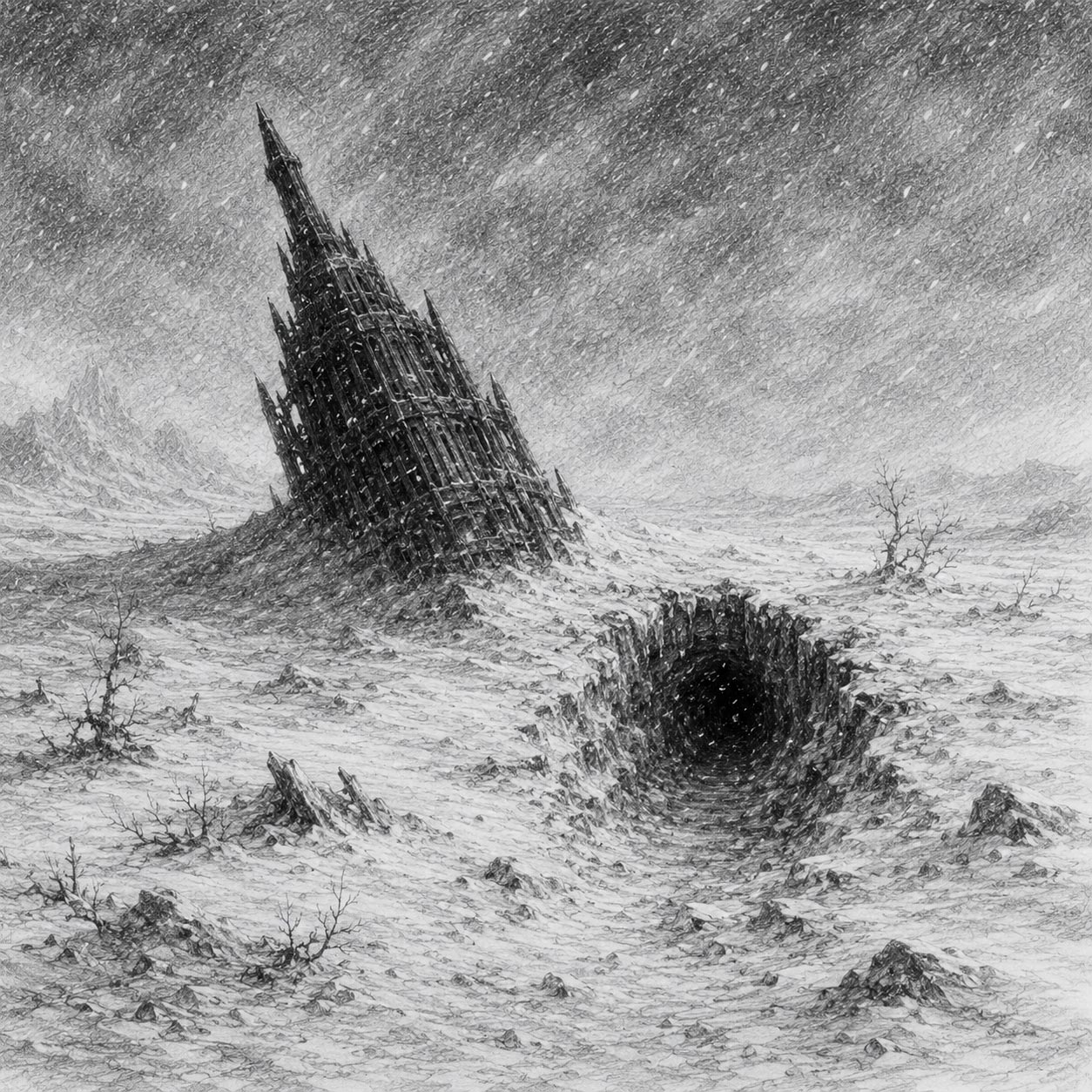
The snow came down heavier now, soft and relentless, from a dark iron‑grey sky. The Brave Hearts barely felt the cold. Their breath steamed in the wreck of the orc camp, boots planted in churned, blood‑streaked snow, ears still ringing with shouts and steel.
The orcs were dead. All of them.
Thelonius, still a hulking dire wolf, padded away from the others. Only one tent still stood, its thick hide walls flexing and snapping in the wind. The rest were wreckage: one seared and half‑collapsed where his flaming sphere had rolled through, another slashed apart by Felwar’s magic until it hung in ribbons.
They knew the orcs had taken captives — at least three or four by Raine’s reckoning. Thelonius moved with his ears low and tail tight, hoping he would find them in the last standing tent. Hoping they were unharmed. Hoping they were not the ones burned by his spell or carved apart by Felwar’s wicked cloud.
The tent was empty.
Thick bedding, strings of half‑frozen meat, and other rank trophies told him whose it had been — the orc chieftain’s tent. No prisoners. No survivors.
“No prisoners here, then,” he muttered around wolfish jaws, backing out, his great head swinging toward the ruined remnants of the other tents.
He padded to the smouldering tent he had burned.
What he found there shook him to the core.
The orc lay twisted and charred, its skin a cracked black lattice where Miquitzil’s conjured web had melted into flesh and cooled there. But it was what lay beneath and beside the carcass that drove the breath from Thelonius’ lungs.
The captives.
A young Reghed woman, perhaps twenty winters at most, and three girls. Fourteen, ten, and a tiny thing who could not have seen more than five. Torn, burned, crushed in the chaos of magic and steel. All of them dead.
Thelonius felt his jaws flood with saliva, the wolf in him answering the hot iron stink of blood on the air. He forced it down and picked his way delicately over the ruined orc to the Reghed bodies. Their faces were twisted in terror and agony, eyes wide, mouths frozen on screams that had already fled.
His stomach gurgled — a low, hungry twist that made his skin crawl.
No.
He could not bear it. Not like this. Not on four legs with his tongue tasting the gore in the air and the beast inside him taking too much interest.
With a shuddering growl he let the magic go. The dire wolf folded in on itself, fur sinking, bones cracking and sliding back as limbs shortened. Moments later Thelonius knelt in the blood‑slick snow in his own human skin, chest heaving, the wolf’s hungers muffled beneath the stark, human horror of what they had done.
He brushed the burned tent hide and other debris aside and leaned over the bodies. He had to know. He had to know whether his spell had killed them, or if they had already been dead. He closed his eyes and steeled himself for the grisly work, but the darkness did nothing to help. In his mind he saw it all again: the three‑foot‑wide ball of magical fire, dripping liquid death as it rolled into the tent and over the goblin, killing it in an instant, then setting the hide alight around the huddled Reghed captives as they pressed together, trying in vain to save themselves from the conflagration. There would have been nowhere for them to go. No escape.
“I killed you,” he whispered to the bodies. “I’m so, so sorry.” Snow fell onto his hot face as he looked up into the iron sky. Maybe you were already dead, he told himself, but the thought rang hollow.
He examined the bodies but could not tell what had killed them. He found no obvious stab wounds, but that was no proof — was it? He sat back on his heels as Raine’s boots crunched through the snow behind him.
“You found the prisoners, then,” Raine said.
Thelonius nodded once.
Raine jerked a thumb over his shoulder. “No prisoners in the other tent. So it was just what they’d already butchered or eaten, and these four. Bad fucking day to be a Reghed barbarian, eh?” Then, sensing the churn of guilt under Thelonius’ skin, he pressed. “What killed them? The orcs?”
“I… I don’t know. For sure.”
“Let me have a look, lad. I’ve seen a lot of death in my time.”
Thelonius shuffled back and Raine stepped in, crouching low. He used a gloved hand to lift an arm here, turn a body there, pushing at burned leather and ruined flesh. Truth was, the corpses were too charred for him to say what had killed them, or when.
“That’s settled, then,” Raine said at last. “Clearly they were already dead. The orcs strangled them.”
“So they… they didn’t burn?” Thelonius asked, voice small.
Raine nodded and lied without flinching. “Yeah, they burned, but they were dead already. It’s gruesome business, anything to do with orcs and goblins. Always ends the same. Your conscience is clear.”
Relief flickered across Thelonius’ face, thin and fragile. He opened his mouth to speak, but Raine was already pushing to his feet, turning away.
“Check for loot,” Raine called over his shoulder. “There may yet be some good to come from today.”
They picked through the ruin of the camp in grim silence, boots crunching over frozen blood and splintered bone. The war chief had the best of it: a thick iron torque at his throat, blackened and etched with three arrows that Raine reckoned any Reghed hunter would recognise as proof of Many‑Arrows filth. There was a crude scrap of map on hide, a smear of tarry melt‑resin, a tiny obsidian idol carved into a one‑eyed skull, and the usual orc trophies — hair, teeth, things better left uncounted.
The real prize lay on the chief’s belt.
The dagger was heavy warg‑bone and dark metal, its edge ground to a razor, the blade carved with a staring eye and channels black with old blood. The handle was wrapped in lynx‑pelt leather, stiff with sweat and grease. It looked less like a weapon and more like something you would use at an altar — a wicked, ceremonial blade made to honour Gruumsh with close‑up work and screaming.
Whoever picked it up could feel it straight away: this was not a good knife, but it was a very effective one.
“It’s magic, aye,” Miquitzil said at last.
The others left the blade where it lay, giving it the sort of berth you give a coiled snake. Miquitzil did not. He watched it for a heartbeat, then gave a small shrug and hooked the scabbard onto his own belt.
Magic is magic, he told himself, fingers resting on the worn lynx‑leather grip. In the quiet of his mind he made a small, private promise to the cruel little thing.
You’ve done enough for Gruumsh. From here on, you work for us.
There were no identifying trinkets to say who the Reghed dead had been, not even enough left of their clothes to mark which tribe they’d called home. Their faces were too badly burned to hold any features, only age and size and the rough fact of them: one young woman, three girls, taken from a small camp a few hours’ walk to the west.
Who could they tell? No one. The men would return from their hunt and find the ruin for themselves. Maybe they would pick up the trail, follow the orcs’ tracks here and find the bodies. Maybe.
The Brave Hearts chose to bury the Regheds where they lay, heaping frozen earth and snow over them and marking the grave with a makeshift flag torn from one of the ruined tents.
The orcs, Thelonius insisted, they would leave where they fell.
“Predators need to eat too,” he said, nodding at the empty sky where carrion birds would one day circle. “Wolves, crows, all those meat‑eater types. It’s hard for them too. Polar bears,” he added, a brief, crooked grin breaking through. He was getting better at nature now — when time and weather permitted he pored over his druid book, tracing the sketches and notes, learning the names of things he had once ignored.
“We stay here for a rest,” Felwar said, limping badly, more torn up than the others. “We might not get another chance. And if the menfolk find us here, we can explain. We avenged their women. Hopefully they see that and not blame us for what happened.” The others shrugged. None of them had much to do with the Reghed tribes. Only Miquitzil had heard their voices up close — his own elders sometimes trading oils for furs and meat with the Tribe of the Elk, who were said to be less savage than the Bear, Tiger, and Wolf.
They made their camp in the chieftain’s tent, the driest place they could find and the only one that would safely hold a small fire. Rest came, but not peace. Dreams of violence and burning hide stalked their sleep. The hours took the edge off their wounds, but not everyone woke feeling lighter.
The Reghed hunters never came.
In what passed for morning, under a dark, colourless sky, the Brave Hearts fed their sled dogs, packed their gear, and headed back out into the endless white. Raine and Thelonius took Garret’s rough map and tried to match it to the land, but the snow and half‑light turned every rise and shadow into the same blank smear. They trudged on for three hard hours before Raine called a halt.
“We have to go back,” he said, squinting into the wind. “Sorry, lads. We’ve gone too far.”
Miquitzil only shrugged and drew in a long pull of his peculiar smoke, the frost in his whiskers catching the ember’s glow. Felwar was less calm. Limping and irritable, he insisted on taking a hand in the navigation.
“Move over,” he said. “If I am going to freeze my arse off, I am at least going to freeze it in the right direction.”
Whether by luck or good judgement, several hours of course corrections and trudging later they crested a low rise and saw it at last — a shard of impossible geometry stabbing up from the tundra, a dark, slanted spike of shiny dark‑grey stone breaking the endless white. A smattering of frost clung to it, glittering like powdered glass, when it should have been buried in white given the severity of the wind and sleet on the tundra.
Felwar joked with Raine and Thelonius, hinting they had only found it thanks to his vast navigation skills. But then they quietened, noticing a change in the air.
The dogs went quiet. No sound but the creak of the sled harnesses and the cold whisper of the wind curling around broken stone. And then they saw Miquitzil.
He was bolt upright, narrow eyes wide — wider than any of them had ever seen — staring at the spire.
Miquitzil felt it the moment he saw the thing.
A soft, impossible warmth stirred beneath his ribs. The shard — the alien crystal buried in his flesh, dead and cold since the day it saved his life — gave a single, delicate pulse. More sensation than heat. The hairs on his arms lifted. His tongue tasted of metal and ozone, the way it did after casting a spell… except he hadn’t cast anything.
The warmth vanished as quickly as it came, but the echo of it lingered. And then a whisper brushed the inside of his mind — meaningless words in a language he did not know, but real. Real enough to terrify him.
Felwar found his voice first.
“What is it, Miq? What have you seen?”
Miquitzil tore his gaze from the spire and looked at the warlock. For a heartbeat he said nothing. Then he tugged his jacket aside and jabbed a thumb at the shard buried in the meat of his ribs.
“This,” he said. “This thing tingled. Felt warm. It has… it has never done that before. It has never done anything before.”
Felwar’s easy smile slipped. “What do you make of it? Can you feel it doing anything now?”
Raine and Thelonius traded a look over the sled. Neither liked the sound of this.
“No,” Miquitzil said. “It… talked to me. In my mind.” He glanced back at the leaning spear of stone. “Or maybe that spire talked to me.”
Thelonius stepped closer, snow creaking under his boots. “What did it say?”
“Nothing I understood.” Miquitzil frowned, searching for the shape of the memory. “It was a feeling more than words. Like thoughts, not sentences. Hard to explain.”
“Could it be your friends are nearby?” Thelonius asked. “Your tribe?”
Miquitzil shook his head immediately. “No. This is me. Not of my tribe.” His eyes drifted back to the spire, thin face tight with something like hope and dread tangled together. “Maybe this place has answers to secrets I gave up on knowing years ago.”
Raine snorted, breath smoking in the thin air. “Good. Then let’s get down there and out of this bastard wind. If that thing wants a word with you, I’d rather it did it with walls around us.”
They settled the dogs in the lee of the tower, out of the biting wind that blew hard off the glacier. They fed them again — more than was sensible, maybe, but none of them knew how long they’d be gone.
Thelonius ruffled the head of the lead dog. “Back soon. Look after them,” he murmured.
The dog stared up at him, solemn and steady. Its head dipped, just a fraction.
Thelonius frowned, unsure if he’d imagined it.
Miquitzil announced, with the flat certainty of a man who knew, that the spire itself was not magical.
Raine had used the time to stomp a slow circle around the leaning shard of stone, squinting against the wind. “No sign of a door, neither,” he called. “But there’s a tunnel around to the right. Here, let me show you.”
He led them along the curve of the spire to where the snow fell away into a narrow cut in the ice. A tunnel mouth yawned there, half‑choked with drift, its walls sheathed in slick, glassy frost. The passage plunged down at a precarious angle — steep enough that a misstep would send you sliding into the dark with no way to stop.
Thelonius peered in, lips thinning. “I’m not going down there blind.” He reached into his thick jacket and, a moment later, his owl emerged and settled on his forearm. It did not look pleased. The bird ruffled its feathers and fixed him with a flat, accusing stare. Not for the first time Thelonius wondered why his magic had given him a barn owl instead of a snow owl, but he pushed the thought aside.
“Go on, then,” he murmured, sending it off.
The bird slipped into the tunnel, wings barely moving as it rode the cramped air downward. Through Thelonius’ distant stare he saw what it saw: ice walls closing tight, the passage snaking ever downward, curling and bending but never rising, burrowing deeper beneath the tundra. After a time the cramped ice gave way to worked stone, dark and ancient. The tunnel ended at a heavy doorway set into the leaning side of the buried spire.
The owl wheeled back and fluttered up out of the hole, settling once more on Thelonius’ arm before worming its way back under his jacket, not even waiting to be dismissed.
“It winds down a fair way,” Thelonius said, blinking himself back into his own body. He jerked a thumb at the spire. “If I’m not mistaken, the door is about eighty feet underground. And it’s the way inside this thing.”
They checked their gear and pooled their rope. Between them they had several hundred feet of thick line and a handful of sturdy pitons. They hammered one into the ice, then another for safety, and fed the rope down into the tunnel. With their crampons biting into the slick walls and the rope for balance, the descent was easy enough — if awkward and slow.
The tunnel spat them out into an upside‑down chamber, boots crunching onto what had once been the ceiling. Frost coated everything in a thin, glittering crust. Across from the tunnel a wooden door sat flush with the far surface — the old floor — hanging above them like a trap ready to drop. It stood slightly ajar. On either side of it, two stone statues jutted down like stalactites. Opposite them, a pair of sconces held flames that burned the wrong way up toward the ceiling.
Raine and Thelonius moved to the statues first. They were humanoid — robed, severe, carved in what Miquitzil said was the old Netherese style. The words came easily to him, and he wasn’t entirely sure how he knew they were true — only that, somewhere deep down, he did. Unremarkable at a glance.
“Never trusted statues,” Raine muttered.
Thelonius squinted up at their faces. “Their heads are wrong,” he said. “Too long. Like someone took a normal skull and pulled it.” It was the only strange thing he could find, but it settled in his gut like a stone.
Miquitzil, meanwhile, padded over to the sconces. The firelight painted his scarred cheeks in orange and gold, but he felt no heat from it. He held a hand close, then closer still, waiting for the bite of flame that never came.
“Cold,” he said. “No heat at all.”
For a moment his jaw tightened — the old fear of fire clinging to him like another layer of skin — and then he let out a breath.
“Continual flame,” he decided. “Trick light. Harmless.”
He relaxed, just a fraction, beneath the dancing, heatless glow.
They moved through the complex slowly, carefully, methodically. No immediate danger, no lurking shapes, no scrape of claws in the dark. Just the wrongness of it all — walking on ceilings, stepping over the lips of upturned doorways, the steady burn of cold fire in sconces that gave off no heat.
Beyond the entrance chamber an upside‑down corridor stretched away, its far stairs choked with ice and rubble.
“Not going that way,” Raine grunted. “So we take the tunnels.”
They found their way into what must once have been a library. Tall shelves, now sideways, had vomited their contents across the ceiling‑turned‑floor. Old leather, split spines, pages frozen together in yellowed clumps. A big table lay on its side, one leg snapped off.
Miquitzil nudged a fallen book with his boot, squinting at the title. “Netherese,” he said, that same odd certainty in his voice. “Magic, cities, things that flew.” He plucked a couple of volumes out of the mess and slid them into his pack for later. Most of it was ruined. Some of it, maybe, could still be read.
At the far side of the room a rough tunnel had been punched through what had once been the floor, leading down. Before they took it, they swept the nearby rooms.
The next chamber looked like a workshop, or what was left of one. Shattered tools and twisted metal lay in a tangle, two heavy worktables — one upside down, one on its side — bearing the brunt of the impact when the spire fell. They turned the place over, sifting through the wreckage for anything that had survived. They found nothing of note, though Miquitzil insisted on careful evaluation of anything written, be it etched into the walls or inked on paper that disintegrated to the touch. Only a scattering of books held their form, though he knew he would need to be careful even with those.
“Well over a thousand years old,” he mumbled to himself, but nobody else heard. “Written in ancient Loross.” Again, he wasn’t sure how he knew that — only that the shard or the tower whispered it to him.
The room beyond was a wrecked potion store, the ceiling‑turned‑floor glittering with glass shards and frozen puddles of long‑spilled fluids. In a far corner, bolted to what had once been the floor and now hung above their heads, a metal chest waited upside down, its lid shut fast.
“I have an idea,” Thelonius said excitedly. “I cast jump and you go up there, grab on and pick the lock. I have the spell!”
Felwar was unconvinced, trying to imagine how he would manage such a thing — upside down, legs straddling the chest like a horse, picking the lock while not slipping and breaking his neck. “Maybe we try to build a ladder out of this rubbish.”
“Tables,” Raine said at last. “We have tables.”
It took the better part of half an hour to drag the broken furniture in, prop it, brace it, and lash it together with spare rope into something that might, if you were generous, be called a ladder. It creaked ominously under Felwar’s weight as he climbed, battered wood slipping and groaning with every step.
He reached the chest, braced himself awkwardly, neck craned as he peered up at it upside down, and rattled the lid. Locked. Of course.
“Don’t suppose anyone found a key,” he grunted.
Nobody had.
He tried to pick the lock once, twice, three times — then his favourite lockpick snagged and snapped.
“Damnit!” He climbed down, scowling. “We can come back. Maybe.”
Raine looked longingly at the chest above, taunting him from the ceiling. He had a thing for treasure.
They abandoned the makeshift ladder where it was and returned to the tunnel mouth in the library. That was where the real way down lay.
They tied off what was left of their rope, hammered in more pitons for good measure, and began the descent. The rough‑hewn shaft dropped them into another upside‑down laboratory, this one scattered with broken glass and twisted metal cages. One held the dried, cracked carapace of some insect‑like person, legs curled tight, mandibles frozen mid‑scream.
“Don’t like that,” Raine said.
“Dead a long time,” Thelonius replied. “Longer than any of us need to worry about.”
More tunnels, more rope. Down again, into deeper rooms where upside‑down cupboards clung to the walls and arcane symbols crawled across what was now the ceiling. They were getting used to the place now. Upside down or not, a wizard’s tower was still a wizard’s tower — full of things that might be useful and more things that might kill you.
They passed an exposed shrine half‑seen through a broken wall, a stone altar clinging to the ceiling with an eight‑pointed star carved into its face.
“Mystryl,” Miquitzil said with customary certainty — though his face betrayed that he didn’t know how he knew. “She is… was… the first incarnation of Mystra, goddess of magic.”
They did not linger. They followed the signs of more recent disturbance instead — dragged furniture, cleared floor space, boot prints in thin frost.
At last, they stepped through into an upside‑down room that had been tamed.
A table stood in the middle of the ceiling‑turned‑floor, surrounded by neat stacks of books. On the table lay a whirring amulet on a chain, ticking faintly in the silence.
On the near side of the table sat a young man in cold‑weather clothes and a frayed witch’s hat, a heavy leather‑bound book open in front of him. His features were lit by a warm, studious smile as he looked up from the page.
Standing just behind his chair was a dead‑eyed warrior in studded leather, flesh drawn tight over its bones, face locked in a permanent scowl. One grey hand rested lightly on the pommel of its sword.
“Welcome to what I believe is a buried spire of Netheril,” the young man said, still seated. “My name is Dzaan.”
He made a small flourish toward the figure at his shoulder. “And this is Krintaas. My bodyguard.”
Up close, Krintaas was worse — skin like old wax, lips pulled tight from his teeth, eyes as warm as chipped stone. His hand never left the sword hilt, not quite drawing, not quite relaxed.
Felwar’s smile died.
“I know you,” he said, peering closer at the wizard’s face.
Dzaan’s brows rose, polite curiosity. “Do you?”
Felwar limped a step closer, studying the face beneath the frayed hat. “We saw you in Easthaven. They tied you to a stake and burned you alive. I watched you die.”
For the first time, something shifted in Dzaan’s expression. The warmth didn’t vanish, but it thinned — like breath on cold glass. Still seated, he turned his head slightly to glance at Krintaas. The wight did not so much as twitch.
“I see,” Dzaan said quietly. “Then my creator is dead.”
“Creator?” Raine echoed.
Dzaan’s gaze returned to them, steady, almost gentle. “I am not the man you saw burned. I am his work. A copy. A construct of snow and shadow and memory.” He spread his hands over the open book. “I am a simulacrum.”
The word hung in the air.
Felwar’s fingers twitched near his blade. “So, you are him. But you are not him.”
“I am all he was,” Dzaan said, “up to the moment he crafted me. His knowledge. His habits. His sense of humour, such as it is.” A faint, self‑mocking smile. “But no new memories since that day, until I began making my own.” He tapped his temple. “I am real enough. But not truly alive.”
He let that sit, then inclined his head. “You know my name. May I have yours?”
There was a pause. Then Raine rolled one shoulder.
“Raine Durstin. Caravan guard. Currently regretting most of his life choices.”
Felwar gave a small bow. “Felwar Crisp. Warlock. Occasionally useful nuisance.”
“Thelonius Jones,” Thel said. “Druid. Still working out what that means.”
Miquitzil’s eyes flicked from Dzaan to Krintaas, then back. “Miquitzil. Hunter. Still deciding if this was a good idea.”
“A pleasure,” Dzaan said — and somehow sounded like he meant it. He closed the book with a soft thump, one gloved finger still marking the page.
Felwar leaned in close to Miquitzil, both raising hands to half‑hide their mouths like gossiping old women.
“We have questions,” Felwar muttered.
Dzaan sat up a little straighter; to the Brave Hearts, it looked as though he sensed the next moment was critical to his immediate future.
Felwar straightened, resting his hands on the back of a nearby chair. “Apologies if we appear rude,” he said. “We did not expect to find anyone down here. Certainly not someone we watched die.”
“I explained that,” Dzaan said mildly.
Miquitzil nodded. “We would like to know how a wizard capable of creating a simulacrum like you was caught by Easthaven militia in the first place.”
Felwar gestured. “Your creator — and therefore you — must be very powerful indeed.”
Dzaan’s mouth quirked. “How was Dzaan — my creator, a mighty wizard — captured?” He tapped the book with one gloved finger. “I will give you three guesses, and then I will tell you the truth. It is simpler than you think.”
Thelonius scratched his beard. “He wanted to be captured… I guess.”
Dzaan shook his head. “No. Not his style. He liked control too much to hand the noose to someone else.”
Felwar clicked his fingers. “To fake his own death.”
“No,” Dzaan said. “If what you say is true, then he is very much dead. Which also explains why he has not returned here, as he promised he would.”
Miquitzil squinted. “The other mages helped Easthaven take him. Got him out of their way.”
“Perhaps,” Dzaan allowed. “But no.”
He rested his fingertips on the closed book, eyes going distant.
“My creator is not so powerful as to be immune to steel, arrows, and a good quality net,” he said. “Perhaps they took him in his sleep. Perhaps they surprised him, as can happen when you are overconfident. After all, he left Krintaas with me — which is a mistake I would never make if our roles were reversed. No, he was not so powerful. And therefore, neither am I.”
His eyes focused again. “He found and used a scroll that contained the spell simulacrum to create me. That is the extent of it. Whatever foolishness led him to a stake in Easthaven happened after that — and without me.”
Felwar frowned. “All right. So why did he come here in the first place?”
“To dig,” Dzaan replied. “He came with two other wizards at first, then a third joined them later. They had heard the same rumours you have, I imagine. Ancient magical sites buried under the ice. Fallen cities. Netherese ruins.” His gloved hand turned, palm up, indicating the room. “This is one such fragment. My creator and the others preferred to work alone, however, so as soon as we — they — arrived, they splintered. Each went their own way.”
Thelonius’ gaze slid to Krintaas.
Raine frowned. “Netherese. What is that, exactly?”
Dzaan tilted his head. “An old word for an older people. Netheril was an empire of wizards far to the south, thousands of years ago. They pulled cities into the sky, shaped magic into anything they wished. Mythallars, flying enclaves, that sort of thing. It went about as well as you would expect.”
Raine grunted. “Meaning badly.”
“Catastrophically,” Dzaan agreed. “Most of what they built is gone now, buried under ice or earth. Fragments remain. This tower is one such fragment. Some are a treasure trove of unique magic. It draws my kind as a bear to a hive.”
Thelonius nudged a bone scroll case with his boot. “And the writing? That strange language everywhere.”
“Loross,” Dzaan replied. “A high tongue of Netheril. Not what farmers spoke — a formal script for mages, scholars, the ruling class. These ruins were theirs, so most of what you see is in Loross. My creator read it. I do as well. I would wager the other three wizards who came north can too. You do not go grubbing in Netherese bones if you cannot read the labels.”
“So. That thing of yours,” Raine said, nodding at the wight.
“Krintaas,” Dzaan corrected mildly.
“Yeah. Him. Is he your protector?”
Dzaan considered. “Hmm. I suppose so. Now that my creator is gone.”
“Can he dance?” Thelonius asked.
Dzaan’s eyebrows climbed. “Can you?”
“Of course,” Thelonius said, offended the question even needed asking. “Does he listen to you?”
“Yes,” Dzaan said. “He does.”
“Will he hurt us?”
“Not unless you hurt me,” Dzaan replied. “We have been over this, I feel.”
Raine snorted softly. “You keep an undead pet. Where I come from, that paints you as someone not to be trusted. They are evil things.”
Dzaan turned his head slightly, looking up at the wight by his chair. Krintaas stared at the Brave Hearts, its face implacable and repulsive.
“It is true that Krintaas lacks the empathy and love that we do,” Dzaan said. “His condition makes such things… difficult. He is not alive, nor truly dead, but somewhere between.” He looked back at them. “But he is under my control. If you do not attack him — or me, whom he is sworn to protect — you are quite safe indeed.”
The Brave Hearts exchanged glances. Felwar’s eyes were hard. Raine’s mouth was a flat line. Thelonius frowned, trying to feel the shape of the magic in the room and not liking it. There was no nature here at all — only cold stone and old spells — and it set his teeth on edge.
Miquitzil’s gaze had drifted to the ticking thing on the table. “What is that?” he asked, nodding at the amulet. “The medallion. May I see it?”
Dzaan’s gloved fingers brushed the edge of the whirring disk. He hesitated, then slid it across the table without standing. “You may. It has been my second most rewarding find so far.”
Miquitzil picked it up. A four‑inch disk, silver‑framed wood, a strange rune carved into its face. It hummed faintly in his hand, like a caged heartbeat.
He stepped away from the table and murmured the words to his magic. First the thin veil of detect magic, then the deeper, more exacting pull of identify.
The spell bit… and slid.
The amulet blazed in his mind’s eye with power, but not in any school his training recognised. It was like trying to read script through ice — shapes and force, but everything blurred, doubled, sliding out of focus whenever he tried to fix it. A snowstorm of interference lay over the thing, dulling edges, scrambling detail. He caught impressions — great age, deep enchantment, a sense of something vast and patient far below — but every time he pushed for more, the magic skated away from him.
Miquitzil let the spell fade with a sharp hiss of breath.
“That should have worked,” he muttered. “I know these spells. I have never had them fail like that.”
Dzaan watched him with open interest, the corner of his mouth twitching.
“Do not be disappointed,” he said. “Netherese magic is unlike anything you can find in the world today. It was built on different assumptions, different patterns. You are listening on the wrong frequency, as it were. You will need a key before you can interpret what you see correctly.” He tapped a few of the nearby tomes. “With some reading in these, it will begin to make sense.”
Miquitzil nodded, frustration bleeding into curiosity. “Makes sense,” he said. To the others: “I would very much like the chance to do some reading.”
Felwar, Thelonius, and Raine exchanged glances, then each gave a small nod. No one argued with more knowledge.
Dzaan frowned slightly. “There is the small issue that the writing is in Loross.”
Miquitzil waved the concern away. “I will manage.” Somehow he knew he could. The curling script that should have meant nothing to him — him, who was no great reader even in Common — had resolved itself into sense the moment they entered this place. The letters sat in his mind with a strange, uneasy familiarity, a latent gift from the shard in his ribs or from the tower itself. He was not about to waste time pulling at that thread. Better to use it.
“Very well,” Dzaan said. “Then let me tell you what you will eventually glean, once your education is complete.”
He nodded at the amulet in Miquitzil’s hand. “It is an amulet that connects to a guardian. A shield guardian, I suspect. Likely the master of this tower’s construct. With its master long gone, the guardian woke and dug its own paths out — some of the very tunnels you used to reach this level.” He shrugged. “Wizards make such things to stand at their side. This amulet is the master’s key. If you wear it, you command the guardian. It can take blows for you, even at a distance, and you can store a spell in it — make the construct cast that spell when you need it.”
Miquitzil turned the amulet over in his hand, thumb brushing the rune.
“There are variations, of course,” Dzaan continued. “Different designs, different instructions. Its exact capabilities will only be known once you can examine the guardian itself.”
“Break this and the guardian falls,” he added. “Keep it, and it protects you.”
It was obvious Miquitzil wanted it. All the Brave Hearts could see that.
Dzaan watched him for a moment, then gave a small nod, as if coming to a decision. He remained seated, fingers resting on the closed book before him.
“Then perhaps we can help each other,” he said. “My life for the amulet.”
Raine’s brows knit. “That is a strange trade, even for a wizard made of snow.”
Dzaan smiled thinly. “I told you — I am real, but I am not truly alive. Below this level is the most exciting discovery: a chamber that can turn illusion into reality. I believe this device can give me life. This tower was built to study such things. All that is needed is a spark of life to make the transformation work. A living soul to complete the circuit.” He touched his chest. “Neither Krintaas nor I have such a spark. But you four do.”
Thelonius stepped forward before he realised he was moving. Krintaas twitched, fingers tightening on the sword hilt — a dead man’s flinch.
“What do you mean, we have a spark?” Thelonius asked.
“You are alive,” Dzaan said simply. “That is how I interpret the text. The magic only functions when initiated by a living creature. It needs that contact with true life to fix the transformation in place.”
Felwar narrowed his eyes. “And what, exactly, happens to the ‘spark’ that goes in? What will happen to us?”
“Nothing harmful,” Dzaan said quickly. “Oh, no, no, no. The life is merely… borrowed. A touch of it, for a moment, to anchor the magic. You will not be hurt.” He spread his hands. “I swear it. I have no reason to deceive you. If I wished you dead, I would simply let this place do it for me.”
Raine snorted. “You will forgive us if we do not take that on faith.”
Thelonius nodded slowly. “You say it does not consume the spark. You say it only borrows. Fine. But every story I have ever heard about wizard towers says there is always a catch.”
Miquitzil placed the amulet back on the table. “You ask much,” he said. “You want us to risk our lives to touch this thing. Even if only for a moment.”
Dzaan did not look offended. If anything, he looked relieved that they were questioning him.
“Then do not trust me,” he said. “Trust the ones who built it.”
He lifted the book he had been reading — the same heavy volume he still marked with one gloved finger — and slid it across the table to Miquitzil. The cracked leather cover read, in faint, curling Loross script: From Shadow, Substance.
“This chapter describes the rune chamber below,” Dzaan said. “Its design, its purpose, the ritual to turn an illusory thing into a true one. Take it. Read. Check my story. If you still think I mean you harm afterwards, you may walk away with the amulet and I will be no worse off than I am now.”
The Brave Hearts looked at one another again. They were sore, cold, and tired; the night in the orc chieftain’s tent had been anything but restful. A room with solid walls and a door did not sound bad at all.
“A rest would not hurt,” Thelonius admitted.
Raine grunted. “We lock the door. We set watches. If he tries anything, we deal with it.”
Dzaan inclined his head. “You are welcome to stay here as long as you need. Krintaas and I will not disturb you.”
They unrolled bedrolls on the ceiling‑turned‑floor between the stacks of books. Krintaas remained standing at the far wall, as motionless as any statue. Dzaan stayed in his chair, drawing another book from one of the piles and opening it, giving them as much space as the small, upside‑down room allowed.
Miquitzil stayed up. Under the cold light of the continual flames he read From Shadow, Substance — diagrams of the chamber, dense notes on illusion and the Weave, dry commentary from long‑dead mages. The description of the ritual matched what Dzaan had told them. The spell drew a sliver of vitality from a living subject to anchor the change, but did not consume it. The risks were in miscasting, flawed runes, sloppy preparation — not in some hidden cost of the life spark itself.
By the time he closed the book, his eyes ached and his fingers were numb. But he was as sure as he was likely to be.
In what passed for morning, they gathered again around the table. Dzaan was still there in his chair, book now closed, hands folded on its cover. Krintaas had not moved.
“Well?” Raine asked.
Miquitzil nodded. “The book says what he says. The room is real. The ritual is as he described. Risk, yes — but not the kind that eats your soul.”
Felwar blew out a slow breath. “All right. We will help you. We go to your chamber, we lend you this spark, you become flesh, and we keep the amulet.”
“Agreed,” Dzaan said at once. A little of the tightness left his shoulders. “Then a word of warning, as payment in advance.”
He leaned forward, eyes intent. “On the level below, there is a basilisk. A beast that can turn prey to stone and then feed on the petrified flesh. Avoid its gaze — that is where its power lies. Do not meet its eyes directly.”
Raine let out a short, humourless laugh. “There’s always something.”
Felwar grunted. “Any other good news?”
“There is a mirror on a wall in an adjoining room below,” Dzaan went on. “Perhaps you could use that. I understand the reflection of its gaze will not petrify you. Turn its own gift against it, if you are clever.”
Thelonius was already dragging his battered druid’s book out of his pack, thumbing through the dog‑eared pages. “Basilisk, basilisk…” he muttered. “Here it is — and similar curious monstrosities.” His face fell. “Not much written here, to be honest. But it does say they are immune to their own gaze.”
Felwar swore and Dzaan looked disappointed.
“Makes sense,” Thelonius added sagely, suddenly pleased to be the centre of attention. “It would be a bit difficult to breed if you could not look at your mate without risking turning her to stone or whatever.”
“Then you will have to write what you learn about the creature in your book yourself, Thelonius,” Dzaan said.
Disclaimer
This is a work of fan fiction. All relevant characters, locations, and settings remain the property of Wizards of The Coast (WOTC) and the story contained here is not intended for commercial purposes.
I do not own Dungeons and Dragons (D&D) or any of the related characters. D&D is owned by WOTC (and its parent companies) and all rights of D&D belong to them. This story is meant for entertainment purposes only.