Session 2
Murder, Then
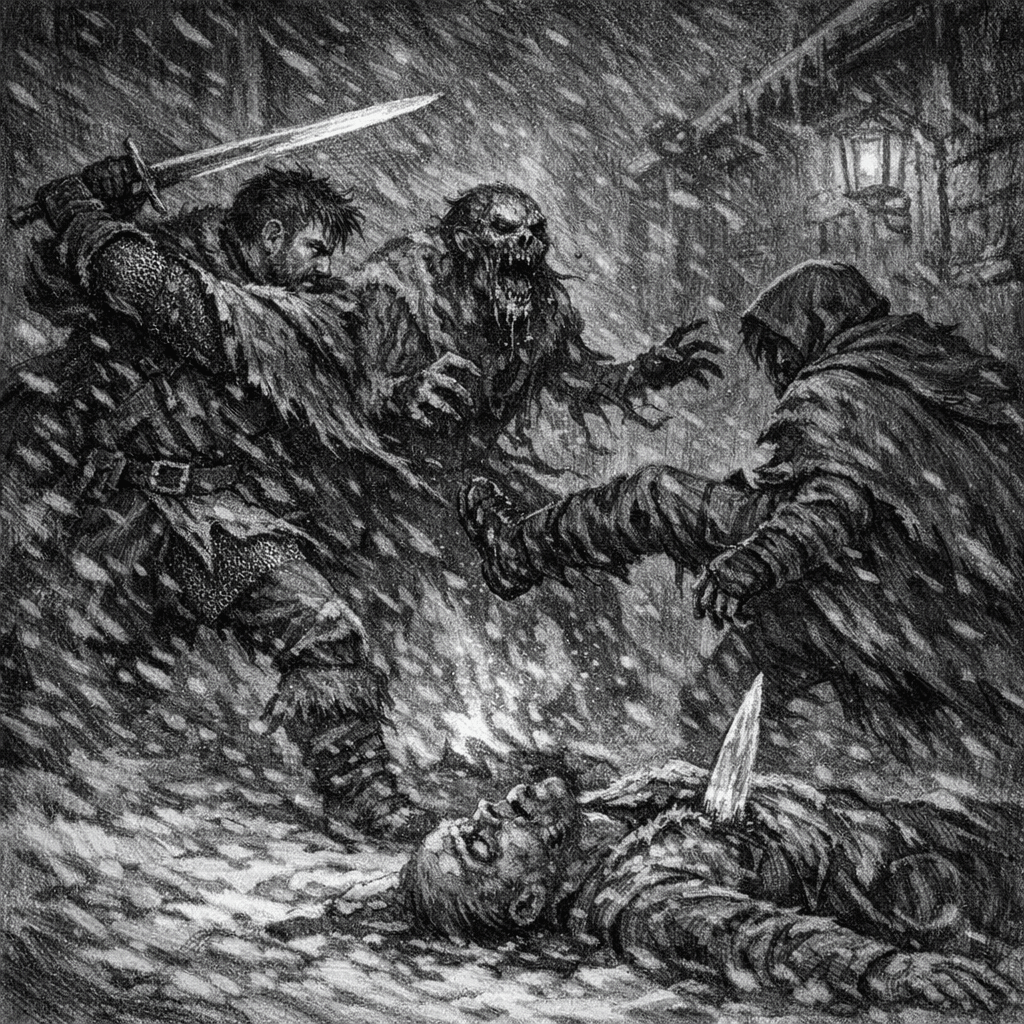
The snow came down heavier now, soft and relentless beneath a dark iron‑grey sky. Ahead, the lights of Bremen flickered as a faint, scattered glow across the frozen black sweep of Maer Dualdon, dark as the heavens above it. As they watched, shapes moved near the distant crossing, heading east toward Targos.
Felwar stopped, eyes narrowing. Shapes resolved for him long before the others saw anything at all, a caravan of dog sleds dragging itself up from the lake’s edge, runners catching on buried ice, beasts labouring through deep snow, bundles piled high and figures hunched tight against the cold.
They urged their axebeaks forward, the birds picking their way across the crust with sharp, deliberate steps. Lanterns swung from sled poles ahead, canvas flapped in the wind, bundled traders trudged beside straining dogs.
Raine leaned forward in his saddle, squinting through the snow. Then he saw it, the faded sigil stamped across the lead sled’s tarp.
“Torg’s,” he muttered. “Torrga Icevein’s travelling caravan.”
He clicked his tongue, half in annoyance. “Prices high enough to make your teeth ache. But with so few caravans still running, folk take what they can get.”
Among the traders, Thelonius caught sight of an odd figure—long ponytail, tight leather vest, shirt open to the chest despite the killing cold. A man dressed for a summer fair, not a night on the Maer. The sight snagged in his mind like a hook and stayed there long after the caravan vanished into the dark.
They pushed on, crossed the frozen skin of the Shaengarne River, and rode toward Bremen’s outskirts.
A break in the wind revealed a lone figure ahead. An elderly dwarf stumbling through the drifts in nothing but a nightshirt, beard crusted with frost, skin the colour of old parchment. He lurched toward them, muttering half‑formed names and scraps of memory that blew apart as quickly as they came.
Thelonious scowled. “He’s nuts. Leave him to the cold.”
Raine glanced at Thelonious but he was already walking off. “Where are you going?” he called.
“To find a drink,” he said and disappeared into the darkness.
Felwar slid from his axebeak and murmured a steadying spell, catching the dwarf before he collapsed. Raine dropped down beside him, taking the man under one arm. Miquitzil moved to the other side, guiding him firmly toward the nearest glow of lamplight.
“Who are you?” Raine asked, keeping his voice even.
The dwarf blinked, eyes unfocused. “Chief…? Is that you…?” he rasped, staring at Miquitzil with desperate, misplaced recognition. “My old friend. Dear Cha’rtok. I am glad you are here. What brings you so far from home? The ice moved… the lake… swallowed them… we must warn… have to…”
Miquitzil shook his head once. “I am not your chief,” he said, calm and steady. “I am not Cha’rtok, though I know the name. Come. Let us get you inside.”
He slipped an arm beneath the dwarf’s, holding him up as the old man’s thoughts unravelled into shivers and broken breath.
“Easy now,” Raine murmured. “You are safe. Let us get you warm.”
The dwarf swallowed hard, still trembling. “Bremen needs the Speaker… someone must fetch him… Dorbulgruf will fix it… he always does…”
Felwar and Raine traded a look. Miquitzil tightened his grip.
“Is Dorbulgruf your kin?” Felwar asked gently.
The dwarf frowned as if the name were a half‑remembered dream. “Dorbulgruf… Dorbulgruf…” He shook his head. “Feels… familiar. But I do not… recall…”
His breath hitched, and he sagged between them.
“Come on,” Raine said. “Inside, before you freeze solid.”
Felwar and Miquitzil took the dwarf’s weight and steered him toward the nearest building with light in its windows, a squat timber structure that proved to be the Buried Treasures. They half‑carried him in, the dwarf muttering fragments of thought he could no longer hold.
As the door swung shut, Raine broke away to see to the axebeaks. The birds followed him through narrow streets toward a low barn whose big doors were hauled tight against the cold. A thin strip of lantern light shone through the gap. He rapped, then shouldered one door open just enough to lead the birds inside.
Thelonius wandered between the buildings.
His hands would not stop shaking. Days without a drink had scraped him raw inside, and the endless, knife‑bright cold rattled around in the emptiness. Strange faces, near‑death on the trail, wolves snapping at his heels, none of it quieted the old itch. He did not need a drink.
His mouth watered anyway.
He told himself he had better things to do than shepherd some half‑frozen dwarf home. That much, at least, he was sure of.
So, he hunched his shoulders against the wind and trudged toward what he guessed was the town’s centre. “Middle of the place,” he muttered. “There’ll be a tavern there.” He had never set foot in Bremen and did not realise the others were already only a doorway away from an inn.
A woman’s frantic cries cut through the wind. She was calling a name he did not recognise, voice cracking with panic.
He heard every word.
He walked past. Not his problem.
Not long after, Raine’s path from the stables almost sent him shoulder‑first into Thelonius. The druid lurched out of an alley, eyes hollow, breath sharp with need.
“You want a drink, you are going the wrong way, lad,” Raine said, steadying him. “Follow me. The others are already there.”
Thelonius grunted something that might have been agreement and fell into step beside him.
They had not gone twenty strides before Raine halted, instincts snapping tight.
Something hunched ahead in the snow, crouched low, shoulders jerking in a greedy, wet rhythm. The air stank of rot.
“Lad,” Raine murmured. “Look there. Mischief.”
The thing, a ghoul, lifted its head and hissed. Lips peeled back from blackened teeth, strings of half‑frozen gore hanging from its chin. Raine already had his sword in hand. Thelonius padded up beside him with a low, animal sound in his throat.
The ghoul sprang.
Raine met it with a brutal swing, steel scraping bone as his blade tore a deep cut through its ribs. The creature latched onto him with clawed fingers, clinging like a nightmare. Thelonius crashed into its flank, knocking it sideways, then drove a savage kick into its sternum that sent it skidding back through the snow.
The ghoul scrabbled up again, feral and starving, and lunged straight into Raine’s rising blade. The strike split its jaw and half its skull. It collapsed with a wet thump into the reddening drifts.
Silence settled, broken only by their ragged breath frosting the air.
They turned to the body it had been feeding on.
The man was dead and not long gone. Raine did not need more than a glance, waxen skin, stiff limbs, no blood left to spill. Worse, a perfect shard of crystal‑clear ice jutted from his chest, driven straight through the heart. Pristine. Impossible.
“Bad night for this one,” Raine muttered.
Thelonius crouched low beside the corpse, breath steaming. “Not natural. And not the ghoul’s work.” He tapped the ice shard with a finger. “This killed him first.”
Raine’s jaw tightened. “Murder, then.”
Thelonius was not sure if Raine was joking and decided not to test it. He flicked a finger against the ice spike jutting from the centre of the corpse’s chest like a flagpole.
“Aye. Murder.”
Movement flickered at the far end of the street. The same woman Thelonius had ignored earlier now staggered into view, lantern swinging wildly as she searched every doorway and shadow.
“Speaker! Speaker Dorbulgruf!” she cried, voice raw with fear and cold.
Raine raised a hand. “Over here.”
She hurried toward them, pale and breathless, lantern bobbing in her grip.
“Please,” she gasped. “Have you seen a dwarf? Confused, old, nightshirt. Speaker Dorbulgruf, he is missing, I have been searching everywhere, I…”
“It is all right,” Raine said, softening his tone. “My friends found him. He is safe. Come with us. I will take you to him.”
Relief hit her so hard she almost buckled. She nodded, clutching the lantern to her chest, and followed their tracks back through the snow.
Minutes later, Raine, Thelonius, and the woman, Elira, as she hastily introduced herself on the walk back, pushed through the tavern door into a wash of firelight and low voices.
Near the hearth, Miquitzil and Felwar were already hovering over the mind‑addled dwarf. A sharp‑eyed woman fussed with his blanket and tried to coax a spoonful of broth past his chattering teeth.
Thelonius drifted closer, shoulder brushing Raine’s. “Who’s she meant to be?” he muttered.
“Name’s Cora,” Raine said quietly. “She owns this place. Buried Treasures.” He tipped his chin toward Elira and the dwarf. “And you heard her out there yelling ‘Speaker Dorbulgruf.’ She must be his assistant or aide or something.”
Thelonius frowned. “What’s a Speaker?”
“It is like a mayor,” Raine said, then saw the blank look and tried again. “A boss. The boss of the town. Each of the Ten‑Towns has a Speaker.”
Thelonius nodded slowly. “That dwarf is the boss of the town? What the hell was he doing out in the snow, then?”
“Shh,” Raine murmured. “If we listen, we might find out.”
Elira rushed to the dwarf’s side. “Speaker! Oh gods, you are alive. I thought we’d lost you.” She checked him with trembling hands, repeating his name as though the sound alone might anchor him.
Dorbulgruf blinked at her, drifting somewhere between confusion and exhaustion.
When she was sure he was breathing and safe, Elira turned to the party, eyes bright with gratitude.
“You have saved far more than you realise,” she said. “This is Dorbulgruf Shalescar, Speaker of Bremen. If you had not found him out there…”
She swallowed the rest.
“Your lodging is covered. Food, rooms, whatever you need tonight. Bremen will not take a single coin from you.”
Cora snorted but nodded. “Aye. Anyone who brings the Speaker back in one piece gets the best beds I have. Not saying much… but they’re yours.” She moved off to feed the fire, which had been doing little more than sulking in the grate.
Thelonius, unmoved, was not overly concerned with lost dwarves—town bosses or otherwise. He settled at the bar and lined up a few bottles, sliding coins across to Cora, who barely raised an eyebrow. Then he started drinking like a man with a score to settle.
Later, over thin soup and stronger drink, Cora fussed around them and slowly opened up. Her son, Huarwar, Hu, had been lost in a blizzard and returned frostbitten and changed. Cruel where he had once been kind, carrying a black shard, and then, the very next day, he was gone again with two tieflings, bound for gods knew where. She begged them to tell him his mother missed him, if ever their paths crossed.
Later still, in their room, Miquitzil set out chalk and candle, muttered the slow cadence of a ritual, and carefully examined the frost‑rimed handaxe Felwar had taken from the cairn.
“This is no simple axe,” he said at last. “It is magic, yes, but it carries a curse.”
Felwar stared at the weapon laid out on the bed, its lines clean and beautiful, struggling to see how something so fine could be poisoned underneath.
“Hurl it into the lake,” Miquitzil went on, “or bury it deep.”
Felwar thought for a moment, then shook his head. “No. I will return it to its owner and bury it once more.”
Neither of them was excited by the prospect of hunting down a lonely cairn in the wilderness, but they agreed it was the best option.
In the morning, the tavern felt smaller. The fire had burned low, the smell of old smoke and boiled grain hanging under the rafters. Dorbulgruf dozed in his chair by the hearth, wrapped in blankets, drifting somewhere between sleep and confusion.
Over thin porridge and yesterday’s bread, Cora filled in the gaps. Bremen’s industry had all but collapsed. Nets hung unused in sheds, ropes stiff with frost. Fisherfolk spoke in low voices of a vast shape moving beneath the ice—a monster ruining their catch of knucklehead trout and threatening to shatter the hulls of their boats. One boy, barely seventeen, still lay in bed, pale and shivering after being tipped into Maer Dualdon. Lucky to be breathing at all.
“Speaking of beasts,” Raine said at last, wiping his bowl clean with a scrap of bread, “we have a string of axebeaks that are not ours. Belong to someone local.”
Cora snorted. “Those birds? They’ll be Tali’s. Half‑elf lass, quill behind her ear more often than not. She rents them out to folk in need.” She jerked her chin toward the door. “I’ll send for her. No sense having her think you stole her damned birds.”
A serving lad was dispatched into the cold. Time stretched. Dorbulgruf snored gently. Thelonius had set about drinking his hangover into submission, hunched over a table by himself with a bottle for company. The others left him to it—some battles a man had to lose on his own.
Eventually the door banged open and a half‑elf woman stepped in, cheeks raw from the wind, snow in her dark hair, a battered notebook tucked under one arm. A stocky dwarf trudged in her wake, face set in a permanent scowl.
It was in that gloom they met Tali—a half‑elf magizoologist with ink on her fingers and a mind three steps ahead of her quill, eager to see whether rumours matched reality. Beside her stood Grynsk, a sour‑faced fisherman whose livelihood had been gutted along with the town’s catch.
Once the return of the birds was settled, Tali encouraged them to stay in Bremen another day and turned the talk back to the lake.
She leaned in, eyes bright. “If you are willing to take a boat out on Maer Dualdon, bring me back anything you can on the creature. Size, shape, behaviour… even a decent sketch. Do that, and I will make it worth your while.” She tapped the pouch at her belt—the promise of coin and trinkets worth more than anything Bremen could scrape together these days.
Grynsk snorted at the talk of monsters. “There is no damned beast,” he said. “Just stories and cowards. What I need is proof the waters are safe.” He jabbed a thumb toward the lake. “I’ll lend you two of my boats, and I’ll pay two coppers for every knucklehead you haul back. You fill those decks with trout, the town will see there is nothing to fear.”
When Felwar offhandedly mentioned the handaxe’s origin, Grynsk’s eyes hardened. In Elvish—unaware some at the table understood—he spat “grave‑robber” toward Tali, as though her association with them had already stained her.
Later that morning they took one of Grynsk’s boats out onto the black water. Thelonius was still drunk, and the slow, queasy rocking did nothing to help; it just sloshed his nerves and stomach around together. He hunched on the bench, knuckles white on the gunwale, fighting the urge to be sick and the older, deeper urge to reach for another bottle.
They landed one knucklehead without much trouble, its pale bulk thudding into the bottom of the boat. The second hit harder. The rod bowed like it wanted to snap, and the line went singing tight, nearly yanking Miquitzil straight over the side into the frigid depths. He had to let go or go in after it, so he dropped the rod and snatched for the gunwale instead, breath tearing in his throat.
Then Thelonius vanished.
One heartbeat he was there in the rocking boat, hunched in his coat; the next, a great thrashing octopus occupied the space where he had been. No shimmer of magic, no swirl of leaves, no warning, just a man replaced by a tangle of tentacles and cold, glistening eyes.
Felwar reacted on instinct. He didn’t know where Thelonius had gone, but he could see Miquitzil off‑balance at the gunwale and a lot of tentacles far too close for comfort. His hand came up and a tiny, crackling seed of eldritch power leapt from his palm, hissing out over the lake to detonate uselessly in the water thirty feet from the boat, throwing up a sheet of spray.
He gritted his teeth and fired again. The second seed slammed into the octopus’ side in a burst of force and light, sending up a cloud of brine and ink. The air filled with the tang of salt, the smear of smoke, and the sudden, sharp pulse of fear.
In the other boat, Raine fought the oars like they were enemies all their own. He tried to pull toward Miquitzil and Thelonius, but all he managed at first was to spin his craft in a slow, clumsy circle on the black water.
The octopus heaved itself over the gunwale and flopped back into the lake with a heavy splash. Miquitzil plunged after it, spear ready, and the cold hit like a hammer. The shock tore the breath out of his chest and turned his limbs to stone.
What am I thinking? Miquitzil screamed at himself. Folly.
The cold punched the thought out of him. It burned up his nose, knifed into his chest, turned his clothes to dead weight. His boots, trousers, and heavy jacket dragged at every kick, pulling him down as surely as any hand on his ankle.
He kicked desperately for the surface, clawing for the boat’s edge. His fingertips scraped uselessly at wet wood, then slipped away.
Something wrapped around his waist.
Tentacles.
They coiled tight, but not to pull him under. The grip was firm, careful, almost gentle. Miquitzil felt himself hauled up out of the black water, swung in a slow, dizzy arc, then dumped back into the bottom of the boat in a choking, coughing heap. Lake water poured out of his sleeves and boots, pooling around him.
The octopus loomed over him, slick and glistening, eyes like cold coins. It flopped into the boat beside him.
Then it shrank.
Flesh twisted in on itself, limbs curling, colour bleeding and folding until there was only a drenched, shivering man on hands and knees where the creature had been. Thelonius spat up a lungful of Maer Dualdon, hair plastered to his face, eyes wild.
“What the hell,” he wheezed. “What the bloody hell just happened?”
Before anyone could answer, the lake moved.
The water around the two boats bulged. A deep, rolling pressure rose beneath them, lifting both hulls an inch, then dropping them again. Out on the black, something huge turned over in the depths.
It came up under Raine and Felwar’s boat first.
The world tilted. Their craft lurched sideways so violently both men had to drop everything and throw themselves flat, clutching at the gunwales as icy spray exploded over them. For a heartbeat it seemed certain the boat would roll, tipping them into the same killing cold that had almost claimed Miquitzil.
It rocked back at the last moment, slamming down onto the water with a bone‑deep crack of wood.
A long, ridged back rolled past beneath the surface, followed by a thick, muscled neck and then a head the size of a horse breaking the skin of the lake between the two boats. Scales glistened in the weak light, wet and dark, and eyes like deep amber lanterns regarded them one by one.
Raine’s hand went to his sword. Felwar’s fingers twitched, ready to summon another crackling seed.
Thelonius lurched to his feet in the rocking boat; one hand braced on the bench. “We mean you no harm,” he called, voice raw but steady. Somewhere in the back of his mind a saner part of him was screaming that he had just turned into an octopus and back again with no idea how, but he shoved that down for later.
The great head turned toward him. For a heartbeat the only sound was the drip of water from its jaws and the soft slap of waves against the hulls. There was something in its eyes, not animal panic, not mindless hunger, but a slow, measuring thought.
When it spoke, the voice was deep and resonant, rolling over the water in clear, deliberate Common.
“I have been awakened,” it said. “Gifted with thought. With speech. Ordered to drive the boats of Bremen from this lake. If I fail, the mind you hear now will be taken from me, and I will sink back into the dark.”
Felwar swallowed, staring up at the thing from the depths that could somehow speak. “Who ordered you?” he called. “Who woke you?”
The head shifted, gaze sliding off him. “I will not say.”
Thelonius drew a shaky breath. “People in this town live on these waters,” he said. “They starve if they cannot fish. There must be another way.”
The creature’s eyes narrowed. “You come here with hooks and blades. You bleed the lake and call it living. I was told to end your boats or lose myself. Those are my choices. It is no choice at all.”
Miquitzil pushed wet hair from his face, teeth chattering. “All right,” he managed. “What if we leave? You let us go, we get off this lake, and we do not come back. And we will see to it no other boats come out of Bremen, either.”
Raine snorted softly. “That is a big promise, lad.”
“Bigger if we are dead,” Miquitzil shot back.
The creature watched them in silence, the water lapping at its jaw.
“At the edge of the ice,” it said at last, “you will leave these boats. You may take your bodies and your fish. I will break the boats to pieces. If Bremen sends more, I will do the same. That is the bargain. You live. I keep my mind.”
Felwar glanced between the others. “Could be worse,” he muttered.
Thelonius met the creature’s eye. “Agreed,” he said. “You have our word—no more boats from Bremen.”
The great head dipped once, a slow, grave nod.
It slid down beneath the surface without another word.
They rowed in shaken silence.
At the ice, they moved fast. Felwar and Raine hauled the heavy knucklehead up onto the frozen lip, boots slipping on the wet crust. Thelonius and Miquitzil scrambled out after them, dragging nets and tackle clear.
Only when all four of them were standing on solid ice did the lake stir again.
The creature rose just enough to bring its bulk to bear. Once, twice, it drove its massive body into Grynsk’s boats. Timber splintered, planks snapped, and oars went spinning away across the water. The sound of it, that hollow, splintering crack, carried far out over the frozen lake.
Then it turned and slid away into the black, leaving only a scatter of floating wreckage and the ripples spreading out from the ruin.
Back at the docks, Grynsk was waiting.
He squinted at the single knucklehead and, true to his word, paid them with a tight jaw and coins counted one at a time. “One fish. Two coppers,” he growled.
When he finally looked past the catch and saw the empty water, no boats, no neat silhouettes tied at their moorings, the gratitude bled out of his face.
“Where are my damned boats?” he demanded.
Raine opened his mouth to explain. Felwar shut him up with a look. “Short version? There is a monster in your lake, it can talk, and it did not give us much of a choice.”
Grynsk’s voice hit a pitch that turned heads up and down the dock. “You sank them? You idiots. Those were the last two. Do you know what that means?”
“It means,” Tali cut in, stepping between them, “that Bremen has proof. Something out there is dangerous enough that even stubborn old bastards like you can’t pretend it’s all stories anymore.”
Grynsk rounded on her. “Easy for you to say, scholar. You ride in on other people’s coin and write your clever little notes while the rest of us freeze and starve.”
He switched to Elvish again.
“Grave‑robber’s friend,” he spat. “Blood on her boots and ink on her hands.”
Tali’s cheeks went pale, then set. She did not back away.
“The boats are on me,” she said, voice low but carrying. “You will have your money, Grynsk. Every coin.” She patted the pouch at her belt like it hurt. “And I will take their sketches, their account, and anything else they can tell me. That creature matters more than your temper.”
He sneered but shut his mouth. A man counting future coin has trouble shouting quite as loud.
They handed over what they had. Rough sketches, measurements by guess and gut, the shape of the neck and head, the way it moved under the water, the exact words of the bargain. Tali drank in every detail, quill scratching, eyes alight with a hungry joy that had nothing to do with food.
When they were done, she pressed a small handful of rewards back into their hands, more gold than Bremen had shown them yet, a stoppered vial of healing draught, and a worn scroll of Animal Friendship.
“For services to understanding,” she said dryly. “And for not dying. That helps.”
Even without knowing her purse, it was clear she was offering more than she could comfortably afford. It had the weight of a final sacrifice, years of patient savings poured out into rough hands and a fisherman who would never thank her.
In a frozen town with boats smashed to driftwood and a thinking monster circling under the ice, it was as close to a fair trade as anyone was likely to get.
Disclaimer
This is a work of fan fiction. All relevant characters, locations, and settings remain the property of Wizards of The Coast (WOTC) and the story contained here is not intended for commercial purposes.
I do not own Dungeons and Dragons (D&D) or any of the related characters. D&D is owned by WOTC (and its parent companies) and all rights of D&D belong to them. This story is meant for entertainment purposes only.