Session 17
Not When It Counts
They were still shaken after the séance. The voices of the dead had not left them; they clung to the walls of memory like smoke that refused to clear. The Brave Hearts had retreated early to their room at the White Lady Inn, each lost in thought. Sleep came only after long, uneasy silence — except for Raine, who lay awake, staring at the rafters as though they might collapse under the weight of his thoughts. Miquitzil insisted on setting a watch, ever cautious, and Thelonius muttered assent before folding into his cloak and drifting into shallow dreams.
When morning came, Raine was already awake. He sat cross‑legged on the floor, his greatsword laid across his knees like a silent accusation. Something in him had shifted. The usual spark — that rough‑edged camaraderie that warmed the group through Icewind Dale’s chill — had drained from his eyes. What remained was colder, sharper, as though Levistus’ touch had seeped beneath his skin. He said nothing, but his silence spoke volumes.
Downstairs, the common room smelled of burnt oats and stale coffee. Scython sat slouched in the same booth as the night before, a half‑empty mug before him, cards scattered like fallen leaves. He hadn’t slept. The tiefling’s fine clothes were creased, his smile gone — replaced by the dull glaze of a man deep into his cups. Once a charming rogue, he was now just another soul worn thin by Easthaven’s long winter. Thelonius recognised the look, the hollow behind the eyes, the restless hand reaching for another drink. He turned away, as though denying it might banish his own reflection from the past.
They ate quietly, the clatter of cutlery doing the talking. Felwar finally broke the silence.
“The ferry. We should take a look before the trail goes even colder.”
They glanced toward Scython, weighing how to approach him, but every excuse sounded wrong in their mouths. None of them wanted to hint at the duergar — not without knowing who might be listening.
“What’s the point?” Raine said, pushing back his chair. “Let’s just go.”
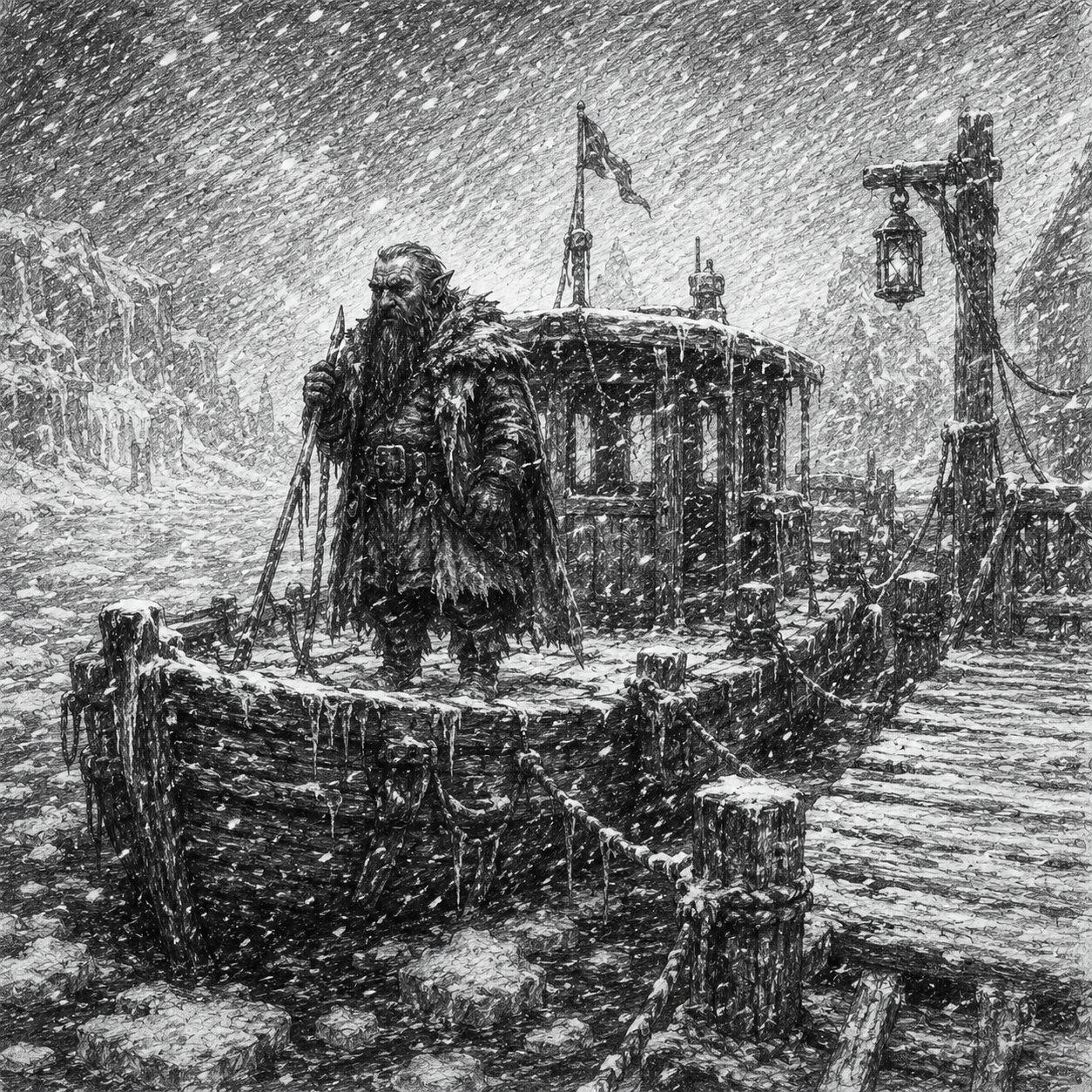
Outside, the world bit back. The wind off Lac Dinneshere came knifing from the northeast, cutting through even their thickest furs. Snow blew sideways in thin, stinging sheets. Only their eyes and cheeks were exposed, and even that felt like too much.
“Cold one,” Raine muttered. No one disagreed.
They trudged along the frozen shore toward the ferry jetty, boots creaking against packed snow. That was when they saw the figure — tall, thin, and slightly off. A dragonborn, perhaps, though its gait was strange, bending in the middle as if it had two waists. It turned toward them and spoke in a stilted, oddly formal tone.
“Good morning, human males. I am just going to get some breakfast and eat it with utensils such as a knife and a fork.”
The group stopped. Felwar blinked. Miquitzil frowned.
The creature nodded to itself, apparently satisfied.
“Yes, I really do enjoy normal human beverages like milk from the cow.”
A small, scaled hand — far too small for the proportions of the coat — slipped from the sleeve to wave cheerfully before it shuffled off into the snow.
“…Right,” Miquitzil muttered, and caught up with the others.
Halfway down the jetty, they ducked beneath the stiff, snow‑covered leather tarps of a moored fishing boat. The planks groaned beneath them as they crouched, peering through narrow gaps in the material. The wind howled through every seam, stealing warmth from their gloves. Thelonius sent his owl aloft to scout, but the poor bird returned minutes later, feathers puffed and eyes narrowed in complaint.
They waited. Ice cracked somewhere under the dock — a deep, resonant sound that carried like thunder.
After an hour, Raine exhaled sharply.
“I’m done waiting,” he growled, pushing through the tarp. “I’m checking the ferry.”
He stomped down the planks, boots thudding dully on frost‑slick wood. The others exchanged a look, then followed.
“Remember,” Miquitzil warned quietly, “these dark dwarves can turn invisible.”
The ferry loomed ahead, silent and rimed with frost. Its hull creaked softly where the lake ice pressed against the timbers. Felwar went first, boots whispering across the boards. He doubted even a shout would travel far in this wind, but still he moved lightly, hand resting on his blade.
He didn’t notice the impossibly thin silken string stretched across the path. It snapped as he stepped through it, the sound lost to the gale. Inside the cabin, a tiny bell tinkled once, then fell silent.
The latch on the door was not frozen over — a sign of recent use — but Felwar missed that too. He scraped at the nearby frost, examined the simple lock, tested the handle, and felt it give. He gestured for Raine to come forward. The warrior moved past him, shield raised, sword angled low, and stepped into the cabin first.
Inside, the air reeked of body odour, leather, and lantern oil. Four dwarf‑sized bedrolls lay strewn across the floor, their coverings made from some slick, rubbery hide. A small table stood in the centre of the cramped cabin, cluttered with crumbs, gnawed bones, and the wrappers of dried rations. An unfurled map was pinned beneath a scrollcase and a heavy clay mug. Someone had been living here — and not long ago.
Raine pushed past Felwar, sword drawn. He swept the blade slowly across the room, checking corners, eyes narrowed against the dim light.
Then the air shimmered.
A shape resolved from nothingness — a grey‑skinned duergar lunging forward, dagger flashing. The blade slid under Raine’s ribs.
He roared in pain, staggering back. But the pain did not stop at the wound; something else pressed inside his skull, cold and commanding. Words formed that were not his own, cutting across his thoughts like splinters of ice.
Strike the one at the door.
Before he could resist, his muscles obeyed. The greatsword came down, catching Thelonius across the shoulder just as he stepped inside. The druid hissed, his form collapsing into fur and chitin. In an instant, a house spider clung where he had stood, scuttling up the doorframe.
“Something’s wrong with Raine!” Felwar shouted, voice nearly lost to the wind. He turned to face the duergar — but Raine’s own cry rose above his.
“No! I was forced to do that!” He bared his teeth at the dark dwarf. “I’ll end you for this.”
The duergar only sneered and motioned him forward.
The cabin erupted into chaos. Felwar’s blade crackled with arcane light as he struck, driving the duergar back a step. Miquitzil’s hands were already weaving runes, blue sparks coiling between his fingers — witch bolt arcing across the narrow space. Thelonius, perched above the door, sent his starry wisp darting down in a streak of pale light that seared the dwarf’s back.
Raine fought through the lingering echo in his head, swinging wide with his sword. The duergar was fast — faster than a dwarf had any right to be — and struck back in kind. Two vicious blows left Raine bleeding again, collapsing to the floor before Thelonius’ healing magic dragged him back from the edge.
The duergar’s eyes flicked to the doorway. He was losing. With a guttural snarl, his body began to shrink — impossibly fast, armour and limbs collapsing inward until he was no bigger than a mouse. Felwar lunged as the transformation took hold, his sword slicing the air and striking the dwarf mid‑change. The blade glanced off, leaving a streak of dark blood across the planks.
Before anyone else could react, the duergar was gone — darting through a tiny, round hole in the floorboards and vanishing from sight.
As Miquitzil squashed a Goodberry into Raine’s mouth, Thelonius scuttled along the wall, then dropped to the floor and slipped through the narrow gap after the dwarf. Below deck, the hold was dark and bitterly cold, the air thick with damp wood and old oil. The timbers groaned with every icy gust from outside.
Directly beneath the hole was the lid of a crate. Thelonius paused, sensing faint vibrations through his legs — movement further in. He crept toward the centre of the hold, upside down beneath the beams, spider limbs gripping the wood effortlessly. Ahead, the noises became clearer: a scuffle, the squeak and rasp of teeth. Three rats were fighting over some scrap.
He turned back toward the hole. That was when he noticed it — fresh wood shavings scattered across the crate below, trembling faintly in a draught. He traced the breeze to its source and spotted a third hole, clean and round, drilled through the side of the hull.
“Balls,” he muttered, scampering across the crate. The hole was tiny, but he forced himself through into the frigid air. Beyond, a thin cord was fixed to the hull, pegged every few feet with tiny knots like handholds, leading down to the frozen surface of Lac Dinneshere.
“Cock and balls,” Thelonius hissed. The duergar had escaped — small or large, visible or not, it didn’t matter. He was gone, likely scampering across the ice even now.
Then inspiration struck.
“Owly! Come here, my lovely.”
Moments later, his fey‑owl fluttered around the hull to where its master clung. The spider clambered onto its leg, spun a line of silk, and fastened himself tight. Together they shot out into the bitter wind. The cold bit at him instantly, gnawing at his joints, freezing him from the outside in. He didn’t have long.
Back on deck, Felwar and Miquitzil were already searching the cabin. Their eyes lifted as Raine strode past them and out the door, his expression dark and unreadable. The duergar had dropped him twice in that fight — once raised by Thelonius’ healing, another time by Miquitzil pressing a single goodberry between his lips.
Raine’s jaw tightened as he stepped out onto the jetty, frost crunching beneath his boots. The cold bit at his wounds, but it was nothing compared to the burn of humiliation. He was furious — not just at the duergar who had bested him, but at Levistus, whose promises of power now rang hollow. He glared out across the frozen lake.
“Screw you, you piece of shit,” he spat, voice raw with fury. The words hung in the icy air like a curse, flung toward the unseen devil who had made him weak when he’d needed strength most.
Then he saw them — three duergar sprinting across the jetty toward the boat, weapons barely visible in the gloom.
Raine’s lips curled into a thin smile. He felt the cold power of Levistus rise within him again, sealing his wounds and steadying his grip on the sword. The irony of being healed by the very fiend he’d just cursed was lost on him; all that remained was the promise of violence.
Miquitzil joined him at the door, resting a steady hand on his shoulder.
“You can breathe lightning like a dragon now,” he said, calm amid the rising wind.
Felwar slipped past them, moving around the side of the cabin with quiet purpose, eyes scanning the boat and jetty for any sign of movement.
Raine’s grin widened. He waited until two of the dwarves were close enough to smell the tannins of their leather armour, then exhaled. An arc of lightning ripped through the air — bright, deafening — striking the frozen planks with a sound like cracking ice. One duergar took the full blast, his beard hairs sparking and standing on end. The other staggered behind him, half‑shielded, smoke rising from his cloak.
The ensuing fight was brief but vicious. Where the first duergar had been powerful and disciplined — a veteran — these newcomers were quicker, sharper, but inexperienced. Their strikes were fast yet poorly judged, and they found no rhythm against the Brave Hearts’ coordination. Within moments, steel met flesh, and the last of them fell to the frost‑slick deck.
When the noise faded, they regrouped near the ferry’s cabin. Thelonius rejoined them in human form, shaking snow from his shoulders. His aerial sweep — carried by Owly across the jetty and frozen shoreline — had turned up nothing. The duergar leader was gone.
Felwar glanced over the corpses, then at the four bedrolls inside the cabin.
“The leader escaped — but whether for good or just for now, we can’t say. What we can surmise is that this nest is empty. Four sleeping sacks, and four duergar accounted for.”
Miquitzil nodded curtly. “Let’s search the room for clues.”
“And loot,” Raine added.
Inside, they rummaged through the scattered supplies until Miquitzil examined the crude map atop the table. It showed the Ten‑Towns region in rough lines, with duergar runes scrawled beside several landmarks.
“Most of the landmarks point to the Ten‑Towns, the three lakes — and this one here is Kelvin’s Cairn,” Felwar said, tracing the runes with a gloved finger. “The ones shaped like eggs are probably hills.” He paused, brow furrowing. “But this… this one’s new.”
He tapped the unfamiliar symbol near the eastern edge of the map.
“Let’s get this translated. Maybe someone in town can help. Failing that, we head back to Caer‑Konig — Oobok can read the script well enough.”
They returned to Captain Imdra Arlaggath and quickly brought her, along with a small detachment of militia, down to the ferry. There, amid the blood and frost, they laid out what they had found — the link to Caer‑Konig, the thefts across Ten‑Towns, and the trail that had led them here.
They did not, however, mention the prophecy spoken by the old crone in Caer‑Dineval. Some truths, they agreed, were better kept from those already burdened with too much fear.
Imdra listened in silence, her expression hard as the ice underfoot. When they finished, she gave a sharp nod and ordered the militia to remove the duergar bodies and inform Scython of what had transpired.
“I’ll see this map translated by dinner time,” she said, tucking it beneath her arm. “You’ll have your answers before nightfall.”
She waved away their thanks.
“Thanks to you, Brave Hearts, Easthaven is safer today than it was this morning. Translating the map is the least I can do.”
Raine’s blood still burned for battle. He needed redemption — not for the others, nor for Levistus, but for himself. The duergar had humiliated him, and the sting of it hadn’t faded. Strength meant nothing if it failed him when he needed it most.
The three younger duergar had fallen far too easily, their deaths offering no satisfaction. It was like striking at shadows — no challenge, no glory, just the cold echo of violence that did nothing to quiet the fire inside him.
“We’re going to need two rowing boats,” he said, voice steady but edged with fire. “We’re leaving now to find those missing fishermen. We’ve got a lead on their location. If they’re alive, we’ll bring them home. If not, we’ll make sure Easthaven knows what became of them.”
Imdra studied him for a long moment. The man was crisscrossed with fresh wounds, his forehead bandaged, blood stains evident, yet he spoke with purpose. She saw in him the same reckless courage she’d seen in too many heroes — the kind that didn’t wait for the pain to fade before leaping back into danger.
“I’ll see it done,” she said finally, her tone softening. “Give me an hour, and I’ll have my men drag two boats down to where the crust meets the water. We’ll have you on your way.”
The crossing was every bit as wretched as the climb up Kelvin’s Cairn. The wind came howling out of the northeast, a knife‑edge gale straight from the glacier, throwing sleet and shards of ice into their faces. Felwar and Raine, lacking magical protection, took the full brunt of it. By the time the eastern shore loomed out of the haze, both men looked hollow‑eyed and sickly, their gloved hands numb around the oars.
On the eastern shore, the frozen surface of Lac Dinneshere pressed against eighty‑foot cliffs running north‑south as far as the snow allowed them to see. Out of the ice rose a multitude of natural spires — some no higher than a house, others as tall as the cliffs themselves — a drowned forest of stone carved by wind and winter.
“Now we search,” Felwar said, his voice thin over the wind. “Bodies, caves — anything that isn’t snow or ice.”
They didn’t have to look long. A few hundred paces north, they found the missing fishermen’s rowboat pulled halfway up onto the crust, its rope tied to a jagged spur of rock at the base of a spire. Frost had crept across the wood like mould, but the contents told a story: four oars neatly stacked, a tackle box, four rods, a half‑eaten loaf, and seven bottles of harsh northern liquor, the glass frosted white.
Thelonius gave a low whistle.
“They were partying, these mad lads. Enough piss in there to fell six men, let alone four.”
He glanced at the others’ unimpressed faces and shrugged. “I’d know. I’m something of an expert.”
Felwar raised an eyebrow but said nothing. The wind moaned through the rocks, and for a moment the frozen silence seemed to swallow even their breath.
They wandered the crust of ice between towering spires; the world reduced to shades of grey and white. Any footprints the missing men might have left had long since vanished beneath the relentless sweep of snow.
Then a sound drifted through the gale — high and clear, like a woman’s voice carried on the air. A haunting soprano, distant yet piercing, wound through the canyons of stone. It was not unpleasant, but it was wrong somehow, too bright for a place so cold and dead.
Before Thelonius could speak, a second voice joined the first — deeper, a baritone harmony that rolled like thunder between the cliffs. His heart lurched as he turned and saw Raine, Miquitzil, and Felwar standing motionless, faces slack and eyes glazed. Their weapons hung loose at their sides, bodies swaying gently in time with the unearthly music.
Thelonius felt the same melody curl through his mind, seductive and strange, but the magic slid off him like water on stone. His will held fast — the charm had no hold here.
“Hey! Guys!” Thel shouted, but his voice barely carried.
Two shadows cut through the falling snow. From opposite sides, the harpies descended in a spiral — one male, one female, both still singing their cursed duet. Their wings were vast and mottled, feathers the colour of old snow and ash. The female’s face might once have been human, but now it was drawn and cruel, her teeth blackened and sharp. The male was broader, his feathers streaked with frost, his song bubbling from a throat not made for melody.
They struck from both sides, claws raking across Thelonius’ shoulders, screeching as they scraped against his thick hide armour. Instinct took hold. He raised a hand and muttered a single word. A pillar of silver‑white radiance burst down from the heavens, engulfing the baritone harpy mid‑song. The smell of burning feathers filled the air as the creature shrieked and fell silent.
Instantly, Raine, Miquitzil, and Felwar snapped from their trance, eyes wide.
“Move!” Thel barked.
Raine surged forward despite his weariness, sword swinging with renewed fury. Felwar’s hand erupted with arcane light, his blade flashing in tight, practiced arcs, while Miquitzil sent streaks of blue energy crackling across the ice. The female harpy screamed, claws raking desperately at the heroes, but the Brave Hearts were relentless. Within moments she was cut down, her body tumbling onto the crust with a dull, frozen thud.
The wounded male tried to flee, beating his wings toward a nearby spire crowned with jagged stones that rose like the battlements of a ruined keep. Thelonius’ eyes narrowed. A grin crept across his face as he lifted his hand, and the silver column of moonlight obeyed. It climbed through the swirling snow, sliding across the rock like a blade of the heavens until it reached the spire’s peak.
A sharp, startled cry split the air — then silence, followed by the hiss of burning feathers carried away on the wind.
Thelonius laughed aloud, his breath misting in the frigid air.
“Ha! Got him!”
Disclaimer
This is a work of fan fiction. All relevant characters, locations, and settings remain the property of Wizards of The Coast (WOTC) and the story contained here is not intended for commercial purposes.
I do not own Dungeons and Dragons (D&D) or any of the related characters. D&D is owned by WOTC (and its parent companies) and all rights of D&D belong to them. This story is meant for entertainment purposes only.