Session 16
Ask me your question
Exhaustion gripped Felwar like a vice. He told the others he needed time to rest and urged them to continue exploring the cavern complex without him, warning them to be careful. Raine had already gone, striding off mid‑sentence as was his way — never one for stillness.
Thelonius, still in wolf form, prowled ahead. His nose drew him down a corridor lined with alcoves and the dry scent of long‑dead bones. They didn’t linger, instead following a narrow, frozen stream deeper into the dark.
The tunnel opened into a chamber where a shallow pool of ice gleamed against the back wall. The ice here was thin — bubbles trapped beneath it like eyes staring up from the depths. Around the corner, the air stank of bear. Tufts of brown fur clung to the rock where something massive had scratched itself raw. Meat and musk clotted the air. The wolf’s hackles rose; instinct screamed at him to run. But he held his ground and padded back to where Miquitzil knelt beside the pool.
“There’s a figure in the water,” Miquitzil murmured. “A statue.”
Raine and Thelonius peered in. Beneath the ice lay the form of a young man, naked but for a well‑placed oak leaf, his stone face turned toward the sky. The turbulent freezing water blurred the details, but the posture was unmistakable — a figure of Silvanus, god of nature and renewal.
To Thelonius, something about it brushed the edge of memory — a warmth he had never earned, never sought, yet somehow recognized.
To Miquitzil, it was more than familiarity. Magic pulsed faintly beneath the surface. He whispered a word and opened his senses to the weave.
“The statue is leaching magic into the water,” he said. “Abjuration. Protection. Strongest near the statue, but the whole pond is touched. The magic fades as the water runs down the stream.”
He cupped his hand, dipped into the pool, and drank — a cautious sip at first, then a gulp, then another.
The taste was neither pleasant nor foul — sharp, alive. It burned faintly like crushed pine and cold metal, leaving a copper tang that thrummed down his throat. For a heartbeat, the world sharpened: colours brighter, sound clearer, nerves humming. Then it passed, leaving a strange calm in its wake — a sense of being washed clean of fatigue and ache.
“I think it’s restorative,” he said quietly. “I feel… better.”
Thelonius-as-wolf lapped at the hole. Raine filled a waterskin and drank, grimacing at the taste but saying nothing. When Thelonius went back for another sip, the effect didn’t return. He gave a soft huff, tongue flicking at the frozen edge, and turned away with unmistakable disappointment.
A one-time blessing, then, he thought, before the cavern swallowed the sound of his breath.
They climbed the carved steps into a small stone room — ten feet high, fifteen feet square — with narrow natural exits to east and west. A rectangular stone tomb sat in the centre, seven feet long, four wide, three tall. Pictographs on the walls showed a tribe crossing mountains and tundra, fighting monsters, then settling in Icewind Dale. The chieftain appeared often, once with a wand raised, casting a destructive spell.
Raine set his hands to the lid and pushed. Nothing. He wedged in a pry bar and tried again. Still nothing. He called Miquitzil and Thelonius — still in wolf form — to help. The wolf’s footing was awkward, and even together they couldn’t budge it.
Raine slapped the stone. “We need Felwar. One more set of hands will do it.”
Miquitzil studied the pictographs again — the chieftain, the wand — and thought of the cursed axe Felwar had taken from a cairn. He let out a slow breath.
“Leave it. We need no more curses from the dead.”
Raine was not pleased, but there was nothing for it except to follow the others out.
Further on, Thelonius caught the smell of the ogre’s den. In the next chamber, six baskets hung from the ceiling on ropes and pulleys. By the south wall, three wooden casks bore Good Mead’s heraldic mark — a horn mug with an antler handle, upright and centred.
Miquitzil lowered the baskets one by one. Most held stolen goods — sheep shears, milk pails, bristle brushes, and several bags of grain and oats taken from caravans on the Eastway. One basket looked like the verbeeg’s stash: mixed silver and copper, a translucent pink moss agate, a healer’s kit, a hunting trap, and a small rabbit‑skin pouch with ten silvered sling stones.
Raine rolled the casks back to the central chamber where Felwar, now rested, was examining a broken cart.
Then the world stopped.
Drips of meltwater froze in mid‑air like glass beads. The campfire light stuttered, slowed — then died into stillness. Every spark turned blue. For everyone but Raine, nothing changed. Only he could see the air shiver.
A vast cold sighed through the cave, blowing coals and snow alike. The blue flame rose higher, stretching into a tall, translucent mask — regal, inhuman, its features shifting like light through deep ice.
Levistus. The Lord of the Fifth.
Even Raine’s heartbeat sounded distant, as if buried beneath miles of frozen sea.
“Raine.”
The name drifted across the cave like a breath through frost.
“My gifted one. My chosen hand in this frozen waste… and yet you idle.”
The voice was velvet on iron.
“Mayhaps I was unclear in my instruction — or in the terms of our arrangement.”
The fire pulsed as he spoke, each flicker revealing fragments of horror: grey dwarves dragging sledges of black iron, a forge burning blue in the dark, and the vast silhouette of something chained — something terrible.
“I gave you strength,” said Levistus, the words heavy as glaciers. “Power to carve through the dark — to end the duergar who gnaw at the Dale’s roots. And what have you done?”
His tone sharpened, each syllable a weight on Raine’s spine.
“They spread like rot, my clever hunter. They are the true blight beneath this snow. End them. Lead. Take your destiny by the throat and stop dithering with these soft, mortal things that slow your stride.”
Then a shift — the voice softened, coiled, intimate.
“You were meant for more than wandering. Be my champion and I will lift you above the frost. Your name whispered in fear and praise alike. Do not lose sight of what matters, Raine — your father, who toils for me still in my prison. Your daughter, precious and precocious, who longs to be free. Their fates rest in your hand.”
The honey froze to iron once more.
“Or stay small. Chase trinkets. Waste my patience while the true enemy grows bold. Even ice breaks when pressed too long.”
The towering face leaned close — so close Raine’s breath frosted against its unseen skin.
“Return to the Caer. The fools of Icewind Dale prepare to throw themselves on its walls. Take command of my Black Swords. End those who oppose me. Then turn them against the duergar. And heed this well, boy — support Avarice in whatever she desires. That one will serve a purpose.”
Raine forced the words out through chattering teeth. “What am I supposed to do? Where are the duergar? You’re not helping me.”
The pain hit like a blade in the gut — white, sharp, immediate. He dropped to his knees, gasping as the cold seared through him from the inside out.
The blue flames flared, taller and brighter but without heat. Levistus’ voice went hard as the ice itself.
“Not helping you? I made you.”
The words struck like a palm to the chest.
“My seer told you the dark dwarves must leave the Dale. I want them gone,” he said, the sound cracking like ice under strain. “And I expect you to make that happen. They rot at the roots of this land — end them. Lead. Take what I have given you and use it.”
The blue face began to fade, collapsing inward as if drawn back into the frozen void beyond the flame.
Then the fire blinked orange. The drips fell. The wind exhaled, and the cave was alive again.
The others moved as though nothing had happened. Raine stayed crouched, breath shallow, the taste of blood and iron thick in his mouth.
Felwar’s voice broke the silence — practical, unknowing.
“I think we can fix this,” he said as the others gathered around the cart. “See the axle? Simple enough to mend. The loose wheel too. My magic will do the trick. A few well‑placed Mending spells. There, there, and there.”
He clicked his fingers three times, pointing to the splintered timber he intended to knit back together.
“Easy enough. We can use the cart to ferry the barrels back to Good Mead.”
Raine said nothing. The firelight caught in his eyes — colder now than the ice around him. He was furious at being treated this way and wished, not for the first time, that he had someone he could go to for counsel.
Miquitzil asked how they planned to pull the cart. Perhaps Thelonius could become a bear again, as he had when they hauled the dwarven ingots.
Felwar had another idea.
“We can kill two birds with one stone. The goats and sheep — if we tie them properly, safely — they can pull the cart. It’s only a couple of hours.”
Raine nodded, eyes sliding from the livestock to the cart and back.
“Simple enough.”
They set to work quickly. The female verbeeg could return at any moment, and every minute spent in her den felt borrowed.
Raine was clear.
“We kill her. It isn’t a hard choice. She’s a threat to the town, and she’ll be worse now her mate is dead.”
Thelonius — back in human form — argued to spare her. She had suffered enough; the death of her mate, the loss of her den, and the town’s retaliation might be warning enough to drive her away.
Felwar and Miquitzil offered a compromise: if the verbeeg returned while they worked, they would end the threat; if she did not, she would be left alive. They agreed, though Raine’s disappointment was plain.
Thelonius took a moment to re‑summon his familiar. The ritual shimmered into being — a faint green glow — and the owl returned, reborn from the ashes of her death in the last fight. He held out his arm, and she settled on it, feathers ruffling softly.
“Go,” he murmured, smoothing her plumage. “Keep watch outside. A giant might return. I’ll be looking through your eyes.”
The owl hooted once and flew out through the tunnel mouth, taking perch in a tree overlooking the four cavern entrances. Thelonius sat with his back to the stone while the others worked, slipping into her sight. The shared senses steadied him — a clean, silent calm, a different kind of warmth than he’d ever found in drink. He rubbed the edge of his druid cloak as his borrowed eyes swept the frozen valley beyond.
Two hours later, just as the cart was ready to move, Thelonius stirred from his trance. Through his owl’s eyes, he saw movement in the treeline — the female verbeeg, creeping closer, using the trees for cover. For something her size, she moved with surprising care, but the owl’s sharp gaze caught every step.
“The verbeeg,” Thelonius warned. “She’s coming back.”
Raine drew his sword, the steel whispering free. Miquitzil and Felwar took their positions, spreading out inside the tunnel mouth. The air tightened.
Then Thelonius called out, his voice echoing through the cave mouth.
“Leave and do not return, or your punishment will be swift!”
The verbeeg froze. Then, without a word, she turned and fled — crashing through the trees, snow flying in great clumps behind her.
The group exhaled as one, the tension bleeding out.
Raine sheathed his sword with a scowl. Miquitzil and Felwar exchanged a look. Through his owl’s eyes, Thelonius watched the retreating figure in silence.
It seemed this particular verbeeg would not die today.
Encouraging the sheep and goats to haul the wagon proved frustrating work, but Raine had some experience with beasts. With patience, steady hands, and a few sharp words, he soon had them pulling — mostly — in the same direction.
On the way back to Good Mead, Felwar suggested a detour to fetch the militia men’s bodies and bring them home. It would cost an hour or two, he said, but the families would appreciate the chance to bury their own. The others exchanged looks and agreed; it felt like the right thing to do.
By the time they rolled to the Speaker’s house in Good Mead, word had already spread. Townsfolk came from their homes to meet them — bundled in furs, faces half‑hidden against the wind. Relief and gratitude washed through the crowd as they saw the barrels intact and the missing goods piled on the cart. There was sadness too, when they saw the mangled bodies of the fallen militia laid out under tarpaulin. The victory was not clean, but it was theirs.
Senior townsfolk took charge, directing the unloading. The casks were carried toward the mead hall, the livestock to pens, the stolen goods to storage. Someone fetched cloth for the dead. Someone else began ringing the small, town bell, perhaps unnecessarily at this late hour.
When Felwar offered to accompany the barrels onward to Easthaven, a dozen hands clapped his shoulders at once. There were cheers, nods, too many handshakes to count. The warmth of it left him dizzy. It was not a feeling he knew — not from Dougan’s Hole, not from anywhere he’d grown up. This place, for all its cold, felt alive.
Inside, Maye — the late Speaker’s housemaid — welcomed them and introduced a woman already waiting by the fire: Olivessa Untapoor, a barrelwright of Good Mead. She thanked them warmly, offering firm handshakes and an easy smile.
Talk soon turned to the coming election. A new Speaker was to be chosen within the tenday, and though Olivessa’s name had been put forward, she confessed reluctance.
“I’m no politician,” she said. “Not one for trade deals or neighbourly quarrels. My opponent, Shandar, means to fell half the White Woods for coin. When the seasons return, the bees will need those blossoms. He doesn’t see it — or doesn’t care. He sells hope, steady income, and a quick harvest. It’s an easy sell when folk are doing it tough.”
Maye nodded. “They are. Desperation makes easy prey of decent people.”
Felwar added quietly, “As it does all across Ten‑Towns.”
Olivessa regarded him for a long moment, then smiled.
“You’ve a way with words, Master Crisp. The town could use someone like you — brave, fearless, charismatic. You could stay here; the Speaker inherits this house while in office. What say you? After your recent exploits recovering the stolen mead, the Brave Hearts’ reputation would carry you to victory in a landslide.”
Felwar shook his head.
“We mean to end the endless winter and bring back the seasons. My path will take me far from Good Mead. You’d be better served by your own.”
Maye’s eyes brightened.
“Then stand together. A joint ticket, perhaps?”
But Olivessa only sighed.
“I’ve no stomach for the daily grind of politics, and he’ll not be here to shoulder it for me. I fear we wouldn’t make much of an alliance.”
After supper, the Brave Hearts shared their story of the verbeeg caves — the stolen mead, the militia’s fate, the strange relics left behind. When the telling was done, the weight of the past days settled over them all at once. Maye built up the fire, wished them rest, and left them to the quiet.
They slept in the Speaker’s parlour, the warmth of the hearth chasing the cold from their bones. Sleep took them before the door had even latched shut.
It ended to the sound of raised voices outside.
Good Mead has no morning — only a thin grey that leaks through frost‑crusted panes when the aurora fades a little. The Brave Hearts stirred in the late Speaker’s parlour. The hearth ticked low. Outside, the shouting sharpened — angry, desperate.
Felwar was the first to move. Barefoot and still half in dream, he crossed the creaking boards and peeled back the curtain.
A thin mist hung over the main street, and in it stood three men — thick‑set, coarse, all bluster and threat. They jeered at Maye, who stood alone on the steps, apron drawn tight around trembling hands. She was panicked, cornered by men who looked capable of real violence. They shouted of “unpaid debts” and “promised coin,” their tone sliding from grievance into menace. Around them, a crowd of townsfolk — fifteen, maybe twenty — watched in that brittle silence of people waiting for someone else to act.
Behind Felwar, the others roused. Boots thumped the floorboards, straps were buckled, blades found their sheaths. The air was taut with waking purpose. They meant to step into it — to do what heroes do when good folk are cornered.
But before they reached the door, movement rippled through the street.
A new crowd pressed forward — burly figures in rough leathers and woodsman’s coats. Axes hung from their belts or rested on shoulders, not in threat but in message. At their head strode a red‑haired brute, beard wild as the forests themselves. His voice rolled like thunder.
“As long as Shandar lives,” he bellowed, sweeping the jeering men aside with a glance, “the hard‑working people of Good Mead will have nothing to fear. The forester’s union will protect you!”
The three troublemakers wilted, shoved and scattered by the woodsmen’s advance. The onlookers found their tongues again. From somewhere in the back, a voice rang out — half hopeful, half hollow.
“Shove off!”
Another voice followed, tired but certain.
“Vote for Shandar!”
The cry caught and spread through the gathered crowd, heavy in the frigid air. Felwar let the curtain fall and turned to the others. In the dim parlour of the dead Speaker, something new was taking root outside — a name spoken like a promise, or perhaps a warning.
The Brave Hearts pushed past Maye, ushering her back inside to safety.
Felwar called after the retreating troublemakers.
“You three, hold. I would have words with you.”
They hesitated — but before any could answer, the red‑bearded leader stepped forward again, axe raised and voice hard.
“I said leave. And don’t ye return, or ye’ll have Shandar to answer for.”
Felwar pressed, “Stay. You’ll speak before you go.”
But the threat in Shandar’s tone — and the dozen woodsmen at his back — broke what little resolve the rugged men had left. They bolted through the crowd, disappearing into the haze of frost and shouting. It was clear to everyone that Shandar’s authority here was more than talk.
Felwar faced him squarely.
“And who are you, then?”
The man planted his axe in the snow.
“I’m Shandar, woodsman of Good Mead — as any here can tell you. The question ought to be, who the fuck are you, boy? And why are you standing inside the Speaker’s house?”
“I am Felwar,” came the calm reply. “And these are my companions — the Brave Hearts: Raine, Miquitzil, and Thelonius.”
Thelonius smiled and gave a small wave.
“I’ve always wondered,” he said lightly, “do the carpets match the drapes?”
A murmur rippled through the crowd. Shandar blinked, confused.
“Your beard,” Thelonius clarified, tone mild. “Red as an apple. Do your pubes match?”
Laughter broke through the tension. Shandar’s face coloured to match his beard, but he swallowed the anger and turned to the onlookers instead.
“Good folk,” he called out, voice booming, “the trouble’s over. Get back to your homes. You’re safe now.”
The crowd began to drift, still laughing, still watching. The name Shandar hung in the air, bold and heavy.
Raine leaned toward Miquitzil.
“I think I recognise that big one with the beard. Saw him talking to Captain Skath in the Luskan Arms back in Targos. Memory’s hazy, but I don’t think Skath was happy about something.”
Miquitzil grunted once, eyes still on Shandar.
Felwar watched as the townsfolk clapped Shandar on the back, voices thick with thanks. The woodsmen grinned, proud and loud in their moment — but something about it didn’t sit right with him.
He stepped forward.
“We, the Brave Hearts, have returned the stolen goods and slain the giant responsible for their theft — and for the murder of Speaker Kendrick Rielsbarrow and four brave members of the town militia.”
The noise fell away as all eyes turned toward him.
“We vouch for Olivessa, who would serve this community well — fair, honest, and with the town’s best interests at heart. At her encouragement, we’ve agreed to escort the recovered mead to Easthaven to ensure its safe arrival.”
Applause rose, spreading quickly through the crowd.
“Thank you!”
“Bless you, Brave Hearts!”
“Gods keep you!”
And, to Felwar’s quiet discomfort, more than one voice called,
“May Auril watch over you!”
Shandar’s glare cut through the warmth of it, but he said nothing. He turned sharply, barked an order to his men, and the woodsmen withdrew down the street, axes over their shoulders and pride heavy in their stride.
Felwar closed the door behind him and returned to the parlour, where Maye sat pale and trembling, sipping a tincture from a small glass.
“The election is in a tenday,” Felwar said quietly to the others.
They looked up, unsure what he meant, but none pressed the question.
By midmorning they were on the road again. The cart creaked eastward, the goats and sheep pulling slow but steady. At the crossroads, as the wagon turned toward Easthaven, Raine’s gaze lingered on the northward road. That way led to Caer‑Dineval — the stronghold of the Black Swords. The thought stirred unease, a whisper from Levistus that he was meant to go there. He pushed it down and caught up with the wagon.
Their driver, Charlie — a wiry man with a frost‑burned nose and a knack for chatter — filled the silence as they travelled. He kept up an easy patter as the cart creaked along.
“Easthaven’s a busy place, always has been. Boomtown at heart. Grows when it shouldn’t, reinvents itself when the rest of Ten‑Towns hunkers down. Watch your purse when we roll in — pickpocketing’s legal inside the limits. You’ll see signs for it. ‘Watch thy pouch!’ Most folk think it’s a joke… Until it isn’t.”
He pointed ahead with his chin.
“Speaker’s Danneth Waylen. Plain sort, decent. Captain Imdra runs the militia tight. You’ll know their colours — snowflake over grey and brown with a sliver of white tower where it meets blue for the lake. Looks proper nice on a shield, it does. Population’s thinned to maybe seven hundred odd, but it still feels full. Each home’s got more yard than other towns. Place is sprawled out because of it.”
He flicked the reins.
“Rivals to the north — Caer‑Dineval and Caer‑Konig — always measuring themselves against Easthaven. Eastway’s the spine of it all. We follow it in, unload at the hall, and if you’re smart you keep one hand on your belt and the other near steel. Easthaven smiles, but it bites.”
Charlie guided the cart through the streets of Easthaven, the sound of hooves muffled under packed snow. Smoke curled above the rooftops near the docks, and a strange flicker of orange light danced against the white sky. Voices carried through the wind — raised, excited, fearful.
“Something’s going on down by the hall,” Charlie said, slowing the wagon. “Never seen the square this full.”
The Brave Hearts climbed down and followed the noise. The crowd thickened as they neared the docks, the orange glow revealing its source — a pyre burning high before the town hall. A man was bound to a stake at its centre, the fire already licking at his robes.
The heat struck their faces even through the cold. Townsfolk pressed closer to the blaze, hands outstretched to its warmth, voices low with approval.
Felwar tapped a man on the shoulder. “What’s going on?”
The man’s eyes narrowed, firelight catching in them.
“A wizard,” he said. “Paying the price.”
Miquitzil blanched, stomach twisting. The bonfire alone was grim enough — but a wizard burning within it struck deeper.
Felwar asked, “Why are they burning him? What did he do?”
The man shrugged. “Something bad, I guess.” He turned and melted back into the crowd, leaving only the crackle of fire and the smell of scorched wool and flesh.
The fire roared higher, fanned by the wind. The man did not cry out or struggle; he was likely dead already. His silhouette stayed rigid until it dissolved into flame and smoke. The crowd crept closer, faces flushed — half from heat, half from the thrill of it.
As the blaze dimmed, a woman in a tailored coat and fur hat stepped forward from the pyre and approached the Brave Hearts, carrying herself with quiet authority.
“I am Captain Imdra Arlaggath of the Easthaven Militia,” she said, voice even and clear. “You’re strangers here, but I saw you arrive with the cart from Good Mead. Does the name Brave Hearts mean anything to you?”
Raine nodded. “That is what people call us, yes.”
She smiled — warm, almost relieved.
“Word came from Bryn Shander. Good to have more allies in the darkness. Welcome to Easthaven, Brave Hearts.”
Raine named each of them, and she shook their hands in turn — firm enough that Miquitzil rubbed his fingers afterward.
Felwar stepped closer as the wind shifted, sending sparks through the dark.
“Why such a final punishment? What was his crime?”
“Dzaan,” she said. “A wizard of the Arcane Brotherhood. He hired a band of adventurers for some expedition — no one knows the details. Something went wrong. He turned on them and killed the lot. Burned them alive. Fireball. Nasty business. One of our citizens saw the whole thing and raised the alarm. In the end he didn’t bother to deny it. Sentence passed, sentence carried out today.”
As if in answer, the pyre shifted and threw a fresh flurry of embers into the night sky.
Imdra studied them for a moment, then said, “You look capable. If you have a moment, I could use your help. Some fishers are missing on Lac Dinneshere — four men, friends, one of them a notable businessman here in town. It’s caused quite a stir. I’d appreciate it if you could look into it.”
She nodded toward the blackened pyre.
“We’ve some of the wizard’s belongings that might serve as payment, if that’s of interest.”
Miquitzil’s eyes flicked up, intrigued.
Imdra gestured to a militia officer nearby.
“Jark here will arrange a boat when you’re ready. A four‑person rower, or a single‑masted skiff that can hold eight — though that one needs someone who knows their way around a sail.”
The aurora thinned overhead as the last flames faded to ash. The Brave Hearts exchanged glances — one task finished, another already beginning.
Felwar nodded. “We’ll do what we can to help, Captain.”
She thanked them and suggested the White Lady Inn if they needed lodging.
“It’s the warmest place in town,” she said, adjusting her fur collar. “And the ale isn’t half bad.”
As she turned to leave, she added over her shoulder,
“Keep a hand on your coin purses. Easthaven still honours its founders’ ways.”
Miquitzil smirked faintly. He had already shifted his few coins into his boots and filled his money pouch with pickled fish eyeballs.
The White Lady Inn was warm, dimly lit, and loud with the chatter of those grateful to be anywhere but the wind. The Brave Hearts secured a small room and a hot meal — salted meat stew and dense bread — and Felwar leaned on the bar to make enquiries.
“I’m looking for the owner of the Easthaven ferry,” he said.
The barkeep, a short, heavyset man with a nose red as a berry, nodded.
“That’d be Scython. He’s a regular — won’t be long before he wanders down. I’ll point him out when he does.”
Felwar thanked him and returned to the table, where Raine was already halfway through his meal. The fire snapped in the hearth, and from the far end of the room a halfling stood atop a stool, tuning a fiddle.
He introduced himself as Rinaldo, and with a bright grin launched into his song — a local favourite built from the faces of the townsfolk.
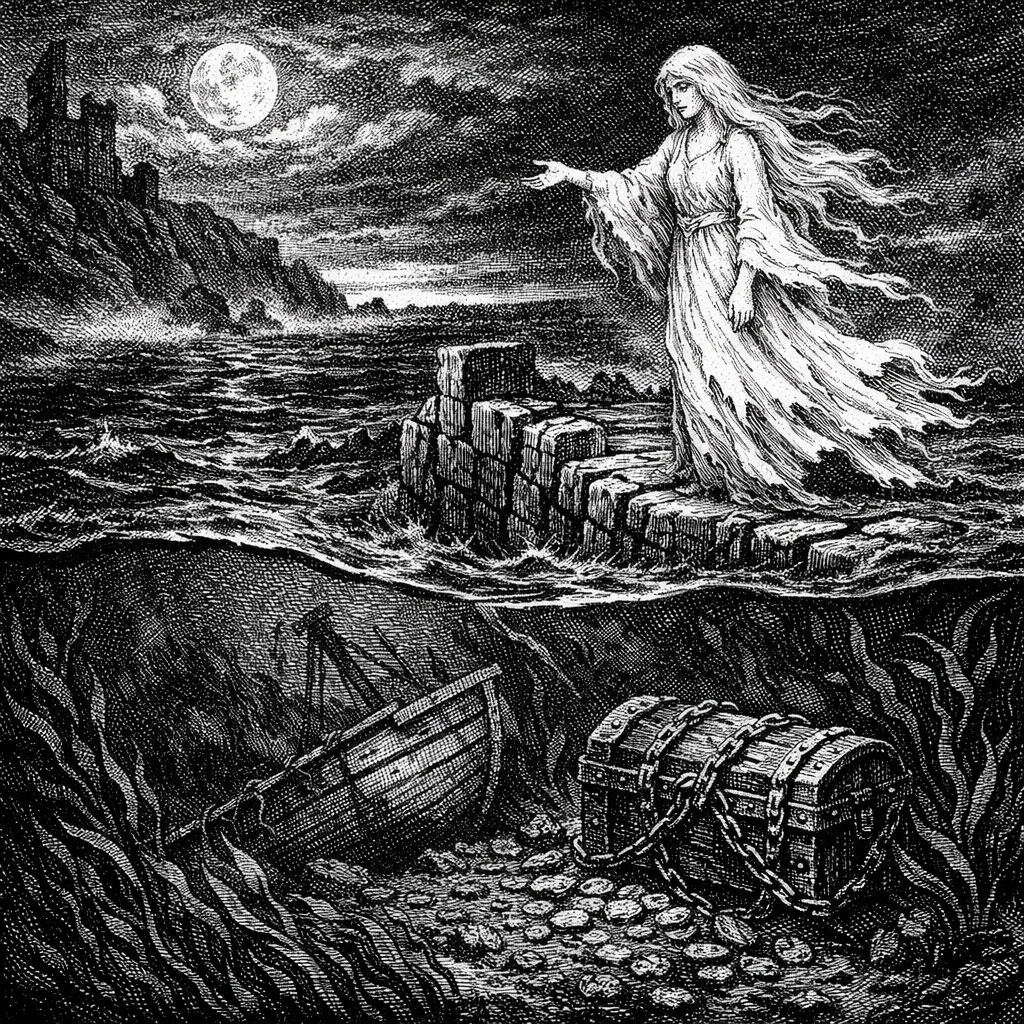
Mist on Dinneshere, night on the quay,
Pale as the moon, she walks by the lee;
White Lady calling, cold as the foam,
“Follow,” she whispers, “to where I roam.”
White Lady, White Lady, stay by the shore,
Keep me from water and winter’s roar;
Lead not my heart to a drowning’s door,
White Lady of Dinneshere.
She once had a husband, flint in his eyes,
Silver locked tight where no mercy lies;
Iron bound coffer chained to his side,
Heavy as sorrow, heavier than pride.
Some say the chest dragged his boat to the black,
Some say her face turned his courage back;
Over he tumbled, down he was drawn,
Coins for the ferryman, none for the dawn.
White Lady, White Lady, stay by the shore,
Keep me from water and winter’s roar;
Lead not my heart to a drowning’s door,
White Lady of Dinneshere.
Down where the kelp hands finger the silt,
Lies all his treasure and all of his guilt;
Bring up that coffer, set love before gold,
Maybe her sorrow can loosen its hold.
Find it, brave seeker, in starless deep,
Lift up the burden that will let her sleep;
Then may the curse fade thin as the air,
And dawn find its pathway over Dinneshere.
White Lady, White Lady, rest by the shore,
Hushed be the water and winter’s roar;
Lay down your grief, walk cold no more,
White Lady of Dinneshere.
The crowd clapped and stamped along, and when the final note faded, some even had tears in their eyes. Rinaldo swept into a bow.
“Thank you, fine folk of Easthaven!” he cried. “Now — if any of you have the courage, join me upstairs! Tonight, at midnight, we speak with the White Lady herself!”
The room buzzed with uneasy laughter and whispered dares. Even the innkeep rolled his eyes. But somewhere above, the boards creaked softly — as though the invitation had already been heard.
A tall tiefling approached the table, his presence commanding without effort. His skin was a deep, burnished red, his eyes bright as embers beneath a heavy brow. Perfectly oiled black hair swept back into a gleaming wave, and two curling horns framed his head like a ram’s crown. His smile flashed — brilliant white, precise, entirely confident. Every movement seemed rehearsed yet effortless, the grace of someone who knew all eyes were already on him.
“Evening, friends,” he said, voice smooth as polished oak. “I’m told one of you was asking after the captain of the Easthaven ferry.”
Felwar looked up, intrigued by the tiefling’s poise, and gestured to the empty chair beside him.
“That would be me. You must be Scython.”
The tiefling inclined his head, grin widening as he settled gracefully into the seat.
“At your service — Scython, captain of the Easthaven ferry and, when mood and company permit, a purveyor of good conversation.”
He glanced around the table, meeting each of their eyes before returning to Felwar.
“Now then, what can I do for the Brave Hearts?”
Felwar leaned forward.
“I was wondering if the ferry might be available for hire. We’d like to rent it out and stay there for a few days.”
Scython’s smile deepened — bright, effortless, full of mischief.
“Ah, if only I could take your coin, my friend. She’s frozen in, poor girl — caught fast in the ice and listing sadly. Breaks my heart every time I look upon her. And the wind out on Lac Dinneshere? It’d flay the skin from your bones. I’d hate to have you pay good silver and wake up cursing my name after the coldest, loneliest night of your lives.”
Felwar pressed gently.
“Just for a few days, perhaps? The income would be generous. And with the ferry out of action, it seems a fair offer.”
Scython laughed softly, low and musical.
“I had you pegged as a generous man, Felwar, even as I crossed the room. But negotiation, dear heart, is so dreadfully dull.” He turned his gaze to the others with a knowing smile. “Let’s not bore your friends with talk of who pays who, or how much, or for what. See? Raine is practically asleep already.”
Raine smirked behind his mug but said nothing.
“Let them enjoy their drinks,” Scython continued, voice smooth as poured honey. “And instead, you and I might retreat upstairs to my warm boudoir to… discuss your desire to use my ferry. My room, after all, is a fine example of a place to stay — for free, if things work out as I intend.”
Felwar blinked, entirely missing the meaning.
“Maybe we can look over your ferry tomorrow,” he said earnestly. “I’d like to see the ice conditions myself.”
The tiefling stared, then chuckled, real amusement flashing in his bright eyes.
“Tomorrow, then,” he murmured, producing a slender rolled cigarette and striking a match with a flourish. He took a long drag and exhaled a silvery stream toward Thelonius before offering it around the table.
Each declined in turn.
Scython sighed dramatically, then stood, smoothing the lapel of his fine coat.
“Another time, perhaps. Maybe we’ll speak again… maybe we won’t. Good evening, darlings.”
He flashed that perfect smile one last time before sauntering off into the crowd, the faint scent of clove smoke and charm trailing in his wake.
Later, Rinaldo — the flamboyantly dressed halfling bard — climbed atop his stool and whistled sharply over the chatter.
“The twelfth bell has rung, my brave Easthavian friends! The séance is upon us! Those who seek truth, come with me — together we shall beseech the White Lady for answers!”
A ripple of laughter and curiosity spread through the inn. A handful of patrons rose, among them the Brave Hearts, and followed the bard up the creaking stairs.
The room above was small and already heavy with incense. Smoke curled thickly beneath the rafters, where coloured silks and paper lamps hung like captured dreams. The floor was crowded — two couples sat cross‑legged beside the four adventurers, everyone shifting uneasily in the close heat. Candlelight flickered over anxious faces.
Rinaldo stood in the centre, his fiddle strapped across his back, his robes swirling as he turned.
“Now, my friends,” he said, his voice smooth and theatrical, “will the Lady forth! Call her from the depths, not with doubt, but with the strength of our joined desire! She listens to those who truly wish to be heard!”
The group obliged, each in their own awkward way.
Felwar murmured a soft prayer — reflex more than intention.
Miquitzil stared at the table, unsure what to do; all of this felt strange, almost childish.
Thelonius sat in utter stillness, brow furrowed. What question would I even ask?
Raine shifted impatiently, muttering, “This is a fool’s game.”
Rinaldo paid no heed. He pushed back his sleeves, raised his hands, and closed his eyes.
“Lady who watches from the lake,” he intoned, “come to us in our darkest hour. Give us answers to the questions that plague us.”
The air turned colder. Frost bloomed across the windows, spreading until the glass turned milky white. One by one, the candles guttered out, plunging the room into shadow.
Rinaldo’s head snapped back, then forward, his eyes now clouded and pale. When he spoke again, his voice was not his own.
“Ask of me your question.”
The younger couple clutched one another. The woman’s voice trembled.
“What baby will we have? A boy or a girl?”
Rinaldo’s mouth twisted.
“GIRL!” he spat — sharp, alien.
The pair gasped, held each other tight, and hurried from the room.
The bard’s milky gaze shifted to the older couple.
“Ask of me your question.”
The old woman stammered, “Is… is my mother well? Wherever she is? She had such a hard life.”
Rinaldo’s voice softened, hollow yet kind.
“Your mother loves you dearly. She is at peace, and she watches over you.”
The woman broke down, sobbing into her husband’s arms. Together they left, leaving only the Brave Hearts and the halfling’s cold, pale stare.
Rinaldo’s clouded eyes fixed on Thelonius. The room seemed to lean with his gaze.
“Ask of me your question.”
Thelonius swallowed.
“Where are the duergar in Easthaven?”
The air tightened. A board popped under the floor like a knuckle.
The voice that answered was sharp, unkind.
“Upon the ferry they can be found.”
A thread of frost crept from the window frame across the wall like a vein. Raine watched it, brow furrowed.
Rinaldo turned his blind stare to Felwar. The halfling’s breath smoked, though the room was warm.
“Ask of me your question.”
“Where will we find the four missing fishers who disappeared on the lake?” Felwar asked.
“Look across the Lac,” the voice said. “Two miles north of the Broken Chisel.”
The final candle guttered and died, its smoke curling upward in thin, searching tendrils. The wisps twisted and gathered, shaping themselves into the outline of a woman in flowing robes. For an instant, her form was clear — a face without features, long hair drifting as if beneath water, robes rippling in a current only she could feel.
A cold pulse passed through the room. Frost thickened on the walls. Every breath came out white.
And then, as quickly as it had formed, the shape unravelled — torn apart by some unseen breeze. The smoke thinned and vanished into the rafters, leaving nothing behind but silence and the sharp scent of extinguished flame.
When it was his turn, Miquitzil steadied himself.
“Who is responsible for the endless winter?”
Rinaldo’s head cocked as if listening to someone at the door. When he spoke, the words scraped.
“Auril the Frostmaiden casts her Rime each night — a spell across the sky — keeping the sun from rising.”
Silence fell. The incense smoke curled inward on itself, folding like a fist. Rinaldo’s dead gaze slid to Raine, an invitation without warmth.
Raine snorted. He had seen and heard enough. He pushed to his feet.
“This is bullshit,” he said, and shouldered for the door.
The latch lifted by itself with a soft click. Cold bled through as he opened it. Behind him, the others turned to watch him leave — even as Rinaldo’s body went limp and slumped sideways to the floor.
The frost on the panes held for a long breath, then thinned in weeping lines. No one spoke.
Thelonius was the first to move, pushing himself up with a groan.
“Always been a moody prick, that one,” he muttered.
Disclaimer
This is a work of fan fiction. All relevant characters, locations, and settings remain the property of Wizards of The Coast (WOTC) and the story contained here is not intended for commercial purposes.
I do not own Dungeons and Dragons (D&D) or any of the related characters. D&D is owned by WOTC (and its parent companies) and all rights of D&D belong to them. This story is meant for entertainment purposes only.