Session 15
The one who keeps two feet
With the seven bodies cut down, the Brave Hearts argued quietly about what to do next. The ground was iron‑hard with permafrost, even in the brush, and leaving them in the open was not a choice anyone liked. In the end they carried each corpse away from the ridge edge and hid them beneath leaf litter and scrub.
“Scavengers will find them soon enough,” Raine said, jaw set. “It is gruesome, yes — but the predators and carrion eaters need an easy meal. The long night is killing the herds. Everything out here is starving.”
Miquitzil kept apart, watching the tree line while the others worked. Once they had agreed these seven were suicides, he wanted nothing to do with them. His silence was a wall.
Felwar crossed to him when it was done. “Are you all right?”
Miquitzil spat into the snow. “Life is hard. You fight or you die. They stopped fighting.”
“I do not see it as suicide,” Felwar answered, voice low. “More murder by proxy. Auril gave them no choice.”
Miquitzil grunted, unmoved, and Felwar let the Ice Hunter be. As he turned away, Miquitzil heard the warlock mutter under his breath, “Auril and my father.”
They pushed further into the forest. Thelonius admitted he did not know this darker stretch of woods well and kept pausing as if trying to summon a map from fog.
“No, I think it is this way.”
A minute of bush‑bashing.
“No, that way.”
Then, by way of explanation: “I was usually very drunk back then. I guess I was lucky to make it home some days, truth be told.”
The others were in no mood for stories. They wanted progress. Thelonius sent his owl into the gloom, but above was a blanket of snow and below a net of branches — no help there.
“It will not be long. We will try for a day or two, then give up,” he said.
The look they traded asked if he was joking.
A few hours later a fold of country jolted a memory. “Yes. I think it was here.” A shallow glade opened where a long‑fallen tree lay like a bleached rib, half swallowed by snow. “I remember that tree.”
He cast about, not certain what he expected to find, only that something should be here. Down a small rise he came upon a hedge of bramble — old, thick, and long enough to mark the boundary of a place. He checked the party was following. They were, if gloomily. Tracing the hedge, he saw it — a wide, angled recess burrowing into the thorn.
“Curious,” he said, and stepped into the tunnel.
To the others there was no recess, no tunnel — only thorns.
“No, wait!” they cried, but Thelonius was gone.
A heartbeat later he reappeared, blinking. “What?”
“How did you move in there?” Raine asked.
“Through there. The tunnel. It goes a little way, but I came back when you called. It is perfectly safe.” He gestured to step in again.
“No — wait,” Felwar said, hand up. “We cannot see any tunnel.”
Thelonius took two steps and vanished to their eyes. “I am standing in it,” he called.
“We cannot see you,” Raine answered.
“Magic,” Miquitzil muttered — certain and saying more than he needed.
Felwar reached out, laid a palm on Thelonius’ shoulder, then jammed his eyes closed. “Let me try something.” He kept his hand there and nodded for Thelonius to move. To those outside, both warlock and druid faded like breath in cold air.
“It is working,” Raine said softly. “You have both disappeared.”
“As long as you keep your eyes shut and Thelonius guides us through, we will be fine,” Felwar’s voice came from nowhere.
So, they went in caterpillar fashion — each with eyes closed and a hand on the shoulder ahead — trusting Thelonius to thread them through the unseen thorn. Snow hushed the world. Branches rasped softly. The air on the other side felt different — quieter, older — as they passed into whatever waited beyond the hedge.
They slipped through the thorn into another world.
The air eased — not warm, but markedly gentler than what they had left. A short twin‑log bridge carried them over a narrow brook that laced the grove; a skin of new ice crackled like sugar glass where the current worried it. Snow lingered in hollows, yet the wind’s bite was gone, and their breath no longer plumed so fiercely.
An acre or so of quiet spread around them. Under a low bush a trio of rabbits slid into view. The largest lifted its head and stared straight at Thelonius. There was no fear there — only a calm, almost knowing regard — and then it lowered its head and grazed, comfortable as pasture stock.
Thelonius blinked. “Ordinarily that one would be in my bag by now,” he murmured, half shocked at himself for saying it.
Above, a cluster of small winter birds — snow buntings and a plump grey jay — hopped along a bowed branch and set up a bright, contented chatter. To their right a red fox stood in the open with a white muzzle and clean coat, tail held easy, watching the party as if counting them. An ermine, white as chalk save for its pin of a black tail, flowed out of the roots of a spruce, regarded Thelonius a heartbeat, and vanished again.
None of them gave alarm. None of them fled or showed fear.
A narrow path of frost‑silvered stone wound upward toward a low hut that squatted on the slight rise at the grove’s heart. The stones felt placed rather than fallen. Thelonius found his feet following them, the others trailing in his wake with the hush that holy places demand.
They passed first one, then another shrub heavy with fruit — berries, full and blue on one, red and glossy on the next. Blueberries and lingonberries, fat and ripe in the dead of winter. Thelonius hesitated, picked a blue, and bit. Juice burst, clean and slightly sour. It woke him up from the inside.
“As it should be,” he said, baffled and certain at once.
They foraged then — a few into mouths, a few into pockets — and as they chewed, the ache behind the eyes eased, the cold in the bones loosened.
Thelonius felt something else loosening too. A weight he had carried so long it had become part of his posture. The grove sat right in his chest like an ember — not hot, but warm enough to notice. His shoulders dropped. His jaw unclenched. For the first time in he could not say how long, he felt comfortable. Known.
The brook’s talk, the easy animals, the impossible berries, the path that seemed to have been waiting for his feet — all of it tugged at a memory he could not quite name. Breath of an elk on frozen skin. A last gift pressed into him. He climbed toward the hut with a quiet rising in him that was not pride and not relief, but something older that he had no word for.
Ringing the hut rose a rough circle of standing stones — weathered granite pillars, each about seven feet high, each bored near the crown with a single round hole about a foot across, like a watchful eye. Thelonius sent his owl to sweep the ring, count, and scout for trouble. It returned a simple report: nine stones, no neat cardinal alignment or star line — just a megalithic circle intent on encircling the hut.
They spoke a little longer about the standing stones, but Thelonius’ attention had already gone to the door. Its skin was stiff with cold, painted with a circle of pressed leaves. An antler tine and a braid of hair — the colour of winter wheat — were pinned beneath wax. The latch was bone, worn smooth by a careful hand.
He lifted it and stepped inside.
The hut was one room, tidy as a bird’s nest. A low bed of woven grass and furs stood against the wall; beside it, a birch‑bark journal lay waiting — folios stitched with sinew. Thelonius picked it up and thumbed through, noting a loose folded sheet tucked between cover and first page. The marks within the book were not the common tongue, yet meaning rose up to meet him. Sparse entries in Druidic — weather notes, animal tracks, when to open the sluice on the brook, how to trim the hedge so the tunnel remembers friends, what songs quiet a frightened fox. It would take hours to read with care, and longer still to understand fully.
A clay stove held a blackened kettle. From the rafters hung bundles of herb — their scents thinned but still whispering pine pitch, juniper, sweet birch. A rack held salves in stoppered clay jars. On a low shelf: a lump of chewed salt, a wooden comb rubbed glass‑smooth, and a small mat scattered with pressed leaves where hooves had once rested to dry.
Along one wall were three wooden pegs. Two were empty. On the third hung a cloak of braided grass, the cords threaded with shed hairs — stag, wolf, elk — trophies of friendship, not of the kill. The hood was the small skull of a yearling reindeer; the short tines were polished by many winters. Inside, the bone was padded with felted moss and hare fur. It smelled of smoke, juniper, and cold air. Eerie and beautiful — a druid’s skin waiting for its owner.
Near the door a staff of pale birch leaned, bound with silvered root, its top split to cradle a smooth river stone the colour of dawn. At the centre of the floor sat a wooden bowl ringed with antlers laid tip‑inward, like a listening circle.
Thelonius felt the old ember in his chest warm again. He had not felt this comfortable in years. When the others stepped in behind him, a sharp wish rose that they had stayed outside. They did not belong here — not really. The feeling came strong and unbidden: this was his place. He pushed it down and tried to bury it.
His eyes caught a shallow scratch in the door beam — plain and steady:
I kept four feet until the end.
Let the next keep two and do better.
“There’s a book here,” Thel said, smile beaming. He lifted the birch‑bark folio and frowned at the script. “I can read it, but these aren’t the letters Ma tried to teach me and Brince. It’s freaking me out — in a good way,” he added quickly.
The others looked but kept their hands to themselves. Each felt it would be rude to pick up or move anything — a private agreement none of them voiced.
Thelonius slid the birch‑bark folio into his pack, tipping out bits of trapper kit to make room. Then he shrugged off his winter jacket, hung it on an empty peg, and lifted the curious cloak.
“Whoa. Steady on,” Felwar said. “Should you be doing that?”
Thelonius grinned. “Yes. It is meant for me. I just know it. This place — and the ground beyond — is a druid’s grove. It likely belonged to the elk who breathed on me at the end and left me these… powers. The elk was a druid. It makes sense now.” He paused as a new thought landed. “He turned me into one — as punishment for my sins.”
The thought did not scare him. The memory of what he had done to animals pricked at him and he pushed it down. That was then. We move forward now.
He gave Felwar a small, relieved smile and turned the cloak in his hands, tracing the braids and the reindeer hood. Then he set it over his shoulders and drew the hood up.
“I think it is mine now.”
The cloak answered — not in words, but in feeling — a quiet yes that settled warm and sure. It was special, indeed.
He returned to his pack on the bed and drew the folded sheet from the folio. “Check this out. A note. I think I was meant to find it.”
Felwar’s voice was soft. “What does it say?”
Thelonius hesitated, unsure if he should read it in private. He looked at his companions — his friends — and decided to share it, as they had shared their stories with him. He eased the fold open, smoothed the soft bark, cleared his throat, and read:
To the one who keeps two feet,
“That is me,” he said, bright with excitement.
I watched men take more than hunger and call it need.
I watched axes bite living wood to warm empty rooms because taking was easier than tending.
I watched snares set for sport when bellies were already round.
The herds thinned. Birds flew late and returned light.
Streams ran clear of fish and full of silt where roots had been.
I chose to keep four feet so I could say what men would not hear from a man.
It cost me my voice and gave me yours.
Learn to speak in leaf and bone, wind and water.
Winter has been given a throne by those who love stillness more than life.
Some druids have wed themselves to that stillness.
They will call it holy.
They will call you traitor to the old ways.
The old way is balance. The wheel turns.
Take this grove. Speak for it.
And also, for the land beyond this forest.
Gather what is wasted and return what is owed.
Where you find cruelty dressed as piety, stand against it.
Where you find hunger, feed it — and teach the hands that take to plant, and the hands that cut to mend.
I leave you a mantle. Wear it when the cold is used as a whip.
I leave you a path. Walk it until the birds return singing spring.
Keep the spark. Spend it well.
— He who kept four feet until the end.
They stepped back into the ring and chose one of the curious stones. The circle wasn’t perfect — natural, if unusual. Up close the pillar felt older than the grove — seven feet of weathered granite with a roughly round eye a foot wide near the crown.
Miquitzil laid a hand on it and frowned. “A strange magic here,” he said at last. “Sleeping. Not a kind I know.”
Thelonius rifled the druid’s satchel until he found the place in the folio. “I need to cast Druidcraft,” he said, crestfallen a beat later. “But I do not have that one.”
Felwar lifted a hand. “I have it.”
Raine blinked. “You have Druidcraft.”
“Yes,” Felwar said, pleased. “It is how I make flowers bloom.” He looked to Thelonius. “Shall I?”
“Yes!” Thelonius’ answer came quick and bright.
Felwar whispered the cantrip. Blue‑green motes stitched out of the air and climbed the stone, following hairline cracks and old frost seams, curling through the round hole like threads through a needle. Nothing moved.
Thelonius reached out and laid his palm against the granite.
The grove hit him all at once.
Knowledge poured in — too much, too fast. He knew the brook’s depth in hand spans and how it would swell at dusk. He knew where the rabbit family bedded and which kit limped on the left hind. He knew the sweet berries from the bitter, the three fox paths, the owl’s usual perch, the birch with rot at its heart that must be braced before wind. He knew the hedge’s secret mouths and the rock on the rise that sat ill‑balanced and must be skirted with care.
He felt the temperature lift by a breath, the soil’s hunger for ash, the slow ache of a spruce limb bowed with ice. He knew the ptarmigan roosts and when they would dust‑bathe, the jay’s cache under the birch roots, chickadees counting daylight in the fir, squirrel middens of cone scale, vole runnels stitched under the snow, shrew tunnels like thimbles, mouse nests packed with grass, the ermine’s white loop from stump to stump, pine marten scent faded at the boundary.
Minnows and sticklebacks holding in the dark pocket below the ice.
Caddis cases under a stone.
Stonefly nymphs clinging to the riffle.
Crane fly grubs in the bank.
Springtails peppering the snow like soot.
Beetle larvae in the rotten log.
Earthworms coiled where the frost had not reached.
Spider egg sacs beaded in the thatch.
Snail trails silvered and still.
Names without words. Patterns without letters. The litany shrank smaller and smaller — mites in moss, spores on the wind, the breath of roots — until his skull rang with it and the world went white.
He dropped like a net cut loose.
Raine caught his shoulders as he sagged. Thelonius’ eyes rolled white for a heartbeat, breath hitching. Felwar’s hand was already on his brow, murmuring. Miquitzil crouched, two fingers to the throat.
“Pulse,” he said. “He breathes.”
Raine frowned. “What the hell?”
Felwar glanced up, uncertain. “I do not know. He seems all right — just… overwhelmed.”
Raine looked to the stone with suspicion and dragged Thelonius unceremoniously back from it.
Miquitzil nodded once. “He is unconscious. Not dying.”
Felwar patted Thelonius’ cheek. “Let us get him inside. We can rest a short while.”
Raine agreed, shifting his grip. “Fine. But not long. We have to get back to our dogs before the winter wolves do.”
The motes winked out one by one along the stone’s veins as they carried Thelonius away.
After a few long minutes in the hut, Thelonius’ fingers twitched and his eyes opened. “Whoa. What a headache. That was… too much.”
He tried to explain — the brook and the berries, the nests and tunnels, a thousand small lives speaking at once — but it would not fit into words. In the end they left him to rest, talked through next steps, and agreed to return to the dogs and make for Good Mead a few hours on. A long rest there before the push to Easthaven.
Thelonius was reluctant to leave the grove. He swore he would return. The new cloak rode warm on his shoulders like a living thing, and the birch‑bark book sat as a quiet weight in his pack — lessons to study when there was time. Outside the cabin the ring of stones seemed to watch them go, and he had to force himself through the bramble tunnel. The air beyond the hedge felt colder than before.
The two‑hour sled run to Good Mead was uneventful.
Raine had been to Good Mead a few times, never staying longer than a night. Only Felwar knew the place in any real sense.
“My mother used to bring me here,” he said after a while, trudging beside the sled, his voice tight with old memory. “Around midsummer. Always midsummer. She never said why, only that she had to have the summer batch mead.” He watched the runners whisper over the hardpack. “On the way back to Dougan’s Hole, she would drink herself hollow. And it would be worse when we got home. I had to mop what she spilled before my father got home.”
He let the wind take the rest.
Felwar pointed with his chin as the sled crested a rise. “Good Mead sits tucked between Redwaters and that stand of dark pine,” he said, more to himself at first. “Squat houses close together — lintels carved with coiled serpents and old lizards. Folk came north from warmer places, mother told me, and they were excellent tradesmen.” His eyes found the tallest roofline. “And there — the mead hall. Two storeys. Eaves carved and painted like wyverns — jaws open, wings flared. This place lives off honey — most everything they sell comes from the bees.”
Thelonius eyed the timbers and the still air, snow falling lazily. “How do the bees fare with no spring, no flowers, no sun?”
No one answered.
They continued the final push toward town.
Then Felwar cocked his head. “Hear that?”
A low, unmistakable droning rose — not from the town as Felwar remembered, but from the trees ahead and to the left. As they slid nearer, a narrow post came into view at the track’s edge, a charcoal‑burned hive scratched on its face with a short arrow beneath, pointing into a path between the pines.
They pulled the dogs over and moved down the path.
They followed the little hive sign into a stand of pine and came out before two long glasshouses. Inside, rows of pots crowded tiered shelves — flowers in full bloom, colour shocking against the snow. Bees moved everywhere, some fat and slow, some small and quick. Overhead, five bright orbs in each house hung like tame suns, pouring steady light through the panes to keep the blossoms open.
A sleepy old man dozed in a boxy guard hut, hands cupped to a brazier. He roused as they approached, blinked as they told him they were Wardens of Icewind Dale, and waved them through with a mumbled caution to watch the glass and don’t lean on the frames.
Several robed figures moved the aisles, hands in soil, whispering and sketching signs. Each murmur steadied a nearby orb, brightening the greenhouse glow.
“Incredible,” Miquitzil breathed.
Felwar snorted. “People will do anything for alcohol.”
“It is their trade,” Raine said. “They ship it south. Folk pay well for Good Mead — some casks fetch a fortune. All stopped now, of course, with the roads sealed.”
Thelonius watched the robed workers. “I want to speak to them.”
“Not now,” Felwar said. “Town first. Sleep.”
They thanked the old guard for letting them through and told him he was doing an excellent job; his shoulders straightened with quiet pride. Thelonius promised he would return in the morning to speak with the druids, but the old man only shook his head.
“They will not speak to you. They tend their flowers and the bees — nothing else.”
They turned the sleds toward Good Mead. Behind them the bees worked on, and the false suns kept burning.
They drew up outside Speaker Kendrick Rielsbarrow’s house to a crush of townsfolk — voices high and frightened. In the press a woman was being held while she sobbed, three children wailed as a man knelt to comfort them, and a knot of youths strapped on long knives as if for war.
Raine stepped into the throng and raised his hands. “Quiet. We are Wardens of Icewind Dale, appointed by Speaker Shane of Bryn Shander. We travel to lend aid. What is happening here.”
The answer broke over him as a single ragged shout from a dozen mouths at once:
“Dead in the woods — five of ours — smashed in — the militia — barrels stolen — my sheep — the speaker is dead — my goats stolen — gods help us — skulls cracked — chests caved — a monster — out by the traps — Fef saw it — Fef!”
The door swung open. A grey‑haired woman with her bun wound tight peered out and waved them in, urgent. Felwar caught the sleeve of a wiry trapper at the centre of the crush and shouldered a path. The Brave Hearts filed into the Speaker’s front room.
“I am Fef Moryn,” the trapper said, voice small under all the eyes. He crushed his fur cap in both hands. Frost had burned his cheeks raw. “I was checking my lines. Found five militia — skulls and chests stove in. No arrows. No blades. Something big with a club, maybe. I ran straight home.”
“Will you take us back?” Raine asked.
Fef balked, then wavered, then nodded. “Near the site. I will not step into it again. But I will lead you close.”
Felwar looked to the others. Raine gave a single nod. Miquitzil’s jaw set. Thelonius adjusted the reindeer hood on his new cloak.
“Right,” Raine said. “We follow Fef’s trail.”
Felwar added, “But not this minute. The five are beyond our help — and we need rest.” He turned to the woman. “Who are you, and may we sleep here? The floor will do.”
“I am ze Speaker’s housemaid,” she said crisply. “You may stay — on ze floor — provided you touch nothing. If so much as a vase is moved, I vill be very cross.” Her expression softened a fraction. “Speaker Kendrick set out for Easthaven vith barrels of honey — mead concentrate. He vas vaylaid and killed. Ze barrels vere taken. Our militia vent after ze thieves. It seems zey vere no match. Ja. You vill go after zee perpetrators, no?” She squared her shoulders. “Zey must be found. For Kendrick. For Good Mead.”
The next day the Brave Hearts set out. They left the dogs in town and trailed Fef several miles into the forest. He hardly spoke at all, and after a few tries, they stopped pressing him. He moved like he belonged here — pausing to read a print, skirting windfall without a word. He seemed to prefer the company of the woods to people. Thelonius liked him for that.
He stopped and pointed. “Through there.” Then he cut a neat notch in a spruce, the V pointing back toward Good Mead. “You follow this mark home.”
Raine and Thelonius shared a look. “We will manage,” Raine said. “No trouble.”
They thanked him and promised to answer for the five dead. Fef only shrugged, already turning away, more relieved to be rid of them than stirred by vows. He vanished into the trees like a fox slipping back to its line.
The Brave Hearts moved cautiously to where Fef had pointed and found the place easily enough. A fight had raged here — long since cold. Five men lay in the churned snow; shields painted with Good Mead’s drinking‑mug emblem. They were not a matched set: a lad of nineteen with peach fuzz and a rent in his mail; a broad‑shouldered brewer’s son in his twenties; a scarred spearman in his thirties; a grey‑at‑the‑temples watchman near forty; and an older hand pushing forty‑five with a captain’s knot on his cloak tie.
Something huge had broken them.
One skull was smashed open like a melon, brain and hair frozen into a grisly crown. Another body was bent almost double around a spruce, spine snapped where the trunk would not yield. A third had ribs pulped in, breastbone split like kindling. A fourth was hurled so hard his shield boss had caved his own cheek. The last sprawled amid a spray of frozen blood, fingers still clenched on a snapped spear haft.
Blood had spattered where the branches thickened and snow could not fall. The undergrowth showed it too — dark rosettes on alder stems, a smear along bark at shoulder height. They scoured the scene.
It was not long before the trail declared itself. Alder and young birch were bowed at seven feet and higher, as if brushed by something tall and heedless. A stride stamped deep and far apart — too long for a man. Prints were harder to find but possible to discern when they knew what to look for: slightly filled indents in the snow. Here and there were drag marks like barrel hoops had cut and skittered, and a sticky amber glaze on a snapped twig that smelled faintly of honey when warmed between the fingers.
“Giant,” Raine said, eyes on the bent branches, anger already simmering.
“Or ogre,” Miquitzil answered, crouching to measure a stride with his hand. “Big either way.”
Felwar touched a dark smear on a trunk and frowned. “A day or two at most.”
Thelonius lifted his chin to the hush. No birds called here. Even the wind seemed to hold its breath.
They set their boots to the heavy trail and followed it to a rocky hillside shouldered with pine. At its base the slope opened into three black mouths.
“Four,” Thelonius said as his owl settled on the antlered hood. “There is a larger entrance around the bend.”
They checked the nearer three first. From the westernmost, a frozen creek slid out beneath a low stone lip, its surface milky and crazed with cracks, the air smelling of wet rock and old cold. The centre cave sat higher — an eight‑foot cut hewn from the hill, half choked by a tight stand of young conifers and two fallen trunks laid like barred spears. To the northeast yawned a broad mouth breathing faint orange light against the ceiling, heat licking the air in slow pulses. The crushed snow and long strides they had tracked marched for that opening and vanished within.
They circled to the owl’s fourth entrance and chose the most beaten path. Half submerged in icy mire lay the bones, skull, and curling tusks of a long‑dead mammoth; plates glazed with rime like old porcelain. Ribs arched from the muck like a fallen palisade; one tusk had speared the earth and frozen there, a pale horn marking the way.
They slipped through the mouth and let the dark take them.
Thelonius’ owl ghosted ahead — gliding until it lost lift, then hopping silent over stone. Side tunnels forked away; one sank to a refuse pit rank with rot and worse. The other opened into a broader chamber.
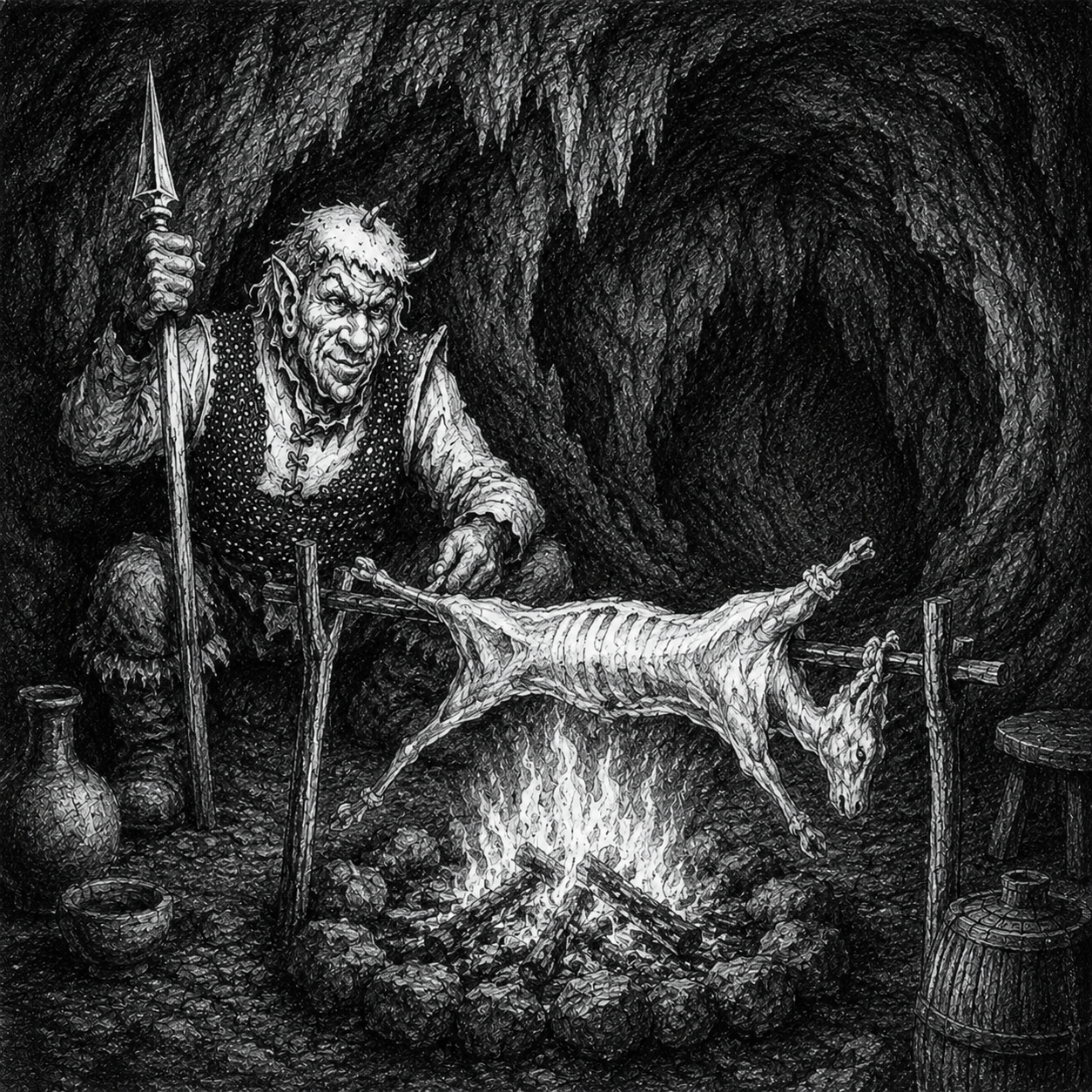
A small fire burned at the centre, throwing a low, steady glow. A goat haunch skewered on a spit, fat ticking into the coals and sweetening the air. Along one wall a crude pen held goats and sheep, bleating and baaing as the party edged past. A wooden cart with a broken wheel slumped beside two old crates and a pair of barrels.
The owl blinked once, twice, then fanned a wing toward a shadowed passage.
Something big moved there.
Heavy footfalls. A low scrape of wood on stone. Those who meant to hide did so. Raine stayed by the spit, hands loose, stomach growling despite himself.
The figure stepped into the firelight — a verbeeg, towering and long‑limbed, like a man pulled on a rack. Fur wraps and stitched leathers hung from its frame. It held a torch in one hand as it stepped into the room. The other hand gripped a spear used more as a walking staff; a chipped pick hung from its belt. The face was all planes and length — cheeks hollowed by cold, nose like a wedge, ears flattened back under a pelt hood. Black hair clung in icy ropes. Its eyes were small and pale, wary as a wild dog, and its breath steamed in ropes as it tasted the air. Wet fur and tallow thickened the smell around it.
The goats bawled. The owl clicked once and scooted further under the broken cart. Raine did not move.
“What you want here? My house.”
Raine stood firm. Felwar stepped from the shadows and the verbeeg jolted, taking a wary pace back. “Two of them!”
Felwar’s face was set. “Did you kill the humans? Five of them — and another besides?”
Recognition flickered in the creature’s small eyes. It tried for innocence and failed. “No know what you say. Leave.”
Raine and Felwar shared a look that said, plain as speech: bullshit.
The verbeeg bellowed, a bark that shocked the goats into panicked bleats. “Friend!”
Raine stepped in. “No friend of yours,” he snapped, and raked a vicious cut across the verbeeg’s belly.
An ogre shouldered in from the side passage — immense, greasy furs thrown over slabs of meat and muscle, a wagon‑axle club banded in iron clutched in one fist. One piggish eye squinted, the other wandered. “Me friend,” it rumbled, taking in the scene. “Arrgh.” The club rose, and the chamber filled with the rush of air before the first swing.
The verbeeg snapped a whistle that knifed down the tunnels. He snatched up a sheep and hurled it at Raine; the throw went wide, the carcass bursting against the wall in a spray of wool and gore.
“Thelonius, now!” Raine barked.
Pale fire speared down as Thelonius called moonbeam, then dropped to all fours and became a grey wolf. Felwar lifted his hand and a cloud of daggers bloomed — not steel but a storm of stinging hornets that shredded the ogre stomping in. Miquitzil stepped close, throat‑sang a harsh note, and a ribbon of aurora leapt from his palm — a crackling witch bolt that stitched light to the ogre’s chest. Raine waded in and carved Friend (as the ogre called itself), drawing a roar.
Friend swung and missed. The verbeeg — fighting with the spit pole like a quarterstaff‑come‑spear, the roast still skewered — slid to flank and whistled again. From the rear tunnel a cave bear thundered in.
Thelonius slid the moonbeam; Friend staggered, steaming, while the hornets chewed at him. “Surrender,” the wolf growled — absurd and perfectly clear.
“Talking wolf?” the verbeeg blinked — then jabbed. The spit pole cracked Felwar across the ribs and dropped him cold.
The wolf shouldered through the melee and pressed warm light into Felwar’s chest. Breath rushed back.
Felwar snapped awake, frost blooming over his leathers as Armor of Agathys took hold. He stepped and hurled a tiny living seed — his eldritch blast — that burst against Friend in force and light. The hornets swarmed again. Panicking, the ogre blundered from moonlight and stings. Raine chased, blade high, and hacked him down as he tried to run.
For scant seconds the fight ebbed and surged. The great cave bear and the verbeeg held the centre, but they were outmatched. Raine’s sword opened the verbeeg, then turned and cut the bear down.
They had barely drawn breath when a blur of motion hit — a second verbeeg shouldered through a side passage and smashed Thelonius’ owl against the cave wall in a puff of feathers. Seeing her mate sprawled and bubbling air from a split chest, she howled.
Raine met her with steel. She seized a tree‑thick branch and clubbed him across the ribs, driving him back a step.
Miquitzil stepped forward, face set. In clear, commanding Giant he spoke a single will‑weighted line:
“Take your friend and flee for an hour.”
Gahg’s fury faltered. The sense of it struck home. She nodded once, heaved the fallen verbeeg up in her arms, and backed the way she had come, lumbering under the weight.
The Brave Hearts let her go, holding still and trusting Miquitzil’s magic to bite.
Silence fell in a rush — only the spit’s hiss and the terrified bleating of goats and sheep.
Disclaimer
This is a work of fan fiction. All relevant characters, locations, and settings remain the property of Wizards of The Coast (WOTC) and the story contained here is not intended for commercial purposes.
I do not own Dungeons and Dragons (D&D) or any of the related characters. D&D is owned by WOTC (and its parent companies) and all rights of D&D belong to them. This story is meant for entertainment purposes only.