Session 14
Nothing Stays Buried
Before leaving Targos, the companions pooled their coin and returned to Barnsley’s yard, the air thick with the sound and smell of restless huskies. They purchased three more sled dogs to bolster their team: Jaxal with a pale coat and restless eyes, Talira lean and eager, and Stinky the Second — a scrappy brute whose name was chosen without ceremony. Alongside Rover, Bosco — the acknowledged alpha at Thelonius’ side — and Corny, the pack was now six strong, their breath steaming in the brittle air.
With foresight against the dangers of the open tundra, they secured a heavy-duty tent and thick furs to lash upon the sled. These would grant them shelter in all but the most merciless storms.
Miquitzil, with gold and silver borrowed from the others, bartered further in town — not for comfort, but for knowledge. He found the ink, ash, and strange herbs required to inscribe Suggestion into the living script etched upon his arm. The spell would be his to command.
When all was prepared, they set out from Targos, sled cutting lines across the drifts, intent on returning the cursed axe to the dwarven cairns where it belonged.
But the Dale punishes pride.
Raine, guiding their way, faltered — a misstep in his reading of the land. The plateau he led them onto was treacherous, a knife-field of fissures and snow-covered crevasses. Some gaped openly, others lay hidden beneath brittle crusts of white.
Thelonius was the first to fall. His weight cracked through a rim of ice, and he tumbled, striking stone. The cold bit deep, the bruising deeper still, and in the scramble, he lost his iron pot to the abyss. The others hauled him back, shaken, as the wind howled through the jagged chasms around them.
They backtracked carefully, losing only time, pride, and Thelonius’ mother’s favourite pot — a dented iron vessel that had served for cooking, brewing, and several less savoury activities besides. The others said nothing, but in secret each was glad to see it vanish into the dark.
Hours later, under a sky thick with cloud, a strange brilliance cut the snow. Some hundred yards away a beam of cold, white-blue light swept back and forth through the storm, wild and unsteady.
As they drew closer, the shape resolved — a child-sized figure draped in heavy winter furs, its movements stiff and shuffling, more puppet than person. The hood hung low, concealing the face, yet from its depths a piercing lantern-glare blazed, twisting and lashing through the blizzard, never still. Around it shimmered a halo of pallid light, snowflakes catching fire in the glow as they whirled and died in the frozen air.
Felwar, seeing light brighter than he had in two years, wondered if this might be some lost creature of Titania’s Summer Court, a spark of the warmth he longed for. But as he closed, the truth sank in. What he felt was not kinship but inversion: a tremor of the Summer Court turned inside out, ice-cold, empty, a mockery of his Fey spark. The thing reeked of Auril.
The Brave Hearts moved to meet it.
Felwar raised his blade, the radiant steel cutting into the phantom’s cloak. Raine was at his side a heartbeat later, his sword crashing down like an axe into frozen timber, tearing rents from which more of that unbearable light spilled. Thelonius whistled his owl to safety and turned the sled away, the dogs snapping and whining against their harnesses.
Miquitzil’s throat-song rose in the storm. His arrow struck true, piercing where ribs should have been and jutting from the phantom’s chest. The creature staggered, its light thrashing wildly, then swung upon Felwar. The beam caught him full — blistering his skin, blackening his flesh. He screamed, seared by the cold fire.
Raine answered with fury, cutting again and again, each strike that would have felled a mortal man only tearing more light loose from the walker’s shredded coat. He laughed as he fought, rage carrying him through the storm of radiance.
Thelonius pressed closer, summoning a shimmer of silver wisps that clung like starlight to the phantom’s cloak, dimming its blaze. Miquitzil circled to loose another arrow, but the shot flew wide, vanishing into the snow beyond the circle of light.
The coldlight walker lashed out, striking at Raine twice, but the champion of Levistus ducked and spun, dodging its blows with mocking laughter. Felwar slid sideways in a misty step and reappeared with blade and spell at once. He stabbed, his magical steel flashing yellow-gold against the blue-white glare, then unleashed an eldritch blast — a seed of searing force that burst in a spray of light.
The phantom lurched once, its beam snapping skyward, then went dark. Its cloak collapsed in the snow. The light was gone forever.
Silence fell heavy in the sudden dark.
Miquitzil’s eyes tracked back into the gloom, toward the mound he had glimpsed before the fight. Half-buried in drift and shadow lay the frozen bulk of a musk ox, dead only recently if the thin dusting of snow upon its flank was any measure. He prodded it with his spear; the point skittered aside as though striking stone.
“Frozen through,” he muttered. “Killed by that thing.”
Felwar crouched beside him. “Frozen solid… like the corpse in the mortuary.”
Miquitzil nodded. “This was the killer then — or one like it. And not Sephek.”
Raine tugged at the torn cloak, revealing blackened flesh and pale bones. “A human child,” he said quietly. “Or was, once. Long dead. Nothing to mark it. We leave it here. Let the wolves eat.”
They nodded, and the storm swallowed the silence once more.
An hour or two later they came upon the cairn — untouched from when they left it but buried beneath a thick layer of snow. Felwar stepped forward alone and set to work, his hands raw as he cleared the drifts and shifted the stones. The others held back, whether out of caution or simply to let him learn his lesson. Who could say?
At last, the axe was returned, laid beside the dwarven corpse still frozen stiff in death. Felwar brushed the haft with a gloved hand.
“There you go, big fella. I only borrowed it a while. Lovely axe — I can see why you wouldn’t want to let it go.”
For a heartbeat he felt a breath of wind — warmer than it should have been. Or did he only imagine it? The others noticed nothing. Felwar rebuilt the cairn stone by stone, then rejoined them.
“To Dougan’s Hole then.”
“We can stay at the Jones’s farm,” said Thelonius. His voice carried an eagerness they had not often heard from him, a quiet excitement at the thought of returning.
The trek south was long. Though they carried a heavy tent and furs enough to camp, the group had agreed it was better to push for the farm than risk the wilds. The dogs laboured through the drifts, their breaths steaming in the freezing dark. Thelonius and Raine called halts when needed, forcing rests to keep the team strong. None of them would see a dog worn out on this first true journey beyond the towns.
Felwar kept pace at first, but before long a tightness settled in his gut — a weight he could not shake. He gave in and rode upon the sled, pale and silent, clutching his side as the dogs pulled him through the drifts. When at last the pain ebbed, he realised it had not been illness at all. Something lingered with him — a blessing, akin to the boon once granted by the chwinga, yet older, heavier. The spirit of the fallen dwarf, whose axe he had borne and returned, could be called upon once if ever his need was great.
They reached Dougan’s Hole in the early morning. Cold and dark, the hamlet gave little sign of life beyond a few thin trails of smoke and dim-lit windows. The streets were empty, snowbanked and silent.
Thelonius led them straight for his family farm, talking as he went. He chattered about games he and his brother once played, punishments they endured, stories that meant something to him if to no one else. The others nodded politely and endured it. Miquitzil, less patient, hung back with a low, steady song to drown the druid’s rambling.
The Jones farm was cold and abandoned. No hand had tended it in years. Weeds — thin and half-dead — snaked across the old potato patch.
“Doesn’t take long for the weeds to take hold,” Thelonius said, crouching at the edge of the plot. “One of our punishments was to bring back a sackful. Weight or number, didn’t matter. Couldn’t stand it. Especially them grissle-nettle bastards. Deep roots, those ones. Pull the taproot or two more grow from the hole.”
He looked up, expecting sympathy. The others gave polite nods.
Raine, eager to move things on, gestured toward a leaning outbuilding. “I’ll take the dogs to the barn and meet you in the house.” His eyes slid to the squat, patched structure beyond. “That… is the house, right?”
It was small, battered, patched and repatched. Raine looked unconvinced that a family could have lived there.
If Thelonius was insulted, he didn’t show it. “Yep, that’s it. Grew up there I did. We did — me, Raine, ma and pa too. Had some good times there.” He paused, face clouding. “Not many though. Nah. Mostly shit, actually. But at least it was home.”
Thelonius worked alongside Raine to see the dogs settled, while Felwar and Miquitzil stood back and watched. There was plenty to do — tackle to be checked, sled scraped clean, pads inspected, coats brushed down and food set before the team. When all was done, Thelonius ruffled Bosco’s ears.
“You’re in charge,” he told the alpha with a grin. “Don’t get any of them bitches pregnant, you hear?” Bosco wagged his tail as if he understood.
The walk to the house was short, but for Thelonius it stretched into an age. Each step carried him back across years of memory — punishments, cruelties given and endured, the guilt that had never left. A queasy sickness knotted his gut, and sweat ran down his back despite the cold. He shifted his shoulders as though to shake it off and forced a smile.
“It’s not much,” he said nervously as they reached the door. “But it should be dry enough.” He paused, then added with grim humour, “And the piss hole won’t smell no more.”
The door was unlocked, as it always had been. Thelonius pushed it open — and stopped dead.
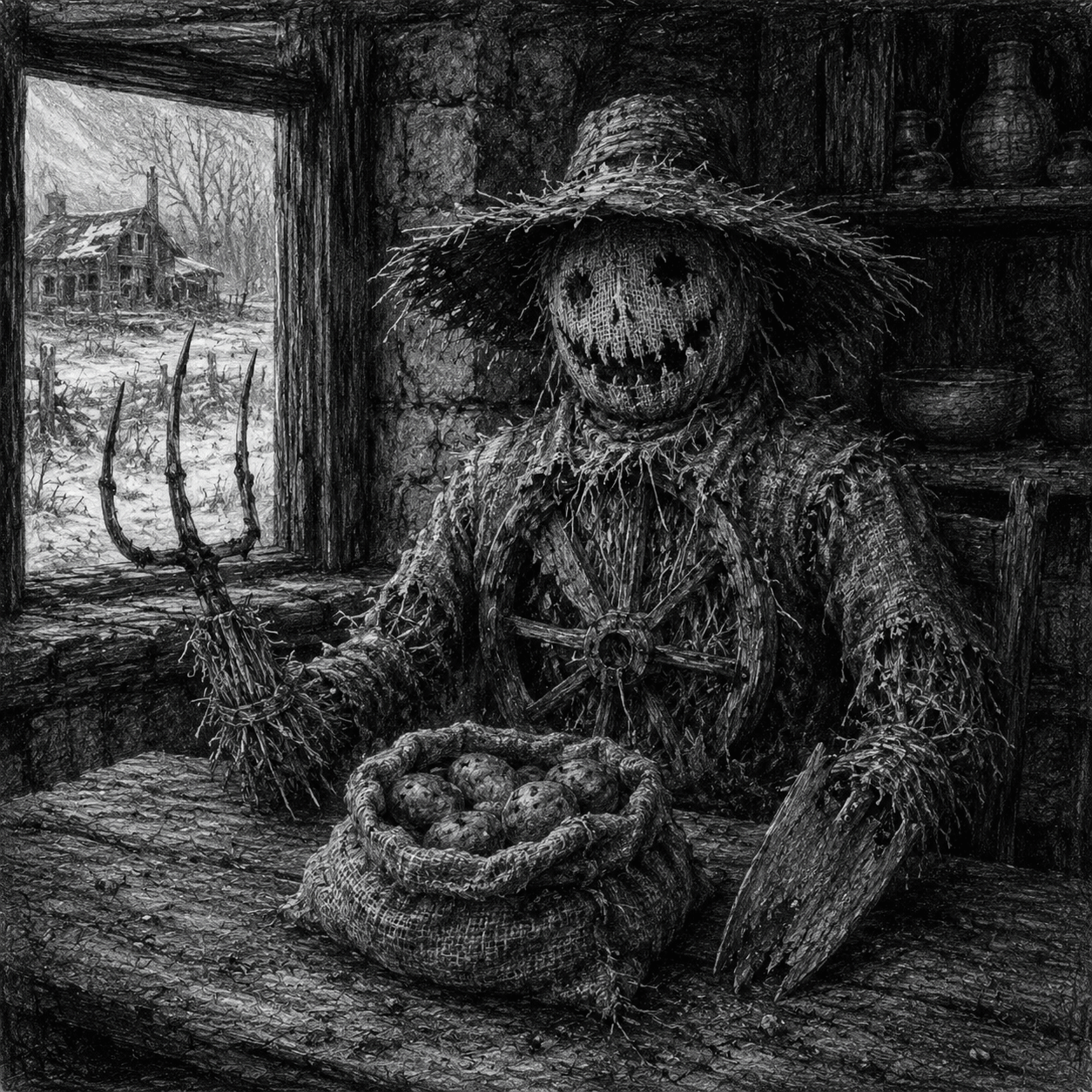
Seated at the kitchen table was something he had not expected: a scarecrow. Not just any scarecrow, but the very one he and Brince had cobbled together over the years. Every broken piece of farm junk had eventually found its way into Scraps: a rusted fork head for one hand, the cracked handle of a shovel for the other, wagon wheels lashed into its frame, bent tines and broken tools stitched with rope and twine into an eight‑foot figure. Its wide-brimmed hat sagged to one side, its burlap face stitched in a grin.
Thelonius laughed aloud, waving the others in. “What are you doing here, Scraps? Brince get lonely, did he?”
But as he crossed the threshold, Scraps’ head jerked up. The stitched grin did not change, but its button eyes began to glow with a terrible light. Thelonius froze as the scarecrow rose across the table, joints creaking, straw shifting, tools rasping against one another.
Then the first volley came — potatoes, hard as stone, whistling through the air with unnatural force. Two flew wide, smashing wall and hearth, but the third struck Thelonius square in the forehead with a dull, icy crack.
He reeled back, clutching his head. “What the actual fuck? Scrappy?”
Instinct took him. Moonlight speared down through the rafters before he realised he had cast it, a silver beam bathing Scraps. The scarecrow’s burlap and straw bubbled and popped, smoke rising in the confined space.
Then Thelonius’ body shifted. Fur rippled across his frame and in an instant the druid was gone, replaced by the brown bear that was fast becoming a familiar sight to the Brave Hearts. The bear bellowed and charged, springing onto the kitchen table — which promptly collapsed, legs buckling outward with a splintering crack. He tumbled awkwardly and landed at Scraps’ feet in a heap of claws and fur.
The others were not far behind.
Felwar stepped in, his eldritch blast slamming into the scarecrow. The impact catapulted a jagged shard of rusted farm iron clear across the room, where it lodged deep into the far wall with a metallic shriek.
Miquitzil darted forward, hand pressed to the bear’s massive haunch. “Fire breath is upon you,” he intoned, “just as we practised.”
Raine, slower to arrive, circled wide and took up a defensive stance, blade ready.
Scraps lashed out with clawed, makeshift limbs, but there was no real weight to the strikes — they barely pierced the bear’s hide. The moonbeam still blazed, and more of the scarecrow’s body blackened and sloughed away, disintegrating before their eyes.
Thel-as-Bear roared, clamping down with his jaws and tearing a sodden, straw-packed rib free from its torso. Then he slashed wildly, scattering splinters and straw, before rearing back as high as the cramped kitchen would allow. His chest heaved, and a cone of dragon-fire burst forth, washing Scraps in flame.
The scarecrow twitched, jittered, and at last came apart, collapsing into charred fragments.
But the fire caught more than its frame. Curtains, thatch, and bits of the house smouldered and flared. All four moved quickly then, stamping and smothering until the flames were out. The house was left scarred, smoky, and silent once more.
Smoke still hung in the rafters, the room thick with the scent of charred straw and singed fabric. Thel-as-Bear shook soot from his fur, the glow of moonlight fading as the last of Scraps smouldered on the floor.
Felwar turned, incredulous. “What the hell, Thelonius? Why didn’t you tell us you had a crazed scarecrow?”
The bear shifted, eyes glinting, and when he spoke his voice was deeper, a natural growl threading through the words. “I didn’t. Not alive, anyway. Brince and I just patched that fucker together out in the paddock. How it got in here…?” He scratched behind his ear with a claw, frowning. “Maybe Brince did it.”
A moment passed before he shook his head. “No way. He could barely get dressed by himself, let alone do that.” He gestured at the smouldering heap with one massive paw.
Raine’s eyes narrowed. “What then? Or who? Levistus? One of those winter druids? Auril herself?”
The house creaked as if listening, but no answer came. Only the hiss of dying embers and the storm outside.
At last Felwar broke the silence. “Um… why would you need a scarecrow for potatoes? They grow underground.”
Thel-as-Bear answered without hesitation, as though it were the most obvious thing in the world. “Crows round here learned to dig.”
Felwar laughed despite himself. “Of course they do.”
They searched the farm then, wary of more strangeness. Near the back woods Thel’s nose caught a scent — unfamiliar, sharp. He saw them first: two sets of green eyes gleaming in the dark. He called the others over.
Felwar peered deep, his warlock sight a gift. “Two wolves. But big. Very big.”
The bear loped forward with confidence. This was his farm, and it would have only one alpha predator. He rose to his full nine feet and growled, a thunderous warning that should have sent any normal wolves fleeing. But these did not. They split apart instead, flanking him slightly, fifteen feet of space and cover between them, but still ahead.
“Fuck off!” Thelonius barked in Common, unsettled at how brazen they were. “You’re not welcome here!” He hesitated, then yelled, “Guys! Here, behind the shed.”
The Brave Hearts assembled, weapons ready. Still the wolves stood their ground.
None had seen such beasts before — grey‑white fur, tall as a man at the shoulder, their breath spilling out in coils of frigid fog.
Thel-as-Bear stepped closer to the larger of the pair, but the other wolf spoke, a deep baritone directed at Felwar. “Keep your beast back. We mean no harm.”
“You can speak?” Felwar and Thelonius said together, astonished. The wolf nodded once.
“Are you awakened?” Felwar asked, curiosity brightening his eyes.
Miquitzil spoke over him. “How can you speak?”
Raine followed with a growl. “What are you?”
And Thelonius, wary, asked the simplest: “What do you want?”
The wolves listened in silence before the slighter of the two answered only the last. “We smell meat in the shed. Dog meat, and much of it. And we hunger.”
Felwar shook his head. “You can’t have it.”
Raine stepped forward, greatsword fully bared. “The dogs are mine, and the only thing you’ll taste tonight is steel.”
The larger wolf bristled, hackles high. “Bring your steel here, then, human.” It baited him, but Raine held firm.
Felwar raised a hand. “We can spare some rations. Here.” He unwrapped a salted knucklehead steak and tossed it into the snow. The larger wolf sniffed once, then swallowed it whole without chewing.
The slighter wolf licked its muzzle. “We are very hungry.”
The Brave Hearts pooled what they could spare — ten days’ worth — and Felwar addressed the leader. “This much, then, and you leave this place.”
The wolf gave a solemn nod. “We return in a day. If the dogs are still here…”
The companions exchanged glances and agreed silently — they would be gone by then.
“Deal,” Felwar said.
The wolves took a few minutes to devour the food, then melted back into the dark.
When the farm was still again, Miquitzil crossed the field to where Scraps had once stood. Clearing the snow, he uncovered something stranger still — pale white, natural wood set in a triangle, stones and chunks of charcoal laid in a careful pattern.
“What’s this, then?” he muttered. Kneeling, he felt the hum beneath and began his ritual. At last he called the others over. “Enchantment. Transmutation. Illusion. Faint, but unmistakable. Who could do such a thing — and why?”
None of them could answer.
While Miquitzil and Raine settled the dogs and prepared the Jones’ house, Felwar took Thelonius through town toward his parents’ place. The chimney was cold, the windows dark. He knocked on the neighbour’s door, Thelonius hanging back in the street to avoid causing alarm.
“Felwar? Is that really you? You look so different.” Bethyl peered through a crack, but did not open wide, nor did she invite him in. There was distrust in her eyes, and no small amount of fear.
“Yes, it is me,” Felwar said, but her husband Daroll pushed forward, pulling her behind him. Felwar had never liked him.
“What do you want?” Daroll demanded. The door opened no wider.
“I came to see my mother. But she appears not to be—”
“She’s been gone for months. And your pa is rarely home either. Goodbye.” He slammed the door.
Thelonius chuckled as Felwar turned back. “Friendly neighbours.”
Felwar muttered a curse, brushed past him, and crouched at his parents’ front door.
Thel cleared his throat. “She’s watching you through the window.”
Felwar swore under his breath and slipped round the back. The lock opened easily to his careful ministrations. Inside, the air was stale. Dust lay thick across the floorboards. He lifted a hand to hold Thelonius at the threshold.
“I’d rather my father not know I was here. The less we disturb, the better. I’ll just be a minute.”
He moved quickly to the window chest. For a moment he dared to hope his dream had meant something — that his mother’s papers might be waiting. Pushing through heavy jackets and furs, his fingers found the small wooden box. Inside were a vial of ink, quills, and folded sheafs of paper. He slipped it into his pack, then took up the broom by the door and brushed the dust to a uniform near‑clean.
“Let’s go,” he said, locking the door behind him.
Thelonius raised a brow. “Did you get what you came for?”
“Not sure,” Felwar replied. “I’ll have a look later.”
The Brave Hearts rested that night, as exhausted as the slumbering pack of dogs huddled together in the barn.
Felwar sat apart, rifling through his mother’s papers. Page after page proved empty. He cursed softly. “Damn.” Then he paused, holding the top sheet up to the lantern. “Wait…”
He brushed a little charcoal across the surface. Slowly, the indent of another page revealed itself — lines pressed by a hand long gone. His mother’s handwriting.
“I remember now! I spilled my mead on Midsummer’s night!”
Felwar read the faint words again and again, brow furrowed. “Intriguing.” Then, with no insight into its meaning, he sighed. “And disappointing.”
The rest of the papers were blank, smooth, devoid of indentations. The letter she had written in his dream — he remembered it clearly — had been burned. Was it only a dream? Or had it been real? He had no way of knowing.
The following day Thelonius was a bundle of energy.
“I want to take you guys to the place where the elk turned me into a druid. It’s not far — through the light woods to where they thicken, up the ridge, then down to the stream. Less than an hour. Come on, Raine, get up and get dressed.”
He pestered and prodded until the others rose, though their limbs still ached and their feet were raw from the long march across the tundra. Walking was one thing — but this early?
“Yes!” Thelonius insisted. “Totally necessary. We might find clues.”
Miquitzil muttered, “Clues to what?”
But Thelonius was already striding ahead, cloak snapping in the wind. “Many clues,” he called back.
They moved through pristine snow beneath birch and fir, the woods thickening as they pressed on. Thelonius knew this land like the back of his hand and guided them with easy confidence.
“Good rabbit hunting through there,” he said, nodding to a copse. “And a stoat family through that hollow.”
They followed the ridge until the trees fell away on their right, the ground dropping sharply eastward. The tops of the pines lay far below, a clean line of sight to the grey horizon beyond. They walked in silence, careful of their footing, until Thelonius pulled up short and swore.
He didn’t speak — he only pointed.
Hanging from several trees were seven people — three men, four women, one a young girl. Snow and frost had caked them beyond recognition. Thelonius motioned, and he and Felwar moved forward, cutting them down one by one.
Miquitzil and Raine searched the clearing. There were no signs of a struggle. Hands and feet were unbound. A look passed between them — suicide.
Thelonius moved through the bodies, checking each in turn. “Oh no… that’s sad.” His voice was small. “Mrs McTavish. She used to give Brince and me pies.” He brushed the snow from her hair, wincing at the holes the crows had made.
Felwar had a dim recollection of Mrs McTavish too. He clenched his fist and struck his palm. “It has come to this? Good people taking their own lives. It has to stop.”
Miquitzil lifted his chin toward the horizon, where the sky was barely a pale scar. “They came here to see what passes for dawn.”
Felwar cursed under his breath. “I’m going to kill her,” he said, quiet and cold.
Raine felt a surge of rage rise like a tide inside him, but he held it down — he hadn’t yet named the shape of the anger.
Disclaimer
This is a work of fan fiction. All relevant characters, locations, and settings remain the property of Wizards of The Coast (WOTC) and the story contained here is not intended for commercial purposes.
I do not own Dungeons and Dragons (D&D) or any of the related characters. D&D is owned by WOTC (and its parent companies) and all rights of D&D belong to them. This story is meant for entertainment purposes only.